Dollar expected to reflect FOMC minutes, electoral scenario, and escalating trade tensions between the US and Brazil
- Bullish
- The proximity of the electoral period tends to increase uncertainty and political risk perception among investors, which may deter foreign capital and harm the performance of the Brazilian national currency.
- The FOMC minutes may suggest a willingness to keep interest rates higher to restore price stability, which would increase the yield on US Treasuries, attract foreign capital to the country, and strengthen the USD globally.
- The escalation of trade tensions between Brazil and the US tends to increase unpredictability in the relationship between the countries and elevate risk perception, harming the Brazilian real.
- Bearish
- No predominantly bearish factors have been identified for the exchange rate this week. However, it is worth considering that the exchange rate is historically volatile and a decline remains possible, either due to frustration with bullish assumptions or the occurrence of unexpected events.
The week in review
- In the US, July readings of Consumer Price Index (CPI) and Producer Price Index (PPI) indicated a moderation of inflationary pressures, decreasing bets on short-term interest rate hikes.
- In the domestic scenario, the approach of the electoral period combined with the release of voting intention surveys significantly increased the perception of local risks, hurting the brazilian real's performance.
- The Brazilian government informed the United States that it would begin the process to apply the Reciprocity Law against newly imposed tariffs, though no immediate retaliatory measures were announced.
USDBRL and Dollar Index (points)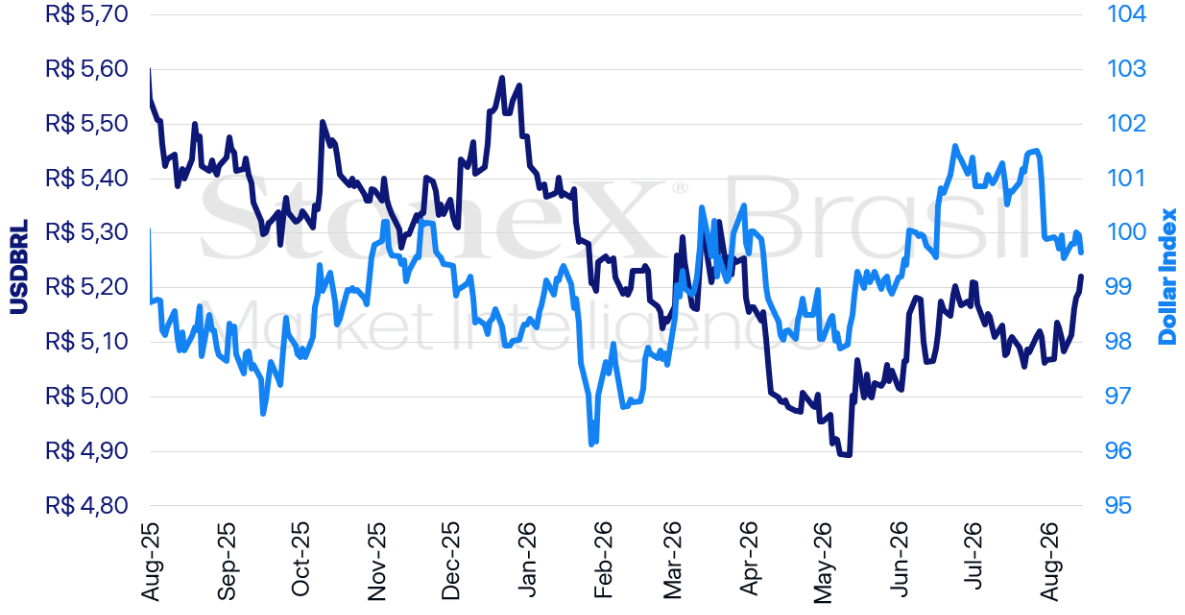
Source: StoneX cmdtyView. Design: StoneX.
USDBRL variations | Daily: +0.53% | Weekly: +2.68% | Monthly: +3.00% | Annual: -4.70% | Over 12 months: -3.66%
Dollar Index variations | Daily: -0.32% | Weekly: +0.11% | Monthly: -0.25% | Annual: +1.35% | Over 12 months: +1.48%
KEY EVENT: Electoral scenario
Expected impact on the USDBRL: bullish
Realized volatility in the USDBRL for the month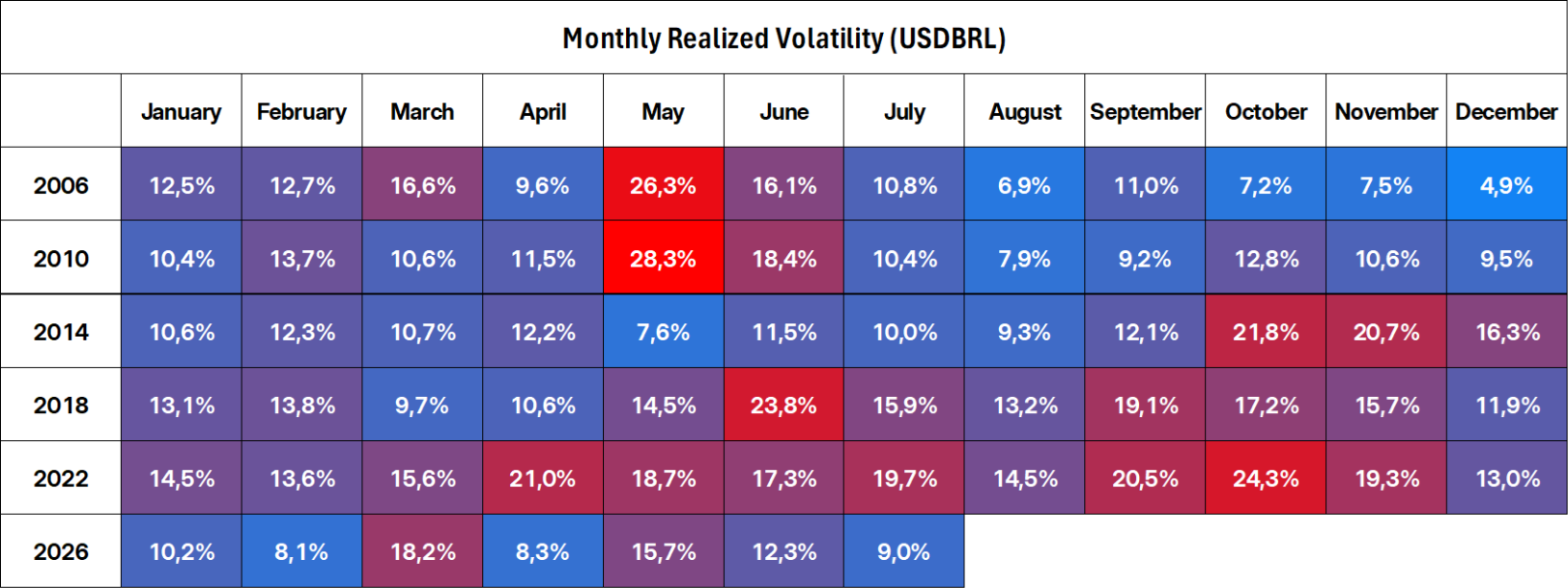
Source: StoneX cmdtyView. Design: StoneX. *Data up to the end of July.
With the official start of the presidential election campaigns on Sunday (16), investors are expected to become increasingly sensitive to election-related news.
- Last week, the BRL experienced a sharp depreciation after voting intention polls increased the perception of political risks regarding national assets.
- In this context, investors are likely to react to the release of another poll on Monday (17).
Why this matters: The electoral period tends to be a time of greater volatility in domestic financial markets, which can increase uncertainty and lead investors to reduce their positions in national assets.
- Additionally, some investors associate a potential re-election of President Lula with greater risks to public account balances.
- For this interpretation, a poll indicating the president's advantage tends to increase the perception of political risks in national assets, harming the Brazilian real's performance.
Overview: Throughout the week, the BRL suffered significant losses against the USD.
- On Tuesday (11), a voting intention poll was released indicating President Lula's lead over candidate Flavio Bolsonaro in a potential runoff, reigniting the perception of political risks.
- In subsequent sessions, even without new developments, the elevated risk perception deepened the BRL's depreciation.
- As the elections approach, investors expect exchange rate volatility to increase as new news and polls about the presidential race are released.
FOMC Minutes
Expected impact on the USDBRL: bullish
Expectations on the Federal Reserve's interest rate decision for September 16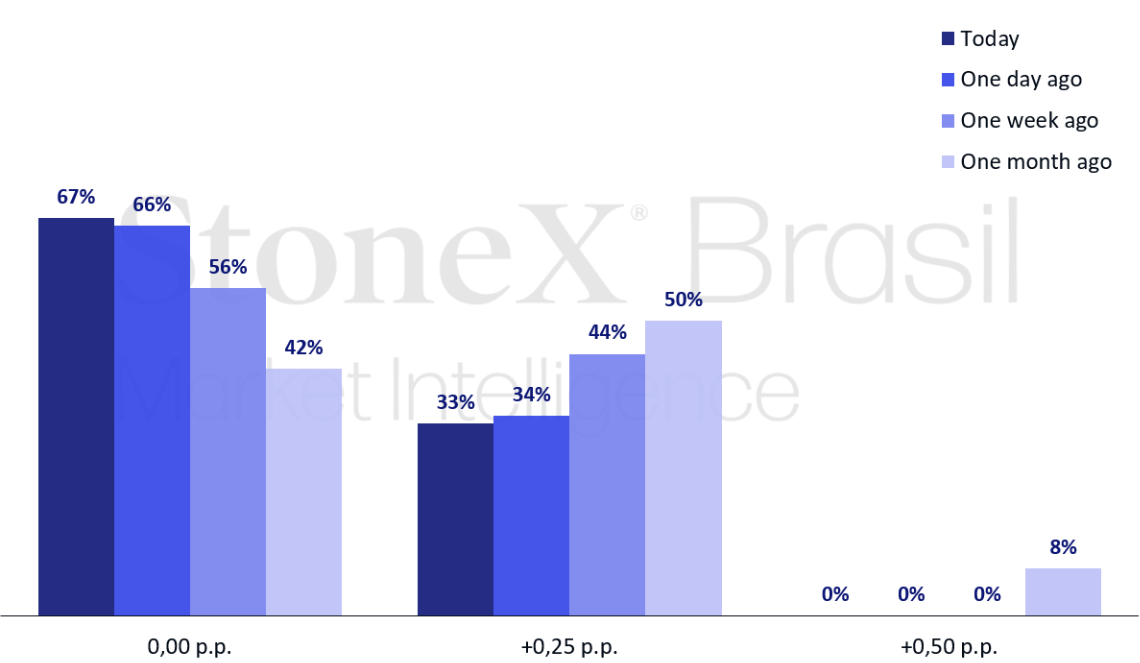
Source: CME FedWatch Tool. Design: StoneX. Probabilities in the futures interest rate market as of August 14, 2026.
In a week without significant indicators on the agenda, the currency market is expected to react to the release of the minutes from the latest Federal Open Market Committee (FOMC) interest rate decision by the Federal Reserve (Fed), which kept interest rates stable, in the range of 3.50% to 3.75% per year.
- Additionally, three of the twelve committee members voted in favor of an immediate rate hike – regional presidents Neel Kashkari (Minneapolis), Lorie Logan (Dallas), and Beth Hammack (Cleveland).
- On the other hand, the press conference by Fed Chair Kevin Warsh conveyed an impression of less commitment to pursuing price stability.
Why this matters: By seeking to "correct the record," the document may show greater concern among FOMC members about inflation above the target, suggesting a willingness to keep interest rates higher to restore price stability.
- This, in turn, would increase the yield of US Treasuries and favor the attraction of foreign capital to the country, strengthening the dollar globally.
Correcting the record: The FOMC minutes may help dispel the discomfort caused by Warsh's statements during the press conference.
- For example, it should explain why the FOMC preferred to keep interest rates stable despite significant concern about inflation above the target, something Warsh refused to address.
- Additionally, it may offer clues about the criteria that could lead the Fed to raise rates in the future, something Warsh also declined to elaborate on.
- Finally, it is unlikely that the document will mention the quality of inflation indices, a topic indirectly addressed by Warsh during the press conference.
Interest rate hike in doubt: Since the FOMC's July 29 decision, investors have increasingly bet against the possibility of short-term rate hikes.
- The main driver of this trend was the perception of a less rate-hike-committed Fed following Warsh's press conference, as mentioned above.
- However, recent economic data has also suggested a less heated US economy than anticipated, indicating that higher rates might not be urgently needed.
- The Consumer Price Index (CPI) and Producer Price Index (PPI) showed moderate readings for two consecutive months.
- Similarly, labor market figures were weaker than expected for two consecutive months.
- Last week, retail sales surprised with a 0.6% contraction in July, well below expectations.
- However, in contrast, the escalation of geopolitical tensions in the Middle East in July again boosted global oil prices, raising fears of inflationary pressures in the second half.
Stay tuned: Before the Federal Reserve's next interest rate decision on September 16, one more monthly reading of the CPI, PPI, and US labor market data will be released.
- Until then, FOMC members are expected to adopt a more neutral stance, waiting to gather more evidence about inflationary risks in the United States.
- Additionally, it will be important to monitor Kevin Warsh's speech at the important Jackson Hole Symposium on August 28.
- In previous years, the Fed Chair's speech at Jackson Hole provided important information about the direction of US monetary policy and influenced investors' expectations regarding the country's interest rate trajectory.
Trade tensions between Brazil and the US
Expected impact on the USDBRL: bullish
Last week, the Brazilian government began the process to adopt the Reciprocity Law against the US in response to tariffs recently announced by the US government.
- Although no measures will be adopted immediately, investors fear a deterioration in commercial and diplomatic relations between the two nations.
Why this matters: The escalation of trade tensions between Brazil and the US tends to increase the risk perception of national assets, deterring foreign capital and weakening the BRL.
- Additionally, escalating tensions with Brazil's second-largest trading partner could harm the country's exports, reducing expectations of foreign currency inflows and weakening the Brazilian currency.
In detail: The Brazilian government informed the Executive Management Committee of the Foreign Trade Chamber (Camex) that it had notified the US government about the start of Reciprocity Law implementation and requested diplomatic consultations.
- At this time, no additional tariffs will be applied. Initially, an analysis process will begin regarding external measures considered harmful, affected national sectors, and an estimate of the economic impact.
- The note issued by the federal government stated that the diplomatic consultation stage aims to "mitigate or annul" the US measures and any Brazilian countermeasures, indicating a priority for dialogue before adopting retaliation measures.
Affected sectors: The Brazilian government continues to study which countermeasures would be adopted without causing harm to the country.
- According to reports, retaliation measures could include restrictions on dividend and royalty remittances in the audiovisual sector, taxation on these flows, and patent breaks for pharmaceutical and agricultural medicines.
- The impacted sectors would be those that favor the US in the trade balance.
Overview: Last month, the US implemented tariffs on Brazilian exports reaching up to 37.5% for certain products.
- The US measure was supported by sections 232 and 301 of the Trade Act, based on allegations that Brazil was adopting unfair trade practices and inefficient legislation to combat forced labor practices.

ECONOMIC INDICATORS
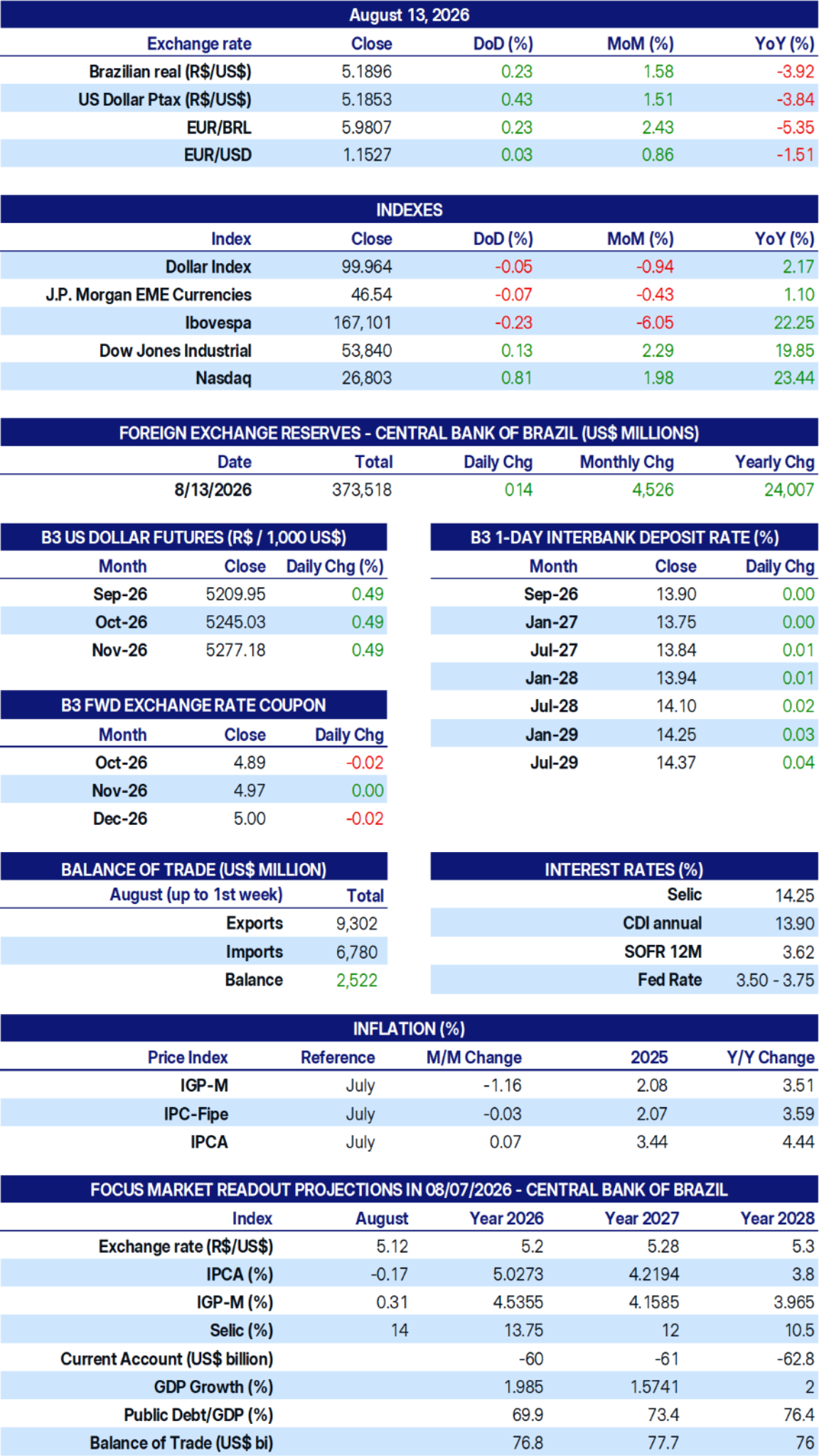
Sources: Central Bank of Brazil; B3; IBGE; Fipe; FGV; MDIC; IPEA and StoneX cmdtyView.