Dollar to reflect perspectives for Lula's fourth term, Copom decision, US data, and US elections
- Bullish
- The expectation of an expansionist fiscal policy in the new Lula administration tends to increase the perception of fiscal risk for Brazilian assets, weakening the BRL.
- Strong readings for US data may increase bets on interest rate hikes by the Federal Reserve in the coming months, which tends to raise yields on US Treasuries and attract foreign capital to the country, strengthening the USD globally.
- Bearish
- The interruption of the cycle of basic interest rate cuts (Selic) should increase the yield on domestic bonds, which tends to favor the attraction of external capital to the country and strengthen the BRL.
- Public spending constraints or regulations in the artificial intelligence technology sector could slow US economic growth, reducing investment attractiveness in the country and harming the global performance of the USD.
The week in review
- During the week, the main event was Lula's surprising victory in the second round of the presidential elections, which caused a sharp reversal in investor positioning that predominantly bet on Flávio Bolsonaro.
- As a result, on Monday (26), the BRL experienced its largest daily depreciation since 2002, closing at BRL 5.40 (+8.8%), and its largest weekly depreciation since 2008, closing at BRL 5.45 (+9.2%).
- In the following days, the prospect of continuity in fiscal policy conducted in an expansionist manner during Lula’s fourth term increased risk perception, keeping the Brazilian currency under pressure.
- On the external front, the Fed maintained interest rates between 3.75% and 4.00%. Kevin Warsh maintained a firm stance against inflation but did not clearly explain why the Fed did not raise rates, keeping his enigmatic communication style. For more details, read our special analysis.
USDBRL and Dollar Index (points)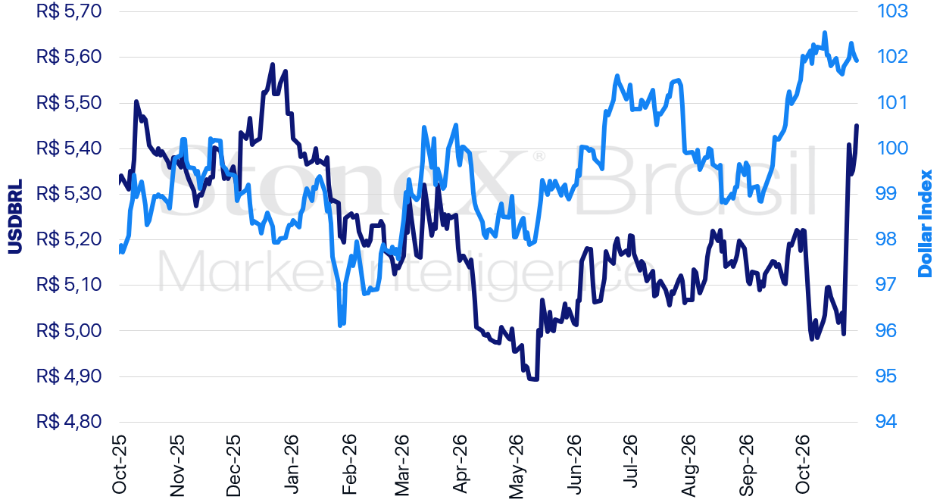
Source: StoneX cmdtyView. Design: StoneX.
USDBRL variations | Daily: +1.12% | Weekly: +9.16% | Monthly: +5.31% | Annual: -0.49% | Last 12 months: +1.31%
Dollar Index variations | Daily: -0.07% | Weekly: +0.13% | Monthly: +0.42% | Annual: +3.67% | Last 12 months: +2.39%
KEY EVENT: Perspectives for Lula's 4th administration
Expected impact on the USDBRL exchange rate: bullish
The foreign exchange market should reflect the environment of pessimism and skepticism regarding economic policies in President Luiz Inácio Lula da Silva's fourth term, closely monitoring signals on fiscal policy management and the composition of his economic team.
- Last week, Lula's unexpected victory caused an intense adjustment in investor positioning, leading to the real’s largest weekly depreciation since November 2008.
Why this matters: Investors anticipate a more expansionist fiscal policy in Lula's new government, which could lead to faster national debt acceleration.
- As a result, there is an increase in the perception of fiscal risks for Brazilian assets and higher risk premiums demanded by investors, which tends to weaken the real.
Fiscal adjustment? Reports indicate that Lula is considering a gradual fiscal adjustment, focused on increasing the share of the budget subject to contingencies, improving the efficiency of social programs, and curbing expenses that grow beyond framework limits.
- This set of measures aims to achieve a primary surplus of 1.5% of GDP by the last year of the next term.
- However, there is internal resistance to adjustments, such as last week’s statement by the Minister of the Presidential Secretariat, Guilherme Boulos, saying, "those who defend Lula making fiscal adjustments (...) didn’t understand anything about this election."
- In this context, investors are pessimistic about a profound adjustment to public accounts, which should increase the risk premiums demanded by them.
Tax increase: Despite concerns over public spending containment, news emerged last week that the government is studying new measures to favor public accounts through revenue-side adjustments, which were poorly received by investors.
- Media reports stated the government is considering taxing income tax-exempt securities like LCAs, LCIs, CRAs, CRIs, and incentivized debentures.
- The measure would be implemented by changing the Tax on Financial Operations (IOF) rate through a decree, avoiding Congress voting and a potential overturn of the decision.
- Additionally, the Federal Audit Court (TCU) set a rate of 11.3% for the Contribution on Goods and Services (CBS), a new tax created by tax reform effective in 2027.
- The value was considered higher than expected by tax specialists.
Copom interest rate decision
Expected impact on the USDBRL exchange rate: bearish
In the domestic economic scenario, investors are watching the basic interest rate (Selic) decision by the Monetary Policy Committee (Copom), amid doubts whether the Committee will continue its sequence of cuts or interrupt it.
- Copom options traded on B3 point to a 66.5% chance of maintaining rates at the current 13.75% per year, a sharp increase from the 17.5% chance recorded on October 23.
Why this matters: The cycle interruption of basic interest rate cuts (Selic) should increase domestic bond yields, favoring external capital attraction to the country and strengthening the real.
Challenging inflation scenario: September's reading of the Extended National Consumer Price Index (IPCA) indicated a price increase of 0.82%, accelerating accumulated inflation from 4.22% to 4.58%, above inflation target tolerance margins.
- The core indicator, which excludes volatile goods like food and energy, also rose from 0.22% to 0.35% during the month, reinforcing the perception of more widespread inflationary pressures.
- Additionally, inflationary pressures may intensify amid a strong El Niño, which tends to raise food prices, and the recent oil price increase, with Brent contracts trading above $110 per barrel again.
- The inflation scenario became more challenging after Lula's unexpected election victory, pushing the real exchange rate above the BRL 5.40 range, the highest level since the beginning of the year.
- This scenario of rising costs for agricultural production, oil and derivatives, and imports tends to strengthen cost-driven inflationary pressures.
Strong labor market: Another bullish risk factor for the inflation scenario is the heated labor market, with the unemployment rate decreasing from 5.3% to 5.2% in the rolling quarter ending in September.
- Unemployment near historical lows increases average worker earnings, reaching BRL 3,790 in the quarter ending in September.
- This, in turn, boosts workers' purchasing power and accelerates demand, which tends to generate inflationary pressures.
Slowing economy: Despite labor market resilience and inflation, data show a slowdown in economic activity since the first quarter of 2025.
- In terms of accumulated growth, the domestic economy grew 3.4% in 2024, while growth over the last four quarters ending in June reduced to 1.9%.
- Additionally, the pace of credit growth has slowed, indicating an exhaustion of borrowing capacity and limiting economic expansion potential.
Uncertainty about the decision: For this reason, there are doubts about Copom's next steps.
- On one hand, the challenging inflationary scenario and heated labor market suggest the need to halt the cut cycle. On the other hand, recent signs of economic slowdown suggest the need for lower interest rates to stimulate the economy.
- Moreover, investor skepticism and pessimism about Lula's fiscal policy increase expectations for a more conservative stance in monetary policy management, as Copom may want to avoid inflation expectation divergence.
- Besides the decision itself, investors should watch the tone adopted by Copom in the statement to calibrate their expectations for firmness in combating inflation.
US economic data
Expected impact on the USDBRL exchange rate: bullish
The foreign exchange market should reflect the release of economic indicators for the United States, calibrating expectations for the country's interest rate trajectory.
- The Employment Situation Report should indicate a healthy labor market, while Purchasing Managers Indexes (PMI) should point to robust productive activity.
Why this matters: Strong readings for US data should reinforce the perception of a risk balance tilted toward inflation, increasing bets on Federal Reserve interest rate hikes in the coming months.
- This, in turn, tends to raise US Treasury bond yields and attract foreign capital to the country, strengthening the dollar globally.
Stable labor market: Median estimates for the Employment Situation Report indicate net job creation advancing from 29,000 in September to 65,000 in October, showing slight recovery.
- Additionally, projections suggest the unemployment rate will remain stable at 4.2%.
- Recent data point to a "low hire, low fire" situation, meaning low hiring and firing rates.
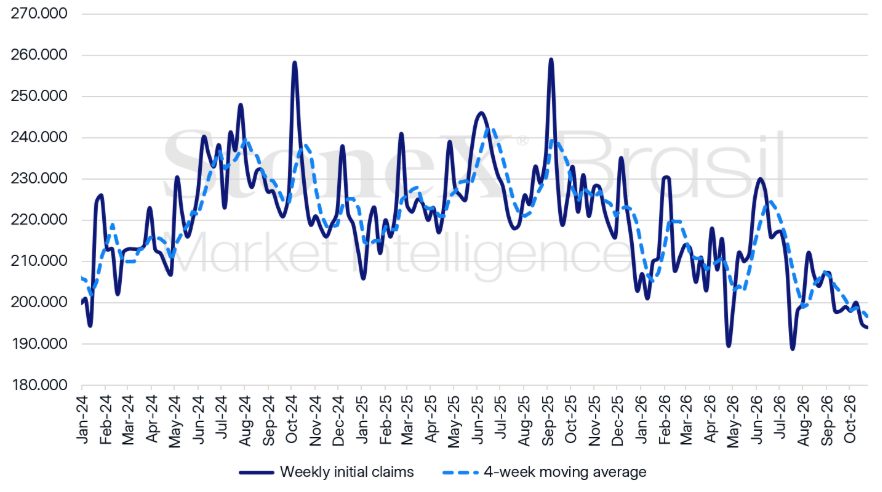
- For instance, weekly initial unemployment claims suggest historically low layoff rates.
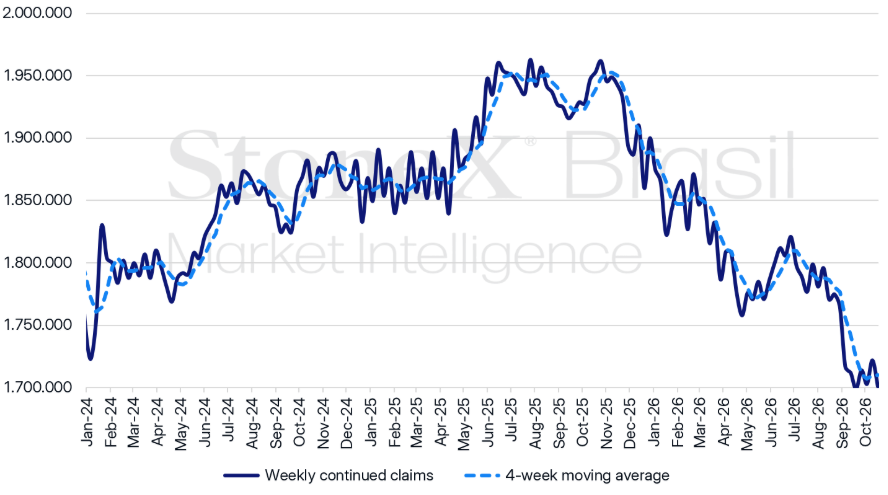
- Continuing unemployment claims, representing individuals receiving benefits beyond the first week, show a slowdown trajectory, suggesting fewer people unable to find jobs.
- This stability is considered healthy given slower growth in the available labor force.
Weekly initial claims (left) and continued claims (right) for unemployment benefits in the United States
Source: US Department of Labor (DOL), Federal Reserve Bank of St. Louis. Design: StoneX.
Production on the rise: Median estimates for ISM-measured Purchasing Managers Indexes (PMI) point to a slight increase in the industrial index, from 54.5 points in September to 54.7 points in October, and a slight decline in the services index, from 54.9 points to 54.8 points during the same period.
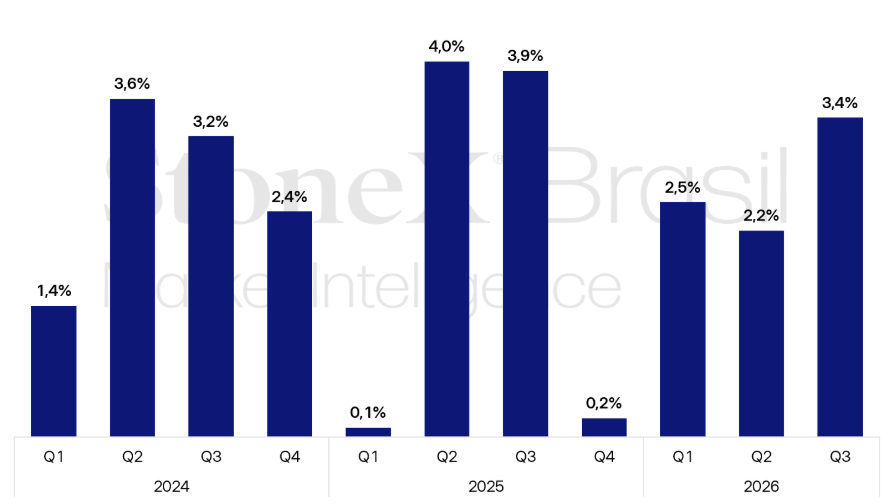
- These figures align with stronger productive activity expansion, consistent with the first preview of the US GDP for the third quarter, which accelerated its annualized quarterly growth rate from 2.2% to 3.4%, driven by increased consumption and investment.
Annualized quarterly growth rate of US GDP
Source: US Bureau of Economic Analysis (BEA), Federal Reserve Bank of St. Louis. Design: StoneX.
US legislative elections
Expected impact on the USDBRL exchange rate: bearish
Additionally, investors are monitoring the US midterm legislative elections, which may end with the Democratic Party taking control of both the House and the Senate.
- According to voting intention polls, Democrats have over a 90% chance of gaining the House majority and about a 65% chance of attaining the Senate majority.
- This new legislative configuration could result in blockages to the economic agenda of Republican President Donald Trump, as well as new regulations unfavorable to the rapid advancement of artificial intelligence technologies.
Why this matters: Constraints on public spending or the artificial intelligence technology sector could slow US economic growth, reducing investment attractiveness and harming the dollar's global performance.

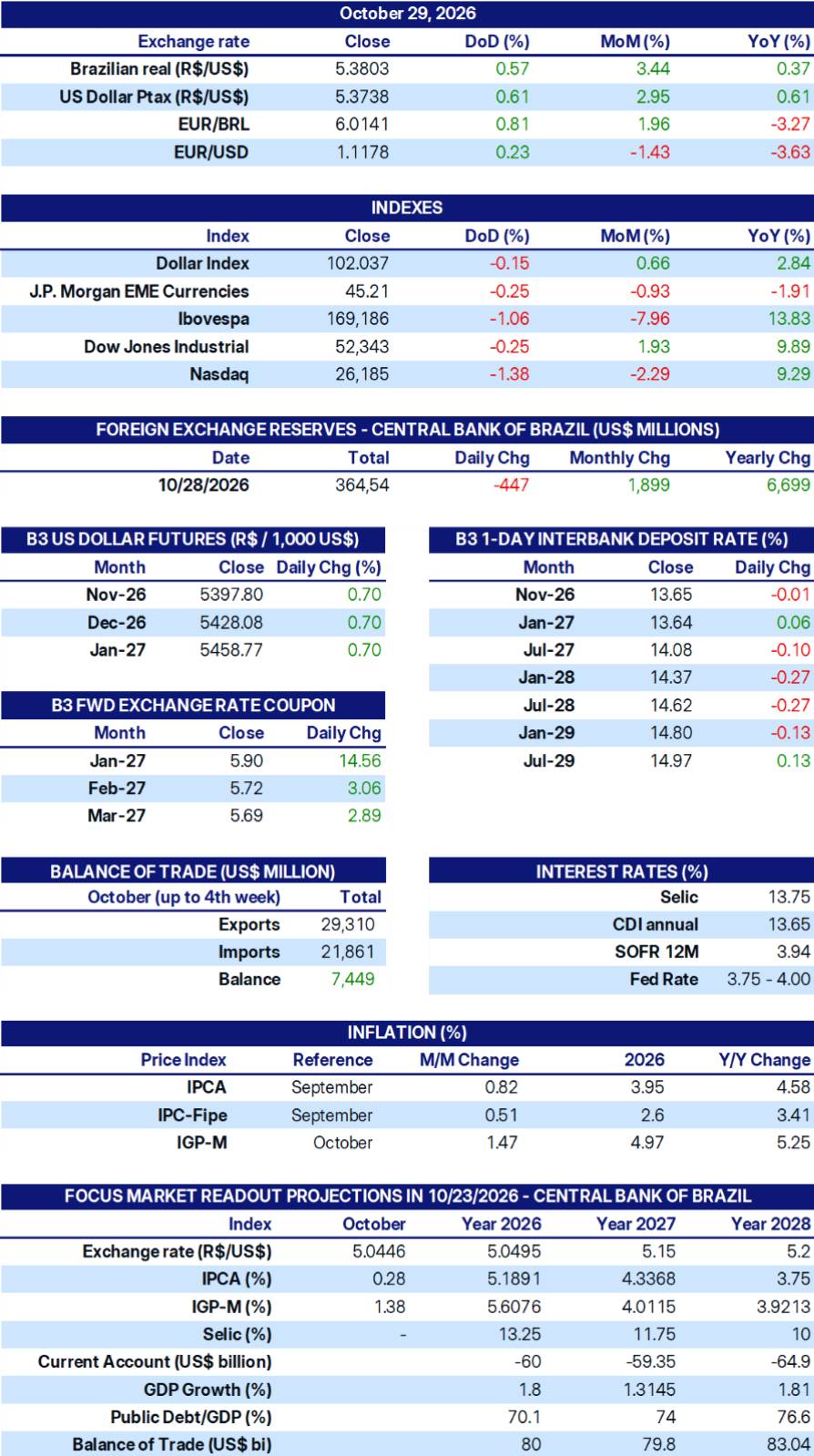
INDICATORS
Sources: Central Bank of Brazil; B3; IBGE; Fipe; FGV; MDIC; IPEA and StoneX cmdtyView.