

FX Weekly Overview (Brazil Issue)
Dollar to reflect US economic data, Central Bank minutes, inflation in Brazil, and the Middle East

Leonel Mattos
- Currencies
By: John Kicklighter, Head of Market Research
The saying ‘correlation is not necessarily causation’ speaks to a strong pull – but also common fallacy – in the markets happenstance alignment is mistaken as a common driver. Correlations are critical for hedging, identifying systemic influences and tracking fundamental narratives; so how do we avoid being led astray?
Talking Points:
To sign up for the Trading Global Macro podcast, find it on your preferred podcast platform: Apple Podcasts, Spotify, or YouTube.
‘Correlation is not causation’ is a common enough saying. More appropriately as it pertains to markets, the statement is accurately summarized as ‘correlation does not necessarily imply causation and relationships change over time’. Correlation speaks to a level of alignment between two or more markets. This can purely by chance, it can reflect a situation where a common motivator is aligning the markets or that one market’s movement is influencing the other. Knowing the circumstances between a perceived relationship we find in the markets is important to interpreting the signal it offers…if there is indeed an insight to be gleaned.
Along with humans innate intelligence as a specifies, there is a strong pattern recognition engrained within our biological adaptation. For our ancestors, if there is a plant, water source or locale that has proven dangerous; they would recognize the catalyst and adapt their habits to avoid the threat. Those more serious natural skills have carried forward to more prosaic endeavors such as evaluating charts for the most advantageous investment of funds.
Arguably one of the most misleading market influences to unravelling success in the markets is to evaluate and pursue all perceived relationships at face value. Simply considering the probability of recognizing a meaningful correlation versus a coincidental pattern, we are dealing with a skew right from the jump. Popular, spurious market drivers include evaluating speculative appetites against lunar cycles or even US NFL Super Bowl wins by NFC vs AFC teams alignment to stock market performance. There may be some degree of alignment – or more belief than evidence – but it doesn’t have a basis in actual fundamentals.
Chart of S&P 500 with Lunar Cycle (Daily)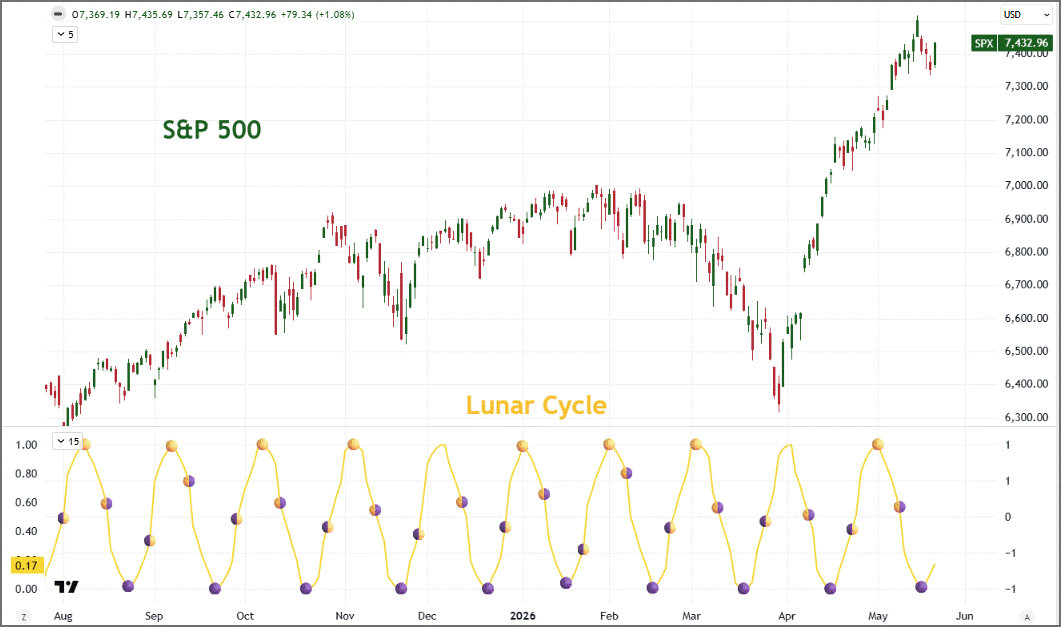
Source: TradingView.com; John Kicklighter
In contrast to the improbable, there are established relationships between markets that form the basis of long-standing investment theory. Arguably the most familiar correlation is established between stocks and bonds, formulating the ‘balanced portfolio’ that optimizes return over time. There are different assets and percentages that are combined according to different theorems and observers, but the 60/40 rule is arguably one of the most common.
According to the textbook theory, a split of 60 percent exposure to stocks and 40 percent fixed incomes (bonds) can yield superior results over time. There are plenty of reasons – and periods through time – to flag that as a dubious mix; but the popularity persists. In general, that market sentiment exists on a spectrum where the collective is either seeking safety or higher return creates a reasonable assumption as to how funds are likely to be allocated in evolving conditions. Over a longer period of time, this negative correlation can help normalize returns – capping gains of one leg but also helping offset some loss from downturns.
Chart of S&P 500 and TLT ETF with 20-Day Correlation
Source: TradingView.com; John Kicklighter
Looking across the market, there are certain correlations that speak to a foundational causation which external influences can actively work to break up. A great current example of this effort at affecting a steer comes on the behalf of the USDJPY exchange rate. One of the most liquid currency pairs in the world, there are certain shared qualities between the US dollar and Japanese yen – including the reality that both are very liquid, backed by exceptionally large economies with qualities of a harbor to global capital in tumultuous seas.
That said, between the two currencies, the US dollar and its backing sovereign debt market are far and away the market’s benchmark when fear boils over. At extremes of risk aversion, the Greenback will draw disproportionately more capital seeking shelter. Then again, in ‘good times’, the US dollar historically holds a meaningful yield advantage against the perpetually lower benchmark for Japan, creating a long-standing carry trade bearing. In more extreme risk on or risk off conditions, the alignment to – or unwind of – carry trade can cater to the USDJPY and its yield spread. Then again, in middling periods, the correlation can wane.
Chart of USDJPY Exchange Rate and US-Japan 2-Year Yield Spread (Daily)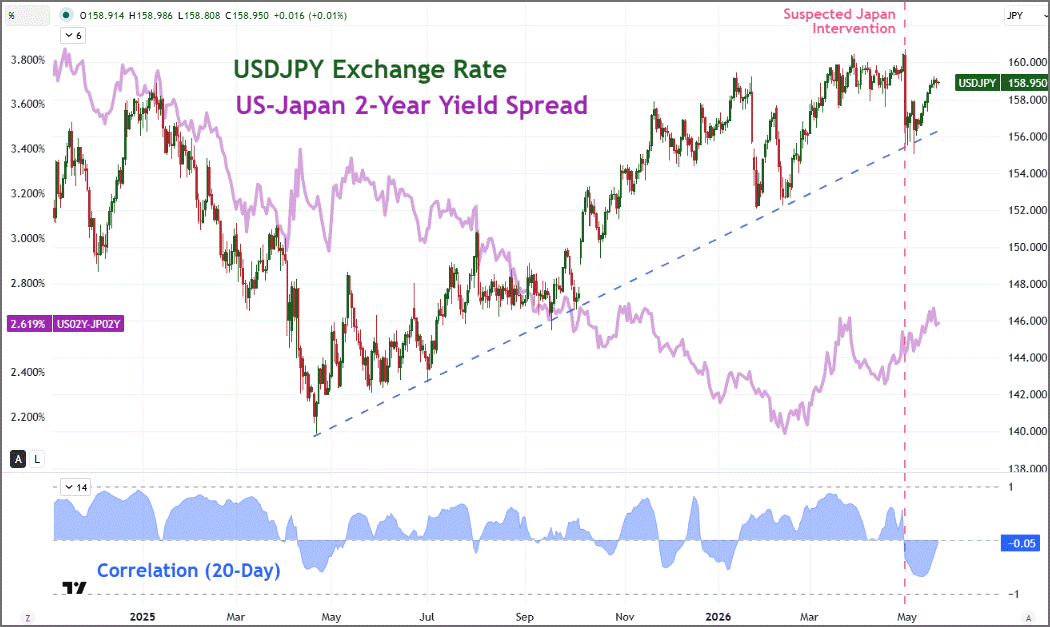
Source: TradingView.com; John Kicklighter
Correlations – like anything else in the market – can and do change. In fact, when we can monitor those changes over time, it can offer us more valuable insights into the broader market than a simple statement on a single (or two) markets that we are observing. A good example of this signaling factor can be found in the relationship of the US dollar to various drivers. The benchmark currency plays a number of different roles that change prominence according to what market influence is most prevalent.
As the most liquid currency backing the largest economy in the world, the dollar sits at the nexus of a number of critical themes. It is an ultimate safe haven in the search of absolute liquidity in severe risk aversion. It is the representative of fiat currency – more often when the world is seeking alternative to debt-backed fiscal authorities. There is carry consideration for a typically higher-yielding benchmark when conditions/inflation improves. There is also a global appeal to large local capital markets (eg S&P 500) that serves in passive ‘risk on’ scenarios. How the dollar aligns to different benchmarks versus others, can tell us which of these themes is more important than others. That can aid in analysis of broader markets than just a view on the Greenback.
US DXY Dollar Index and VIX Volatility Index Correlation (Daily)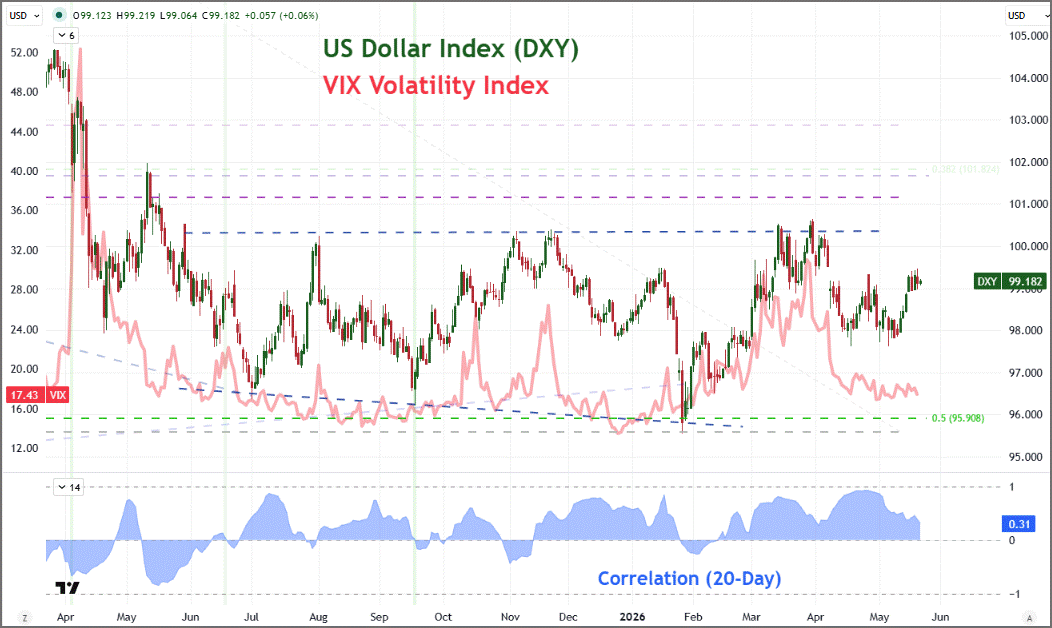
Source: TradingView.com; John Kicklighter
Sometimes, narratives can promote correlations as reflections of certain causation that strains credulity when we consider the actual fundamentals or market factors beyond the supposed relationship. A very popular, recent example of this is arguably found in larger trends of the crypto market’s most popular member: Bitcoin. The defi space and this symbolic benchmark were billed early on as a new alternative to fiat that would unshackle peoples’ income and wealth from the prying eyes and taxes of governments. In the meantime, it was sold as a store of wealth on par with the most liquid traditional currencies. This can be a very appealing scenario for many, but is it practical consider governments who back fiat and rely on them to fund debt and raise taxes will simply allow a convenient work around?
Setting aside the alluring – and lurid – fundamental prospects of Bitcoin, there is unquestionable value to be found in crypto that can play a critical role in the plumbing of the financial system. The ability to speed up and make more accurate custody and clearing in traditional markets is no small value-add. And yet, it isn’t as compelling as headlines that ‘the Greenback’s replacement is at hand’. Nevertheless, there is an adoption face to new markets with considerable promise – be it as replacement fiat or expansive protection node in global markets – which appeals to opportunistic funds. That is perhaps why BTCUSD has a better correlation to the S&P 500 than it does inverse correlation to the Greenback.
BTCUSD Overlaid with S&P 500 and Inverted DXY Dollar Index (Daily)
Source: TradingView.com; John Kicklighter
Stay connected to timely global macro analysis designed to help market participants navigate shifting economic conditions and evolving risk. Gain access to regular market commentary, updated quarterly forecasts, a comprehensive two-week forward economic event calendar, and specialized tools built to support informed trading and risk management decisions.
-- Experts: John Kicklighter, Global Head of Content; Matt Weller, Global Head of Market Research
The subsidiaries of StoneX Group Inc. provide financial products and services, including, but not limited to, physical commodities, securities, clearing, global payments, risk management, asset management, foreign exchange, and exchange-traded and over-the-counter derivatives. These financial products and services are offered in accordance with the applicable laws in the jurisdictions in which they are provided and are subject to specific terms, conditions, and restrictions contained in the terms of business applicable to each such offering. Not all products and services are available in all countries. The products and services offered by the StoneX Group of companies involve risk of loss and may not be suitable for all investors. Full Disclaimer. This content is not intended for residents of any particular country, and the information herein is not advice nor a recommendation to trade nor does it constitute an offer or solicitation to buy or sell any financial product or service, by any person or entity in any jurisdiction or country where such distribution or use would be contrary to local law or regulation. Please refer to the Regulatory Disclosure section for entity-specific disclosures. No part of this material may be copied, photocopied or duplicated in any form by any means or redistributed without the prior written consent of StoneX Group Inc. The information herein is provided for informational purposes only. This information is provided on an ‘as-is’ basis and may contain statements and opinions of the StoneX Group of companies as well as excerpts and/or information from public sources and third parties and no warranty, whether express or implied, is given as to its completeness or accuracy. Each company within the StoneX Group of companies (on its own behalf and on behalf of its directors, employees and agents) disclaims any and all liability as well as any third-party claim that may arise from the accuracy and/or completeness of the information detailed herein, as well as the use of or reliance on this information by the recipient, any member of its group or any third party.
© 2026 StoneX Group Inc. all rights reserved.
Our subscribers have access to comprehensive market analysis from StoneX spanning commodities, equities, currencies and more.
Dollar to reflect US economic data, Central Bank minutes, inflation in Brazil, and the Middle East

US indices have led sentiment to fresh highs this past week even as the fundamental backdrop struggles to present a solid foothold. Will thin liquidity aid or hamper the swell and what does the event risk ahead propose?


A softer run of U.S. data is doing more to move the U.S. dollar than any chart, with a jobs report and an inflation print set to land back to back. A cooler U.S. CPI report would hand the Federal Reserve room to ease, and that prospect is already loosening the dollar's grip.

Our market expertise, advanced platforms, global reach, culture of full transparency and commitment to our clients’ success all set us apart in the financial marketplace.
Reach
With access to 40+ derivatives exchanges, 180+ foreign exchange markets, nearly every global securities marketplace and numerous bi-lateral liquidity venues, StoneX’s digital network and deep relationships can take clients anywhere they want to go.
Transparency
As a publicly traded company meeting the highest standards of regulatory compliance in the markets we serve, our financials and record of accomplishment are matters of public record. StoneX’s commitment to “doing the right thing over the easy thing” sets us apart in the industry and helps us build respect, client trust and new partnerships.
Expertise
From our proprietary Market Intelligence platform, to “boots on the ground” expertise from award-winning traders and professionals, we connect our clients directly to actionable insights they can use to make more informed decisions and achieve their goals in the global markets.