An AI wobble this past week starting with a poor reaction to Broadcom’s earnings turned into an outright tumble for broader measures like the Nasdaq 100. Is this just an overdue pressure release pullback or a tip into a full reversal?
Talking Points:
We are heading further into seasonal doldrums, but risk-oriented assets experienced a sudden loss of altitude through Friday’s trading session
AI-charged market segments – like SOX and the Nasdaq 100 – experienced the steepest losses, but the unwind spilled over to most areas of sentiment-orientation
Risk appetite will be the principal lens through which to assess markets going forward; but key event risk like US CPI, UofM and an ECB rate decision will provide fuel
Watch the Full Video
A Steep Tumble from a Stretched Market
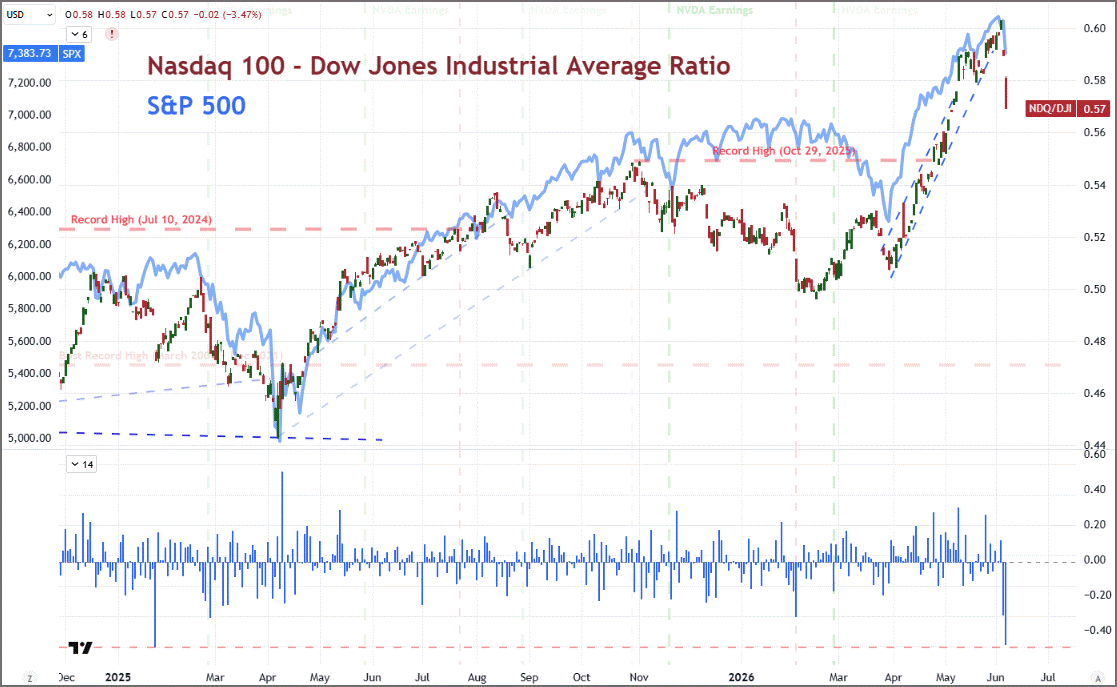
Before gaining serious traction Friday, the market’s sentiment settings were broadly mixed and collectively detached from a clear systemic fundamental theme this past week. The market’s drift carried a level of concern of neglect; but it also proved remarkable resilience to a number of worrying threats - such as the ongoing US-Iran war. Then we had Friday’s turn with the worrying alignment of various markets, reflecting the ‘correlations go to one’ warning traders sound amid severe risk aversion. There are a number of impressive stats to reference as far as the severity of the decline at the very end of the week such as: the S&P 500 suffering its worst single-day loss (-2.6 percent) in eight months; the VIX volatility index notching the biggest surge (40 percent) since the Liberation Day tariffs announcement or the Nasdaq 100 - Dow Jones Industrial Average ratio registering the biggest two-day drop (-5.6 percent) since November 2020.
Chart of the Nasdaq-Dow Ratio Overlaid with S&P 500 (Daily) Source: TradingView.com; John Kicklighter
While there was breadth to the market’s intense selloff, it seemed the avalanche began at the top of the speculative mountain. Before Friday’s fireworks, the Nasdaq-Dow ratio suffered a sharp -2.2 percent tumble Thursday that seemed to clear the technical floor to the persistent, tech-based advance through the preceding eight weeks. The catalyst for that initial tumble seemed to be the strong reaction Broadcom’s earnings. AVGO dropped nearly -15 percent From Wednesday’s close to Thursday’s open reportedly because the chip maker – and the 6th largest market cap US company – didn’t impress with its guidance. It is hard to imagine how AI-oriented company results can continue to outpace the incredible surge in assumptions implied in the climb in price of these tickers.
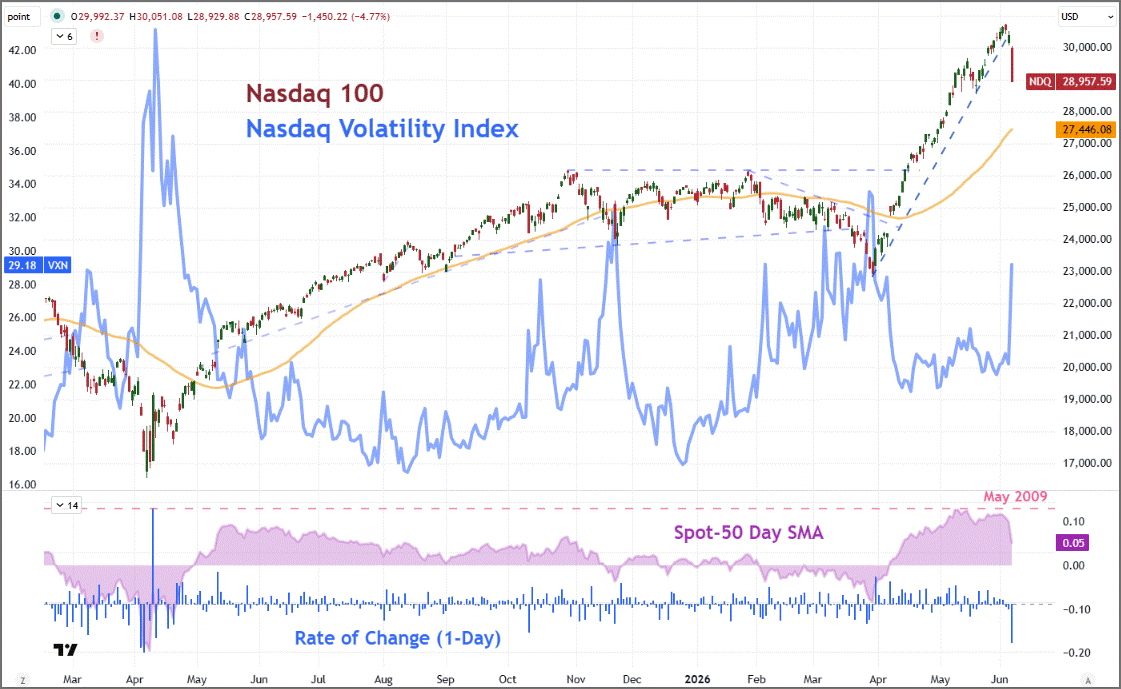
In recent weeks, the concentration of risk appetite shifted from the leading, mega market cap stocks (which happened to be tech-oriented) like the Magnificent 7 to a more specific association to front-running AI spenders and benefactors. The PHLX Semiconductor Index (SOX) was a particular lightening rod, nearly doubling over the past two months and gaining 46 percent relative to the Nasdaq 100 itself. Such charges cannot go on forever as the saturation of exposure will eventually require rotation of fresh funds that cannot cover the elevated prices. The SOX suffered a -10.3 percent drop – the biggest in five-and-a-half years. A retreat was overdue, and arguably has been for a while. The S&P 500’s nine consecutive week charge and the Nasdaq 100’s running 13 percent above its 50-day simple moving average (on May 8th) speak to extreme duration and pace; but this is a good example of ‘the market remaining irrational longer than the incredulous remain solvent’.
Chart of Nasdaq 100, Nasdaq Volatility Index and Activity Measures (Daily) Source: TradingView.com; John Kicklighter
Was Friday’s Tumble a Severe Enough Jolt to Shift ‘Risk Appetite’?
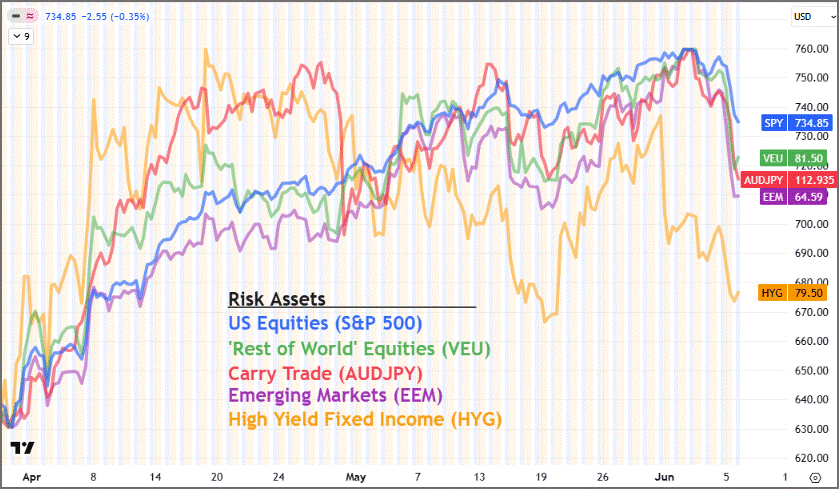
Seeing such a dramatic retreat that spans such a variety of market benchmarks with a fundamental backdrop rife with threats that have been strategically ignored, it is tempting to believe that this is an inevitable turning of the tide. However, that doesn’t necessarily have to be the case. The belief in exponential value creation through AI is not likely fully exhausted, and abrupt retreats like these can be treated as an opportunity to jump in on a rare pullback in a thematic melt up. Gauging a full-blown risk aversion in sentiment is better done through measuring progress through a breadth of unrelated benchmarks that tend to align – especially over a sustained period – only through a fundamental motivation of building up or unwinding ‘risk exposure’. Friday’s plunge helped push the alignment, but one day does not make a trend. Should measures like US and Global equity indices, carry trade, emerging markets, high yield fixed income, crypto and other measures continue to lose altitude in concert; it will more assuredly shift the virtuous cycle of complacent bid into the vicious cycle of flight to safety.
Chart of ‘Risk Assets’ (4 Hour) Source: TradingView.com; John Kicklighter
While I am a believer that sentiment often precedes motivation (fundamentals); whether the markets find stability re-establish the complacent climb or the unwind continues with pace, the financial headlines will seize on reasons for any eventuality. While there are scenarios for a sudden fundamental development that inspires the bulls back into a still-elevated market (eg. exceptional growth potential, new stimulus, another pivotal technological advancement), they are highly improbable to develop ‘suddenly’. More likely, a hand hold for the bullish-inclined would be the positioning of ‘a rare pullback in the transformative AI trade’. Should that take, the rebound would likely flag quickly and we would return to more seasonal doldrums. Alternatively, should the markets continue to unwind, it is likely that we see a myriad of connected fundamental headlines cycle through: from US-Iran stand off concerns to downstream growth throttling to central bank inflation fighting.
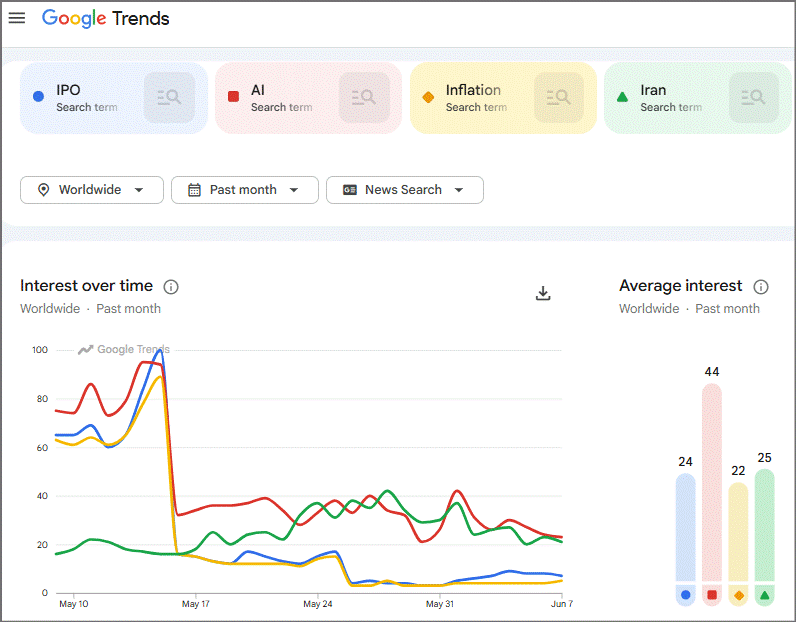
Google Trends for Key Market Themes (Daily) Source: Google Trends; John Kicklighter
If Market Conditions Activate Event Risk – Some Themes to Monitor
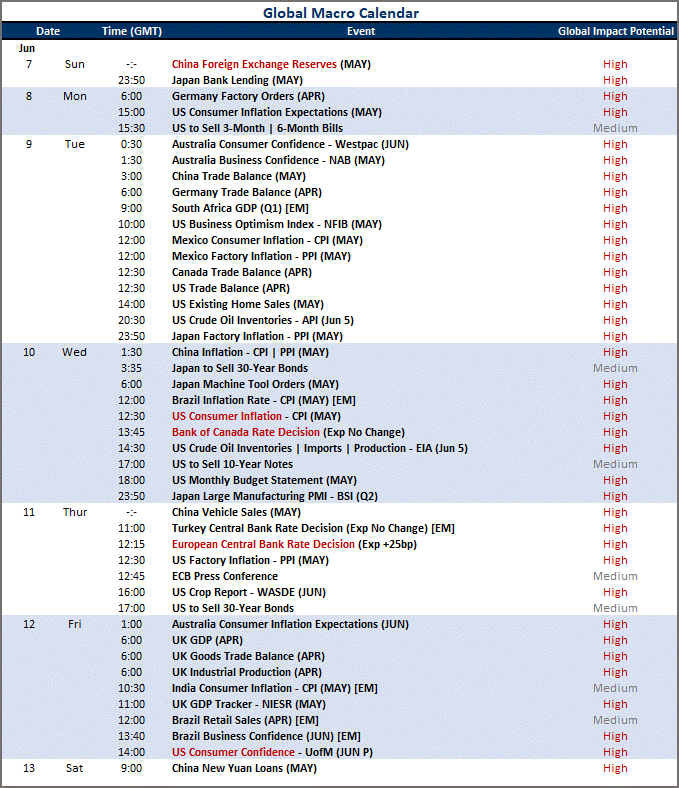
When markets are catering to a clear direction and backed by tempo – which tends to be more intense when bearish – there tends to be greater deference for fundamental themes and scheduled event risk. AI is the most prolific engine for bullish interests, but the menu for bearish concerns is far more varied. Should the market rank look for justification for their flight, they can look beyond the volatile back-and-forth in headlines around the Middle East war and flow of traffic through the Strait of Hormuz. There are tangible measures of market impact through trade figures due through the week (eg China, US and Canada). Monetary policy can be registered as a tangible consequence of the 14-week war as the rebound in inflation has shifted the outlook for global monetary policy to further measured rate cuts to imminent rate hikes, which makes the ECB a focus point. Then there is the inevitable focus on milestones of sentiment itself with a host of confidence figures (business and consumer) dotted throughout the coming week.
Calendar of Top Global Macro Event Risk Source: John Kicklighter
An NFPs Beat This Past Week Amplifies Attention On CPI
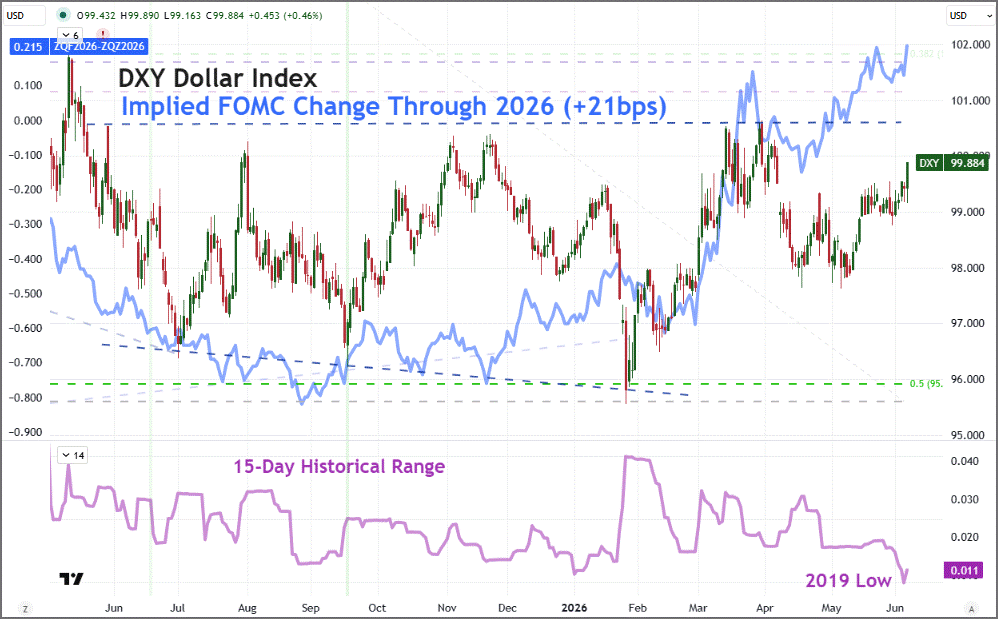
Before the US-Iran war, the markets were projecting the Federal Reserve was facing two to three 25 basis point rate cuts through 2026. As the military actions carried on and then the inconsistent ceasefire kept the Strait of Hormuz’s closure as a center piece pressure point for both sides, inflation expectations started to climb sharply. US consumer inflation expectations (measured by the New York Fed) rose to 3.6 percent through April while the University of Michigan’s consumer confidence index registered a one-year inflation forecast of 4.8 percent. Consumer expectations tend to be exaggerated, but even the ISM manufacturing and service sector component inflation gauges have climbed sharply. The May CPI reading from the BLS will draw considerable interest as a more ‘official’ gauge – with headline and core annual rates expected to accelerate to 2.9 and 4.0 percent respectively. Those are both well above the Fed’s supposed 2.0 percent target. What’s more, with NFPs beating to the upside last week with a steady, low unemployment rate; the traditional calculation for Fed next steps is pretty straightforward.
Chart of DXY Dollar Index Overlaid with Fed Implied 2026 Rate Change (Daily) Source: TradingView.com; ICE; CBOT; John Kicklighter
If Even the ECB Is Hiking Rates…
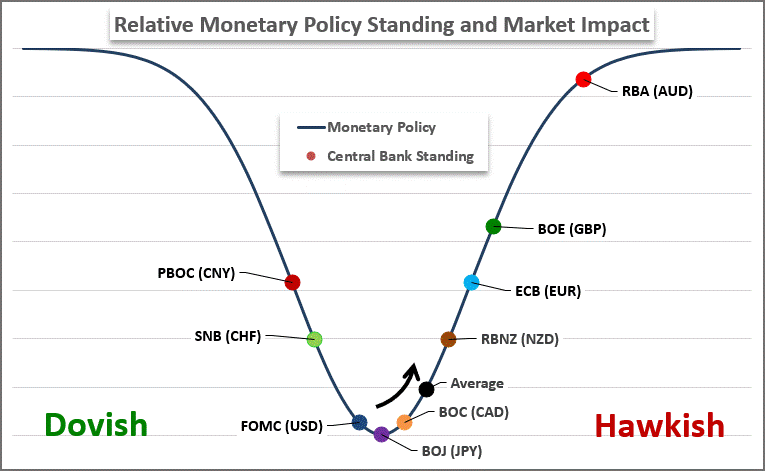
There are a few major central banks due to weigh in on their monetary policy mix over the coming week and the Federal Open Market Committee will have its very controversial first meeting under new Chairman Kevin Warsh Wednesday June 17th, but the European Central Bank (ECB) decision Thursday may be a pivotal event in this theme. The ECB has warned of inflation and the need to curb its rise for some months now, so much so that the economists expect the group to hike its benchmark rate 25 basis points to 2.40 percent at this meet. This would be the first increase from the authority since September 2023, so it is certainly a shift. However, the more significant context from this event is the implications it holds for global monetary policy and not just Europe’s settings. Historically, the ECB is among the more dovish of the major players; and a hike this week would see the group start a tightening cycle before the Fed, Bank of England, Bank of Canada and others considered to be on the more hawkish side of the scale. That will likely look like justification – if not just expectation – for others to follow suit.
Major Central Bank Relative Monetary Policy Standing Source: John Kicklighter
Reconciling the Extreme Pessimism of the US Consumer with Steady Data
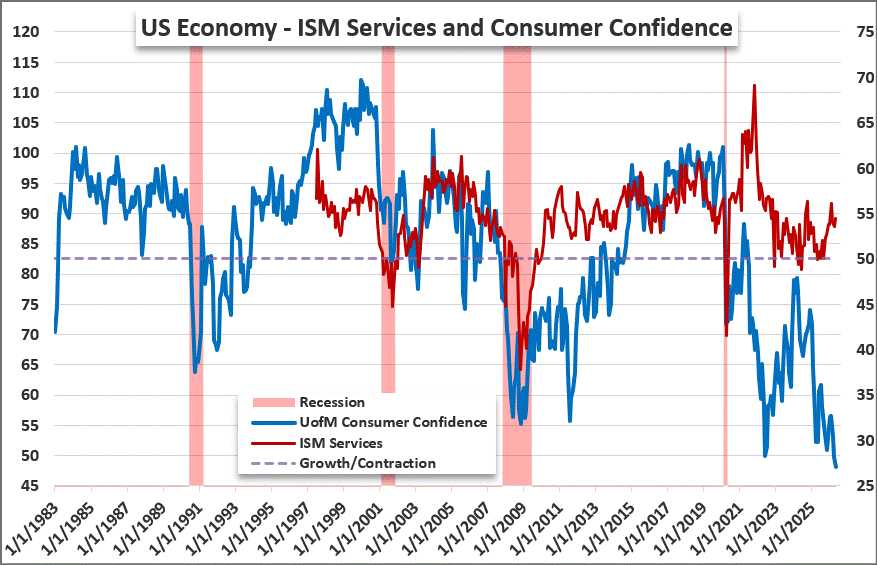
There has been an extreme divergence between the positioning of key US data and the expectations of consumers, in many ways the engine of economic activity. Through its May update, the University of Michigan’s consumer confidence survey extended its tumble to fresh series lows – stretching back nearly three-quarters of a century. This can be seen as extremely worrying given that sentiment surveys like these are considered leading indicators to consumption intentions down the line. If the US consumer stops spending, the impact could be severe for the American economy and the export health of many major trade partners. And yet, despite the severity of the retreat thus far, we have not seen a collapse in activity in other crucial areas of the US data map. Employment, retail sales, business orders and other measures seem to be holding up – though there are arguments to be made of undercurrents for all of these. Consumer sentiment has increasingly skewed negative over the year, so that can account for some of the severity in the contrast that we see here, but such a prolific course gap is likely to hold for long. Eventually, sentiment or economic health will relent.
Chart of UofM Consumer Confidence, ISM Service Sector PMI and US Recessions (Monthly) Source: University of Michigan; ISM; John Kicklighter
Access More Global Macro Insights, Forecasts and Tools
Stay connected to timely global macro analysis designed to help market participants navigate shifting economic conditions and evolving risk. Gain access to regular market commentary, updated quarterly forecasts, a comprehensive two-week forward economic event calendar, and specialized tools built to support informed trading and risk management decisions.
The subsidiaries of StoneX Group Inc. provide financial products and services, including, but not limited to, physical commodities, securities, clearing, global payments, risk management, asset management, foreign exchange, and exchange-traded and over-the-counter derivatives. These financial products and services are offered in accordance with the applicable laws in the jurisdictions in which they are provided and are subject to specific terms, conditions, and restrictions contained in the terms of business applicable to each such offering. Not all products and services are available in all countries. The products and services offered by the StoneX Group of companies involve risk of loss and may not be suitable for all investors. Full Disclaimer. This content is not intended for residents of any particular country, and the information herein is not advice nor a recommendation to trade nor does it constitute an offer or solicitation to buy or sell any financial product or service, by any person or entity in any jurisdiction or country where such distribution or use would be contrary to local law or regulation. Please refer to the Regulatory Disclosure section for entity-specific disclosures. No part of this material may be copied, photocopied or duplicated in any form by any means or redistributed without the prior written consent of StoneX Group Inc. The information herein is provided for informational purposes only. This information is provided on an ‘as-is’ basis and may contain statements and opinions of the StoneX Group of companies as well as excerpts and/or information from public sources and third parties and no warranty, whether express or implied, is given as to its completeness or accuracy. Each company within the StoneX Group of companies (on its own behalf and on behalf of its directors, employees and agents) disclaims any and all liability as well as any third-party claim that may arise from the accuracy and/or completeness of the information detailed herein, as well as the use of or reliance on this information by the recipient, any member of its group or any third party.
Our market expertise, advanced platforms, global reach, culture of full transparency and commitment to our clients’ success all set us apart in the financial marketplace.
Reach
With access to 40+ derivatives exchanges, 180+ foreign exchange markets, nearly every global securities marketplace and numerous bi-lateral liquidity venues, StoneX’s digital network and deep relationships can take clients anywhere they want to go.
Transparency
As a publicly traded company meeting the highest standards of regulatory compliance in the markets we serve, our financials and record of accomplishment are matters of public record. StoneX’s commitment to “doing the right thing over the easy thing” sets us apart in the industry and helps us build respect, client trust and new partnerships.
Expertise
From our proprietary Market Intelligence platform, to “boots on the ground” expertise from award-winning traders and professionals, we connect our clients directly to actionable insights they can use to make more informed decisions and achieve their goals in the global markets.