Dollar expected to reflect Brazil's presidential election, Fed's interest rate decision, US economic data, and PTAX
- Bullish
- The release of strong inflation and GDP readings in the US tends to increase investors' bets on interest rate hikes by the Fed in the coming months, which tends to raise the yield on US Treasuries and favor the attraction of foreign capital to the US, strengthening the dollar globally.
- Bearish
- Bets on Senator Flavio Bolsonaro's victory in the elections strengthen expectations for fiscal adjustments, which tend to reduce the perception of fiscal risk of Brazilian assets and favor the BRL's performance.
- The Federal Reserve's decision to maintain interest rates tends to reduce the yield on US Treasuries and hinder the attraction of foreign capital to the country, weakening the dollar globally.
The week in review
- Voting intention polls indicated a technical tie and Lula's recovery, but Flavio Bolsonaro's numerical advantage maintained the prospect of government change, which reduced fiscal risk perception and limited losses for the Brazilian currency.
- Abroad, global risk aversion strengthened due to fears of oil shortages, fiscal and political concerns in France, and mixed results from US tech companies, boosting demand for safe havens.
USDBRL and Dollar Index (points)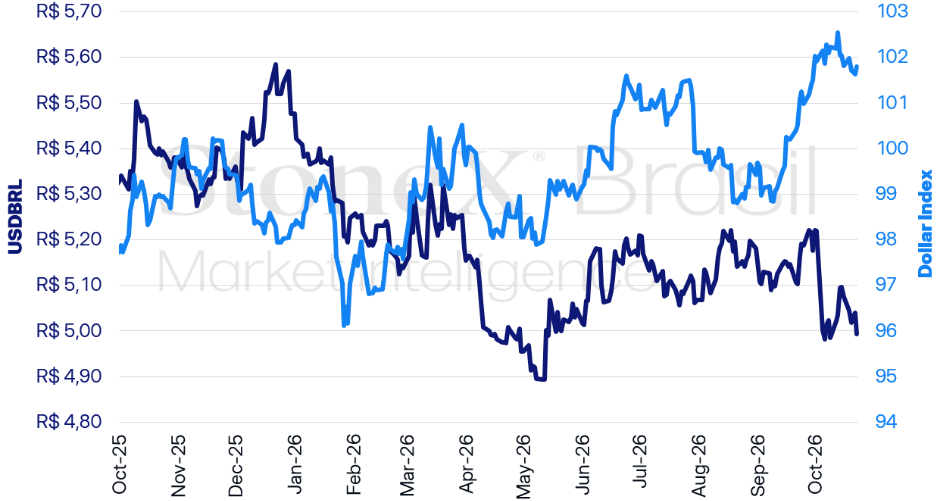
Source: StoneX cmdtyView. Design: StoneX.
USDBRL variations | Daily: -0.94% | Weekly: -1.60% | Monthly: -3.53% | Annual: -8.84% | Over 12 months: -7.30%
Dollar Index variations | Daily: +0.18% | Weekly: -0.00% | Monthly: +0.30% | Annual: +3.54% | Over 12 months: +2.89%
KEY EVENT: Second round of elections
Expected impact on the USDBRL: bearish
The currency market is expected to react to the second round of national elections on Sunday (25), aiming to monitor the definition of the next president and adjust expectations for economic policy over the next four years.
- In the final stretch of the electoral race, financial markets should follow the debate between candidates on TV Globo on Friday (23) and another round of voting intention polls by AtlasIntel, CNT/MDA, Quaest, Datafolha, and BTG/Nexus on Saturday (24).
Why this matters: Recent reactions from financial market players reveal a preference for Flavio's election, expecting robust fiscal adjustments under his government.
- As such, the expected victory of the senator should strengthen bets on a more conservative fiscal policy, which tends to reduce the perception of fiscal risks for Brazilian assets and favor the BRL's performance.
Expectations: Overall, investors remain optimistic about a victory for Senator Flavio Bolsonaro, which has favored maintaining the exchange rate at lower levels since Flavio's surprising lead in the first round.
- Despite optimism, the recovery trend shown by President Luiz Inácio Lula da Silva's campaign in recent weeks maintains the perception of a tight race (though not overtaking Flavio numerically in key polls).
Latest polls: The latest Datafolha survey showed Flavio and Lula tied with 50% of valid votes each, compared to 51%-49% in favor of Flavio in the previous survey.
- In terms of voting intentions, Flavio's intentions remained stable at 47% compared to the previous week's poll, while Lula's rose from 45% to 46%.
Possibility of a turnaround? In recent weeks, President Lula's campaign shifted its communication strategy, focusing on influencers and mass mobilization on social media and messaging apps.
- Additionally, pro-Lula demonstrations in different cities across the country brought momentum to the president's campaign, aiming to bring to the polls voters who abstained in the first round.
- This set of factors, combined with recent government announcements, tends to favor a recovery for President Lula at the polls, although the tight race scenario remains.
- However, there may be a perception that election polls are underestimating Flavio's potential victory, as seen in the first round, strengthening optimism for the senator's success.
What if Flavio wins? In the event of Flavio's victory, optimism for fiscal adjustments early in his government should gain strength, supporting the performance of national assets.
- Moreover, the fact that Flavio's party (Liberal Party) became the largest Congressional bloc should favor the candidate's governance and facilitate progress on his economic agendas.
- However, given Flavio's favoritism among investors, there may be a profit-taking movement that pressures the performance of national assets.
- Regarding fiscal adjustments, it is worth noting that, so far, Flavio's economic team has made few statements about concrete measures to curb public debt growth, with investors giving them the "benefit of the doubt."
- As such, in the absence of concrete announcements to contain public spending, investor expectations may be disappointed, negatively impacting domestic assets.
What if Lula wins? In the event of President Lula's victory, a deterioration of national assets is likely, driven by investor disappointment and the continuation of the current government's expansionary fiscal policy.
- However, the growth of the PL bloc in Congress should limit the scope for advancing expansionary policies in a potential new Lula administration.
Fed interest rate decision
Expected impact on the USDBRL: bearish
Probability of an interest rate hike in the Federal Reserve's October 28 decision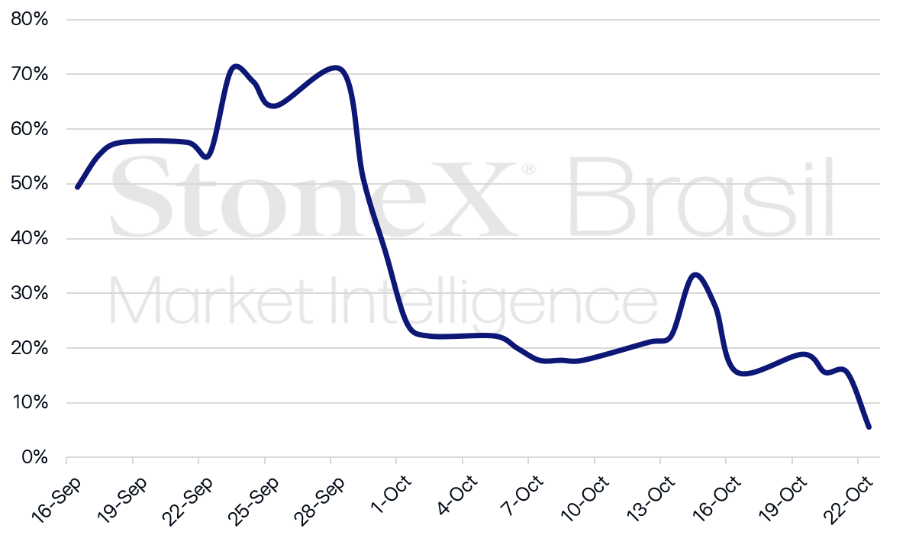
Source: CME FedWatch Tool. Design: StoneX.
Externally, the currency market is expected to react to the Federal Reserve's Federal Open Market Committee (FOMC) decision, which is expected to keep its benchmark interest rate unchanged in the range of 3.75%-4.00% per year.
Why this matters: The Fed's decision to maintain interest rates tends to reduce the yield on US Treasuries and hinder the attraction of foreign capital to the country, weakening the dollar globally.
Stronger data: Economic data released since the last FOMC interest rate decision on September 16 has reinforced the perception of a risk balance for the US economy leaning more toward inflation.
- The second-quarter GDP growth rate was revised upward, driven by the expansion of personal consumption and business investment.
- Although labor market numbers fell below analysts' estimates, they continued to point to a stable and healthy scenario, without major risks of intense weakening.
- Inflation data presented stronger-than-anticipated readings, suggesting more persistent and widespread price pressures, moving away from the Federal Reserve's 2% annual target.
- Additionally, the shortage of oil and derivatives since the US-Iran conflict and the global semiconductor shortage caused by infrastructure expansion investments in artificial intelligence are expected to keep price pressures intense in the coming months.
Contradictory signaling: However, despite this scenario of higher risks for accelerating inflation, there is virtually unanimous consensus among investors that the Fed will opt to keep rates stable.
- This is particularly contradictory given Kevin Warsh's remarks at the Jackson Hole Symposium, where he defined a necessary condition for the Fed not to raise rates as "a clear and rapid decline in inflation" – a criterion clearly unmet by recent data.
- This apparent contradiction primarily results from statements by senior Federal Reserve leaders, including New York Fed President John Williams, Fed Vice Chair Philip Jefferson, and Fed Governor Christopher Waller, who argued there is no urgency to raise US rates and that the Fed has time to gather more information before the next hike.
- As it is virtually unthinkable to imagine dissenting votes among the Federal Reserve Chair, Vice Chair, and New York Fed President, investors interpreted these remarks as explicit signaling of the October decision.
- Since Warsh refrains from analyzing and discussing the US economic outlook, the statements of other members gain importance in communicating the Federal Reserve's monetary policy direction.
What will Warsh say? Given the near-consensus on the decision, investors are expected to react to Federal Reserve Chair Kevin Warsh's press conference to adjust expectations for the trajectory of US interest rates.
- Warsh is likely to adhere to his enigmatic, generic, concise, and minimally informative style, avoiding explicitly suggesting any possibility for future action by the US central bank.
- Nonetheless, he is also unlikely to refute the possibility of another rate hike in December, aiming for investors to continue betting on that trajectory.
US economic data
Expected impact on the USDBRL: bullish
Additionally, investors are expected to react to the release of the September Personal Consumption Expenditures (PCE) Price Index and the first reading of the US GDP for the third quarter.
Why this matters: The release of strong readings for inflation and GDP in the US tends to increase investor bets on Fed rate hikes in the coming months, which tends to raise the yield on US Treasury bonds (Treasuries) and favor the attraction of foreign capital to the country, strengthening the dollar globally.
Estimates: Following above-expected numbers for September's Consumer Price Index (CPI) and Producer Price Index (PPI), the monthly PCE increase is expected to rise from 0.3% in August to 0.5% in September.
- The core PCE indicator, which excludes more volatile food and energy components, is expected to accelerate from 0.2% to 0.3% during this period.
- The annualized quarterly GDP growth rate is expected to rise from 2.2% in the second quarter to 3.0% in the first estimate for the third quarter.
- If projections are confirmed, these readings should reinforce perceptions of a robust US economy and the persistence of a challenging inflationary environment.
End-of-month PTAX rate
Expected impact on the USDBRL: undefined
End-of-month PTAX rate – selling (BRL/USD)
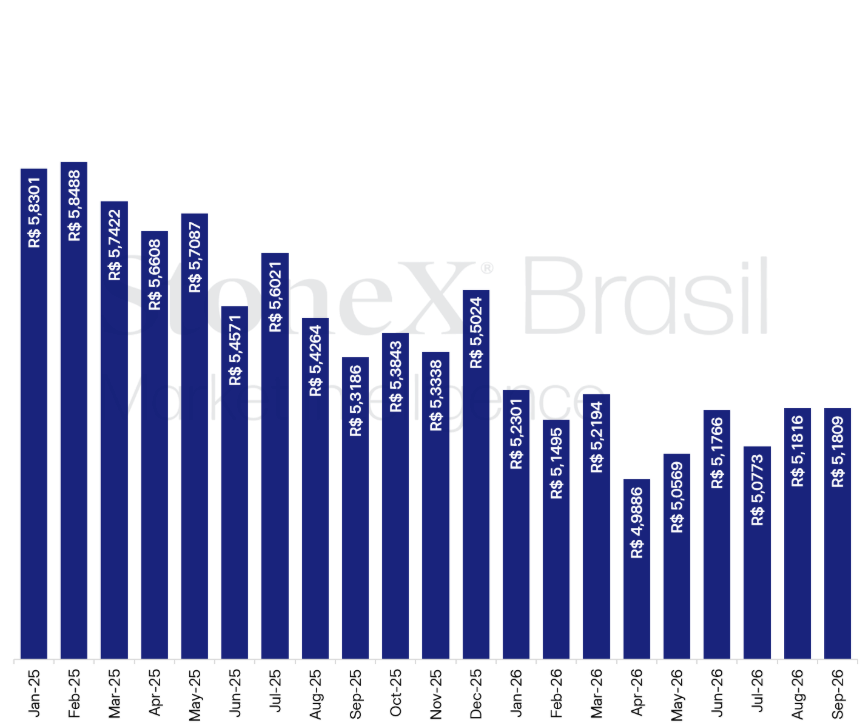
Source: Central Bank of Brazil. Design: StoneX.
Trading volume and exchange rate volatility are expected to rise on the last trading day of October due to the formation of the end-of-month PTAX rate.
- The PTAX rate is a benchmark published daily by the Central Bank, and its end-of-month value is widely used in currency contracts and derivatives.
- The Central Bank calculates its value through the average of quotes obtained during four consultation windows, between 10:00 AM and 1:10 PM.
Why this matters: Financial market operators intensify their trades during the formation intervals of the month's last PTAX rate to try to influence its value in a way that benefits their positions, increasing volatility and complicating the reading of real movements on the day.

INDICATORS
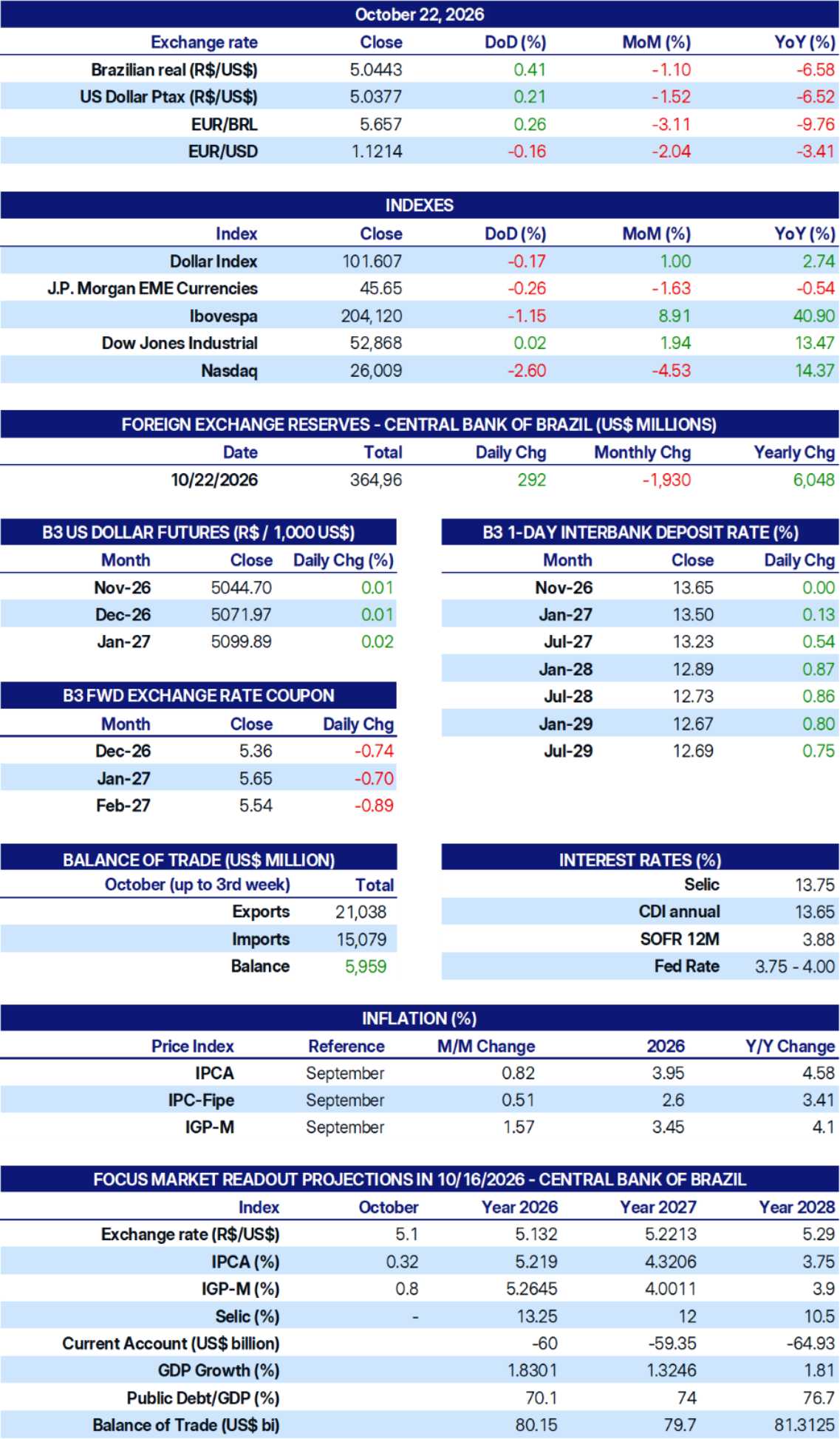
Sources: Central Bank of Brazil; B3; IBGE; Fipe; FGV; MDIC; IPEA and StoneX cmdtyView.