February 15 - Weaker than expected retail sales are driving strength in stocks at mid-day, with all major indexes in the green at the time of writing as traders hope for a more dovish Fed following today's data release. The VIX is off slightly, hovering near 14.3, while the U.S. dollar is fading as it trades near the 104.1 level. Treasuries are slightly softer on the day, with 10-year yields near 4.21% and 2-year yields falling below 4.55%. Crude oil is up at mid-day, rebounding from sharp losses yesterday, as the nearby WTI contract pushes above $77.30/barrel, while the ags are largely mixed, starting the day quite weak but attempting to rally from this morning's lows.
The U.S. manufacturing sector is seeing some improvement as we progress through 2024, with the Philadelphia Fed Manufacturing Index breaking into contractionary territory in February for the first time since August, coming in at a 5.2 reading, while the February New York Fed Manufacturing Index improved dramatically, albeit still showing contraction at -2.4, from the month prior's horrendous -43.7 reading. Additional data released this morning for the month of January showed a slightly worse picture to start the year, with U.S. industrial production falling 0.1% month-on-month, missing forecasts of a 0.3% rise, and manufacturing production dropping 0.5% month-on-month despite expectations of improvement. Capacity utilization was also down in January, falling to 78.5%, a 0.2% drop from the month prior and hitting the lowest level seen since September 2021. Despite the bad news from January, the February index readings from the Northeastern U.S. offer a silver lining for improvement this month, as this region has been one of the hardest hit in the recent manufacturing downturn, and the sharp jump in sentiment could suggest the worst is behind us.
The U.S. housing market is continuing its rebound in February, with today's National Association of Homebuilders Housing Market Index climbing to 48, still slightly in contractionary territory but marking the fourth consecutive monthly improvement after bottoming out in November. The improvement in sentiment from homebuilders could be a reflection of an uptick in the split of prospective buyers opting to build instead of buy, with inventories of existing homes remaining tight as those locked into low-rate mortgages stay where they are. It's also impressive, and somewhat unexpected, to see the housing sector express positivity despite seeing U.S. average 30-year mortgage rates rise to a two-month high at 6.87%. Although we have seen a step back from the red hot market seen immediately post-COVID, the U.S. housing market has been shockingly resilient through the last couple years despite facing dramatically higher interest rates and weakened purchasing power due to lingering inflation.
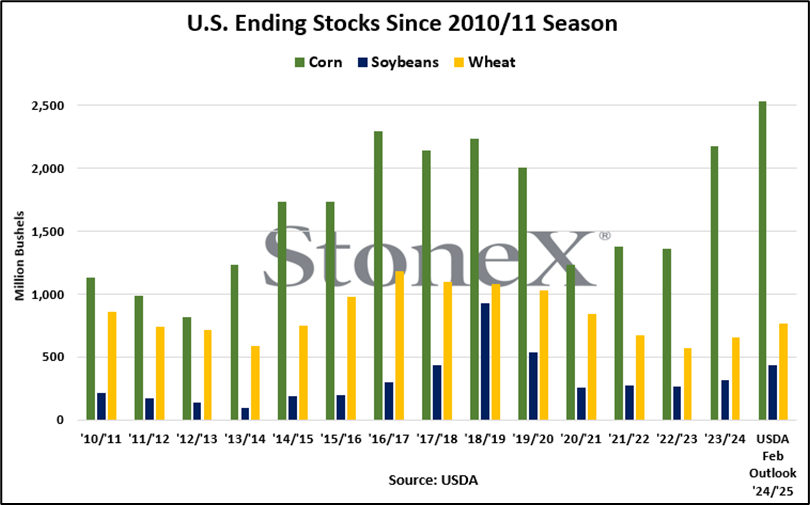
The debate over U.S. spring plantings looks to heat up in the months ahead now, with this morning's numbers from the annual USDA Ag Outlook Forum giving us our first glimpse. Although corn acres came in below market expectations and soybeans above, USDA's initial ending stocks expectations are pretty ugly across the board, with corn pegged at 2.532 bbu (high since at least 1991), soybeans at 435 mbu (high since 2019), and all wheat stocks at 769 mbu (high since 2020). Of course, we can't put too much faith into these numbers because it's still very early in the year and these are not survey-driven estimates, simply a "first stab," so to speak, from analysts at the USDA. Regardless, they still paint a picture of growing grain stocks in the U.S., with this season's ending stocks already getting heavy and export demand expectedly weak due to big corn and soybean production from South America and wheat production from Russia. Nearby soybeans are attempting to find some strength ahead of this morning's NOPA crush report, however, with expectations of a fresh record 189.9 mbu for the month of January, though a slight drop from December's all-time high of 195.3 mbu. The wheat market is also attempting to find some strength on smaller spring wheat plantings, though we did see SovEcon raise their Russian wheat production estimate to 93.6 MMT, which is well above USDA's most recent 91 MMT and would represent a new all-time record high if realized.