February 3 - Headlines continue to drive action in both the equity and commodity markets, with the primary focus being on President Trump's tariff policy, although the markets must also digest some pretty significant jobs data later this week as well. Stocks and most commodities started the day with some significant losses, but they have generally come off those lows after Mexican President Sheinbaum reported that Trump delayed implementing tariffs on Mexico after she offered to send 10,000 national guard troops to the border to help secure it, while continuing conversations on other items of concern. Prime Minister Trudeau of Canada has another call with Trump this afternoon, raising hopes that we'll see something similar develop there. Meanwhile, this morning's economic data also came in better than expected, although the tariff headlines are the primary drivers thus far.
Stocks continue to trade in the red at midday, although well off their session lows. The VIX is trading near 19, after trading above 20 earlier in the session. The dollar index is trading near 109.0, after spiking to near 109.9 earlier in the session. Yields on 10-year Treasuries are trading near 4.53%, while yields on 2-year Treasuries are trading near 4.25%. Crude oil prices are mixed to firm, but roughly $2.50 off their session highs on the one-month delay for Mexican tariffs and on speculation that we could see the tariffs against Canada delayed. The grain and oilseed complex rallied to post notable gains at midday as trade war fears eased. StoneX Brazil dropped its soybean production estimate slightly to 170.9 mmt, with corn up to 129.4 mmt.
Construction spending rose 0.5% on the month in December, up from an upwardly revised 0.2% gains in November, and above analyst expectations of 0.3% gains. That puts construction spending up 4.3% year-on-year in December, trending upward from the 3.0% gains seen in November. The PMI manufacturing index for January rose to 51.2, up from the 50.1 flash estimate earlier in January, and up from 49.4 previously. Today's number suggests that the manufacturing sector is finally seeing some expansion. The ISM manufacturing index came in at 50.9 for December, also indicating expansion. That's up from 49.2 in November and up from analyst expectations of 49.5. Of course, stocks are down today on worries that a possible trade war could undermine the strength seen in the above data.
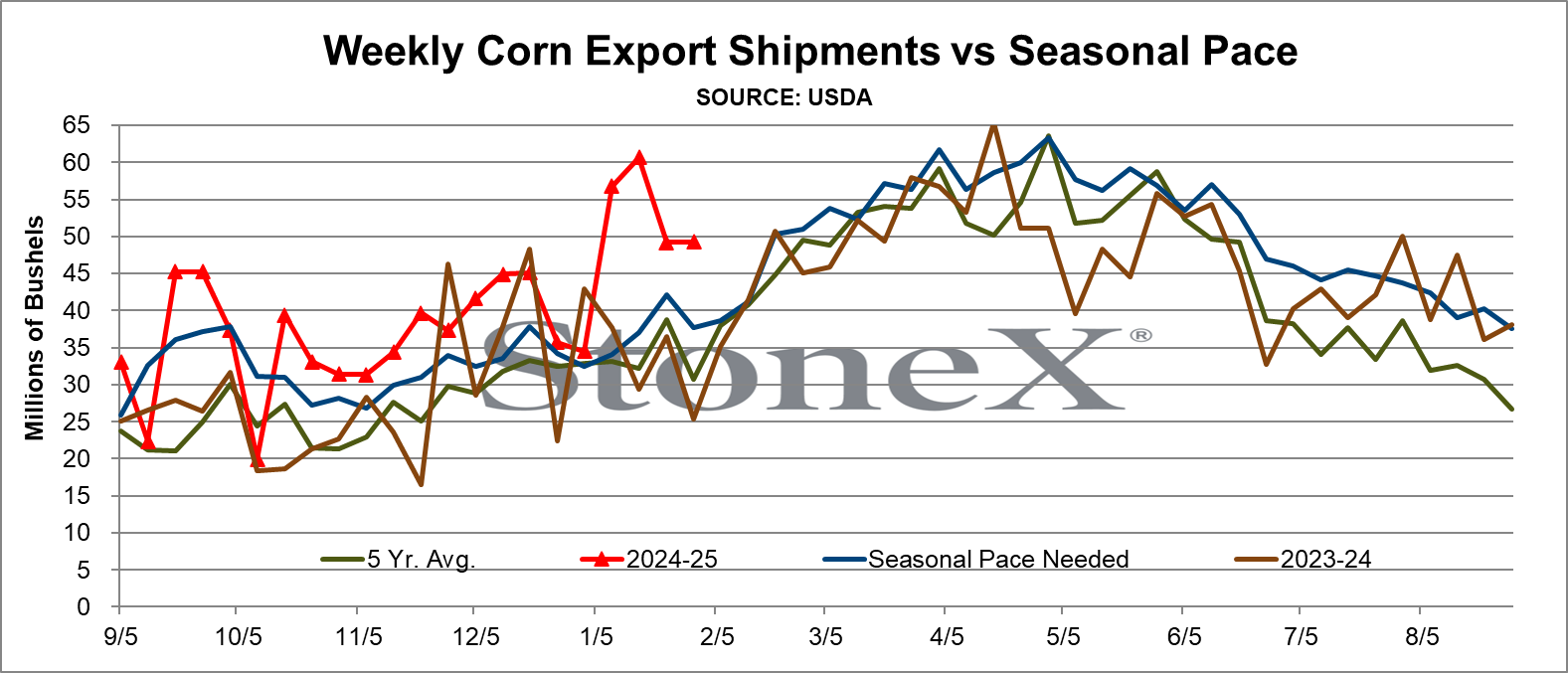
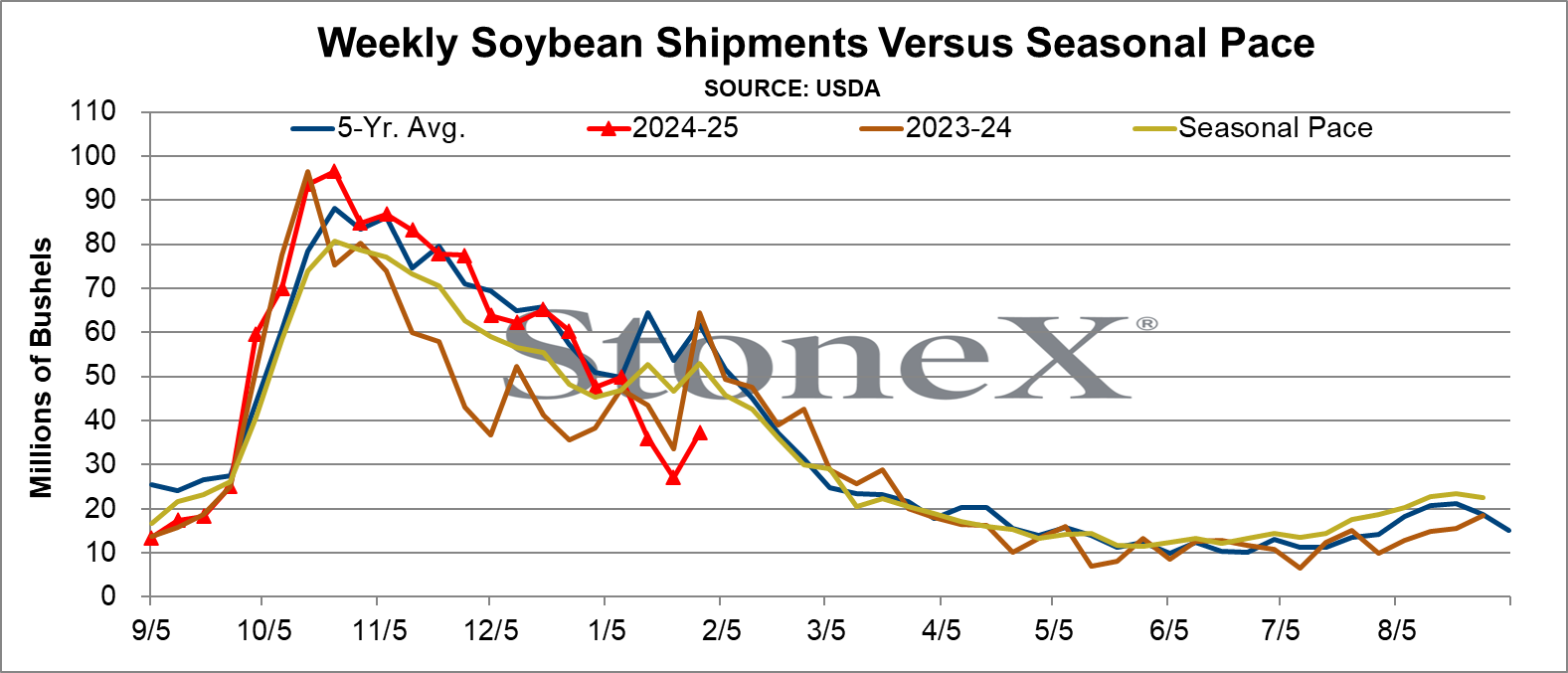
USDA inspected 49.3 million bushels of corn for export shipment in the week ending January 30, as shown below, along with 37.2 million bushels of soybeans, 9.3 million bushels of wheat and 2.9 million bushels of grain sorghum. The portion of the above that was inspected for shipment to China included 12.8 million bushels of soybeans and 2.7 million bushels of grain sorghum. Marketing year to date corn export inspections total 856 million bushels, up 214 million bushels or 33% from the previous year's pace, and 126 million bushels above the seasonal pace needed to hit USDA's target. That surplus gap continues to grow, being up from 114 million bushels the previous week. The one-month delay in enforcing tariffs on Mexico will likely keep the flow of corn going south strong this month, but keep in mind that many of these shipments don't even show up in the inspections report, because they don't have to be inspected according to our trade treaty. Nonetheless, they remain at risk if we do see a trade war break out. Marketing year to date soybean export inspections total 1.252 billion bushels, up 170 million bushels or 16% from the previous year's pace, and up 85 million bushels from the seasonal pace needed to hit USDA's target. But, that gap is rapidly shrinking, as it's down from 100 million bushels the previous week.