LBMA Precious Metals market volumes, August 2021 and their significance.
Welcome to our monthly analysis of LBMA trading volumes for the major precious metals. As usual, there are some interesting patterns to explore.
With the exception of palladium, which had some lively days, August was generally its usual sluggish self across the precious metal’s suite, with a number of market participants away from their desks. Gold’s dramatic fall in the early part of the month, though, was met with heavy volumes both on the way down and on the initial bounce thereafter. Palladium’s activity looks as if it was from the industrial sector.
As ever, heavy volumes were almost always followed by changes in trend, or at least a correction; as sentiment changes so some positions are opened while others are closed.
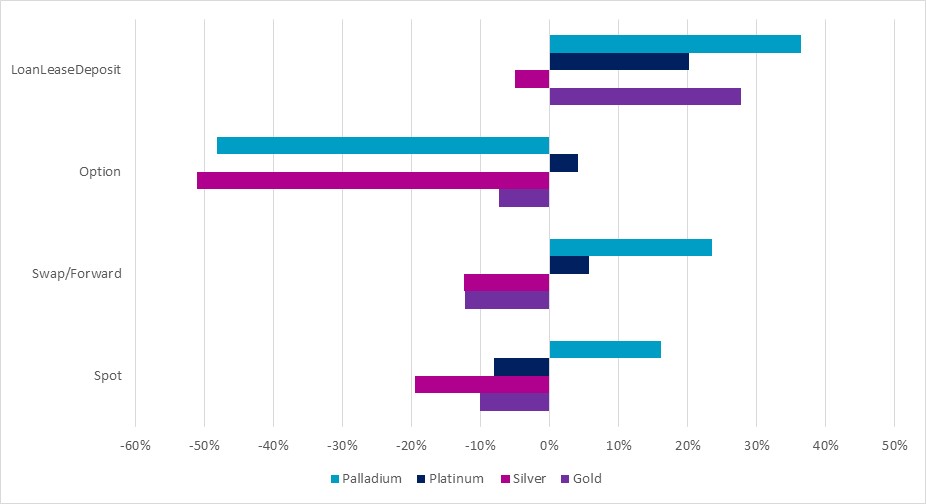
Daily average trading volumes in August, compared with the average for the first seven months of the year.
GOLD
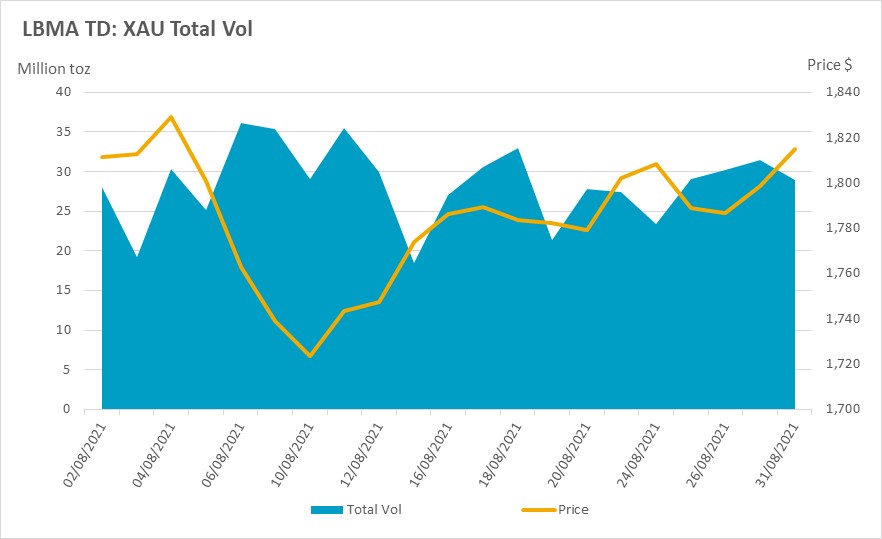
The notable feature of the spot gold market during August was the heavy fall in price in the first week. The month opened with gold trading above $1,800, at the levels that prevailed for much of July, and it did try to move above $1,830 in the first week, but this proved insurmountable. The following day the price edged lower, and then on Friday/Monday the 6th and 9th of the month, prices tumbled, dropping from $1,805 (intraday) to $1691, a drop of $114 or 6% in just two days. The general feeling was that this was triggered by a switch by a fund or funds out of gold and into Treasuries. It also coincided with the so-called “Death Cross”, with the 50-day moving average crossing below the 2000-day at the $1,818 level on the first day of the falls and this would certainly have generated some technical trading; and of course momentum trading and stops will have also been involved. The spot volumes traded on the Monday, which sustained an intraday range of $75, were the highest since mid-June but were not matched by similar increases in the forward or loan/lease/deposit rates, which adds weight to the argument that this was a “one-off” and not fundamentally driven.
The initial bounce also saw heavy volumes as bargain hunting developed and the drop had been unwound by the third week of the month.
The United States’ economy was a key feature all through August, with Fed Chairman Jay Powell addressing the Jackson Hole economic symposium on the 26th; much as expected he reiterated his dovish stance with respect to inflation, maintaining the view that this bout of inflation is “transitory”, i.e. it reflects supply chain disruptions that are characteristic of an economy moving from recession to expansion. The increasing bifurcation within the Federal Open Market Committee became ever more apparent over the course of August with a number of hawkish comments from members of the Committee. Gold has almost invariably been a “Fed-watcher” but this time it is very heavily focused on Washington as the markets consider the possibility of tapering being implemented before the end of the year. Gold is less concerned about inflation per se than about the level of interest rates, which remain very low in nominal terms, while the vast majority of rates are negative in real terms. This is supportive for gold but has been priced in for a good while.
Probably one of the most interesting elements of the market was that while most areas were relatively quiet, the loan/lease/deposit volumes picked up very smartly in the final week of the month. Daily average turnover in this area was 4.4M ounces in the final week, compared with 2.0M ounces over the rest of the month and an average of 1.9M ounces for the rest of the year. This coincided with the spot price once again regaining the $1,800 level and suggests that there may have been some hedging from the mining fraternity, locking in prices over $1,800 – a level that has again come under test in the early part of September. Some gold:silver ratio trading may have been underway, also; see below.
SILVER
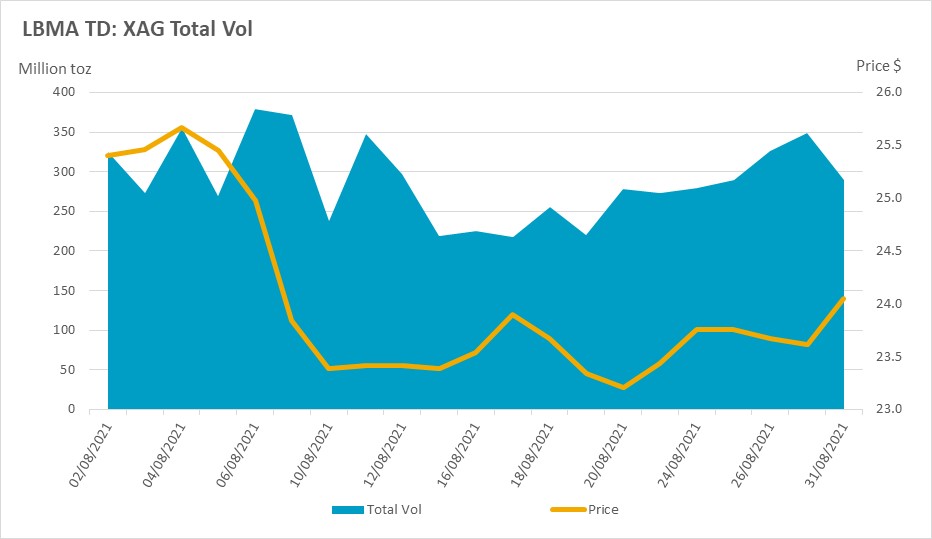
Silver tumbled in line with gold at the start of the month but did not recover in the same way. When gold is not enjoying a marked trend, either bullish or bearish, silver tends to look to its industrial nature. Bear in mind that although silver is generally deemed to be a “precious” ketal, it does not have gold’s advantages in that respect; it is no longer an internationally accepted currency, is much more volatile than gold and therefore is arguably not a safe haven in the way that gold is and 60^ of silver demand (excluding exchange0-traded products) is industrial. Fundamentally the market is expected to be more or less in balance this year, but sentiment is very cautious because of the uncertainties surrounding the path of the COVID virus. As a result the price only unwound half of the losses that it sustained in the fall-out form gold’s drop.
Here, too, the heaviest volumes in the spot market were sustained during the fall, which took silver from the month’s high of $26.0 to the intraday low of $22.63Towards the end of the month there was a jump in spot volume (as there was in gold). The spot price was rising towards $25 at this point while the gold:silver ratio was also widening, strongly suggesting that silver’s upward momentum was being driven by gold. The ratio tested the 76 level, where it failed at month-end.
The swap/forward market activity was also instructive; there were two days of particularly heavy activity. The first was at the start of the month which was just off the high for the period (that came on day three); silver had been in a bear trend in the second half of July and rallied towards month-end; this action suggests some forward selling, looking to lock in the improvement towards $26 as the move was starting to run out of momentum. Then again at the end of the month their story was similar, albeit at lower levels; after a rally from $23.35 towards $24.25 the move was starting to lose steam and here, too it is likely that there was some hedging in the fact of uncertain economic prospects. This is reflected also in the loan/lease/deposit volumes, which were high at the start and end of the month but subdued during the middle fortnight. The option market was very quiet, with the exception of healthy activity in the immediate aftermath of the sharp drop towards the start of the month, and as the price range started to narrow it looks as if there was some bargain hunting in evidence.
PLATINUM
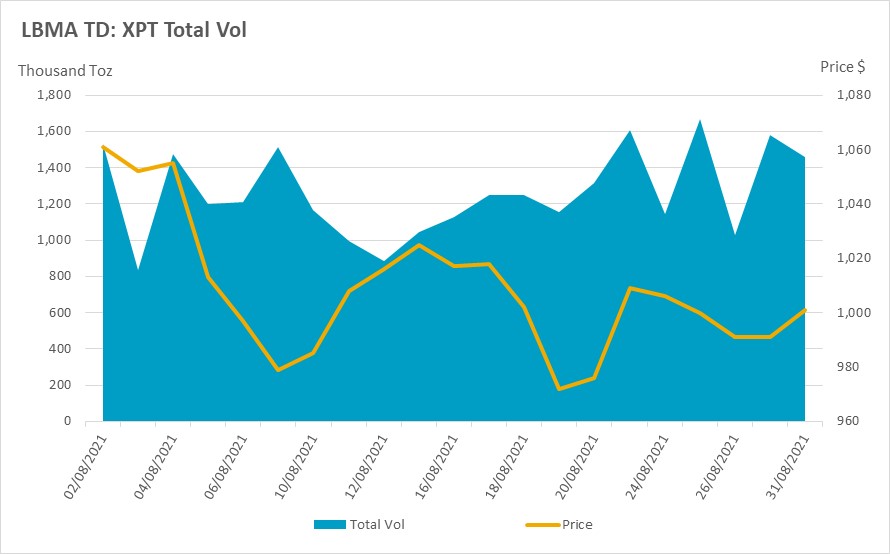
Platinum came down in sympathy with gold and silver at the start of August, falling below the psychologically significant $1,000 level to touch a low of $964, a level that was revisited halfway through the month. Most of August was spent between $964 and $1,033, a narrow range of just 7%, before further retreats as September developed. Spot conditions were sluggish over the month as a whole, posting a 10% contraction against the average for the first seven months of the year, but volumes in the other areas were healthy. Swap/forward turnover was 7% higher than for the rest of the year, options were only mildly up (3%), but loan/lease/deposit was much higher, up by 24% against the rest of the year. It looks as if this could have been the adjustment of a major forward book or books, given that it was twelve months previously that Scotia wound down its activities in the precious metals markets and the book would have been novated.
As we have noted before, borrowing is commonplace in a number of platinum’s end-uses as it forms part of the in-process fixtures in areas such as petrochemical catalysis, and the manufacture of float and fibre glass; when the elements are spent, they go for reconstitution and much of the metal involved is borrowed.
There was only one stand-out day in the spot market, which was towards the end of the month when almost a million ounces turned over (this increased volume was not mirrored in the derivatives). There was no specific fundamental reason of this activity, although Jay Powell’s dovish testimony to the House Financial Services Committee may have given the markets some confidence. The trading range was narrow, reflecting ample liquidity. Towards the end of the month platinum regularly tested support at $980; this proved resilient and gave the market some impetus for a short-lived rally towards $1,020 towards month-end. This prompted lively activity in the loan/lease/deposit sector; as noted above this could have been book readjustment but given that the post price had rallied smartly, there may well have been some hedging activity as the month drew to a close.
PALLADIUM
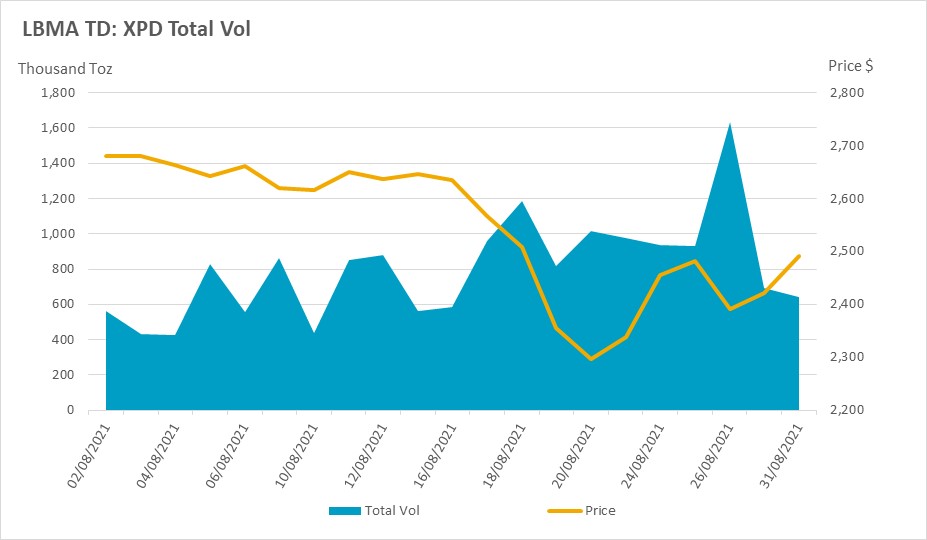
Palladium was much the liveliest, in relative terms, of the precious suite during August. Spot turnover was 19% higher than the average for the rest of the year, swaps and forwards were up 28% and loan/lease/deposit posted a 42% increase over the January-July average. Palladium is not as closely tied to the borrowing market as platinum, since over 80% of its demand is in the emission control catalyst sector, which is an outright consumption rather than leasing. In the final week of the year, however, turnover in this latter element rocketed, with over 300,000 ounces traded on the 26th, against an average for the rest of the year to that date of just under 44,000 ounces. With no activity of note in the spot market, this implies either the commissioning or de-commissioning of an industrial plant (palladium’s other industrial uses are electronics, dental and chemical).
The semi-conductor chip shortage is now having a deleterious effect on the auto sector, with companies cutting back on production of their vehicles and inventories of already-manufactured vehicles are piling up. The auto industry has generally been living on a just-in-time basis, which has hampered logistics in the face of this supply disruption; the increase in NYMEX inventories in the middle of this year does suggest that there was some inventory on hand that has been sent onto the terminal markets; it is also, therefore, quite possible that some auto manufacturers have been taking forward cover of palladium in order to maximise recovery potential when the chip shortage has worked through. The auto companies are largely towards the back of the queue behind the likes of the giants Apple and Samsung, and it is perfectly possible that they won’t be back to normal until the middle of next year.