World Gold Council Gold Demand Trends; inside the jewellery and bar&coin numbers
-
Different regions had very different patterns but the clear conclusion is that gold’s role as a risk-hedge in the retail sector was pivotal last year
-
Coin & bar demand soars in the Americas and Europe when compared with 2019
-
Notional expenditure on investment-grade jewellery was up 84% over 2020 and 31% over 2019
-
Notional expenditure on coins & bars was up 33% on 2020 and 77% on 2019
The World Gold Council (WGC) released its Q4 and full-year 2021 “Gold Demand Trends”, which has substantial granular numbers for jewellery and bar&coin demand in particular, as well as more over-arching figures for other elements of the market. In thas piece we look at the jewellery and bar& coin demand. While the WGC’s “percentage change” column against 2020 is of course instructive, we are looking also at the change against 2019, i.e. pre-pandemic levels as 2020 was anomalous.
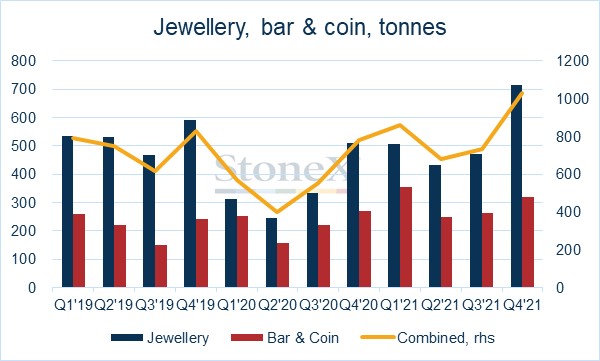
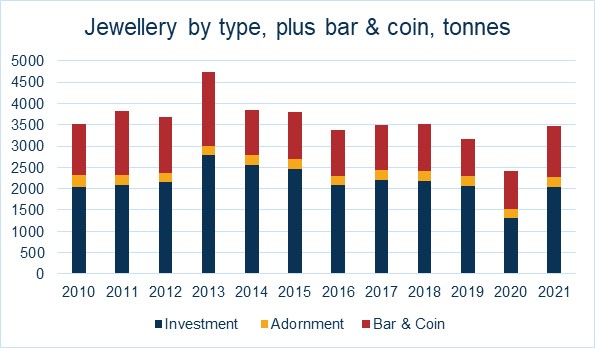
Source for both charts: World Gold Council, StoneX
We are looking at the global numbers and also stripping the sectors into what should be considered ornamental jewellery (essentially North America and Europe), and “investment-grade” jewellery, concentrated in the Middle East and Asia. The point of this is that because of caratage issues, even plain jewellery (i.e. without any gems set into the piece) in North America and Europe has many layers of additional costs built into the price, with the result that the intrinsic value of the contained gold gets lost in the overall pricing. For example in the case of nine-carat gold jewellery in the UK, gold is only 37.5% gold with the vast majority of the balance being copper and the piece in question can easily cost four times the value of the contained gold. In the Middle East and Asia, the piece is priced on the basis of its weight, the LBMA afternoon auction of the previous day, the purity is much higher, from 21-carat in Saudi Arabia through to 24 carat in Hong Kong and China (otherwise known as 99.99% purity of “four nines”). With just fabrication and potentially also storage charges, the piece carries a much much smaller premium over the gold content. For this reason it is not unusual for pieces to be sold back (for a range of reasons) for melting from time to time, or traded in for an upgrade, because the resale price will be a fair reflection of the underlying gold price.
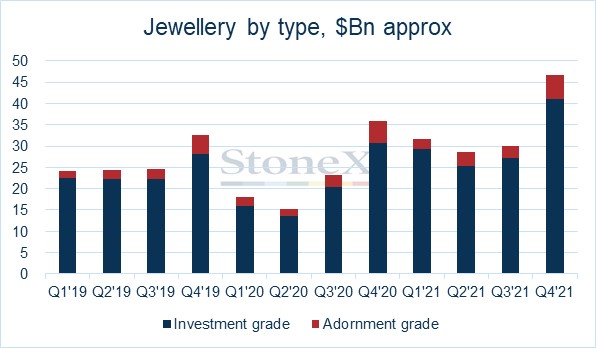
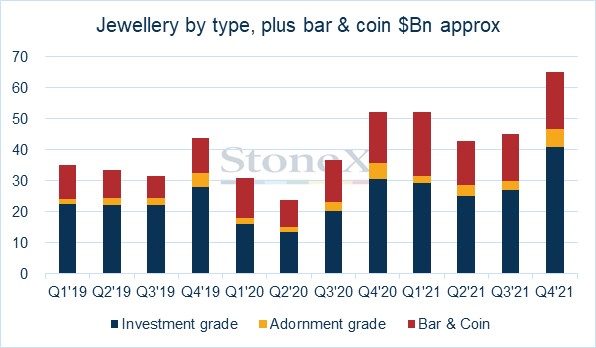
Source: World Gold Council, StoneX
So what did 2021 tell us?
Tonnage up against 2020, steady against 2019
Initially it tells us at a global level that jewellery demand in 2021 was 52% higher than in 2020, but virtually unchanged from 2019.
Bar & coin was up 31% on 2020 and up by 36% against 2019.
Taken together, world total demand in the two sectors was up by 44% on 2020, and 11% against 2019.
Source: World Gold Council, StoneX
Notional expenditure.
It is not possible to quantify this precisely, but if we take the quarterly tonnage numbers against average quarterly price and amalgamating them, that gives us a rough idea of the value of the contained gold.
Globally, at $123Bn, jewellery was 52% ahead of 2020 and 29% up on 2019. Bar & coin were up 33% against last year but 77% above 2019; and combined, the total was up 45% against 2020 and 43% higher than 2019.
Now to split jewellery into price-elastic and non-price elastic, as defined earlier.
The adornment grade jewellery was, in tonnage terms, 23% ahead of 2020 but 12% behind 2019. This might at first glance be expected to partly reflect the reduction in consumer confidence abd the reluctance to spend on anything other than the essentials, but the expenditure numbers below actually tell a different tale. In the price-elastic investment-grade sector, tonnage was up 55% against 2020, and down by just 1% against 2019 as gold retained its role as a hedge against risk. Also, of course, we have to bear in mind that parts of Asia, notably India, had to contend with renewed surges in the virus, which undermined 2021 purchase. The massive jump in Indian demand in the fourth quarter, after a comparatively weak six months, was testament to this.
When it comes to expenditure, higher gold prices suggest that adornment-grade jewellery was up by 23% over 2020 and 35% over 2019, so the market certainly didn’t go into meltdown. We do have to be careful though because of the dilution of the gold content as against the sticker price on the piece in question.
In the investment-grade sector the 2021 notional expenditure was up by 84% over 2020 and 31% over 2019, at $123Bn – dwarfing the adornment grade ($14Bn) by a factor of 8.6 times.
Biggest risers
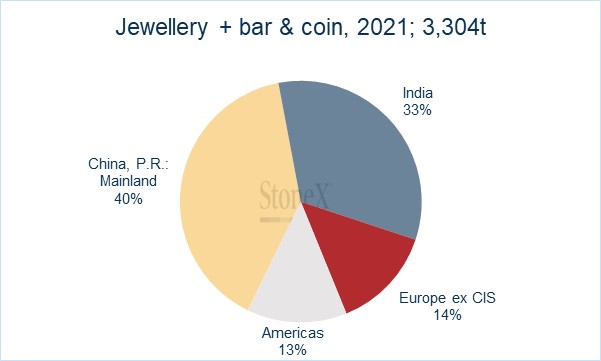
To round this off it is worth breaking demand down by region. It will surprise no-one that the two behemoths of the sector, China and India continued to dominate, and India’s Q4 surge in demand was particularly impressive. If we disregard Japan, which posted very big gains but off very small tonnages, then in percentage + tonnage terms the biggest swing over 2020 was India, with a 79% gain (446t up to 797t), with China in pole position and posting an increase of 57% from 613t to 960t. Against 2019, India’s gain was 16% and China, 13%.
Market share over the year as a whole looks like this: -
Source: World Gold Council, StoneX
Other notable swings in percentage terms were in the United States, which posted a 76% increase over 2019, reflecting the massive surge in bar & coin demand in that country; the combined total rose from 151t in 2019 to 266 in 2021; of this 115t gain, a massive 97t was in bar& coin, a near five-fold increase. Not to be outdone, Europe (excluding the CIS) posed an increase in bar & coin of 77% between 2019 and 2021, from 149t to 264t, as retail purchasers flocked to gold as a safe haven.
On balance, then, gold demand held up well, certainly in terms of expenditure as investment grade jewellery in Asia and the Middle East went hand-in-hand with bar & coin demand in the Americas and Europe. At an individual level it has not lost its importance. The professional sector, however, has a more widely varied view. We will look at the activities of the official sector in a different piece.