- World production estimated above consumption in 2023/24, according to the USDA;
- Improvement in productivity with the harvest progress in Brazil;
- USDA estimates Brazilian crop at 155 million tonnes;
- Crop should still be favorable in Argentina;
- Concerns about the pace of global demand;
- Area growth prospects in the US.
- Lower production figure by CONAB;
- Possible impact of rains on the planting pace in the US;
- Torrential rains in Rio Grande do Sul causing floods;
- High net short position of spec funds;
- Buenos Aires Exchange cuts Argentine crop 23/24;
- The Argentine situation still favors holding soybeans as insurance.
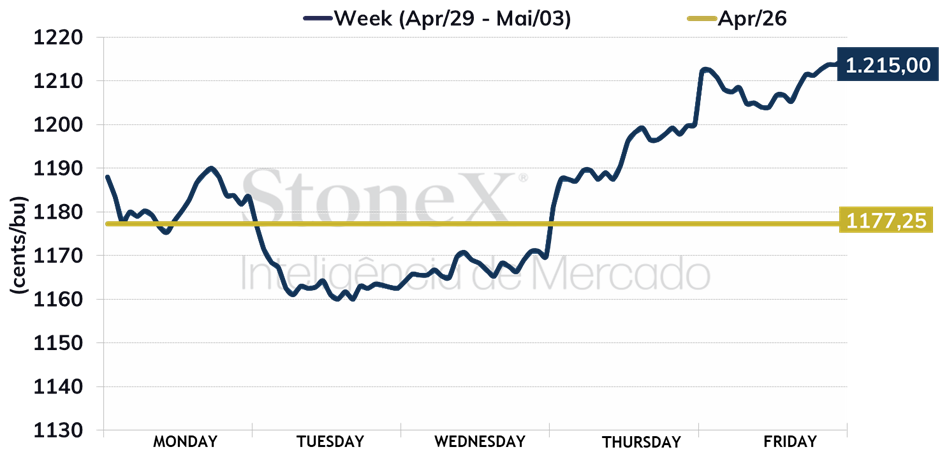
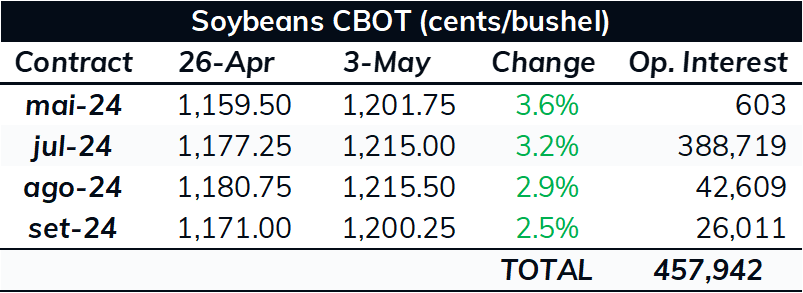
Last week, soybean quotes posted gains, with the July contract ending Friday (3) at 1215 cents per bushel, a 3.2% increase for the period. These gains were driven by concerns about the planting pace in the US and flooding in Rio Grande do Sul, here in Brazil, and were more concentrated towards the end of the week.
Prices continued to be under pressure in the last trading sessions of April, even with the strike announced in Argentine ports against the fiscal and labor measures approved by President Javier Milei's government. Nonetheless, on Tuesday (30/04), the oilseed workers' union (SOEA) suspended the strike, and activities started to return to normal.
Argentina stands out in the global export of soybean meal and oil. With the rebound of the crop in the country, the expectation is that crushed and exported volumes will return to usual levels after falling due to the significant drop last year.
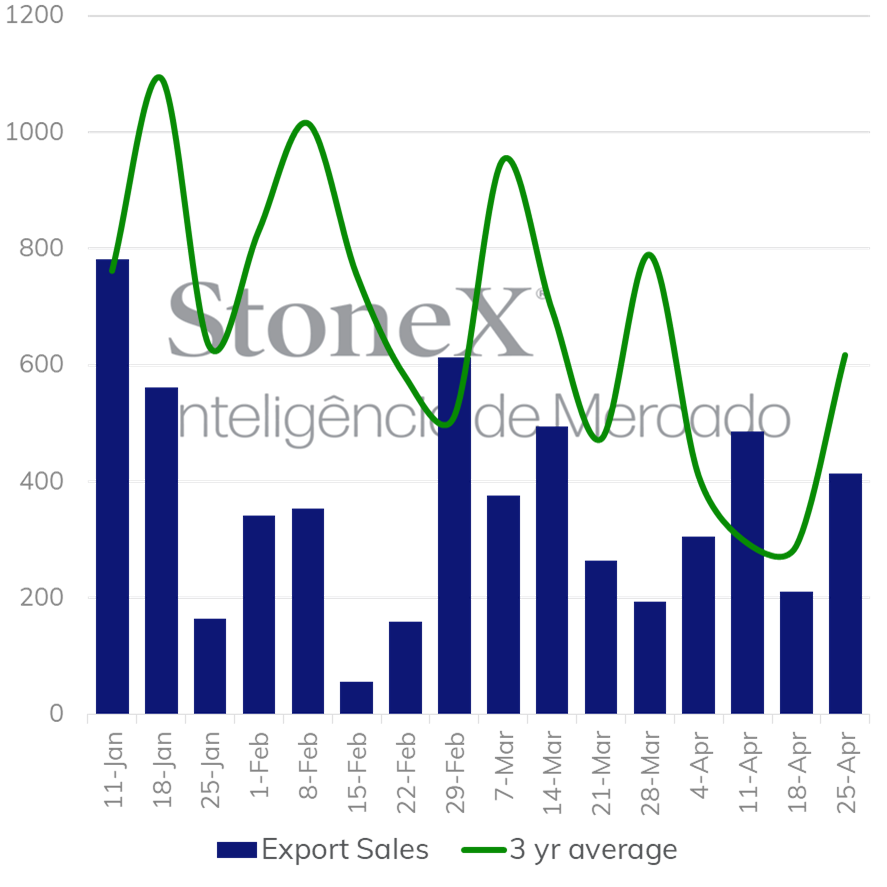
On the demand side, the slower pace of sales and shipments from the US continues to weigh on quotes. In the week ending on 04/25, 250.3 thousand tonnes of soybeans were inspected for shipment, a lower volume than the previous week and than the one recorded in the same period last year. In total, 38.75 million tonnes of soybeans from the 23/24 crop have been inspected, a figure that indicates that the USDA may still be overestimating exports for the cycle by 46.3 million tonnes, even with the small cut made in the April report and a number 14.7% lower than that of the 22/23 cycle.
Export sales of the 23/24 crop reached 414 thousand tonnes in the week ending on 04/25, a volume within the market's estimated range of 100 to 700 thousand tonnes. In the accumulated, 46.3 million tonnes were traded, representing a delay versus only 850 thousand tonnes required. In this way, it is necessary to keep up with the pace of shipments to assess whether this volume will be exported or if there will be cancellations and/or rollovers for the next crop.
From the middle to the end of the week, concerns about the impact of weather on the crops in Brazil and the US opened up space for the funds to shortcover.
In the US, the beginning of planting was more advanced, reaching 18% on Sunday, 04/28, above the same week of last year, when it was at 16%, and above the 5-year average for the period, at 10%. Nonetheless, the rain forecasts for the country in the coming weeks have brought banter about possible delays. However, for soybeans, it is not so concerning due to the slightly later window compared to corn and the accelerated pace at the beginning of the cycle. Even so, anything that threatens the US crop has the potential to move the quotes.
In Brazil, concerns are now related to the soybean crop in Rio Grande do Sul after the torrential rains that affected the state between late April and early May, bringing destruction and human losses.
It is not yet possible to assess the impacts on soybean crops, but the southern half of the state, which harvests later, may suffer losses since there are flooded regions. This southern half, whose crops have not yet been harvested, would represent up to 20% of the state's total crop. It is also necessary to consider the impacts on quality, as even without crop failure, the grains may reduce in quality, a situation that also applies to what has already been harvested and stored in structures that have been flooded. Nonetheless, even if there is a loss of quality, with this soybean not qualifying, for example, for export, it is not possible to say that it would be an irreversible loss, as it can still be used, depending on the conditions, but with price discounts.
So, at this moment, it is not possible to estimate with confidence the size of the losses in the crops versus what has already been harvested. On the other hand, logistics costs are likely to increase, even though alternative routes to transport the grains to the port and consumption regions exist, as highways and railways have been severely affected.
This week, the situation in Rio Grande do Sul should continue to be monitored, as well as the progress of the American crop and the release of the USDA's supply and demand report (WASDE), which will be released on Friday (10), bringing the first figures for the global crop 24/25.