- World production estimated above consumption in 2023/24, according to USDA;
- US harvest progress;
- StoneX estimates a new record crop for Brazil in 2023/24;
- El Niño can favor crop production in South America;
- Weak accumulated export sales from the US.
- Chinese imports could surpass current estimates;
- Heated American domestic consumption;
- Productivity and production cuts in the US crop.
- Argentina may run out of soybeans for crushing in the coming weeks;
- Irregular rains in some Brazilian producing areas.
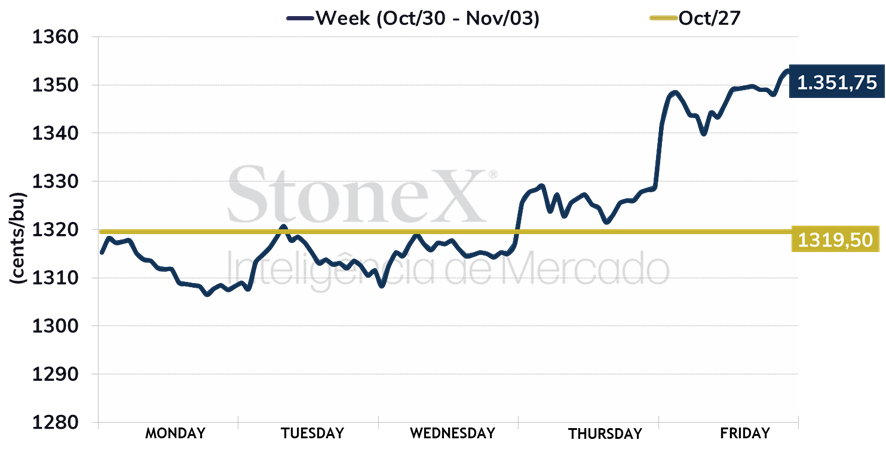
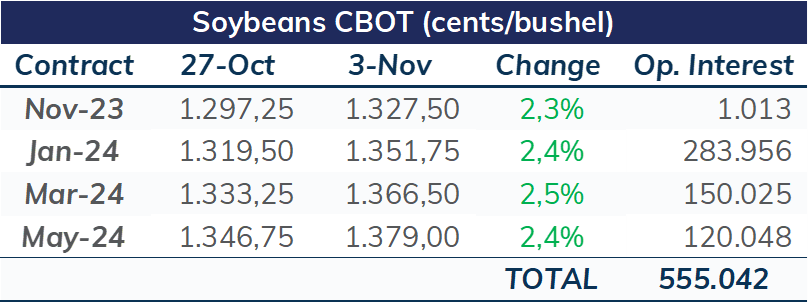
The soybean quotes in Chicago oscillated at the beginning of the week, gaining strength in the last trading sessions of the period and closing the fourth consecutive week with gains. The January contract ended Friday's session (03) at 1351.75 cents per bushel, an increase of 2.4%.
Although the progress of the harvest in the US continues to be a period of pressure on prices, the soybean meal market, amid concerns about the Argentine supply, moved prices. Furthermore, concerns about crushing in Argentina and climate issues, as well as increased optimism regarding Chinese imports of American soybeans, were support factors.
Until Sunday (29), 85% of the soybean crops in the US had already been harvested, slightly below what the market expected, with a weekly progress of 9 p.p. This result was below the 87% recorded in the same period last year but exceeded the five-year average of 78%. The increase in soybean availability during the harvest season tends to weigh on prices. Still, in this cycle, with estimates pointing to a tighter balance in the US, consumption trends are closely monitored.
In the North American market, the prospects for renewable diesel and, consequently, for crushing remain positive. At the same time, export data is closely monitored, with the USDA estimating that shipments in the 2023/24 crop year will decrease compared to the previous year and with export sales also being delayed.
Last week, comments from some grain companies in China, indicating that the country's imports could be higher than the volume estimated by the USDA for the 2023/24 cycle, at 99 million tonnes, cheered the markets, as they could strengthen US exports in this fourth quarter of 2023 since seasonally this is the best shipping period for the country. It was mentioned that imports from China could exceed USDA's estimate by 4 million tonnes.
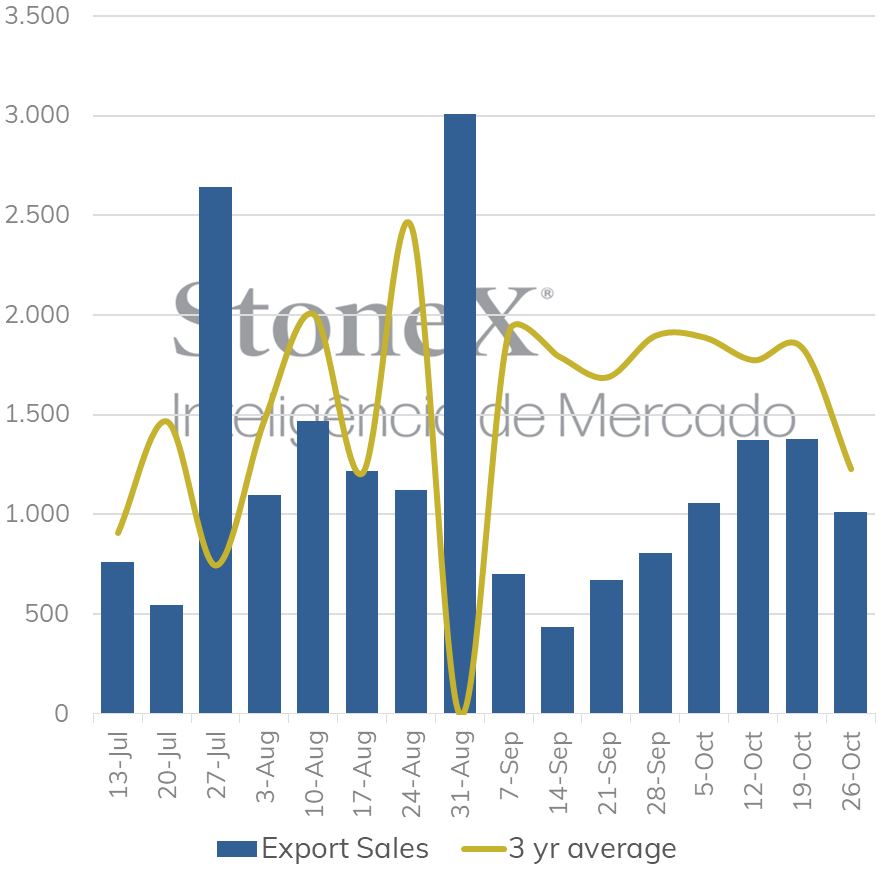
However, for now, the US export sales data does not reflect these rumors. In the week ended on 10/26, the soybeans sales for the 2023/24 crop reached just over 1 million tonnes, bringing the total to 23.3 million tonnes compared to 32.2 million tonnes last year, with the export estimate being 6.45 million tonnes lower than the achieved in the 2022/23 cycle.
On the other hand, the shipments are more heated, but it is still very early, and important changes can happen. In the same week, 1.9 million tonnes of American soybeans were inspected for shipments, below the same week last year. Still, it brought the accumulated in 2023/24 to 10.2 million, slightly above the volume in 2022, when it reached 9.9 million tonnes.
Regarding the crushing in Argentina, concerns about the lack of soybeans until the end of November continue, remembering that the country concentrates its exports on soybean meal and oil and not on grain. As the crop failure was very significant in the 2023/24 cycle, around 60%, even with more active imports, there is a risk of a shortage of soybeans for processing. With that, the soybean meal market posted strong increases and corrections, which also moved soybean prices.
The soybean planting starts later in Argentina, and consequently, the availability of the grain next year only increases between March and April, which reinforces concerns about crushing until then. For the 2023/24 crop, expectations are for productivity recovery and an increase in planted area, with the Buenos Aires Grains Exchange estimating 17.1 million hectares. The planting is just beginning, starting mainly in the north of the Córdoba Province and in the northwest of Buenos Aires.
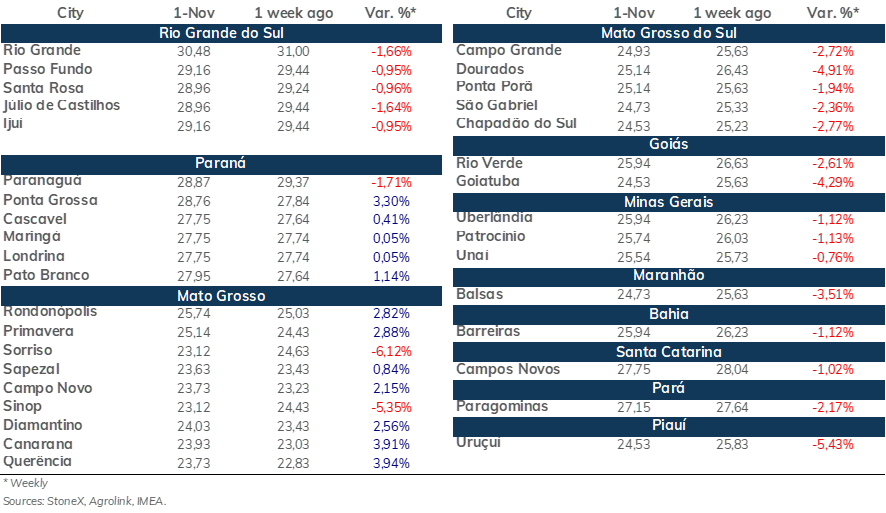
In Brazil, the weather remains on the radar amidst the irregularities of the rains. In Mato Grosso, the weekend was marked by good rainfall in several regions, including the northernmost areas. In the next ten days, there is precipitation forecast in a large part of the soybean-producing region, but the volumes may still be light in the central area of Brazil. With that, the planting will continue to be closely monitored, highlighting the delays. As of last Friday (03), 50.7% of the projected national soybean area for the 2023/24 cycle had been sown, according to StoneX, compared to 59.5% in the same week last year.
The second week of November brings important releases for the soybean market, emphasizing the Conab Crop Survey and the USDA WASDE report, both the next Thursday (09). The November WASDE report usually does not bring major surprises, but its release is always highly anticipated.