

FX Weekly Overview (Brazil Issue)
Dollar to reflect US economic data, Central Bank minutes, inflation in Brazil, and the Middle East

Leonel Mattos
- Currencies
By: John Kicklighter, Head of Market Research
The markets are coming out of the holiday period of hibernation with speculative benchmarks like the S&P 500 close to their record highs. What do seasonal norms suggest for the opening of a new year and what fundamental focus will the market latch onto first?
Talking Points:
The opening trading session of the 2026 did not offer much clarity around any renewed convictions towards risk appetite or influence from any of the major themes of the past year. As far as potential, the lack of liquidity following the full drain of the global New Years day market closure would leave Friday’s session reasonably tepid. However, looking out over the coming week, we will wade back into deeper waters with market participants’ looking to establish their strategies for the new year. Referring to historical norms of the seasonal transition, the first week of the calendar year for risk appetite (using the S&P 500 as the benchmark) averages one of the strongest advances of the 52-week period with volume and volatility typically very low.
Historical Average S&P 500 Change and Volume by Calendar Week 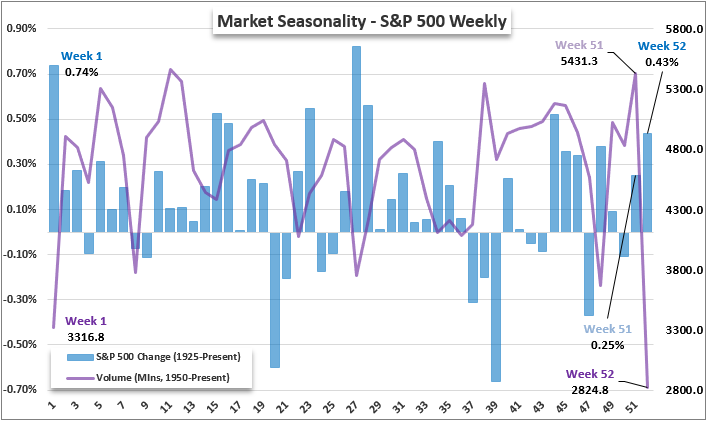
Source: John Kicklighter, Standard & Poor’s
What day the first week of the year begins on can vary, so there is some variability to that average. Looking more specifically at the first full week of January from the past 20 years, there is some notable variability of change, but the previous six years have held the week’s change within a 2 percent absolute move. The full range over the period was also notably restrained. There is also a popular quantitative norm to associate the opening week of the year to the overall performance of the full year. While there are a few years where that particularly stands out – such as the deep bear market of 2008 or the more measured retreat in 2022 – the typical orientation of the US equity market to rise over the long-term creates a misleading association.
Performance by S&P 500 on First Full Week of Year and Full Year 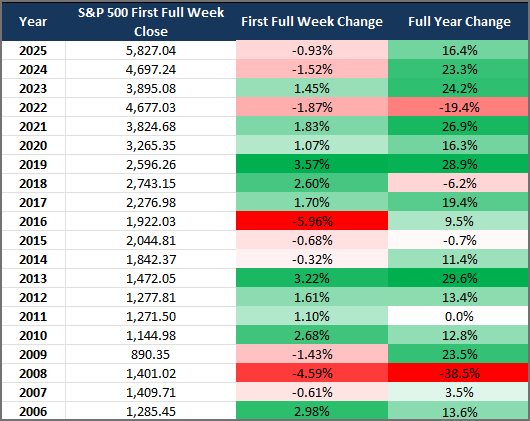
Source: John Kicklighter, Standard & Poor’s
Bringing the focus back to the immediate future, risk exposure ended this past year stretched by measures of speculative concentration, professional-vs-retail balance, open interest and basic levels of prevailing price. That doesn’t mean that markets have to reverse course just because of an arbitrary date shift, but the liquidity dip may spur a broader evaluation of circumstance. Should collective sentiment be forced to lead the way, it is more likely to be a slow evolution with the lingering threat of sudden and intense bouts of risk aversion – as fear is more contagious than greed. More productive would be an attachment to a larger structural fundamental theme that can steer across geographical and asset typal lines. Interest around growth, interest rate policy, deficit expansion and trade policy still linger; but there is not clear traction at present. A return to focus on AI as a transformative factor is unpredictable and the United States extradition of Venezuelan President Nicolas Maduro over the weekend could trigger another geopolitical charge. Time, volume and price movement will tell.
Top Global Theme Searches in Google Trends 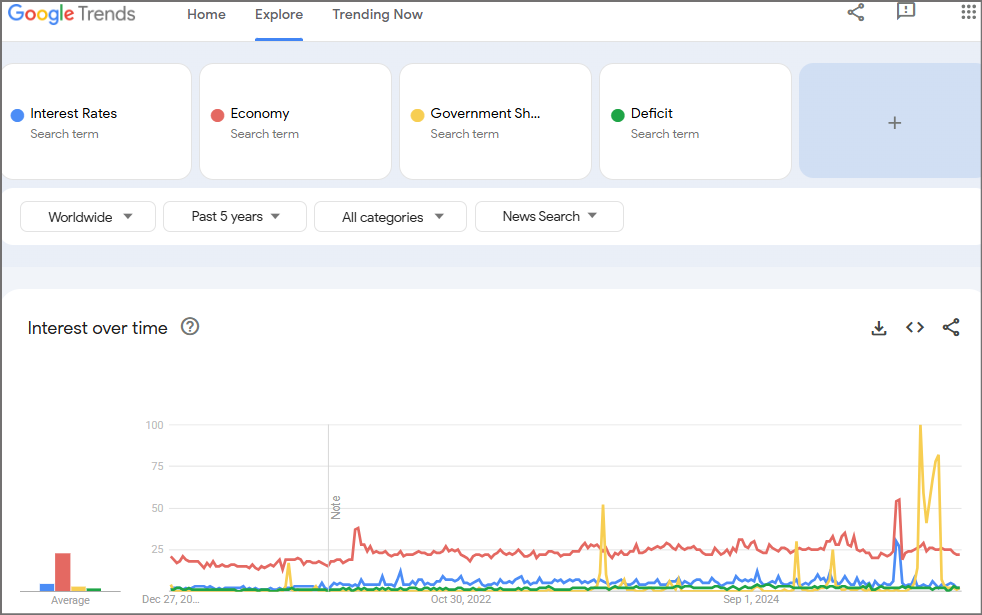
Source: John Kicklighter, Google Trends
The pull of fundamental themes waned in the closing months of 2025 and there presently doesn’t seem a clear road to the reconstitution for the most prominent drivers of the past year – including rates speculation, trade barriers, deficit side effects, economic potential debates or even AI revolution hopes. It is possible that these matters can explode in the global market’s common discussion out of the blue, but it is more likely that attention will be set through definitive events, whether scheduled or otherwise. More events like the extradition of Venezuela’s president are possible, and argue the close monitoring of the financial headlines; but the more reliable source is top shelf event risk. There is a meaningful amount over the coming week with the capacity to tap multiple themes; but the greatest concentration seems to be focused on the United States’ economic health and monetary policy outlook.
Calendar of Top Global Macro Event Risk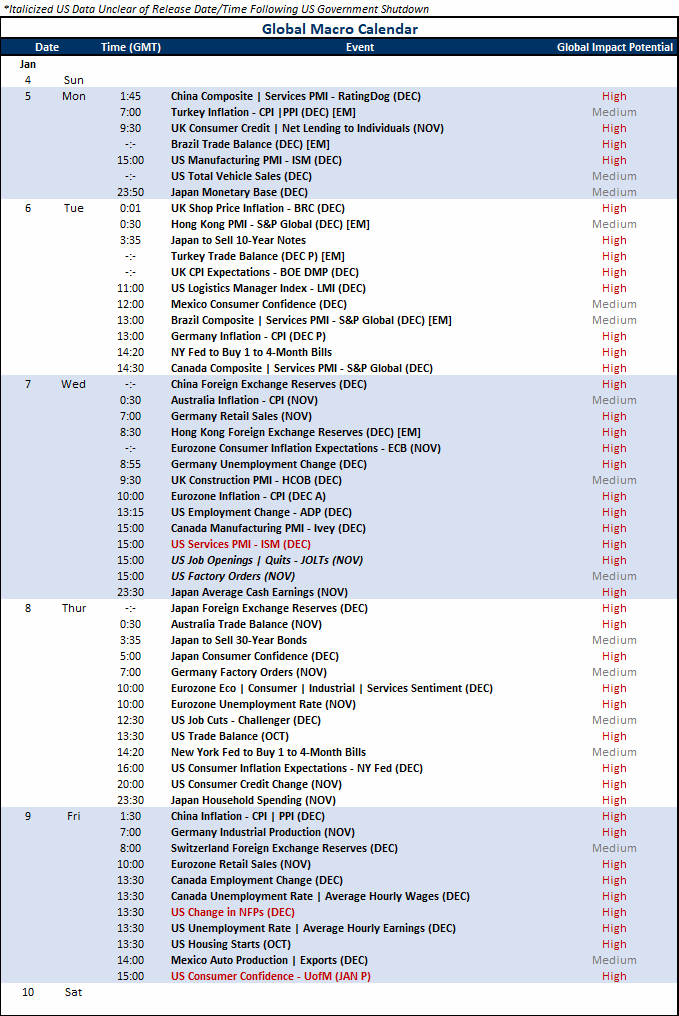
Source: John Kicklighter
To start things off in the top data run this week, we have the release of the ISM’s manufacturing activity survey for December. Factory activity in the US has struggled for months with the employment measure in contraction for much of the past two years. This is not a favorable reflection on the results of tariffs aimed, in part, at bringing such activity back to the United States; but its reflection of the broader economy is ultimately more important. In that context, the service sector activity report for the same period due Wednesday carries far more clout.
The country is far more dependent on services when it comes to economic output and employment – accounting for more than three-quarters of both nationally. The overall ISM activity measure has held to positive growth though its employment component continued to contract (below 50) through November. If this segment of the world’s largest economy were to lose traction, the wider economy would be more at risk of succumbing to the long-threatened and avoided recession.
Chart of ISM’s Manufacturing and Services Activity Overlaid with SPX (Monthly)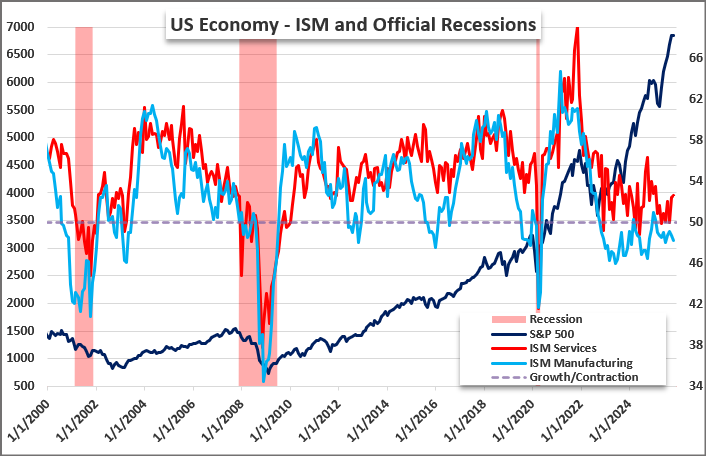
Source: John Kicklighter; ISM; Standard & Poor’s
On Friday, the insight for the US economy and monetary policy course will be dealt a double hand. First up in the morning before the US open, we are due the Bureau of Labor Statistics’ employment report. After months of delay, a dropped month’s data and non-Friday releases; we are finally due nonfarm payrolls for the right month and on the traditional ‘NFPs Friday’. The consensus forecast for last month’s net payrolls change is for a modest 45,000 jobs added to the economy following on the November’s net 64,000 increase.
It is worth noting that while the October release was dropped, there is a number in the books for -105,000 net jobs lost – the biggest decline in five years. Between pre-existing concerns about the data’s accuracy with big revisions along with the effects of the government shutdown, this data will be under intense scrutiny for its accuracy. That can either soften the impact of the data or intensify an unfavorable interpretation. Either way, expect the Fed to be watching closely as this is the component of its dual mandate that makes the case for further rate cuts moving forward.
Chart of US Change in Nonfarm Payrolls and Historical Revisions (Monthly)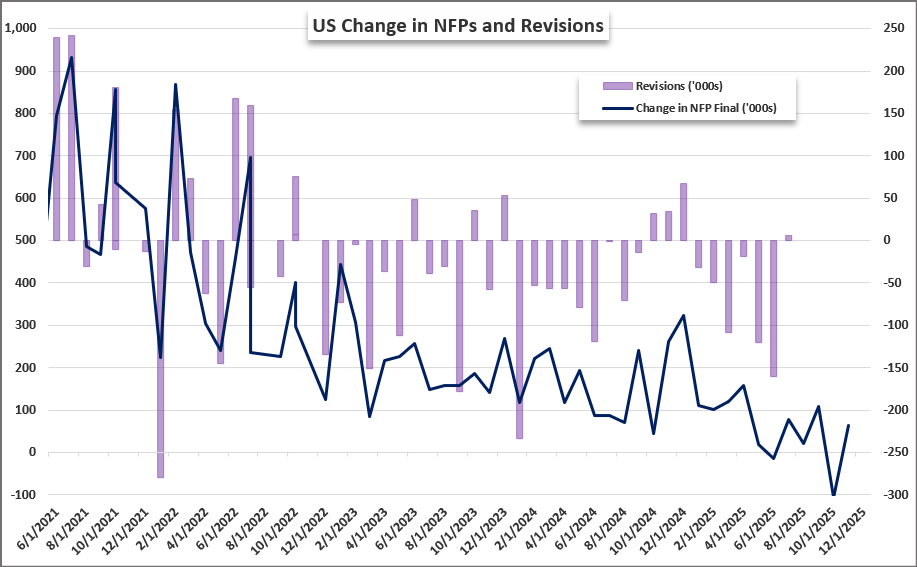
Source: John Kicklighter; Bureau of Labor Statistics
The other Friday release with serious weight is the 15:00 GMT release of the University of Michigan’s leading January consumer confidence survey. Amid all the debates over the accuracy of official data reports, the interpretation made by authorities like the Fed and numbing effect of revisions; there is a fog of complacency that can follow otherwise high profile event risk. Sentiment surveys like those from the UofM, however, are not as open for debate.
Telling the US consumer – the largest source of growth for the largest economy in the world – that they are anything other than what they reflect in these measures will not alter the outcomes attached to their plans for spending. There was a rebound in the previous month’s update from the near-series (back over 70 years) record low. If that recover falls apart, the current conditions plummet to an actual record low will carry more weight. It is possible that these dire warnings continue to receive speculative discount in attention, but the risk that the market takes it seriously are acute at these levels.
Chart of US Consumer Confidence and Official US Recessions (Monthly) 
Source: TradingView; University of Michigan, NBER; John Kicklighter
-- Written by John Kicklighter, Global Head of Content
© 2025 StoneX Group Inc. all rights reserved.
The subsidiaries of StoneX Group Inc. provide financial products and services, including, but not limited to, physical commodities, securities, clearing, global payments, risk management, asset management, foreign exchange, and exchange-traded and over-the-counter derivatives. These financial products and services are offered in accordance with the applicable laws in the jurisdictions in which they are provided and are subject to specific terms, conditions, and restrictions contained in the terms of business applicable to each such offering. Not all products and services are available in all countries. The products and services offered by the StoneX
Group of companies involve risk of loss and may not be suitable for all investors. Full Disclaimer.
This content is not intended for residents of any particular country, and the information herein is not advice nor a recommendation to trade nor does it constitute an offer or solicitation to buy or sell any financial product or service, by any person or entity in any jurisdiction or country where such distribution or use would be contrary to local law or regulation. Please refer to the Regulatory Disclosure section for entity-specific disclosures.
No part of this material may be copied, photocopied or duplicated in any form by any means or redistributed without the prior written consent of StoneX Group Inc. The information herein is provided for informational purposes only. This information is provided on an ‘as-is’ basis and may contain statements and opinions of the StoneX Group of companies as well as excerpts and/or information from public sources and third parties and no warranty, whether express or implied, is given as to its completeness or accuracy. Each company within the StoneX Group of companies (on its own behalf and on behalf of its directors, employees and agents) disclaims any and all liability as well as any third-party claim that may arise from the accuracy and/or completeness of the information detailed herein, as well as the use of or reliance on this information by the recipient, any member of its group or any third party.
The subsidiaries of StoneX Group Inc. provide financial products and services, including, but not limited to, physical commodities, securities, clearing, global payments, risk management, asset management, foreign exchange, and exchange-traded and over-the-counter derivatives. These financial products and services are offered in accordance with the applicable laws in the jurisdictions in which they are provided and are subject to specific terms, conditions, and restrictions contained in the terms of business applicable to each such offering. Not all products and services are available in all countries. The products and services offered by the StoneX Group of companies involve risk of loss and may not be suitable for all investors. Full Disclaimer. This content is not intended for residents of any particular country, and the information herein is not advice nor a recommendation to trade nor does it constitute an offer or solicitation to buy or sell any financial product or service, by any person or entity in any jurisdiction or country where such distribution or use would be contrary to local law or regulation. Please refer to the Regulatory Disclosure section for entity-specific disclosures. No part of this material may be copied, photocopied or duplicated in any form by any means or redistributed without the prior written consent of StoneX Group Inc. The information herein is provided for informational purposes only. This information is provided on an ‘as-is’ basis and may contain statements and opinions of the StoneX Group of companies as well as excerpts and/or information from public sources and third parties and no warranty, whether express or implied, is given as to its completeness or accuracy. Each company within the StoneX Group of companies (on its own behalf and on behalf of its directors, employees and agents) disclaims any and all liability as well as any third-party claim that may arise from the accuracy and/or completeness of the information detailed herein, as well as the use of or reliance on this information by the recipient, any member of its group or any third party.
© 2026 StoneX Group Inc. all rights reserved.
Our subscribers have access to comprehensive market analysis from StoneX spanning commodities, equities, currencies and more.
Dollar to reflect US economic data, Central Bank minutes, inflation in Brazil, and the Middle East

US indices have led sentiment to fresh highs this past week even as the fundamental backdrop struggles to present a solid foothold. Will thin liquidity aid or hamper the swell and what does the event risk ahead propose?


A softer run of U.S. data is doing more to move the U.S. dollar than any chart, with a jobs report and an inflation print set to land back to back. A cooler U.S. CPI report would hand the Federal Reserve room to ease, and that prospect is already loosening the dollar's grip.

Our market expertise, advanced platforms, global reach, culture of full transparency and commitment to our clients’ success all set us apart in the financial marketplace.
Reach
With access to 40+ derivatives exchanges, 180+ foreign exchange markets, nearly every global securities marketplace and numerous bi-lateral liquidity venues, StoneX’s digital network and deep relationships can take clients anywhere they want to go.
Transparency
As a publicly traded company meeting the highest standards of regulatory compliance in the markets we serve, our financials and record of accomplishment are matters of public record. StoneX’s commitment to “doing the right thing over the easy thing” sets us apart in the industry and helps us build respect, client trust and new partnerships.
Expertise
From our proprietary Market Intelligence platform, to “boots on the ground” expertise from award-winning traders and professionals, we connect our clients directly to actionable insights they can use to make more informed decisions and achieve their goals in the global markets.