

FX Weekly Overview (Brazil Issue)
Dollar to reflect US economic data, Central Bank minutes, inflation in Brazil, and the Middle East

Leonel Mattos
- Currencies
By: John Kicklighter, Head of Market Research
We are closing out 2025 with a ‘risk appetite’ drive in comfortable control – despite a myriad of fundamental concerns amongst market participants. What should we expect from conditions in the transition into 2026 and what fundamental themes should we expect to pick up the torch?
Talking Points:
We are fully in the throes of the seasonal distortions in the financial markets. In the last full week of trade for the calendar year – the third week of December – the economic docket offered up a few top shelf and systemically relevant updates to help shake off the downshift in momentum and volatility that kicked in around the United States’ Thanksgiving holiday. Yet, they would fall short of overriding the throttling influence of complacency with risk assets drifting near record highs. History suggests that the conditions that we can expect over the coming few weeks will very likely reinforce the quiet that we have experienced.
Using the S&P 500 as a speculative and sentiment benchmark, the 52nd week of the year is defined by the lowest volume of any other stretch and the 1st week of the year carries the second lowest turnover. Volatility-wise (referencing the VIX), activity bottoms before taking a turn into Winter recovery that peaks around the 12th week. In terms of performance, the index has averaged gains through this stretch with a smaller distribution of performances – as meaningful losses are significantly less frequent.
Historical Average S&P 500 Change and Volume by Calendar Week 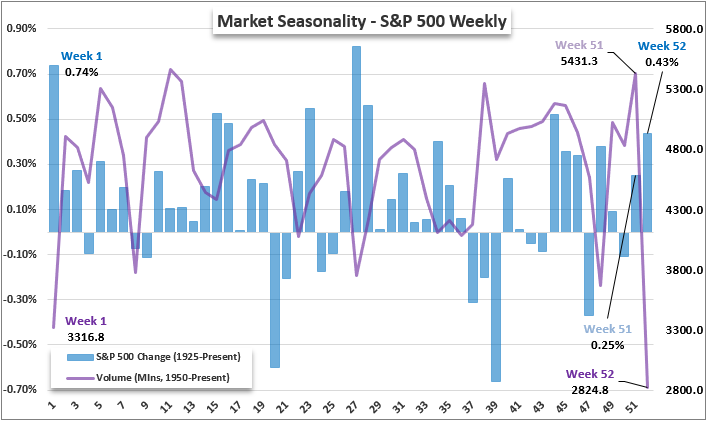
Source: John Kicklighter, Standard & Poor’s
Looking back over just the past 10 years, Christmas week has averaged exceptionally small moves in absolute terms – though there were very modest declines in some years week-over-week. The exception was 2018 when the S&P 500 registered an impressive 2.8 percent rally over the holiday week, but that can be a development attributed to the preceding three weeks more than 12 percent tumble. Moderation relative to such a tempo carried a bigger rebound.
A word of caution is necessary when we look to these norms and assume complacency is predictable. With thin liquidity conditions, strong jolts to sentiment can generate sharper moves as there is less of a market to absorb the repositioning that can occur in that environment. And, given fear is the stronger and more unifying motivator compared to ‘greed’ (the other end of the sentiment spectrum); strong bearish developments carry the higher probability of these outlier scenarios.
S&P 500 Index with 12-Week Historical Range Percentage and ATR Volatility (Weekly) 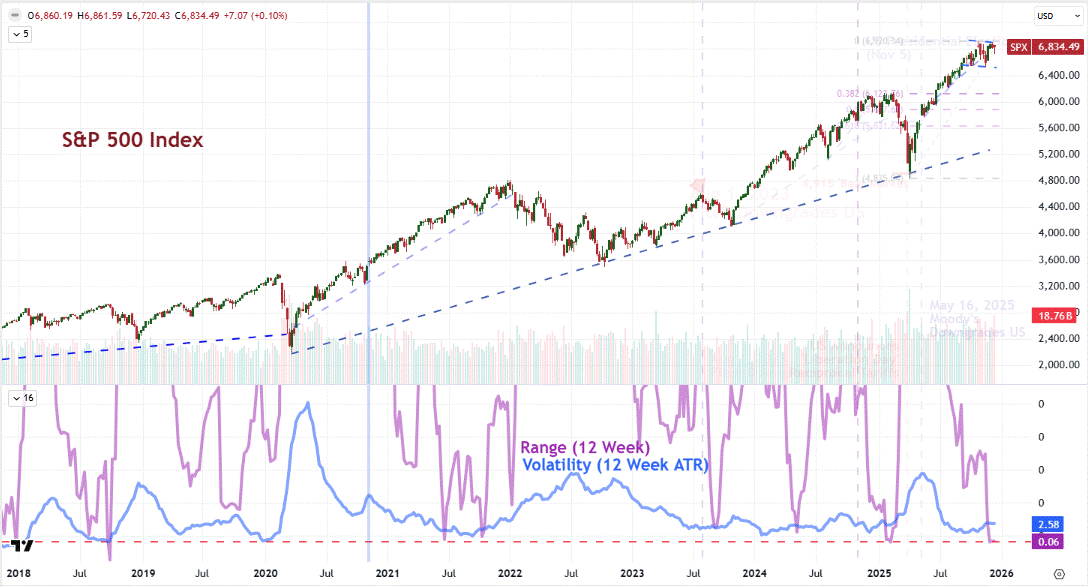
Source: John Kicklighter, TradingView.com, Standard & Poor’s
Looking a little further out into the distance, the opening weeks of the new year typically see a rebound in volatility and quick normalization of volume as markets get back to the activity of deploying capital effectively. The month of January averages a meaningful bullish advance over the past 75 years; but in the past 20 years, it moderates to virtually no change. Given that we are coming out of a period of potentially five or six weeks of tepid activity, it could prove a slow start without a clear fundamental charge to take up the banner of market interests. It is also possible that the moderating tempo after a strong bull trend in the recovery move of April through December, could offer a foothold for exhaustion similar to the open of 2018, 2020 and 2022.
Historical Average S&P 500 Change and Volume by Calendar Month 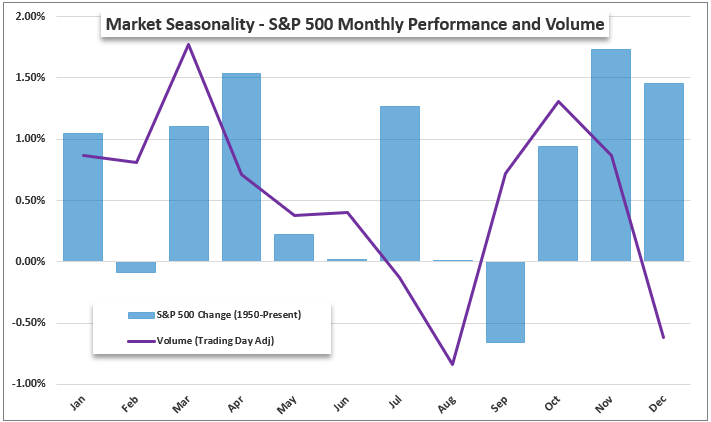
Source: John Kicklighter, Standard & Poor’s
Over the next few weeks, through the twin holiday drains of Christmas and New Years, there is a smattering of event risk that will factor into the assessment of longer term fundament trends. However, there is nothing that stands out prominently enough as a lurking catalyst for volatility that can override the low liquidity status we are facing. That said, it is worth shifting our focus out to the start of the new year to see what events and themes could potentially shake loose the cobwebs and either restore the climb from the likes of the S&P 500 or otherwise tip confidence into an overdue correction.
Calendar of Top Global Macro Event Risk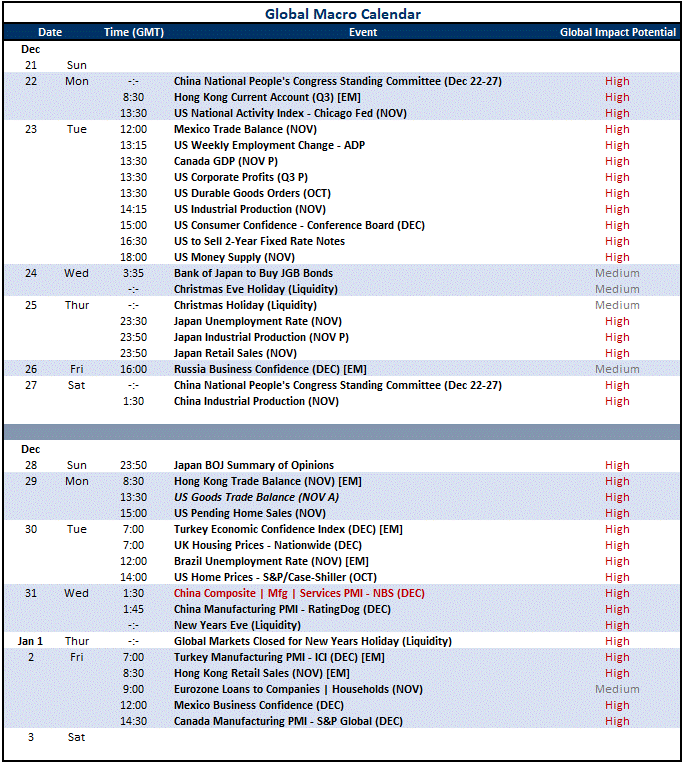
Source: John Kicklighter
Remarkable through the end of this past year was the lack of market moving influence drawn through monetary policy. The Bank of England cut its benchmark rate, the European Central Bank suggested its easing phase was done, the Bank of Japan hiked rates as a major outlier while the Federal Reserve gave a very controversial mixed bag (rate cut, restart of QE and suggestion of only one further reduction in 2026). Broadly speaking, it seems that the average for the developed world is for the easing cycle to essentially have come to its end.
For capital markets, that would mean less accommodation moving forward and more recognition around the standing of speculative assets based on other fundamental footings - which are less than inspiring. The central bank calendar nearly empty for most of the year (eg the FOMC on January 28th and BOJ on the 23rd), but this theme will be stirred by speculative interests and fresh readings of data like nonfarm payrolls and the consumer price index (CPI), which are expected to normalize for the US after the distortion from the government shutdown.
Chart of Relative Monetary Policy Standing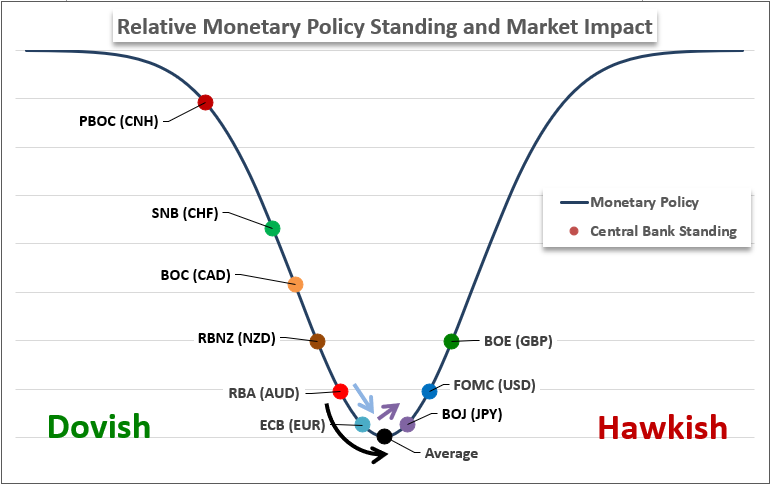
Source: John Kicklighter
In the absence of monetary provocation and questions over the veracity of data, the focus remains on the sentiment of engines of economic activity and financial stability. We can reflect on the perceptions of governments, businesses or even supranational groups (like the IMF’s January WEO update); but the consumer is arguably the most important read for us to take in. Further, the US consumer is singularly one of the largest contributors to expansion on the planet. That said, the Conference Board’s consumer sentiment report is due this coming week. Yet, the University of Michigan’s reading will draw more attention owing to its proximity to its series’ low and earlier release with January’s preliminary reading due during ‘normal’ liquidity conditions on January 9th.
Chart of US Consumer Confidence and Official US Recessions (Monthly)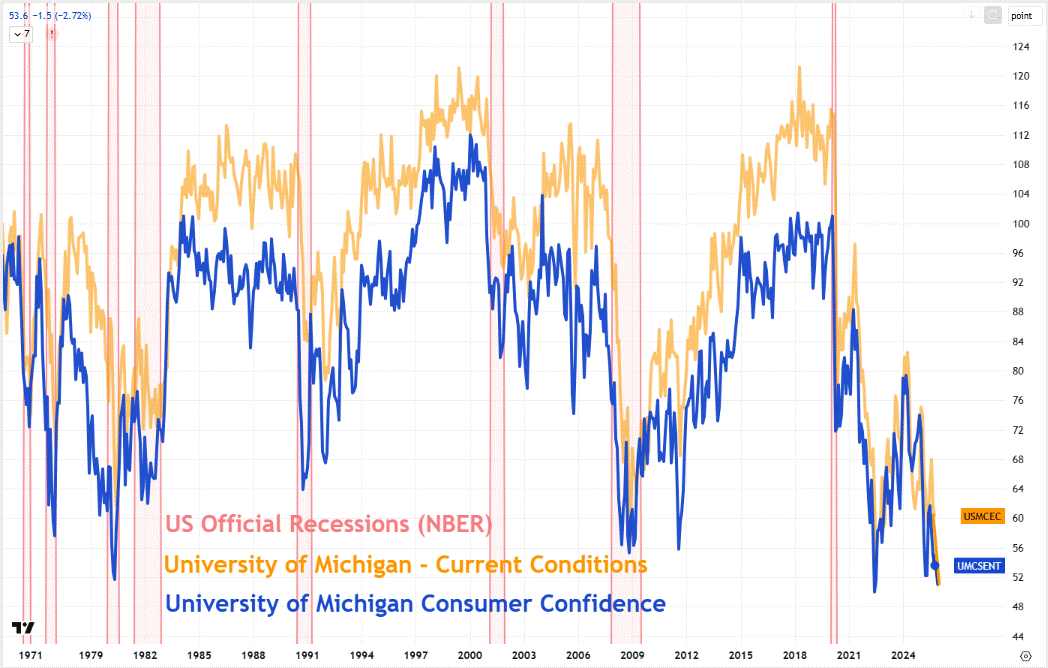
Source: TradingView; University of Michigan, NBER; John Kicklighter
Finally, more of an outlier risk to track – and again, in the US sphere of influence – is the possibility of another budget cliff come the end of January. The continuing resolution that reopened the US federal government funded activity through January 30th. From there, if a full appropriations is not approved by that point or another temporary CR struck, the largest country in the world may face a budget cliff and shutdown. With the contentious ACA subsidies due to expire on December 31st and higher health care costs set for a large swath of Americans, the pressure of action from Washington will escalate materially.
At present, betting markets put the probability of another US government shutdown at 30 percent, but the risk is acute relative to the still-moderate chance. The shutdown from October 1st to November 12th seemed to render modest fallout for the markets outside the Dollar’s struggles, but that is likely to change if the country falls into technical arrears and throttles spending of federal workers once again.
Probability of US Government Shutdown Jan 31st in Betting Markets 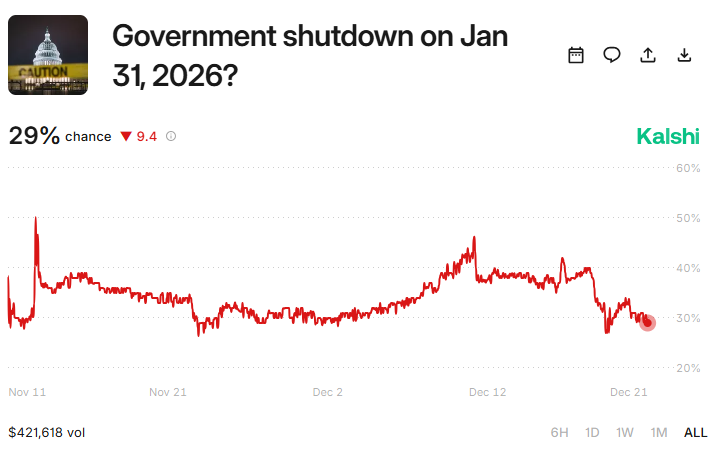
Source: Kalshi.com
-- Written by John Kicklighter, Global Head of Content
© 2025 StoneX Group Inc. all rights reserved.
The subsidiaries of StoneX Group Inc. provide financial products and services, including, but not limited to, physical commodities, securities, clearing, global payments, risk management, asset management, foreign exchange, and exchange-traded and over-the-counter derivatives. These financial products and services are offered in accordance with the applicable laws in the jurisdictions in which they are provided and are subject to specific terms, conditions, and restrictions contained in the terms of business applicable to each such offering. Not all products and services are available in all countries. The products and services offered by the StoneX
Group of companies involve risk of loss and may not be suitable for all investors. Full Disclaimer.
This content is not intended for residents of any particular country, and the information herein is not advice nor a recommendation to trade nor does it constitute an offer or solicitation to buy or sell any financial product or service, by any person or entity in any jurisdiction or country where such distribution or use would be contrary to local law or regulation. Please refer to the Regulatory Disclosure section for entity-specific disclosures.
No part of this material may be copied, photocopied or duplicated in any form by any means or redistributed without the prior written consent of StoneX Group Inc. The information herein is provided for informational purposes only. This information is provided on an ‘as-is’ basis and may contain statements and opinions of the StoneX Group of companies as well as excerpts and/or information from public sources and third parties and no warranty, whether express or implied, is given as to its completeness or accuracy. Each company within the StoneX Group of companies (on its own behalf and on behalf of its directors, employees and agents) disclaims any and all liability as well as any third-party claim that may arise from the accuracy and/or completeness of the information detailed herein, as well as the use of or reliance on this information by the recipient, any member of its group or any third party.
The subsidiaries of StoneX Group Inc. provide financial products and services, including, but not limited to, physical commodities, securities, clearing, global payments, risk management, asset management, foreign exchange, and exchange-traded and over-the-counter derivatives. These financial products and services are offered in accordance with the applicable laws in the jurisdictions in which they are provided and are subject to specific terms, conditions, and restrictions contained in the terms of business applicable to each such offering. Not all products and services are available in all countries. The products and services offered by the StoneX Group of companies involve risk of loss and may not be suitable for all investors. Full Disclaimer. This content is not intended for residents of any particular country, and the information herein is not advice nor a recommendation to trade nor does it constitute an offer or solicitation to buy or sell any financial product or service, by any person or entity in any jurisdiction or country where such distribution or use would be contrary to local law or regulation. Please refer to the Regulatory Disclosure section for entity-specific disclosures. No part of this material may be copied, photocopied or duplicated in any form by any means or redistributed without the prior written consent of StoneX Group Inc. The information herein is provided for informational purposes only. This information is provided on an ‘as-is’ basis and may contain statements and opinions of the StoneX Group of companies as well as excerpts and/or information from public sources and third parties and no warranty, whether express or implied, is given as to its completeness or accuracy. Each company within the StoneX Group of companies (on its own behalf and on behalf of its directors, employees and agents) disclaims any and all liability as well as any third-party claim that may arise from the accuracy and/or completeness of the information detailed herein, as well as the use of or reliance on this information by the recipient, any member of its group or any third party.
© 2026 StoneX Group Inc. all rights reserved.
Our subscribers have access to comprehensive market analysis from StoneX spanning commodities, equities, currencies and more.
Dollar to reflect US economic data, Central Bank minutes, inflation in Brazil, and the Middle East

US indices have led sentiment to fresh highs this past week even as the fundamental backdrop struggles to present a solid foothold. Will thin liquidity aid or hamper the swell and what does the event risk ahead propose?


A softer run of U.S. data is doing more to move the U.S. dollar than any chart, with a jobs report and an inflation print set to land back to back. A cooler U.S. CPI report would hand the Federal Reserve room to ease, and that prospect is already loosening the dollar's grip.

Our market expertise, advanced platforms, global reach, culture of full transparency and commitment to our clients’ success all set us apart in the financial marketplace.
Reach
With access to 40+ derivatives exchanges, 180+ foreign exchange markets, nearly every global securities marketplace and numerous bi-lateral liquidity venues, StoneX’s digital network and deep relationships can take clients anywhere they want to go.
Transparency
As a publicly traded company meeting the highest standards of regulatory compliance in the markets we serve, our financials and record of accomplishment are matters of public record. StoneX’s commitment to “doing the right thing over the easy thing” sets us apart in the industry and helps us build respect, client trust and new partnerships.
Expertise
From our proprietary Market Intelligence platform, to “boots on the ground” expertise from award-winning traders and professionals, we connect our clients directly to actionable insights they can use to make more informed decisions and achieve their goals in the global markets.