

Market commentary Currencies- Thought Leadership Team
Banks preparing for the November 2026 deadline must look beyond ISO 20022 output to source data, client channels, automated structuring and exception controls.

Global Author
- Currencies
Quarterly Commodities Outlook is available for free now. Download your report →
By: John Kicklighter, Head of Market Research
Market conditions suggest a benchmark like the S&P 500 is skewed more towards a measured ‘trending’ backdrop, but will event risk change that?
Key Talking Points:
What kind of conditions are we faced with right now? Using the S&P 500 as a ‘risk appetite’ benchmark, the index is at the top of its one-week and one-month trends while the 10-day rate of change is in the top decile of the past year. Recent volume on the index has been healthy despite seasonal expectations of slowing turnover, and open interest on Emini futures is at the lower range of its past 15 year span. VIX is particularly low –supportive of the index climb - while the 10-day ATR remains high at 2.2 percent of spot – which speaks to practical activity. This registers as a measured ‘trend’ backdrop that will draw on event risk like the FOMC rate decision and remain sensitive to systemic upheaval from matters like trade wars.
Table of Relative Market Trend and Volatility Over Different Time Frames

Source: John Kicklighter
From the fundamental backdrop, there doesn’t seem to be a single dominant line of interest for the market-at-large. In the past month, news search density around the theme ‘tariffs’ has dropped from highs that dwarfed economic standards like ‘inflation’, ‘employment’ and ‘GDP’ according to Google Trends. That doesn’t mean that there is no longer risk from jawboning, headlines or full changes to trade policy. However, the diminished awareness may require more definitive developments or some form of momentum to regain control of market’s day-to-day volatility. In the void left by an all-consuming trade war fear, we don’t have a singular focus. Though, there are a few important fundamental themes that seem to carry substantial weight in an adjacent node of interest. An accelerated economic moderation due to the trade uncertainties of late is one concern, sovereign budget erosion, questions over the long-term status of true havens and speculation around central banks’ response to recent hardships are all on the radar.
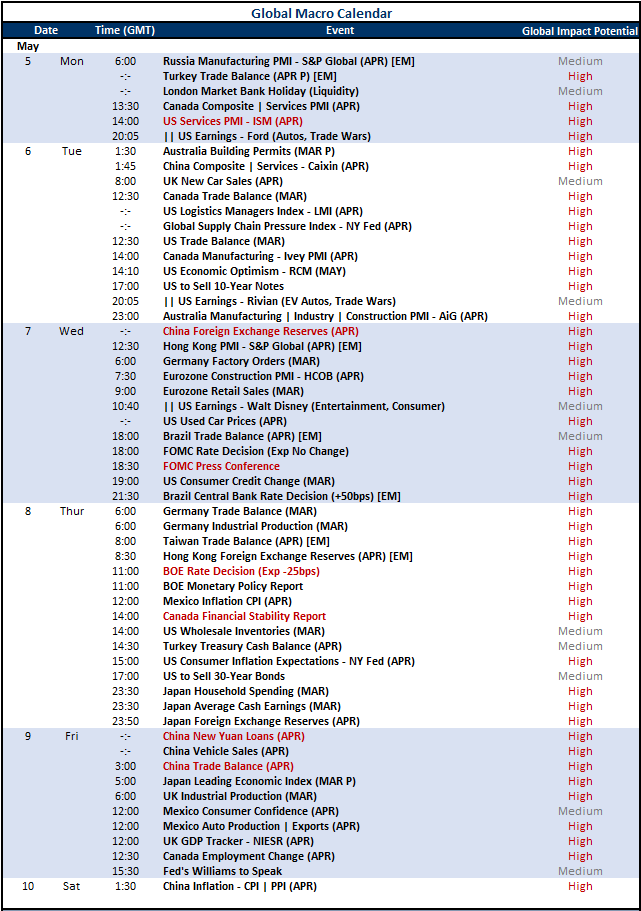
Calendar of Top Global Macro Event Risk
Source: John Kicklighter
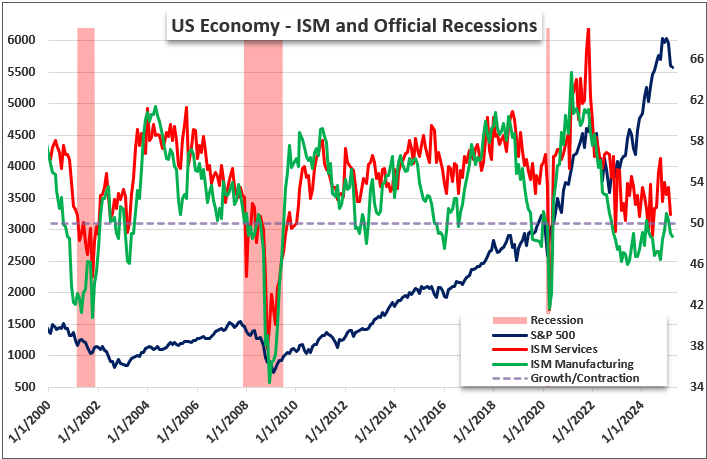
Full CalendarThere is a little something to fuel each of these matters from the global macro docket in the week ahead. However, if we were to assess the most potent listings according to recognition and ability stir their adjacent theme, the first top listing would be the ISM’s US services activity report for April. The manufacturing reading for the same month was released last week and the data was not encouraging. The overall activity measure dropped further (into contractionary territory) while new orders jumped but still below a 50 reading and prices ticked further higher to post-Covid highs three years ago. The factory update was an insight on direct trade considerations but the service sector accounts for approximately 80 percent of economic output and jobs in the United States. In short, it is the backbone of the country’s health. The headline reading is expected to ease modestly (50.8 to 50.6) with new orders seen flipping back to growth, the employment component is expected to edge higher but stay well in contractionary territory and the inflation gauge is actually seen easing. There is some room for this data to ‘impress’ with stronger readings, but the greater impact would come from disappointment.
Chart of S&P 500, ISM Services and Manufacturing Activity (Monthly)
Source: John Kicklighter, ISM
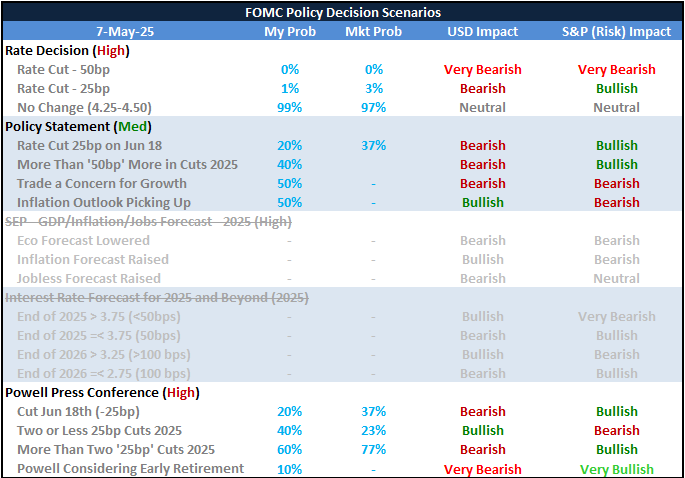
For absolute reach, the top event risk for the week ahead is rate decisions. Only two of the major central banks – the Federal Reserve (Fed) and Bank of England (BOE) – are due to update policy this week, but they will be making consequential announcements. As the largest central authority in the world steering the largest economy, the Fed’s proclamations carry the greatest global weight. No change is expected at this meeting, with Fed Fund futures affording a scant 3 percent chance that there is a 25 bp (basis point) cut in the range to 4.00-4.25 percent. Yet, a hold won’t render this a ‘dead’ event. Given the growing concern around economic activity and President Trump’s very vocal criticism of the group and Chairman Jerome Powell, there will be an elevated level of interest that will urge greater focus around the policy statement and Powell’s press conference half an hour later. The market will attempt to draw out of the commentary and views the probability of a cut in June (June 18th is the next announcement) as well as the full scope of potential adjustment through year end. There will also be a distinct interest in if or how the Chairman will address the pressure the President has heaped on the central bank. Regardless, it is likely that Trump will eventually weigh in central bank if they indeed hold. As for the BOE rate decision, there is actually a change expected. A -25 bp cut is expected to a 4.00 percent benchmark following the February 6th cut, the third in this cycle. The last reduction earned a short-lived FTSE 100 jump and GBPUSD decline, but it didn’t foster any lasting trends.
Table of FOMC Decision Scenarios with Expected Dollar, S&P 500 Market Impact
Source: John Kicklighter
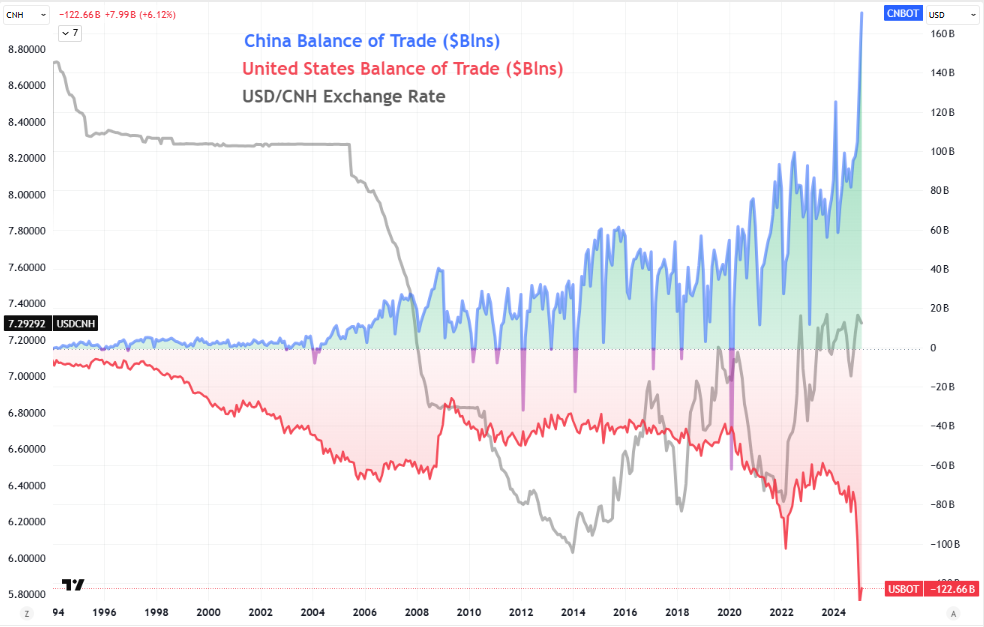
Finally, a theme that is closer to the heart of April’s fundamental focus – trade wars – may find potential fuel from the US and Chinese trade balance figures, on Tuesday and Friday respectively. The advanced March goods trade balance for the United States was released last week with the largest deficit on record (-$162 billion) driven by the front loading of imports ahead of the anticipated tariffs. We will see how solid those numbers are from the broader reading this week – and there remains some question about the extent of disruption owing to the 90-day delayed US tariffs against most trade counterparts, though the ongoing standoff with China will represent a large imbalance between the world’s two largest economies. How significant is the tangible impact to their respective global accounts? The answer to that question matters materially to their perceived growth trajectories as well as their respective inflation outlooks. China’s surplus is expected to further drop from $102.6 billion in March (it hit a record $170.5 billion in February) to a more moderate $70 billion in April.
Chart of USDCNH Exchange Rate with US Trade Deficit and China Trade Surplus (Monthly)
Source: John Kicklighter, TradingView, St Louis Fed Federal Reserve Economic Database
What are the major events and indicators on tap for the global economy that could charge volatility in markets and reshape deeper fundamental themes? Sign up for the updated Global Macro Calendar updated each week with a two week look ahead of the top events!
Sign Up
---- Written by John Kicklighter, Global Head of Content
The subsidiaries of StoneX Group Inc. provide financial products and services, including, but not limited to, physical commodities, securities, clearing, global payments, risk management, asset management, foreign exchange, and exchange-traded and over-the-counter derivatives. These financial products and services are offered in accordance with the applicable laws in the jurisdictions in which they are provided and are subject to specific terms, conditions, and restrictions contained in the terms of business applicable to each such offering. Not all products and services are available in all countries. The products and services offered by the StoneX Group of companies involve risk of loss and may not be suitable for all investors. Full Disclaimer. This content is not intended for residents of any particular country, and the information herein is not advice nor a recommendation to trade nor does it constitute an offer or solicitation to buy or sell any financial product or service, by any person or entity in any jurisdiction or country where such distribution or use would be contrary to local law or regulation. Please refer to the Regulatory Disclosure section for entity-specific disclosures. No part of this material may be copied, photocopied or duplicated in any form by any means or redistributed without the prior written consent of StoneX Group Inc. The information herein is provided for informational purposes only. This information is provided on an ‘as-is’ basis and may contain statements and opinions of the StoneX Group of companies as well as excerpts and/or information from public sources and third parties and no warranty, whether express or implied, is given as to its completeness or accuracy. Each company within the StoneX Group of companies (on its own behalf and on behalf of its directors, employees and agents) disclaims any and all liability as well as any third-party claim that may arise from the accuracy and/or completeness of the information detailed herein, as well as the use of or reliance on this information by the recipient, any member of its group or any third party.
© 2026 StoneX Group Inc. all rights reserved.
Our subscribers have access to comprehensive market analysis from StoneX spanning commodities, equities, currencies and more.
Banks preparing for the November 2026 deadline must look beyond ISO 20022 output to source data, client channels, automated structuring and exception controls.

The US dollar index is rising on falling volume, and volume confirmation is the test that separates a trend with buyers behind it from a corrective bounce. Matt Simpson works through what the participation behind the advance is showing.


Dollar to reflect US economic data, Central Bank minutes, inflation in Brazil, and the Middle East

Our market expertise, advanced platforms, global reach, culture of full transparency and commitment to our clients’ success all set us apart in the financial marketplace.
Reach
With access to 40+ derivatives exchanges, 180+ foreign exchange markets, nearly every global securities marketplace and numerous bi-lateral liquidity venues, StoneX’s digital network and deep relationships can take clients anywhere they want to go.
Transparency
As a publicly traded company meeting the highest standards of regulatory compliance in the markets we serve; our financials and record of accomplishment are matters of public record. StoneX’s commitment to “doing the right thing over the easy thing” sets us apart in the industry and helps us build respect, client trust and new partnerships.
Expertise
From our proprietary Market Intelligence platform, to “boots on the ground” expertise from award-winning traders and professionals, we connect our clients directly to actionable insights they can use to make more informed decisions and achieve their goals in the global markets.