A Framework to Master Commodity Purchasing in Volatile Environments
A dynamic hedge strategy should include these four key components:
- Value & Time Triggered Purchases
- Seasonality & Momentum
- Minimum / Maximum Pricing
- Deferred Purchases for Well Supplied Markets
Commodity markets are volatile, but your business doesn’t have to be. By combining the right physical procurement strategies with smart financial hedges, your business can do more than just survive volatile markets – it can thrive while navigating a sea of price uncertainty.
Corn and soybeans soared during the drought of 2012. Wheat was unrelenting when fighting broke out in Ukraine in 2022. The energy markets are always one geopolitical event away from running much higher.
How can food and beverage companies meet or beat budget during years of tight supply or extreme price volatility? In our over 30 years guiding procurement professionals to control commodity costs, we have found these are the key components for an effective price risk management strategy:
1. Value & Time Triggered Purchases
For periodic purchases, combine seasonality, inflation, and historical prices to determine when a commodity is in “value,” or in other words, at the bottom half of its expected trading range. When prices are in value, go to the market and add coverage. If prices are elevated above value the entire period, get coverage but keep it in the near term to only address time-sensitive needs. Commodities eventually revert to the mean, but you do not want to be caught empty-handed if the markets really take off.
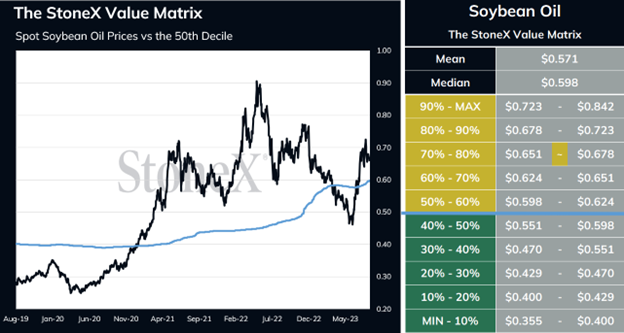
Take soybean oil for example. Below is our Value Matrix from July 2023, an indicator that takes the last four years of prices and tells us what percentile the current price is in, adjusted for inflation. After spending much of 2021 and 2022 in overvalued territory, soybean oil prices were still above the 50th decile the summer of 2023. While 70 cents seemed like a good price compared to 2022 prices, the market was still overvalued. It would not be back under the 50th decile until price dropped below 60 cents per pound.
Companies should be trying to buy in the bottom half of prices. Try to limit buying at the upper end of the value matrix as prices rarely live in the 80th to 100th decile for very long. The Value Matrix below helps us make those decisions.
2. Seasonality & Momentum
You can’t always buy in the bottom half of prices, or in the lower quarter for that matter. Some years just won’t allow for it if we have drought impacted crop or geopolitical disturbances. In that case, use a combination of seasonality and momentum to make timely purchases during the budget year.
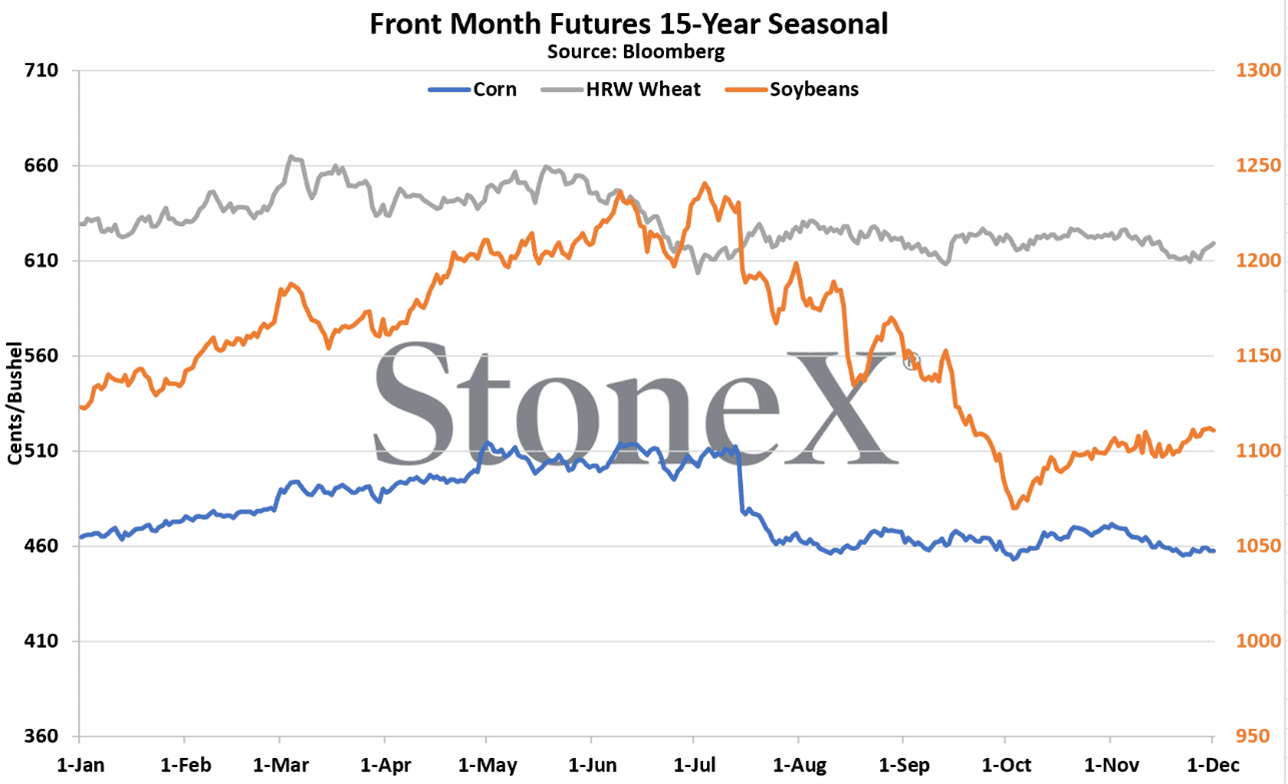
Below is a seasonal chart of corn, wheat and soybeans. Prices tend to rally before a critical event like planting and growing, and then come back down once the market is confident crop development is on track. Prices then tend to decline as we head into harvest before bouncing back as grain is locked in storage and exports pick up due to new crop becoming available on the market. To gauge momentum, you can use a few technical analysis indicators to identify which way the market is moving in the short and long term. Combining the seasonality and technical analysis can direct purchasing decisions in high priced environments.
3. Minimum / Maximum Pricing
Knowing the maximum price for a commodity that fits your budget can be the cornerstone of a minimum/maximum pricing strategy. Identify your max price as well as a lower price you are comfortable with. With financial tools known as collars, you can create a strategy that caps your upside price, sets a price floor, and allows your price risk to float between the floor and ceiling until you make a physical purchase. This is a preferred strategy during years of tight supplies, when the risk of higher prices is determined to be greater than the risk of prices falling substantially lower.
For example, let's say you have exposure to the price of hard red winter (KC) wheat. The price is $6.00 for December futures, and your max budget is $7.00. In this theoretical example, you could buy a $7.00 call and sell a $5.00 put for zero cost (the price paid for the call is equal to the price collected for the put). This allows you to have price insurance on the futures board at $7.00 but also can participate in a price decline to $5.00. This can be a highly effective tool to control prices in a volatile market.
4. Deferred Purchases for Well Supplied Markets
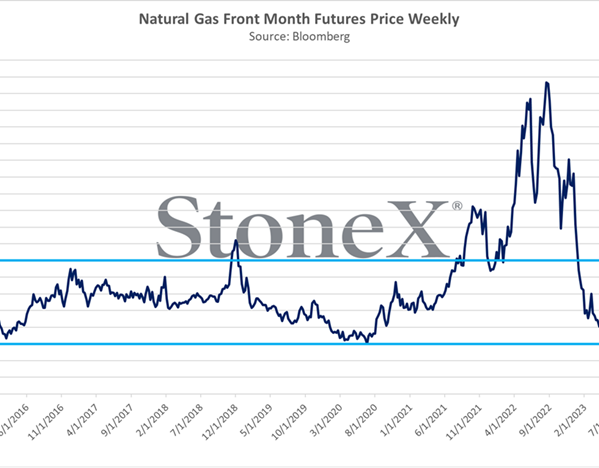
When prices are historically low, you can’t take it for granted. You never know when a low-priced market changes radically and becomes a raging bull. Natural gas is a great example, as its price ranges have swung drastically between 2021 and 2023. Prices traded between $2 and $9 over that period. Now that natural gas is trading in a more historical price range, it is a suitable time to add coverage for multiple years in the future. For example, you could go out all the way to December 2027 and start layering energy price hedges over the next four years. Current prices and deferred futures markets are at value levels, and we are only one energy crisis or geopolitical conflict away from sending natural gas soaring.
Putting It All Together
It is important to identify long-term value opportunities for the commodities you need to buy while also effectively managing risk in highly volatile markets. You can achieve these goals by executing a dynamic hedge plan based on the following:
- Set triggers based on time and historical value
- Leverage seasonality and technical analysis to guide pricing decisions outside of value
- Employ dynamic financial tools such as collars to control your price range
- Capitalize on low prices to secure coverage past the current budget year
Putting these all together will help you to control commodity costs in both low- and high-priced environments.
Choosing the Right Partner
You want a firm that knows your industry – and knows your markets. With over 100 years of experience in the commodity markets, StoneX (NASDAQ: SNEX) checks both boxes. We work with your company to maximize purchasing opportunities and manage the inherent price risks. By controlling your commodity costs to the highest standard, StoneX is more than just a financial services company—we are your partner. Together, we can drive your company’s future growth.
Learn more
This material should be construed as the solicitation of an account, order, and/or services provided by the FCM Division of StoneX Financial Inc. (“SFI”) (NFA ID: 0476094) or StoneX Markets LLC (“SXM”) (NFA ID: 0449652) and represents the opinions and viewpoints of the author. It does not constitute an individualized recommendation or take into account the particular trading objectives, financial situations, or needs of individual customers. Additionally, this material should not be construed as research material. The trading of derivatives such as futures, options, and over-the-counter (OTC) products or “swaps” may not be suitable for all investors. Derivatives trading involves substantial risk of loss, and you should fully understand the risks prior to trading. Past results are not necessarily indicative of future results. All references to and discussion of OTC products or swaps are made solely on behalf of SXM. All references to futures and options on futures trading are made solely on behalf of SFI. SXM products are intended to be traded only by individuals or firms who qualify under CFTC rules as an ‘Eligible Contract Participant’ (“ECP”) and who have been accepted as customers of SXM.
SFI and SXM are not responsible for any redistribution of this material by third parties, or any trading decisions taken by persons not intended to view this material. Information contained herein was obtained from sources believed to be reliable, but is not guaranteed as to its accuracy. Contact designated personnel from SFI or SXM for specific trading advice to meet your trading preferences.
Reproduction or use in any format without authorization is forbidden. © Copyright 2024. All rights reserved.




