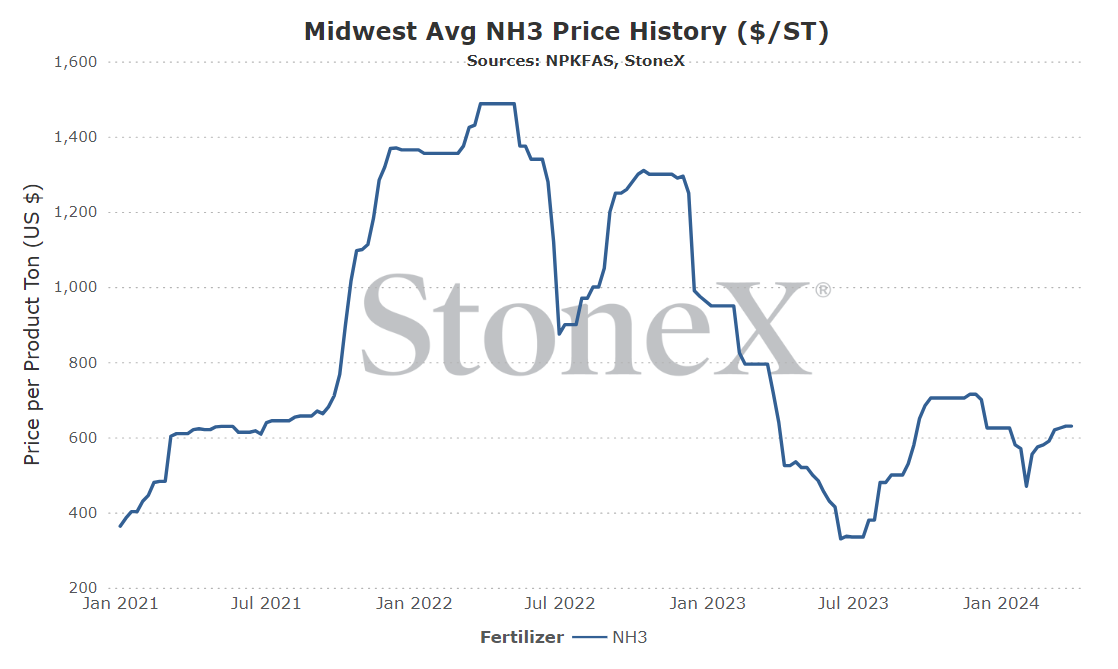
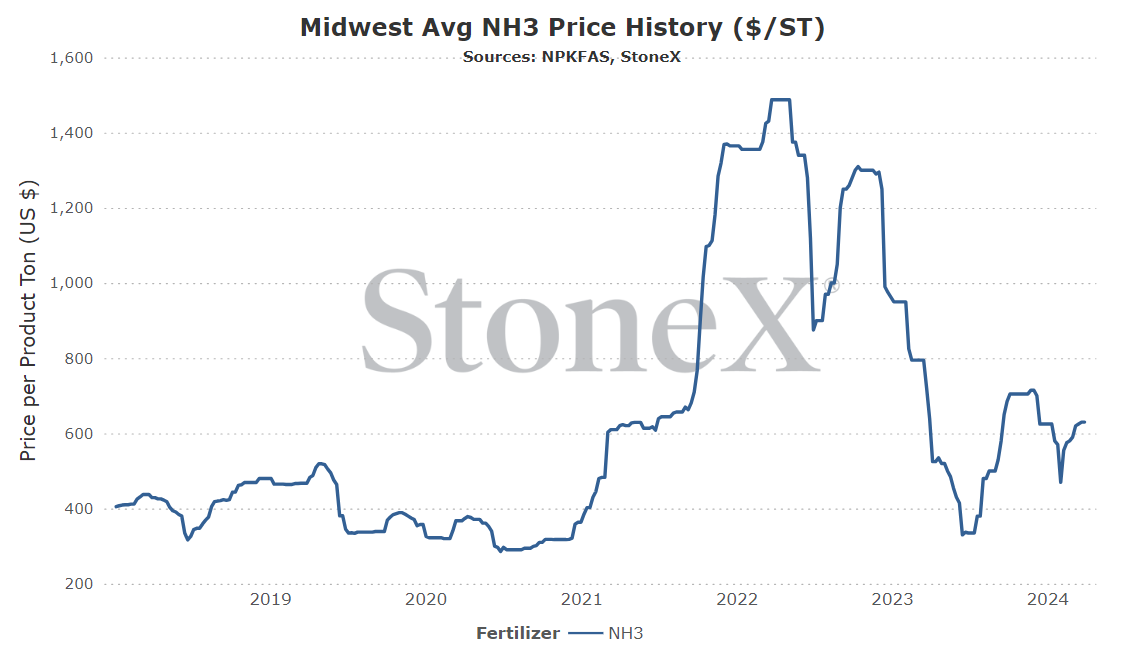
The first graph is the AVERAGE of the entire Midwest U.S. region. That means your local value WILL be different than what the graph reflects. Please do not take this into your retailer and say "why isn't my price the same as here". That is comparing apples to oranges. You might be on the cheaper or more expensive side of this graph. This doesn't take into account logistics/storage/interest/insurance/shrink/etc.
This graph looks at the price from a short ton and USD currency POV.
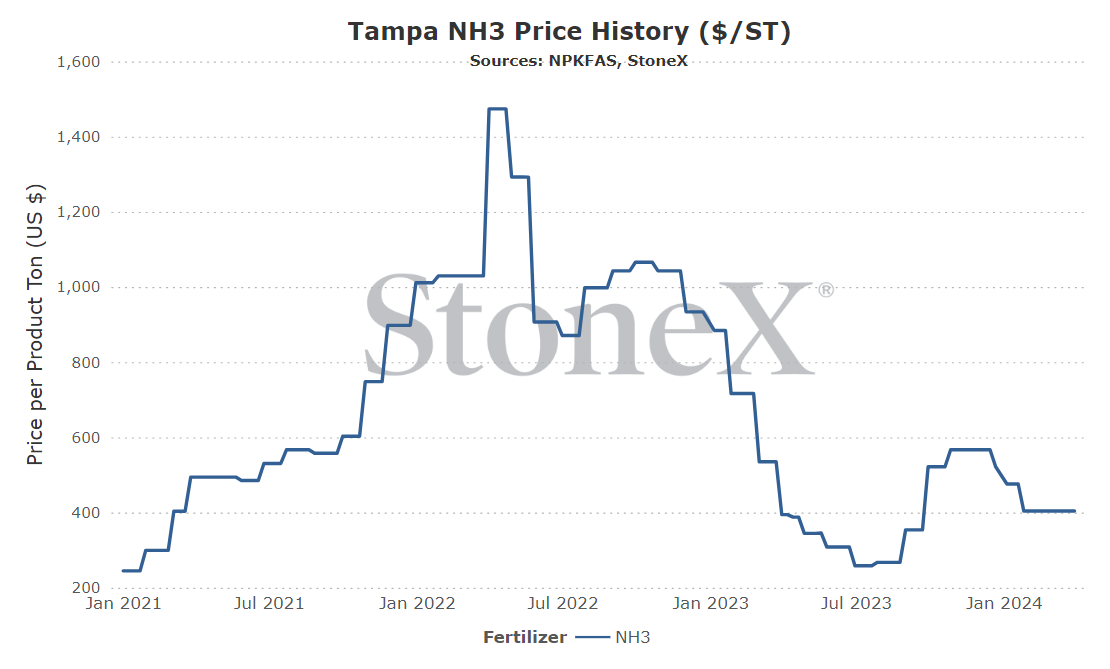
This second graph looks at the price set for Tampa NH3. This value does not have a high correlation to Midwest values. It is a talking point used when prices are rallying...yet somehow gets skipped on the way down. This price is more an indication of the global price. This price is set by two parties (purchaser - phosphate producer in Florida / seller - international producer providing NH3 to FL phosphate production).
This graph CAN be used as an indication of global market price direction/trends. This graph SHOULD NOT be used to determine a Midwest value. Tonnage is listed in short ton and currency in USD.
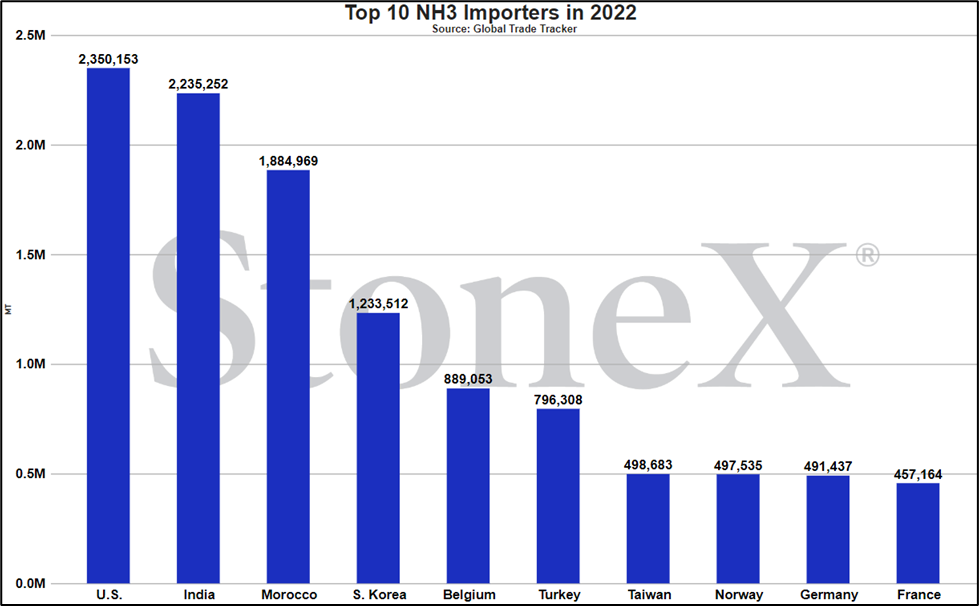
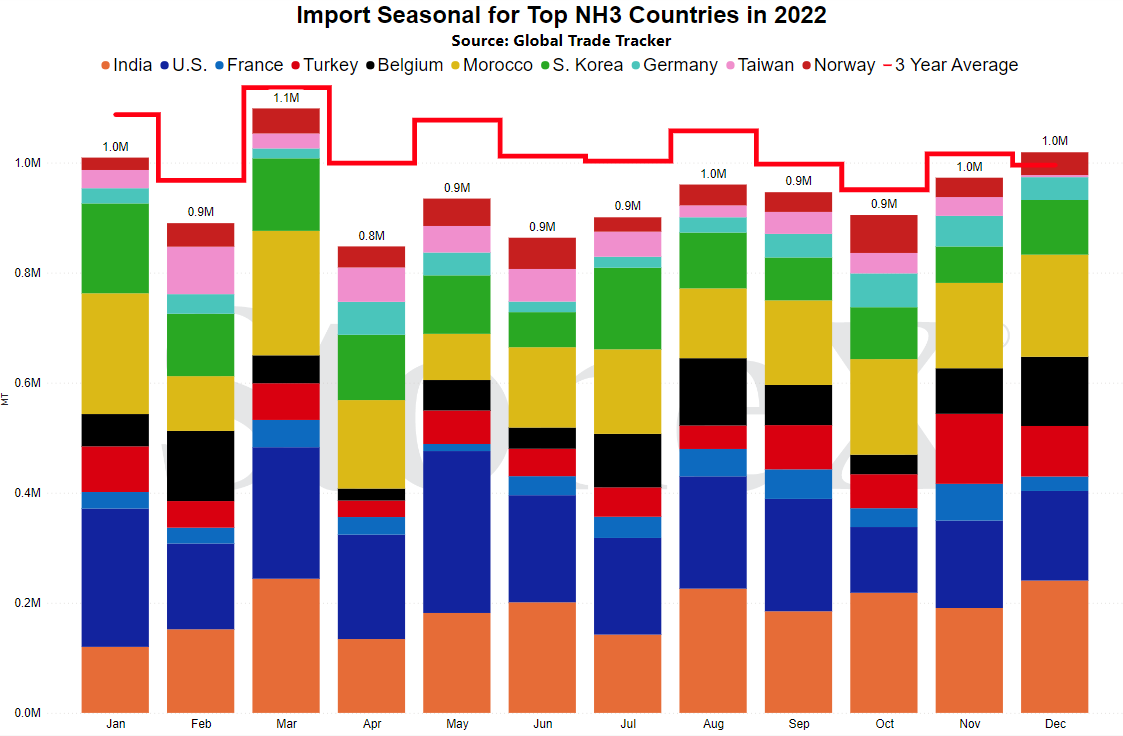
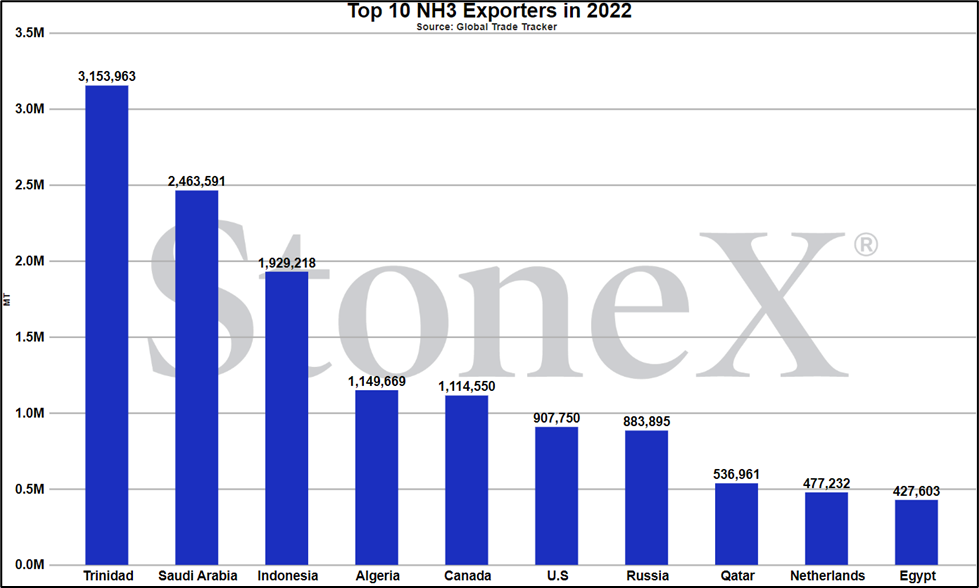
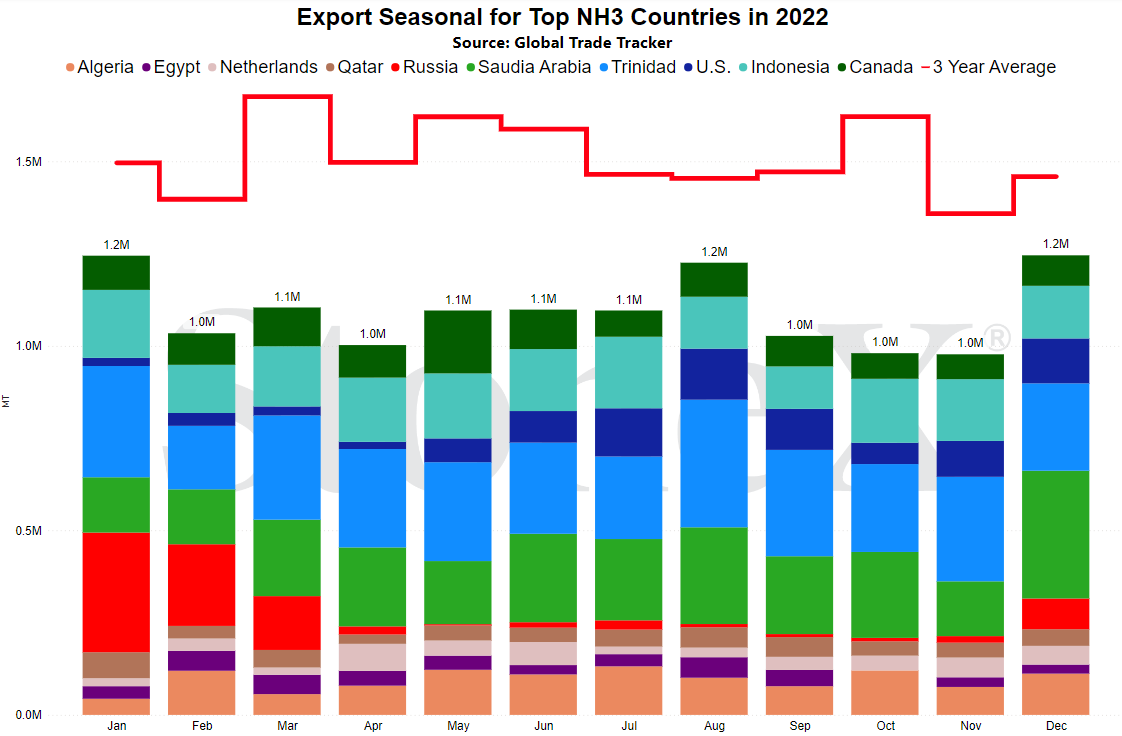
We continues to believe that Russian NH3 exports will return sooner than later which will move them back toward the top of global exporters. That would add a lot of supply globally that has been missing. However, I would be lying if Ukraines success in attacking well within Russia didn't have me wondering if Taman (their new anticipated export location) isn't in the crosshairs. Wouldn't take much of an attack to slow/delay that project. Still...
Barring successful attacks on Teman or unforeseen production issues globally, we continue to expect global prices to correct lower in the coming months.
North America
Fall was huge. It emptied the system. It was going to be hard to prepare if winter gave a normal 3 month window to refill. It only got 2...and spring was good.
For the very short term, inland NH3 values should hold but in a few weeks, regions that are done with application and have production will likely start targeting areas with demand remaining. This typically causes prices to start falling as the battle over demand begins.
Then we have to start talking about summer resets...
April Tampa price beats expectations and rises
As the family and I were loading up the vehicle to drive from Breckenridge to Kansas City (home), I checked my computer one last time for updates and was bowled over by the news that the April Tampa NH3 price had been announced...$30 HIGHER than March! That was not something we expected!
Still, $30 when compared to recent years is not much of a price mover. I'm not saying this to try and offset my being wrong! It is just that we have seen this price move triple digits so $30 doesn't seem large in comparison.
Ultimately, we are still expecting the price to decline in the nearby months...though the next piece could disrupt that POV if it happens.
Ukraine attacks on inland Russian refineries put their NH3 export return in question
Even though the news doesn't say much about it anymore, the war between Ukraine and Russia rages on. We have actually seen a bit of an escalation recently. Ukraine has been widely successful in attacking targets such as refineries well within Russian borders. In response, Russia has jumped its missile retaliation on major cities such of Kyiv.
So how does this make much of a difference for NH3?
Well, refineries are pretty important and with Ukraine successfully targeting them, it makes sense that Russia will begin to increase defenses at those locations. If that happens, it is time to start targeting other infrastructure. Taman sits just east of Crimea...well within range of Ukrainian attacks. I would guess that a new deep sea NH3 port is fairly low on the Russian defensive priority list, but a smaller attack would cause massive damage. Think about how a simple hose breaking on a nurse bottle can hamper your application. Now, imagine attacking a structure that was specifically built to handle NH3 in liquid form. Any break or any small leak can have fatal consequences.
So far, there is no discussion that this is high on their attack target list...but it could be. A single successful attack could see Taman coming online be delayed by months or more. Currently, the global NH3 market is expecting Russia (the world's typical largest exporter) to return sooner than later. If the facility is attacked and damaged, it will remove a lot of that expected supply.
North America: Late fall run + early spring start = tight N.A. inventories
It's the story that keeps on giving...and beating up farmers across North America.
Last fall was a huge application run. We continue to believe it to be the 3rd largest fall application going back to 2000. That on its own merit is a big deal. Considering how many farmers/retailers have moved away from NH3 (not to mention the loss of the western NH3 pipeline), it is even more impressive. A large part of why it was so big was that the season ran until mid-December. So we had a long/late run that emptied a lot of storage and run late.
If we had a normal spring start (March'ish), it was going to be difficult to get refilled and prepared.
The fact that so many areas started in early/mid-February made it that much harder. Winter only lasted 2 months. The result is that inventories stayed low and the market stayed in catch up mode...which the supply side loves to use to push values higher.
Fortunately, spring/prepay application should be wrapping up for many as planters start to get pulled thru fields. Those remaining areas of demand will hopefully start to see more competition. Domestic producers, once their areas demand is thru, start targeting these outside areas with cheaper tons. Now, it takes longer for these loads to arrive, coming from so far away so it is hard to incorporate into a program. If I am a retailer, I have to run that thin line of wanting lower prices but making sure I have product when you show up. Still, the hope is that we will start to see this competition push values lower in those areas with demand still to come.
U.S. Midwest Wholesale price average
Vs 30 days ago - +2% or approximately $6 higher
Vs 90 days ago - -11% or approximately $54 lower
Vs 6 months ago - -16% or approximately $78 lower
Vs 1 year ago - +5% or approximately $20 higher
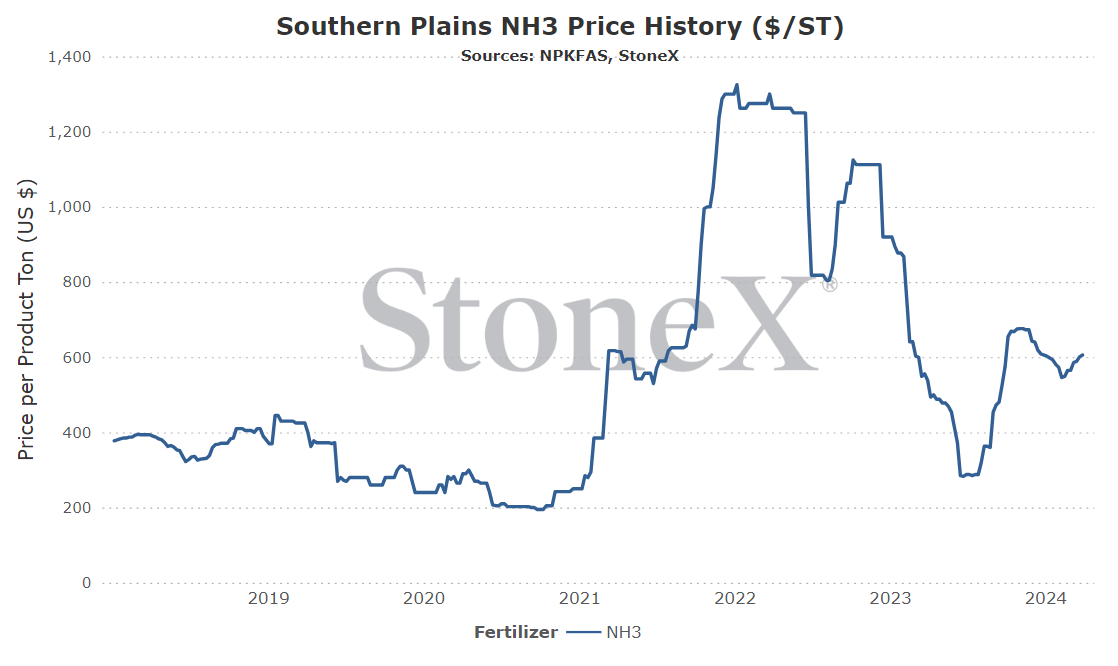
U.S. Southern Plains price average
Vs 30 days ago - +7% or approximately $41 higher
Vs 90 days ago - unchanged vs 3 months earlier
Vs 6 months ago - +15% or approximately $80 higher
Vs 1 year ago - +13% or approximately $68 higher
- If Ukraine attacks Taman, Russia - many in the NH3 space are expecting Russia to return to a certain extent on the export marketplace with Teman coming online. However, one single successful attack by Ukraine could delay that return significantly. NH3 is not an easy product to handle logistically. Small issues can become fatal so imagine that on an industrial scale.
- Inland regions still remain tight on inventory - a lot of regions have wrapped up their spring application season in lieu of running planters in the field...but that doesn't mean all areas are done. There are likely going to continue to be areas that are struggling with product availability. Just because the calendar flipped to April does not mean logistics no longer matter.
- Russian exports return - the return of the world's largest exporter of NH3 does not guarantee that prices will fall, but it sure as heck helps!! Many have already factored in their return but actually seeing product flowing is another step. If/when we see their return, no doubt long positions will be more reluctant to hold in hopes of higher prices. The more folks want to sell off product, the larger the chance that prices fall.
- N.A. clears the spring demand "hump" - this is coming closer by the day. The number of areas that still have demand are shrinking as farmers opt to plant. That means remaining positions get more and more competitive on the fewer and fewer demand areas left. Hopefully for those that still have product to buy, this will mean a chance of locking up some cheaper last minute material.
We believe that only looking at the flat price of either grains or fertilizer can be misleading:
-
Only selling grain can hurt you if fertilizer prices rise substantially
-
Only buying fertilizer can hurt you if grain prices fall
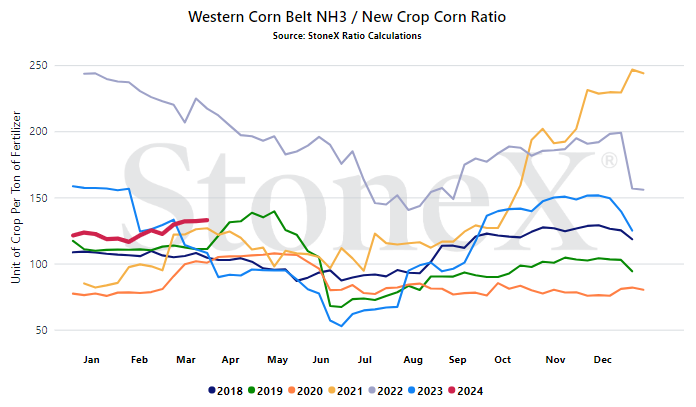
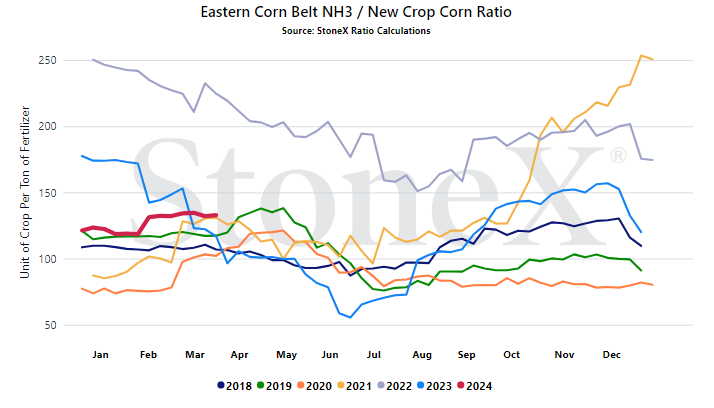
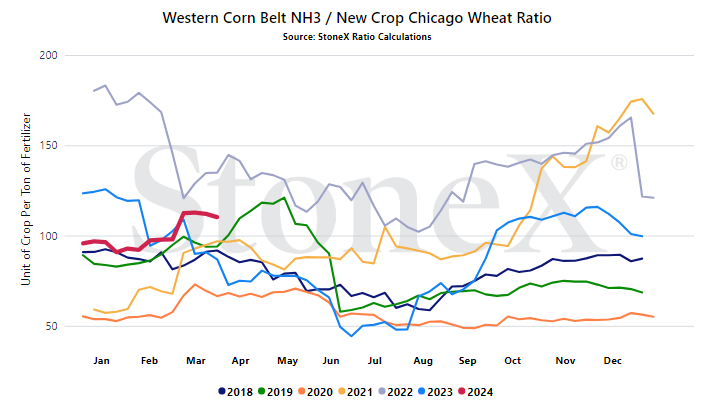
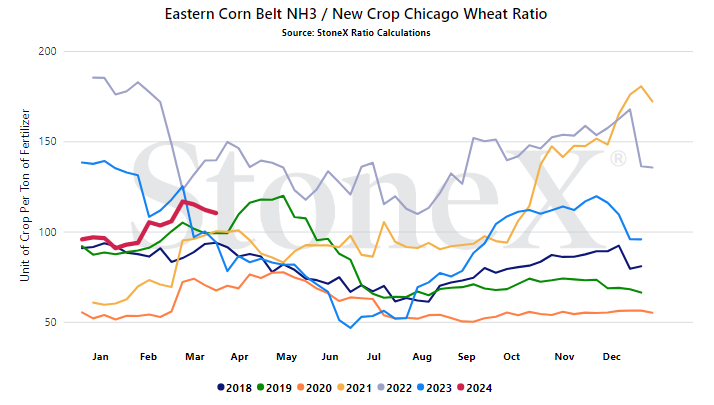
We look at the ratio "value" to get a better indication of where we are or how many bushels of X does it take to pay for 1 ton of fertilizer.
Would you rather:
-
Spend 150 bushels to pay for 1 ton of potash
-
Spend 100 bushels to pay for 1 ton of NH3
When we compare the current ratio value against recent years, we start to see if we are high or low.
YOUR VALUES MAY LOOK DIFFERENT
This graph looks at the NOLA NH3 price vs the flat grain price. There are no logistics on either product. Your location will look different due to fertilizer logistical costs, grain basis, etc.
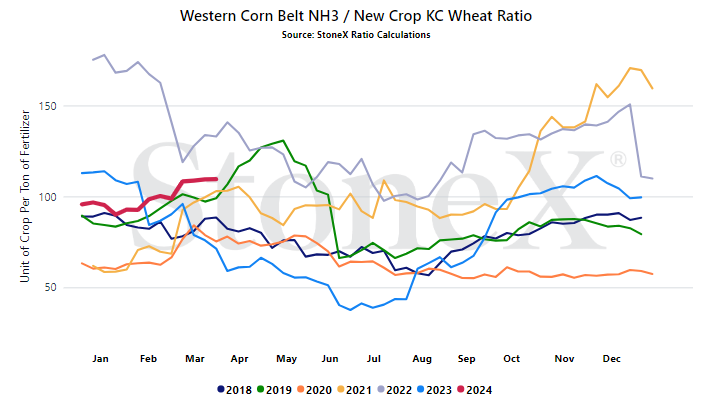
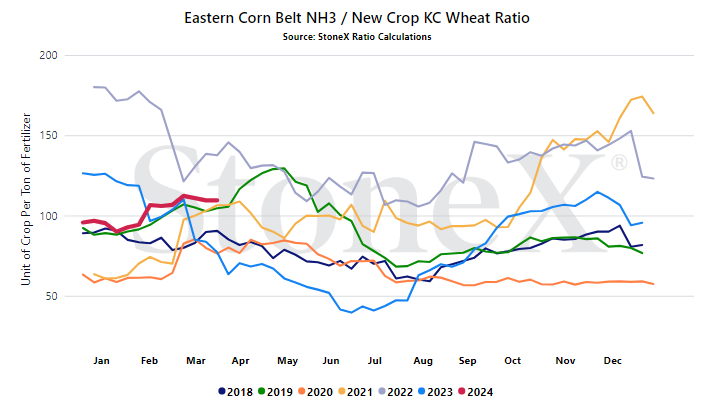
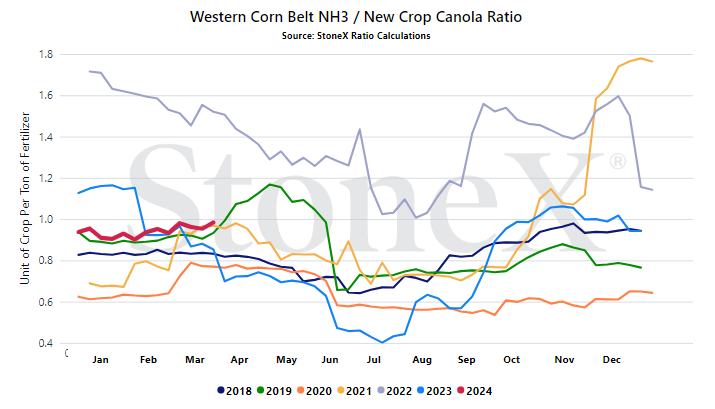
- Russia - Taman comes online, it should be a major bear factor. Taman gets attacked and Russia's export return gets delayed significantly, it should be a major bull fact. It's that simple...
- N.A. application season winds down - as demand dries up, the competition gets fierce. That normally presents itself in the form of lower prices.
- When will manufacturers start talking summer fill/fall prepay? - this one will likely be a while, but we have to watch. We should be coming out of spring relatively low on ending inventories which means manufacturers have more time to wait out the market while hoping for bullish conditions.
StoneX Ratio Calculation
The ratio calculation is derived from Bloomberg historical grains values as well as fertilizer values from StoneX, NPKFAS, and Argus.
The calculation is simply dividing the fertilizer price by each grain price.
All data was sourced from StoneX unless otherwise noted.