Global
There have been some efforts globally to push price ideas higher. The President of Belarus has mentioned reducing production rates to battle low prices. Some Canadian manufacturers have slowed production for similar strategies. We have even seen some of the largest global buyers (like China) buying well over their normal rates.
Still, global prices have done nothing which raises the question: what could change the pattern?
We continue to see the global potash market as being very well supplied, even in the face of higher demand. That is what has allowed prices to remain relatively stagnant. Frankly, that continues to be the case as we look forward unless the potash manufacturing side can "come together" on a strategy.
As the world moves into a slower time of year for demand, it should mean that global prices see even more downside pressure...but values are already low. How much lower can they go from here?
That is the hardest question today. On the surface, the fundamentals continue to paint a bearish picture but that will not happen without a fight. We are watching even more closely for signs that global manufacturers are willing to stand up and fight. This could mean more production being curtailed. This could mean more attempts to push price ideas higher.
The success/failure will all depend on how global buyers react.
North America
N.A. values have been rising in the last month.
Fundamentally, there continues to be plenty of reasons:
- Solid fall season wiped out inventories
- Late fall run removed December as a fill period (lost a third of winter fill)
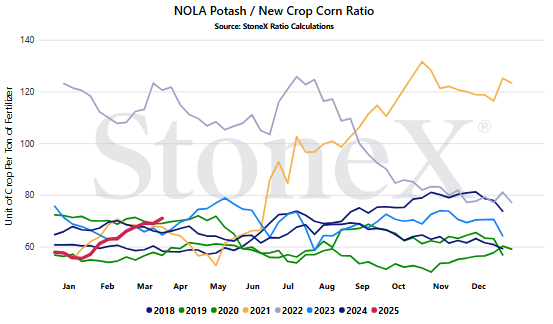
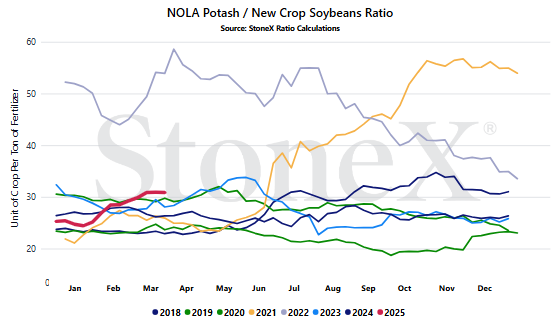
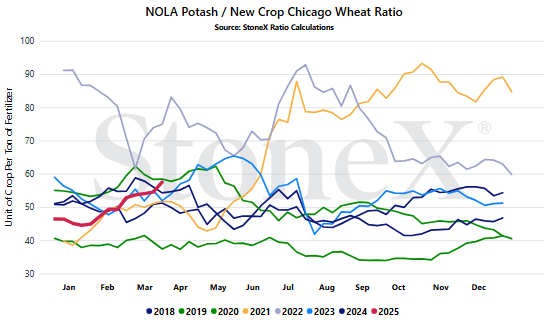
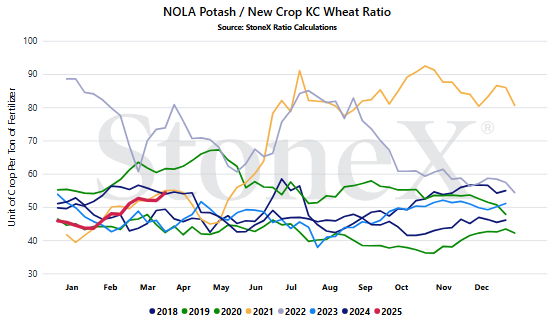
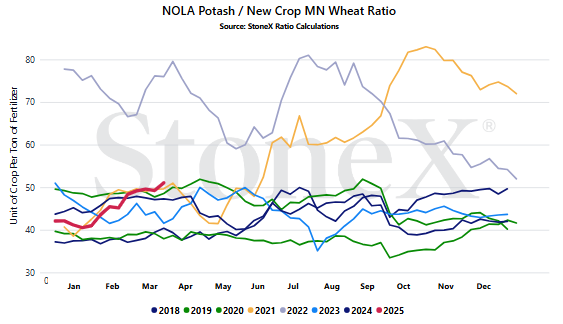
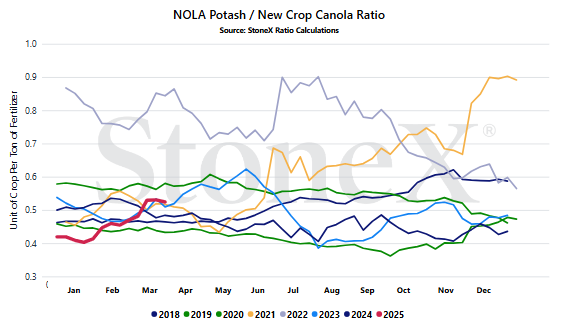
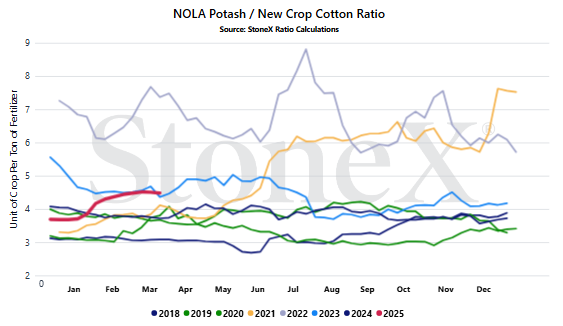
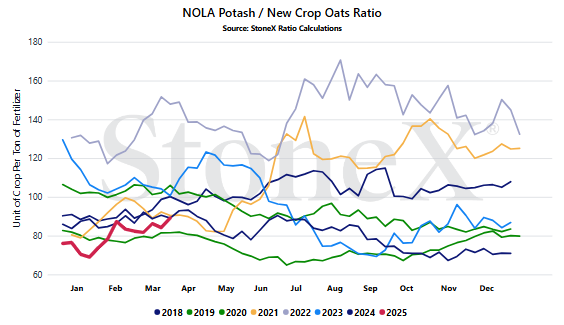
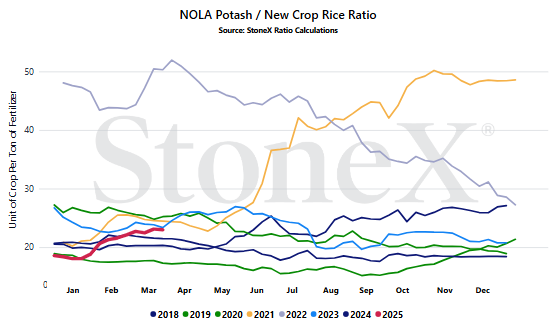
- Potash prices were excellent to start 2025 (take a look at the ratio charts below)
- Demand has been rising quickly with higher corn acres
However, it seems a lot of the price increase success continues to revolve around tariff fears. We also have to keep in mind that spring preplant demand is nearly done and global values have not moved higher with N.A. pricing which means there could be trouble heading into summer.
I believe short term will see potash prices continue to be supported...but that support is going to be short lived. Once preplant demand makes way for planting, buyers have 7 months before the fall season begins in November. That is A LOT of time for the market to sit back and ponder how they want to approach recently higher prices.
If we see buyers stepping forward, it should help lock in these higher prices. However, if buyers are content to sit back and say no thank you for the next couple months, we could see the pressure get to manufacturers/sellers.
I am still in the camp that prices will start to give up recent gains as we move into April and beyond.

U.S. tariff delays on Canada "save" U.S. potash markets
As I write this, we are less than 24-hours from the next benchmark date of April 2nd which could usher in tariff's on Canadian potash shipments into the U.S. So far, we have been hearing that there have been some solid conversations between the U.S. and Canada but unfortunately, tariff's are still on the table.
Fortunately for U.S. potash users, April 2nd will help limit the damage on spring '25.
This has been a story since the Trump administration took charge. Tariff threats have been lobbed across the border from both sides and interestingly, potash became a major talking point in the coverage. While we in the fertilizer industry understand that Canadian potash flows are incredibly important to U.S. farmers, it isn't often that fertilizer gets discussed in the news/Washington D.C./etc. This was one of the rare times.
Originally, the tariff's were to go into effect in early February which would have been devastating for potash values. Fall '24 was solid, which helped to drain the system of any excess product. The fall '24 run was "late" with many areas not starting until Thanksgiving week and many territories running until nearly Christmas. At least 2nd half December typically see's winter fill begin so having application still occurring that late meant the market lost winter fill time to prepare for spring. Then, spring '25 demand continued to grow on the back of higher corn acres expectations.
All of this had already set a short-term bullish situation for potash. Having the possibility of tariff's on top of the higher prices in early February would have hurt significantly more. U.S. retailers/farmers would have been stuck with no time to try and source potash from other areas around the world. Given the time it takes to secure a vessel, ship it to the U.S., unload said vessel, and then move the product into place, by the time all that happened it would have missed spring season. U.S. buyers would have been forced to pay the tariff.
Then, the delay happened. A late night agreement happened and the tariff's were delayed until early March. That gave the market another month to slam as many tons across the border before the tariff's went into effect, and the market took full advantage. Based on conversations, every possible way of moving tons across the border was utilized.
Once again, another delay until April 2nd which brings us to today.
These delays have been key for U.S. farmers. While tariff's going into effect early February would have hurt significantly, tariff's going into effect April 2nd give the U.S. the one thing is desperately needs...time. For many areas, farmers minds are switching from preplant applications to actual planting. Most spring needs potash is already in place and much of the application is complete. While there will be some usage thru the year, the next major application cycle isn't until November, nearly 7 months away.
That gives the U.S. time to figure this thing out.
- Will tariff's be put into place?
- How will the market react once tariff's actually go into place?
- How much more can be bought from other global producers?
- Would additional tons from other global producers cost less/more?
In this scenario, time is the most valuable asset. If the tariff's went into place in early February, there was no time. U.S. buyers were stuck with their "typical" patterns. Now that we are into April, the market can take a bit of time to figure out the best route forward.
I continue to hope that a late day agreement will be found that can put this whole nasty chapter behind us, but I am also a realist that knows how rare it is for that to happen. We can hope for agreements to be made, but we must prepare for the worst case scenario.
What does this mean for farmers?
Long story short: U.S. farmers were spared even higher prices this spring with the tariffs being delayed.
Had the tariffs went into effect in early February (or even early March), U.S. buyers would have little choice but to accept the higher pricing and tariff penalties. There just wasn't enough time for the market to shift to possibly lower priced international supply alternatives.
Even if the tariffs go into effect tomorrow (April 2), most of spring needs are either already applied or stockpiles in place. Most product coming in during April is the start of fill for the fall season. That means U.S. buyers have time to wait to see if the tariffs happen and if they do, look for alternative and cheaper sources around the world.
I, for one, continue to hold out hope that the tariffs do not happen...but hope is not a strategy.
China's Jan/Feb trade data shows large imports, global values still mute
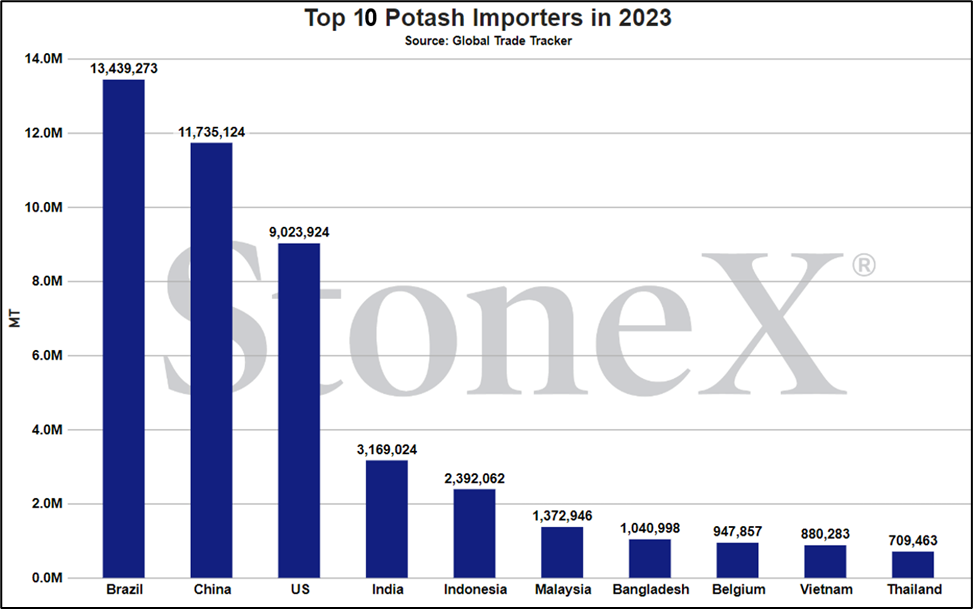
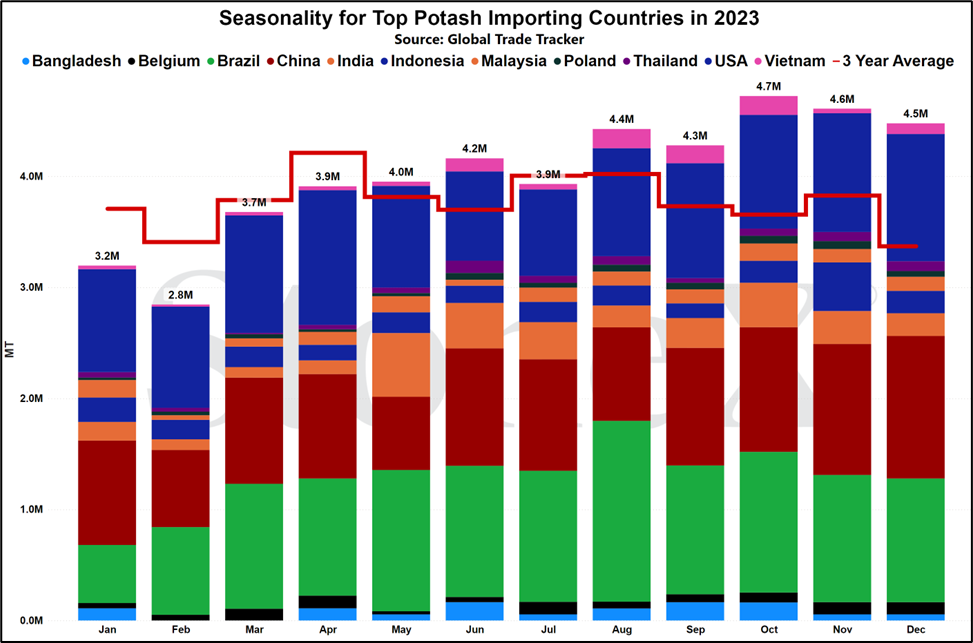
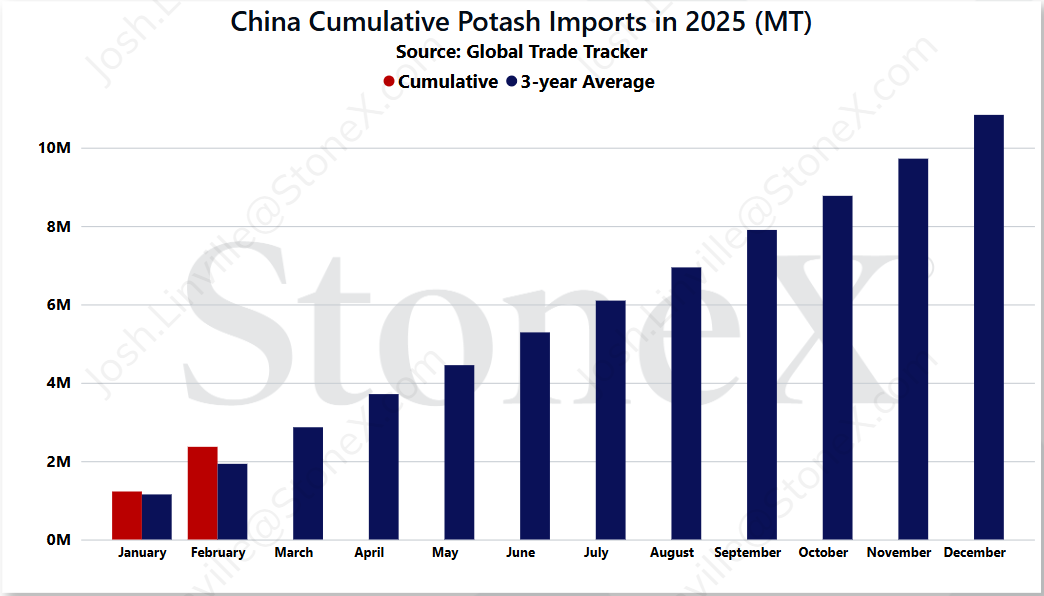
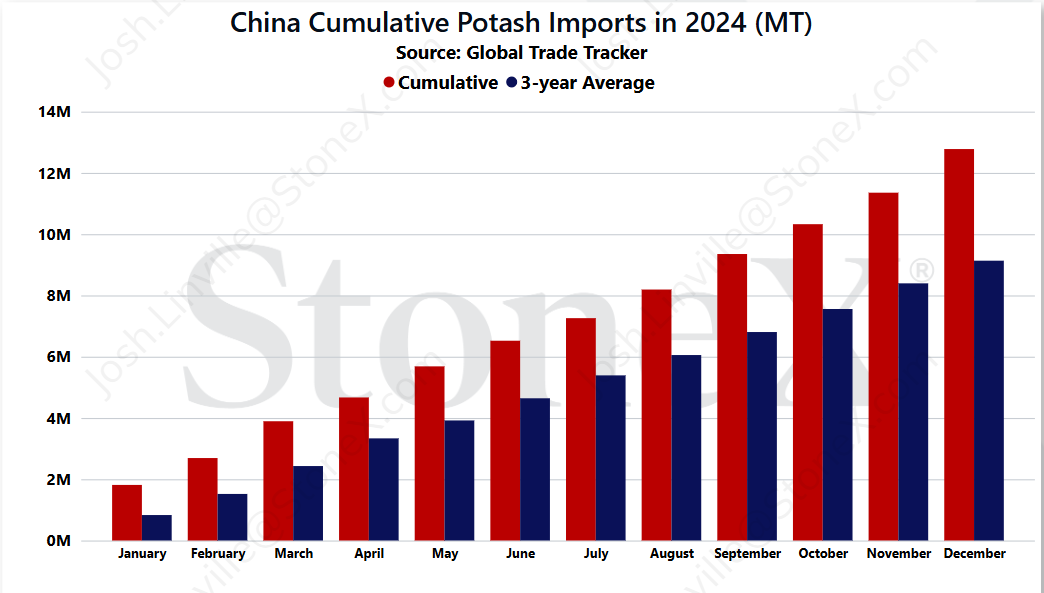
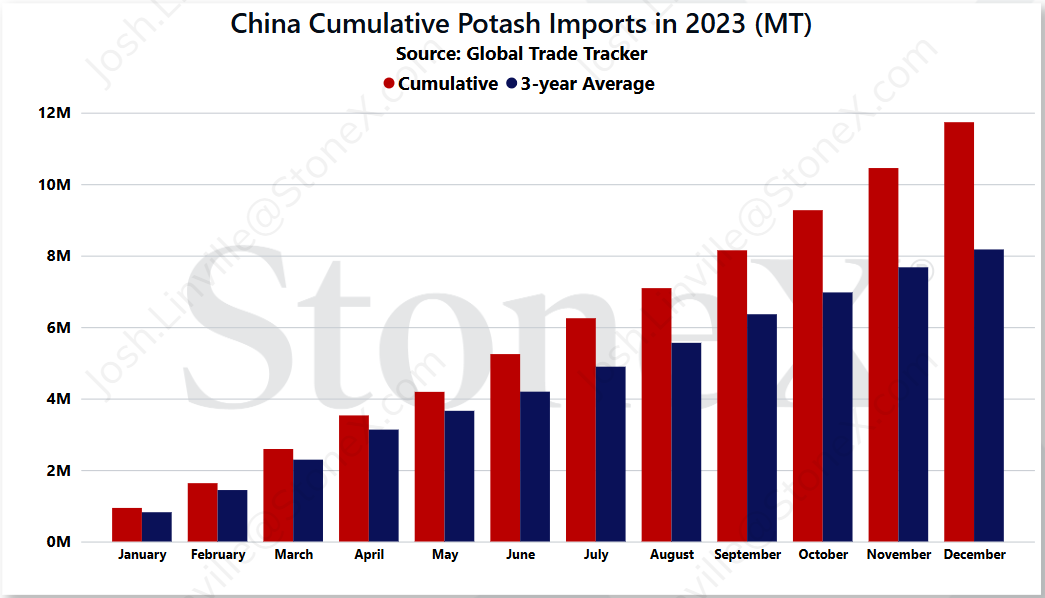
In 2023, China was the 2nd largest buyer of potash in the world sitting behind only Brazil. It makes sense to watch one of the world's largest buyers for signs of where the market might be headed.
Over the last few years, China has completely blown thru their "typical" purchase volumes of potash. Normally, they would import around 8M tons. The last couple full years has seen them well above that value:
- 2023 @ 11.7M tons
- 2024 @ 12.8M tons
2025 has also started hot with 2.36M tons already arriving between January/February. Once again, well ahead of their 3-year average.
Many have been speculating for the "why" behind the massive surge in potash purchases. Given China's lack of transparency, the number of why's is pretty wide. My "why" doesn't have anything to do with their purchasing. They are purchasing a lot more. That is enough for me.
My "why" has to do with why global potash values have continued to stay stagnant even with this big bump in demand. I think it has to do with our continued view that global potash is very well supplied.
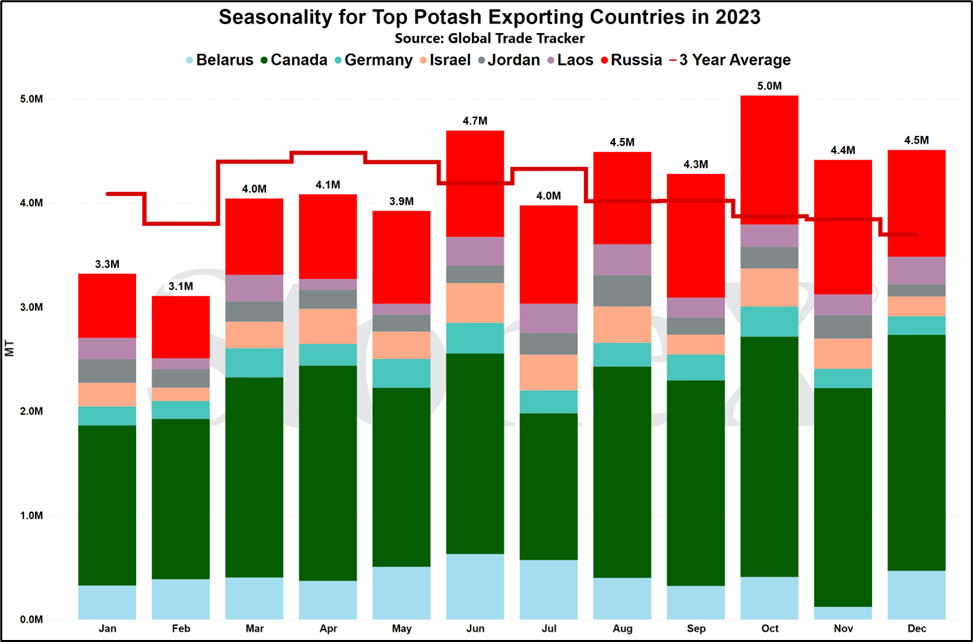
When we look around the world, we see a lot of existing production as well as a lot of coming production/supply:
- Canadian production is expected to increase, focus on BHP's facility
- Russian production is expected to increase
- Laos production is expected to increase with China continuing to invest
- Belarus will continue to make gains back to being a normal supplier after losing Lithuania channels
Current global prices (outside U.S.) have remained relatively stagnant even in the face of this surge of demand. While anything can change, the lack of volatility is something that we interpret as a market that is very well supplied. We need to continue to watch the market. It would not surprise me to see global manufacturers start to piece a "big demand story" together to justify higher prices. We have already seen/heard stories of some discussing the need for potash prices to rise. No doubt their hope is if they talk about it enough, it will happen.
Until then, global potash has remained fairly flat with much bigger demand than expected.
What does this mean for farmers?
Long story short: one of the biggest global potash buyers purchasing well ahead of average helps to keep prices from sliding further and may eventually cause prices to increase.
China is a major buyer in the global potash market. If/when they start buying millions of tons more than usual, that helps to remove a lot of excess product from the marketplace. Excess product can lead to lower prices with sellers being more desperate.
As long as China, and other major buyers, continue to buy ahead of schedule, it helps limit downward price ideas.
N.A. potash demand rises slightly on higher corn acre forecasts
One of the big U.S. ag stories for 2025 has been the increase in corn acre expectations.
Here at StoneX, we started 2025 with our estimate sitting at 92M. Within a couple weeks, that estimated was raised to 92.5M and ended up closing the month at 93.5M. In recent weeks, based on several factors (corn price vs other grains / elevator feedback / seed company feedback / etc), the estimate was moved to 94.2M with a lean to the higher side.
Watching the USDA announce 95.3M acres was a shock to the system...but what does that mean in terms of potash demand?
Let's use our starting 2025 corn acre estimate and assume the USDA is right:
- 95.3M - 92M = 3.3M additional corn acres
- Average application rate of potash = 150 lbs/acre (varies based on location/removal/etc)
- 3.3M x 150 lbs/acre = 495,000,000 lbs of actual potash demand increased
495M pounds?! That's a lot...but is it?
For every 1 ton of potash (assuming 60% analysis), there is 1,200 pounds of actual potash.
- 495,000,000 lbs / 1,200 = 412,500 tons of additional potash demand
So, is 412,500 tons of additional potash demand big? Yes...and no.
When we look at it from an overall U.S. potash market perspective, it really isn't. We estimated that the fertilizer year potash demand would be just shy of 5M tons. Another 400K+ is near 10% increase, but given that we have the biggest producer in the world just to the north, 400K is not insurmountable.
However, we didn't start 2025 heavy on inventories.
- Fall '24 potash season was solid and emptied warehouses
- Fall '24 applications ran late, digging into part of typical winter fill period
- Potash prices started 2025 very attractive, tempting further demand
Basically, the U.S. market started very low on inventories and has been playing catch up. In this scenario, adding another 400K+ to the system has helped to buoy price ideas during a period where we haven't seen a lot of global price increases.
The long story short is that the increase in corn expectations has helped to push potash price ideas higher, it isn't an impossible situation. Just adds a bit more stress to the market.
What does this mean for farmers?
Long story short: while this increase in demand has certainly helped potash prices higher, it does not spell a worst case scenario (product shortage) that some may be yelling.
Adding nearly half a million tons of demand onto a market just before application is almost certain to support price ideas. It impacts the S&D and places a lot of pressure on logistics to deliver more product on time.
However, we still do not believe we need to be worried about a "shortage" situation. There is a lot of potash out there, it is just a matter of moving to the right place in the right time.
That is the fun of just in time demand. It gets to meet just in time supplies...and those are usually pretty proud of themselves!
U.S. potash values 22.5% higher since start of year, "baking in" tariff fears?
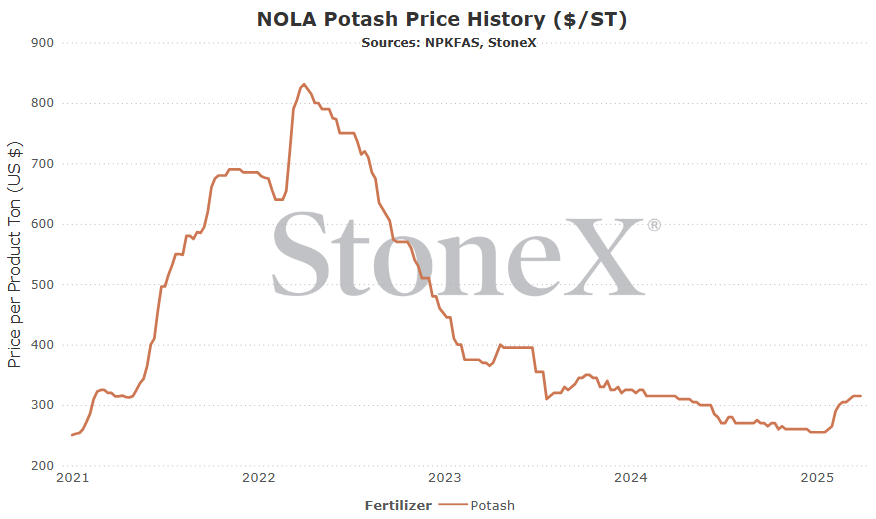
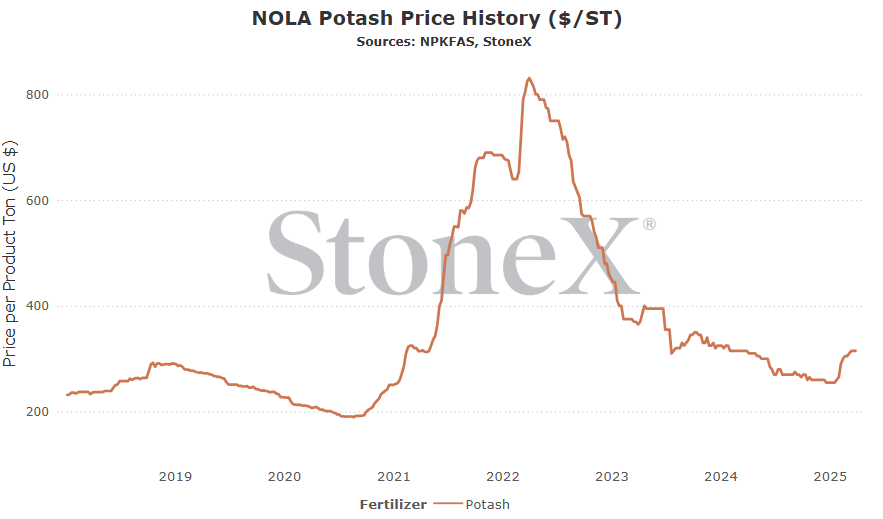
Since the start of the year, NOLA potash (I know NOLA potash is not the best price reference, it should be Midwest, but we have more data for NOLA) has increased around 22.5%. It started in the mid-$250's and is currently in the mid-$310's. Most people look at that percentage increase and immediately think "the reason U.S. potash is up is due to tariff fears".
While that is a solid theory, it is not one I believe.
I think potash values being higher have a lot more to do with fundamentals than it has to do with the tariff's. There were plenty of things that happened to support price ideas:
- Solid fall demand emptied the system
- Late fall run removed part of an already short winter fill
- Potash demand has been rising with higher corn acres
Those 3 things alone should be enough to be price supportive.
So where do tariff fears come into play?
Unfortunately, the tariff's appear to be an add on to higher prices if they go thru. From what we have seen/heard, potash contracts now largely state that the buyer is responsible for the cost of any/all tariff rates. That places a further burden on the U.S. farmer.
Again, as I have stated multiple times, I'm hoping for a last minute agreement which puts all of this behind us. Again, hope is not a strategy.
What does this mean for farmers?
Long story short: if the U.S. places tariff's on Canadian goods, the cost of the tariff is likely to be paid by the U.S. farmer.
Now, as we move past spring and into summer, the market will have more time to try and find better alternatives. If alternatives exist, that can help the U.S. push more of the tariff back on Canadian manufacturers. Effectively making both parties share the cost.
NOLA/New Orleans Louisiana
Vs 30 days ago - 3% or approximately $10 higher
Vs 90 days ago - 24% or approximately $60 higher
Vs 6 months ago -19% or approximately $50 higher
Vs 1 year ago - unchanged vs last year
U.S. Midwest Average (average of several points across the Midwest)
Vs 30 days ago - 1% or approximately $4 higher
Vs 90 days ago -16% or approximately $49 higher
Vs 6 months ago - 7% or approximately $23 higher
Vs 1 year ago --8% or approximately $30 lower
- U.S. / Canada tariff threats/war continues – Canada is the world's largest supplier of potash and it isn't even a close 2nd. The U.S. continues to pick a fight with Canada on tariff's. While the U.S. has discussed lowering tariff's on potash, Canada may sense weakness and place some of their own. If this fight continues, it is likely that U.S. farmers end up paying the price for this fight. U.S. values would remain high/possibly push higher as a result.
- Solid N.A. spring run empties the system - this one is very likely. Demand has been solid. High fertilizer/potash acre forecasts continue to rise which raises potash demand that much more. It is very likely that inventories will be near zero by the time planting starts. While there is a long time between spring and fall applications, having a nearly emptied system gives sellers a bit of breathing room.
- Global manufacturers take steps to curtail production – if global production were to continue normally, the outlook appears flat to bearish...but that assumes. We have seen/heard several stories of countries/companies discussing curtailing production due to low potash prices. One cannot do it alone but if multiple companies and/or countries were to take similar steps, it can help support price ideas by substantially lowering supplies.
- U.S. / Canada tariff situation gets resolved – I REALLY hope this one is the case. Not just for potash's sake but for North America as a whole. U.S. potash prices are up about 25%...or around the same percentage as the originally threatened tariff rate. Once past spring, if the tariff situation gets resolved, it could remove the price floor and allow prices to fall to their previous start of year levels.
- Once spring application ends, buyers run for the hills due to high prices - the market in the U.S. has watched potash values creep higher since the start of the year. The market also knows that once planting begins, potash application largely wraps up and it will be 7 months before the fall application. Very few to no one will want to carry that risk thru the summer. If anyone has anything left in storage, we could see some fire sales. Doesn't appear likely today, but something we will still watch for.
- Global S&D outlook continues to appear very well supplied – our long term outlook has remained unchanged. Canada has more production coming. Russia has more production coming. Belarus continues to improve export flows. China continues to invest in Laos. It all combines to a greater production/supply growth than global demand growth. If it all holds, that continues to paint a bearish outlook.
Where are the current potash/grain ratio values today
We believe that only looking at the flat price of either grains or fertilizer can be misleading:
-
Only selling grain can hurt you if fertilizer prices rise substantially
-
Only buying fertilizer can hurt you if grain prices fall
We look at the ratio "value" to get a better indication of where we are or how many bushels of X does it take to pay for 1 ton of fertilizer.
Would you rather:
-
Spend 120 bushels to pay for 1 ton of potash
-
Spend 60 bushels to pay for 1 ton of potash
When we compare the current ratio value against recent years, we start to see if we are high or low.
YOUR VALUES MAY LOOK DIFFERENT
This graph looks at the NOLA potash price vs the flat grain price. There are no logistics on either product. Your location will look different due to fertilizer logistical costs, grain basis, etc.
- North American trade war changing flows - if tariff threats had come to fruition in early February as had been feared, U.S. farmers had little chance to look elsewhere. It was simply to close to spring application season. While D.C. politicians would be right in saying that Canadian firms would pay the tariff, what they would not recognize is that those checks would be paid with U.S. dollars. Now, with the tariff backed up to early April (past preplant season), the U.S. has time. There is 7 months between planting and November. That is a long time to find new flows of product if the tariffs happen (hopefully they do not). That places more pressure on the manufacturers in Canada.
- How will global producers "fight" lower prices - global potash manufacturers are likely not thrilled with current values. They are low from their perspective. While they are likely profitable, the profits are nowhere near what they were in late '21/early '22. There have already been some attempts to buoy price ideas. Production curtailments. Statements made during interviews and the sort. No doubt these fights will continue...but will the market allow them? That will be the deciding factor.
- U.S. values are up around 25% since start of year, will summer see that fall back? - U.S. prices are up about the same percentage as the original tariff threat was. Around 25%. So that makes me wonder what will happen if the tariff threat/war goes away. Global prices haven't changed a whole lot. Spring season is nearly done for potash, giving buyers a lot of time. All this to say, if peace can be found between the U.S. and Canada, will U.S. values give up the gains they have seen to start 2025?
StoneX Ratio Calculation
The ratio calculation is derived from Bloomberg historical grains values as well as fertilizer values from StoneX, NPKFAS, and Argus.
The calculation is simply dividing the fertilizer price by each grain price.
All data was sourced from StoneX unless otherwise noted.