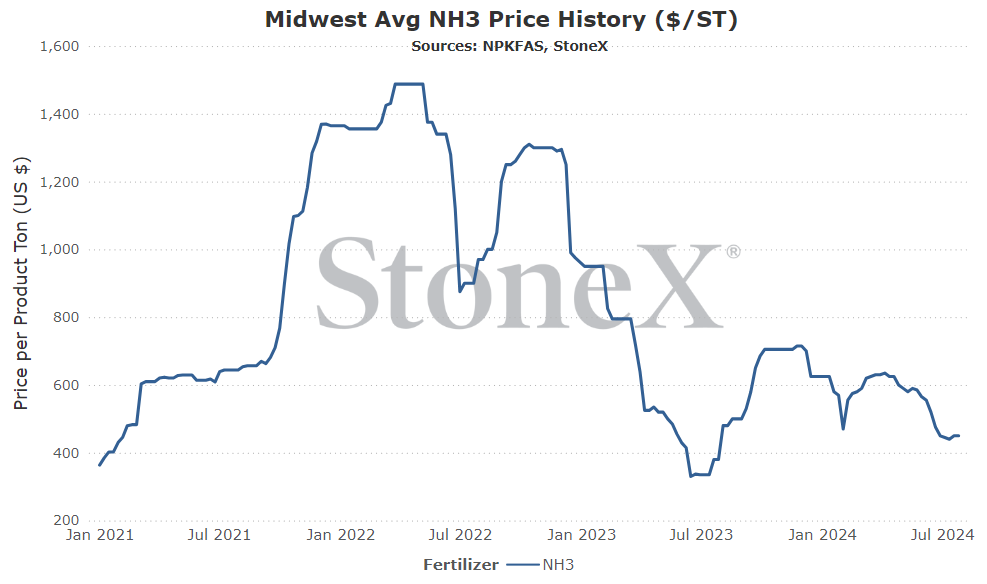
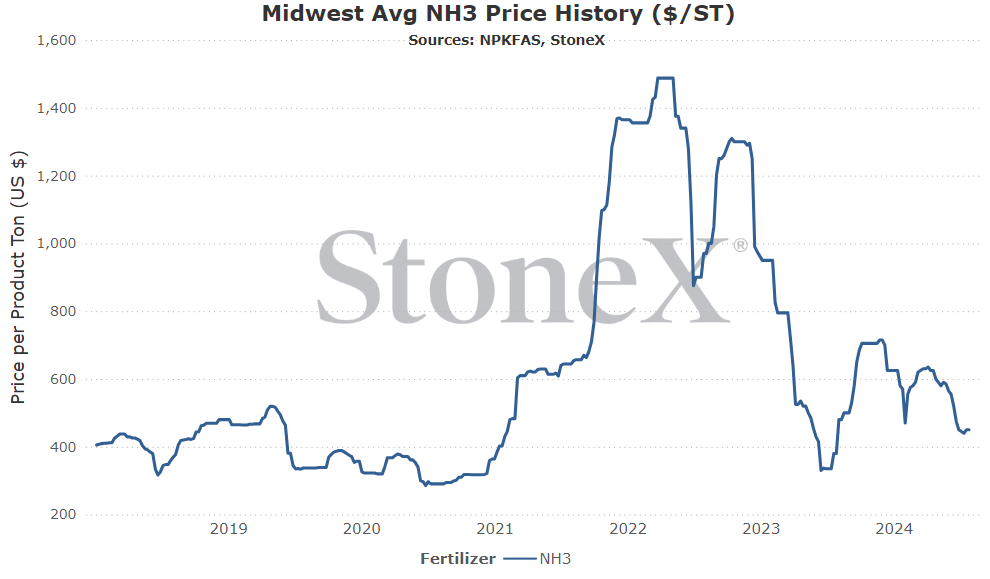
The first graph is the AVERAGE of the entire Midwest U.S. region. That means your local value WILL be different than what the graph reflects. Please do not take this into your retailer and say "why isn't my price the same as here". That is comparing apples to oranges. You might be on the cheaper or more expensive side of this graph. This doesn't take into account logistics/storage/interest/insurance/shrink/etc.
This graph looks at the price from a short ton and USD currency POV.
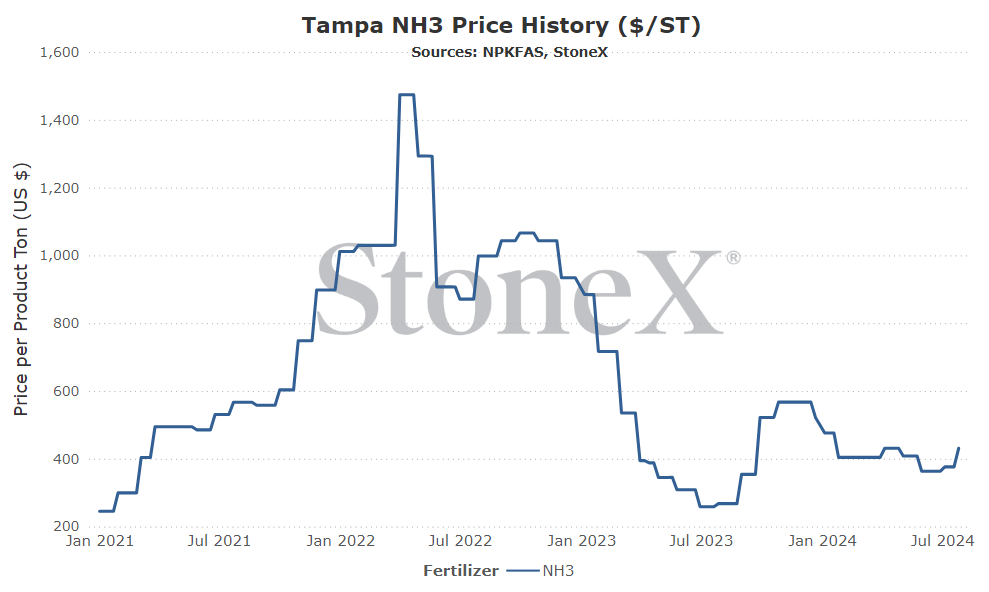
This second graph looks at the price set for Tampa NH3. This value does not have a high correlation to Midwest values. It is a talking point used when prices are rallying...yet somehow gets skipped on the way down. This price is more an indication of the global price. This price is set by two parties (purchaser - phosphate producer in Florida / seller - international producer providing NH3 to FL phosphate production).
This graph CAN be used as an indication of global market price direction/trends. This graph SHOULD NOT be used to determine a Midwest value. Tonnage is listed in short ton and currency in USD.
Our hope of seeing Russian exports returning in a big way during 2024 continue to falter. Production issues continue to pop up (Trinidad). Unfortunately, supply issues are building which is cutting into supplies that were expected to be in the marketplace this year.
NH3 feels like is should remain relatively price range bound in the shorter term. Supply issues will help push price ideas higher while quiet periods will help lean on values. Hard to see a break out today.
North America
N.A. fall prepay programs have been released. If you haven't seen anything, you should shortly.
Unfortunately, from our perspective, most of the values were a bit higher than last years. Especially hard to stomach given how much lower grain values. That said, it still surprises me how aggressive manufacturers got last summer so we figured it would be a stretch to get back there this year.
Ultimately, values feel supported. There is certainly questions being asked in terms of demand destruction with grain values down. Will farmers cut back their fall NH3 application rate? Will fall guys wait until spring? Will we ultimately see no change to fall?
I would venture to guess that fall demand will be near normal. If it is a failure due to cuts or due to mother nature, we could see winter fill programs be more aggressive but then spring programs will be higher priced as the system struggles to get everything done.
Update on Russia's return, 2024 not looking positive
If I say "Russian exports are coming back in a big way very soon" enough times, I'll eventually be right.
Just not this month.
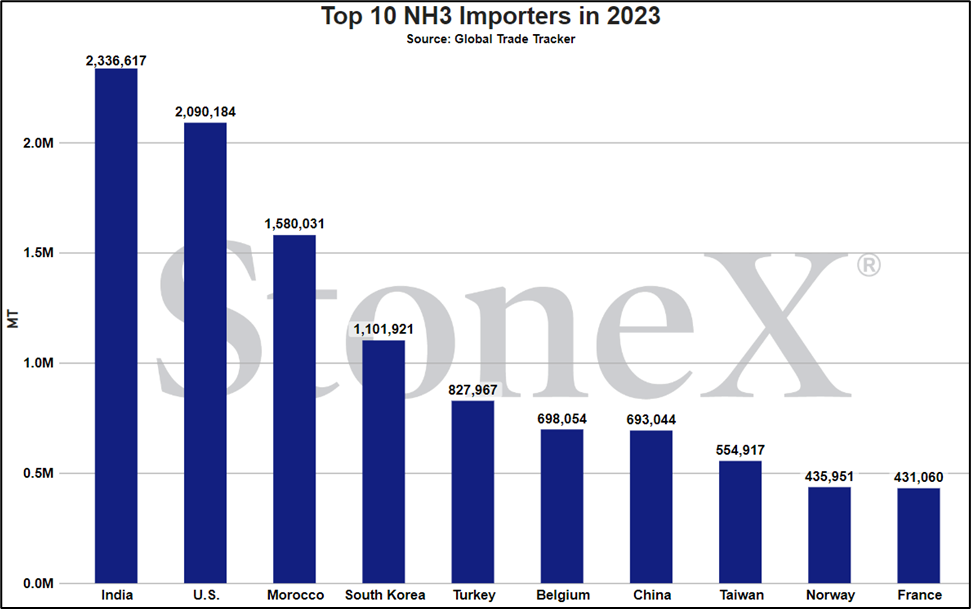
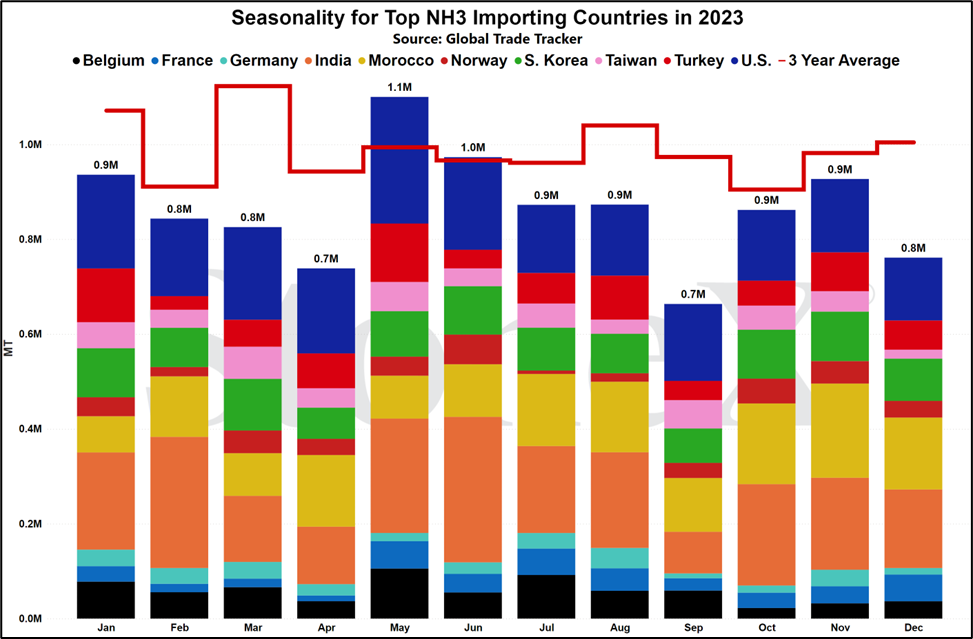
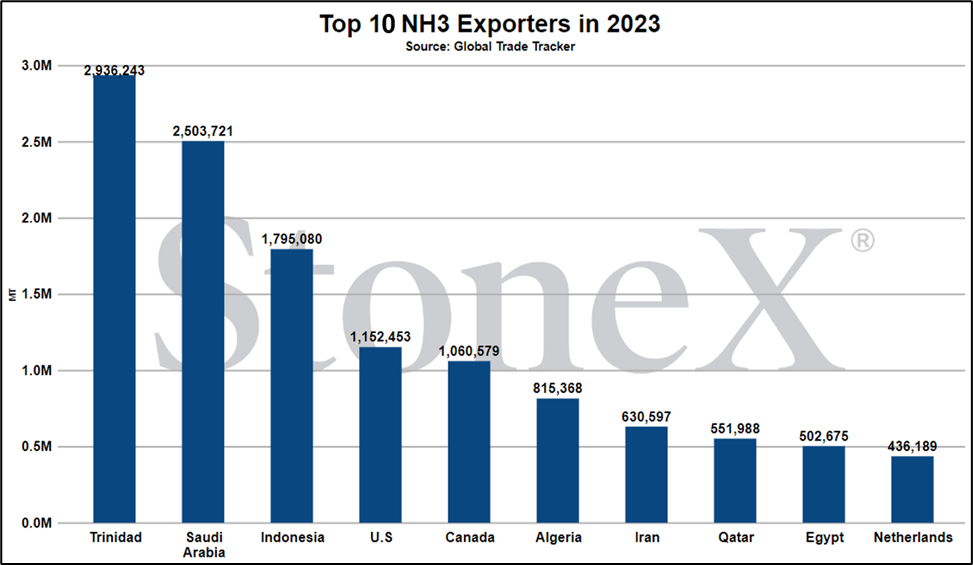
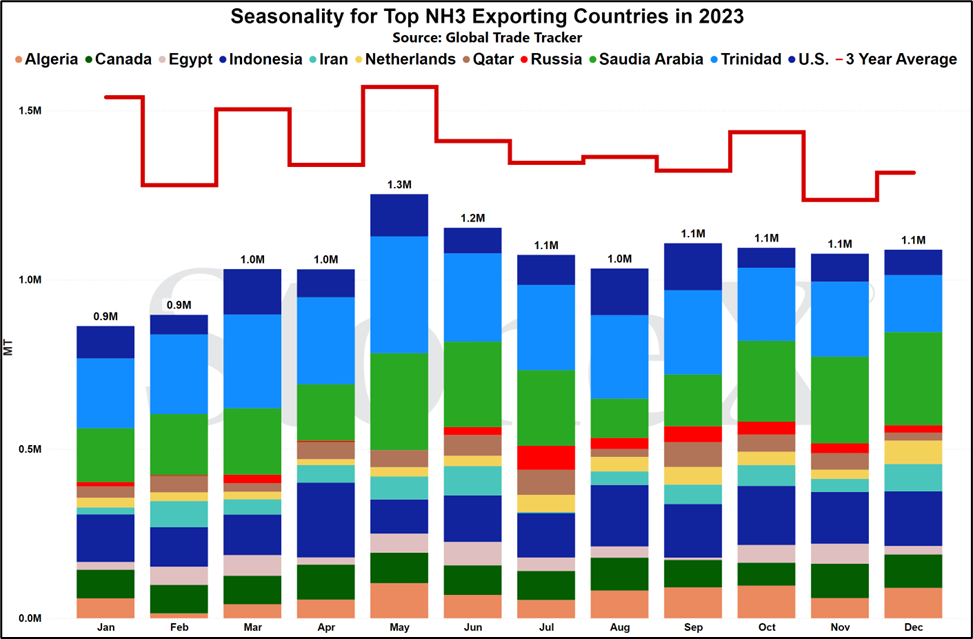
Hopes that Russia will resume NH3 exports from Taman and retake its title as the worlds largest exporter/supplier have continued to wane in 2024. While it does sound as though product is expected to start flowing, a return to their typical 5M tons per year seem a ways off.
Unfortunately for the global nitrogen market, this lends that much more price support. As long as Russia is not playing a large part in the export marketplace, the global S&D remains much tighter and suppliers able to keep their price ideas high.
Tampa August price rallies $60 on tighter supplies (Trinidad/Russia)
As some global production issues started to mount and the hope of Russian exports started to fade, I started to believe that we would see Tampa rally from July.
$60 higher was a bit of a shock.
However, it shouldn't be. Trinidad has continue to deal with gas curtailments that have been hitting their nitrogen production. That removed a lot of supply from the marketplace and sales books that were already comfortable got that much better. Hopes of seeing a big return of Russian NH3 exports have continued to suffer as it sounds 2024 will not see many tons departing. Hopes are now watching 2025.
The Tampa price isn't a value that we can do much with. In practical terms, it is just the monthly agreement between two parties. However, it does help to show a nitrogen market that continues to see support.
Fall N.A. prepay programs out, higher than last summer
If you are a North American farmer and you have recently talked with your retailer about the fall NH3 prepay pricing, you might have been taken aback by the fact that this years price is higher than last years price. Not only the shock of it being higher but that it is higher even with grain prices being so much lower.
What gives?
Unfortunately, this was expected.
Last years program pricing was shockingly low. It blew thru our expectations. It was so low that it actually set records when looked at in relation to corn values. When most folks in the industry talk about last years pricing, there is generally a bit of a chuckle and a "sure wish we could do that again".
However, if last years program shot far too low of expectations, this years program was on the higher side. It almost felt like they were trying to make up for last years "mistake". Maybe not but it sure fits.
As much as I would like to tell you to hold off and things will get better, I do not expect that. Sounds as though the uptake was pretty solid. At the end of the day, fall NH3 applicators are fall NH3 applicators unless Mother Nature forces their hand. That, combined with an expected 90+M acres of corn next year means that NH3 demand should remain solid.
Just the way the fertilizer world works sometimes.

U.S. Midwest Wholesale price average
Vs 30 days ago - unchanged vs 30 days earlier
Vs 90 days ago - -25% or approximately $150 lower
Vs 6 months ago - -21% or approximately $120 lower
Vs 1 year ago - 18% or approximately $70 higher
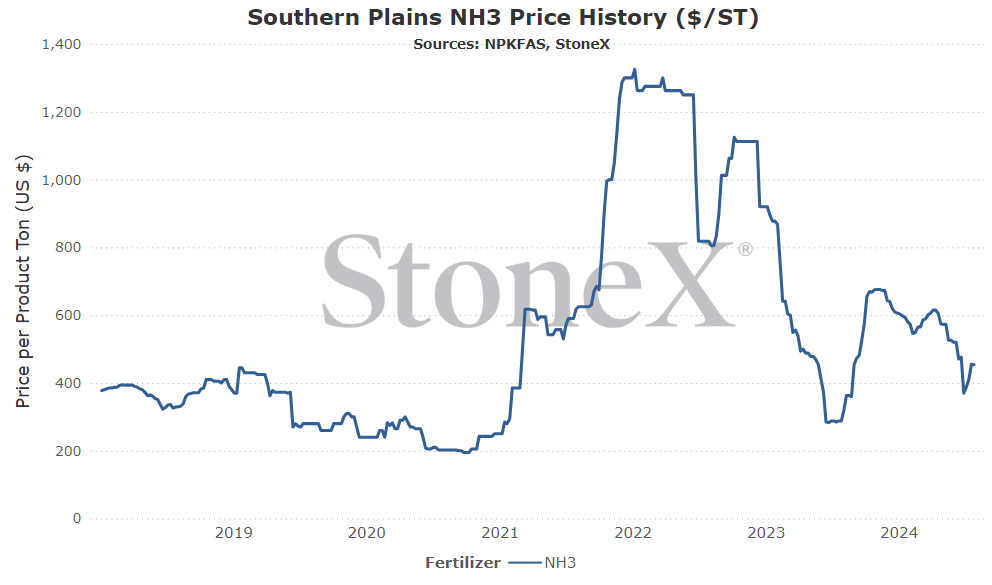
U.S. Southern Plains price average
Vs 30 days ago - 23% or approximately $84 higher
Vs 90 days ago - -21% or approximately $120 lower
Vs 6 months ago - -21% or approximately $119 lower
Vs 1 year ago - 58% or approximately $166 higher
- Doesn't look like Russia is coming back - I was hopeful that Russia, typically the biggest global exporter, would return in 2024 and provide some much needed supplies to the market. That hope is failing more and more by the day. Even if they start exporting, it does not look like it will be at normal tonnages. That removes a lot of expected/hoped for supply from the global S&D.
- Production problems continue to eat into available supplies - Trinidad has had production issues due to gas supplies. Europe still remains at 75% of normal. The list goes on. Each of these on their own is not a huge deal to the global S&D. When combined, they start to eat into available product and cause prices to rally.
- Enough N.A. fall prepay was locked up to set a floor - I was hopeful that when N.A. fall prepay programs were announced that they would be in line with last years. I fully realize that grain prices are lower than last year but even with that, a rollover on the program would have been solid. Even with the higher price, it sounds like the uptake was solid in the industry and gave manufacturers a solid reason to keep prices steady to higher.
- Farmer economics may impact fall application more than expected - those that purchased into the fall prepay programs likely expected fall demand to remain relatively unchanged. As they say, fall NH3 guys are going to stay fall NH3 guys...unless they do not. Farmer economics stink right now and should cause folks to at least consider their alternatives. Will that mean application reductions? Will that mean delaying to spring?
- Some production issues should be resolved sooner than later - we are hoping that at least some of these production issues we have been seeing will resolve themselves sooner than later. The biggest from my POV was Trinidad and it sounds like steps have been taken to allow production to return.
- If Russia surprised with an earlier return - this...is a stretch. I do not believe it will happen. There isn't much that really helps this argument/POV. However, it still needs to be considered because if it happened by itself, it should have wide reaching implications. Still, I wouldn't get my hopes up on this one.
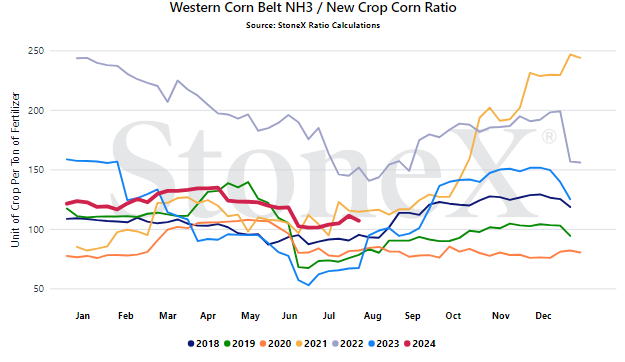
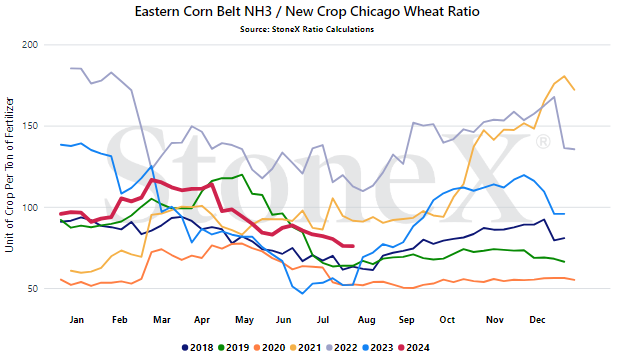
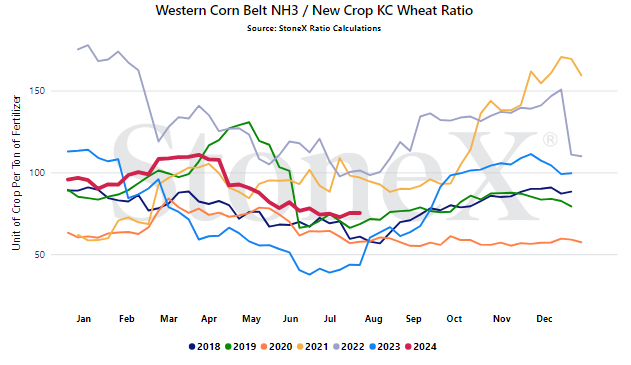
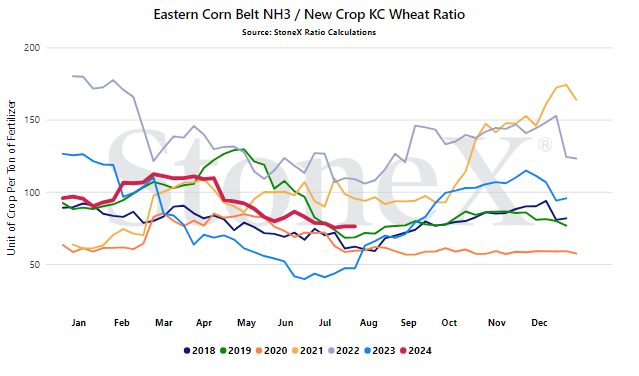
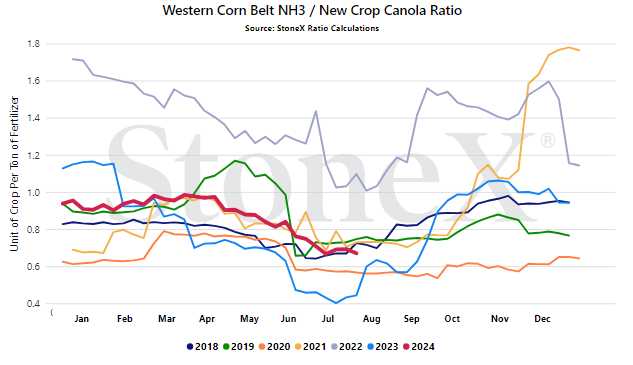
Where are the current NH3/grain ratio values today
We believe that only looking at the flat price of either grains or fertilizer can be misleading:
-
Only selling grain can hurt you if fertilizer prices rise substantially
-
Only buying fertilizer can hurt you if grain prices fall
We look at the ratio "value" to get a better indication of where we are or how many bushels of X does it take to pay for 1 ton of fertilizer.
Would you rather:
-
Spend 150 bushels to pay for 1 ton of potash
-
Spend 100 bushels to pay for 1 ton of NH3
When we compare the current ratio value against recent years, we start to see if we are high or low.
YOUR VALUES MAY LOOK DIFFERENT
This graph looks at the NOLA NH3 price vs the flat grain price. There are no logistics on either product. Your location will look different due to fertilizer logistical costs, grain basis, etc.
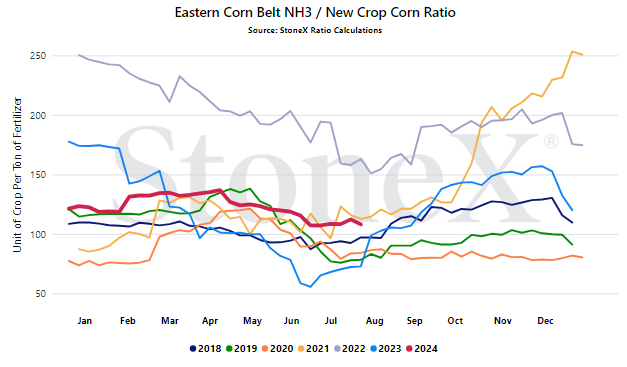
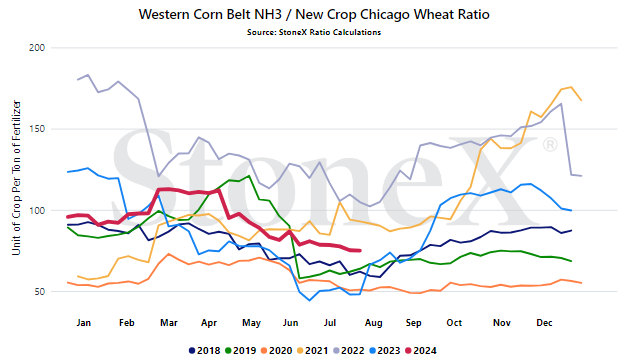
- Russian exports...or lack of for 2024 - I had been hopeful of a return of Russian NH3 exports. As the world leader, their return would have upset what has become the global norm. In a sense, they would have provided a lot of inventory to a market needing it and help values fall. However, at this point, losing most hope that big tons appear in 2024. Is it too early to start hoping for 2025?
- Trinidad production issues - in another less supply available than originally thought, Trinidad isn't helping things. With gas supply issues, nitrogen manufacturers are having to cut back production rates until those supplies come back. That just eats into available supply and supports NH3 values.
- Solid N.A. fall prepay uptake - from our perspective, it seems like the fall prepay programs had a solid uptake. At least enough to make manufacturers comfortable until very close to the start of fall season. If they are comfortably sold and global POV is supportive, hard to see values falling anytime soon.
StoneX Ratio Calculation
The ratio calculation is derived from Bloomberg historical grains values as well as fertilizer values from StoneX, NPKFAS, and Argus.
The calculation is simply dividing the fertilizer price by each grain price.
All data was sourced from StoneX unless otherwise noted.