Global
For me, it is really hard to see a lot of upside in the potash marketplace. Sure, there could be some insane Black Swan events that come along and change the direction, but it would take a lot of effort for that to happen. Globally, potash is currently very well supplied. Going forward, it appears that supplies should continue to get better.
The outlook remains flat with more of a tendency to the lower side than the upper side. Current supplies appear adequate. Looming new production and Belarus still lower than normal points to even more supply becoming available in the future.
North America
Like the global outlook, it appears that supplies are in good order. Values have largely been doing nothing but sliding since topping out early 2022. We are watching the Canadian rail strike story closely as that could impede product shipments. While the overall outlook would remain bearish, logistical troubles could push nearby product higher. Aside from that:
The North America potash price outlook remains flat to bearish until closer to fall application season. Once near/in the fall application season, we could see prices tick higher as the market scrambles for resupply but outside that, it appears that supply is sufficient.

Canadian rail strike continues, threatening potash logistics
My top story for global potash continues to be centered around the Canadian rail strike.
This story has been ongoing for a while now. Unions have voted to strike but no one has been willing to take the step into a work stoppage that would cause potash shipments to cease. Could they do this in the near future? Certainly, but it is not an expectation. At the end of the day, I still do not believe that anyone in this situation wants work to stop. All parties are aware of the importance of rail to Canada as a whole. Stopping shipments would bring a light onto everyone that is not wanted nor needed.
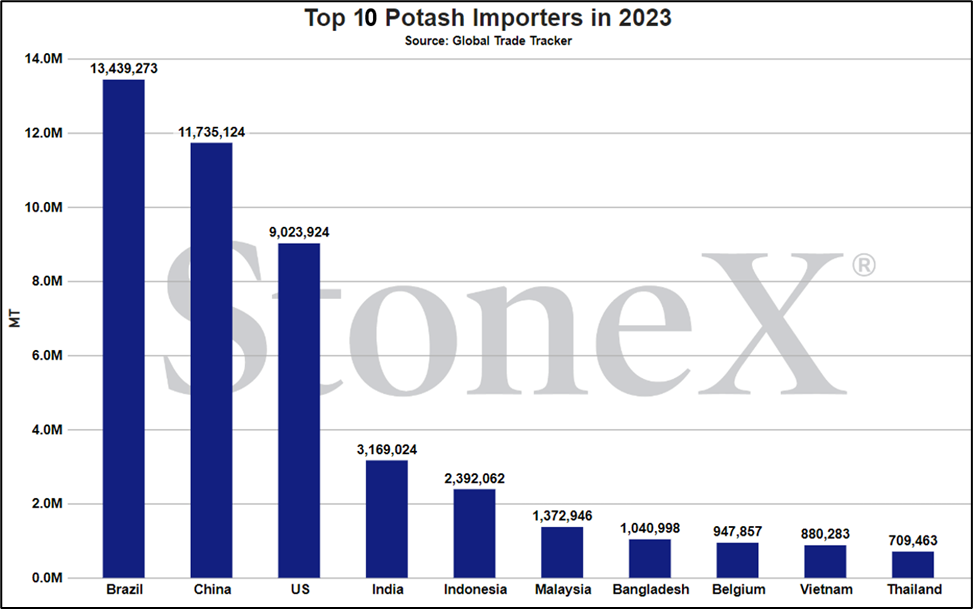
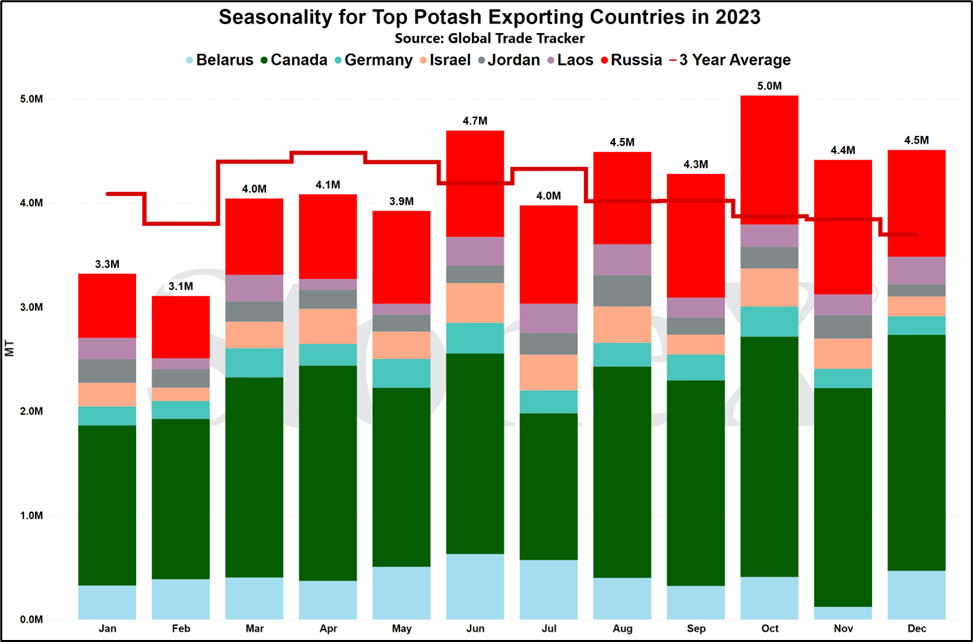
However, we do need to continue to watch just in case it turns into a story. One could say that Canadian potash is rather important on the global stage since they are twice the size of the next larges exporter (Russia) and account for more imports than numbers 2, 3, 4, and 5...combined.
Even in the event of a work stoppage, the length will be more important than the actual event. If it turns out to be only a few days, potash production can continue with storage being used to hold the product. However, only so many days of manufacturing can be held. In the case of a longer term rail stoppage, mining efforts would have to slow/stop until shipments began again.
I'll leave this piece like this: I do not believe/expect a rail strike to stop shipments but if it were to happen, it could have global implications so it is worthy of our time to watch.

Global S&D outlook remains well supplied
Over the last 30 days, there has been a lot of information that should support potash values:
- Mosaic/Nutrien potash exporter Canpotex has announced their being fully committed on sales thru the end of September.
- 2025 crop mix expectations continue to point to solid fall 2024 / spring 2025 demand
- Closing fertilizer year 2024 (June 30) ending inventories for U.S. were relatively low
- India secured their annual contract
- China secured a large contract with Israel
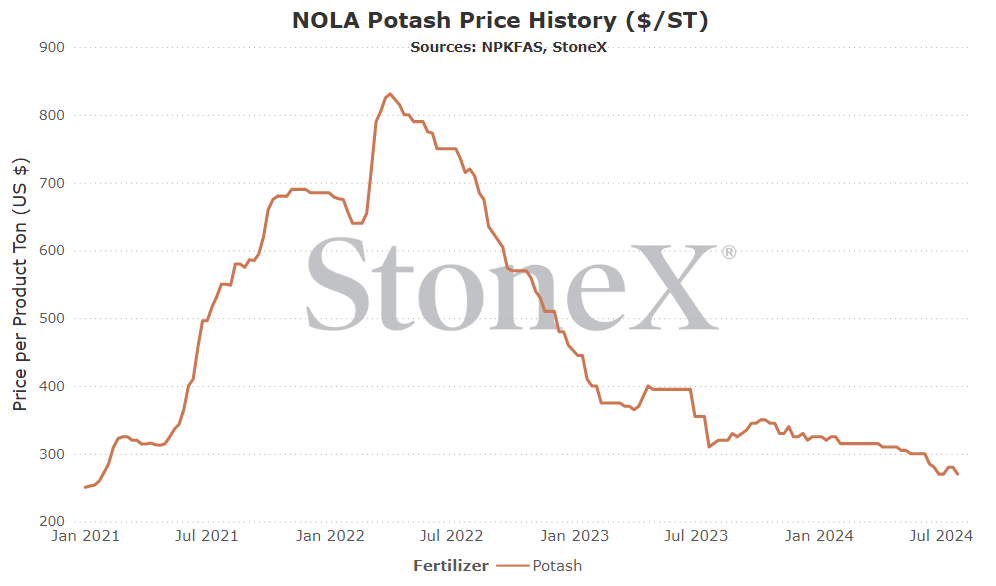
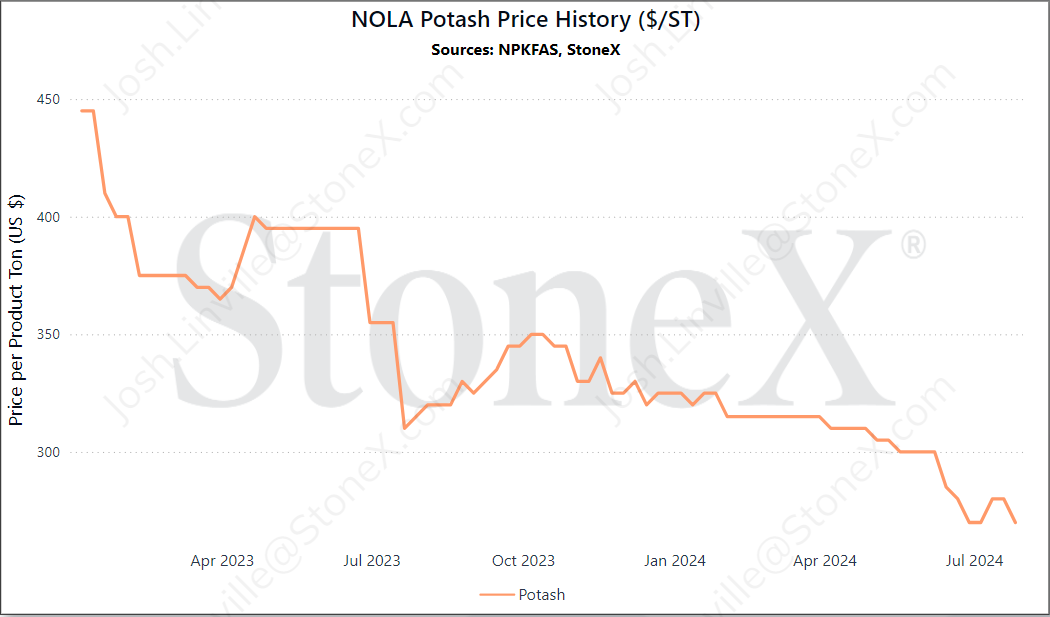
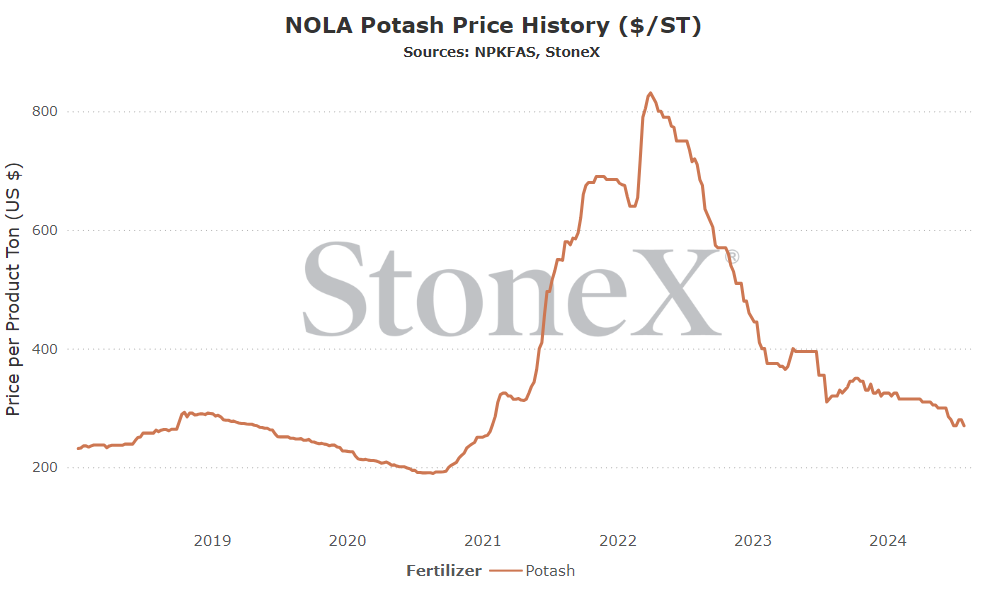
The list goes on and most of those points on their own merit would have created higher prices over the last few year...but that has not been the case. With the exception of a couple short term bounces, the trend has been lower. If the graph below was ran starting in 2022, it would show an even more stark negative line. Could prices start rebounding on recent news? Certainly, but it still hasn't as of my writing this.
Basically, what I am trying to say is that even with all of this positive news surrounding the potash marketplace, values are still stagnant to lower. Why?
Well, my perspective is that there is ample supply...with more on the way.
Expansions continue in Canada. New mines are still believed for Russia. China continues to invest in Laos to increase their production (and in turn reduce their need of "western" produced product). The market is currently well supplied, and it looks like supplies are going to continue to build. When markets become oversupplied, it has to correct the S&D. Prices fall until it forces that highest cost producer to shut down, thereby removing that supply and creating the balance. I cannot say for certain that is the case, but it sure feels that way.
Last point - do not let this lull you to sleep. Just as soon as we think we have the market cornered, it will lash out and make us look like fools. Things change fast...
Questions about fall N.A. demand due to poor farmer economics
Regardless of what some folks in the ag industry want to think, farmer economics are nowhere near as good as they have been the last few years. Almost a year ago today, new crop corn values were in the mid-$5's. Today, they are nearly at $4 and it seems there is more fear of further downside.
So what will farmers do...and when will they do it?
That is the biggest question every fertilizer input has to ask today.
- Will farmers cut back on application rates to save money on inputs?
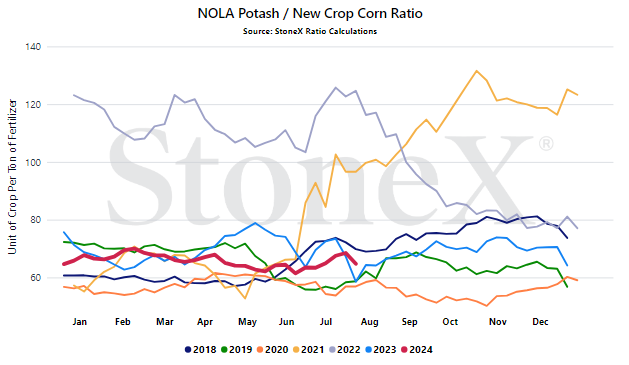
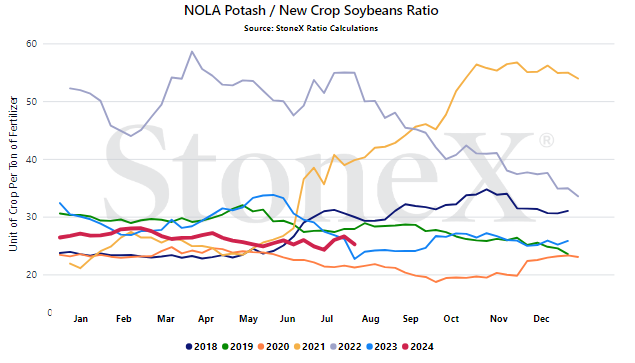
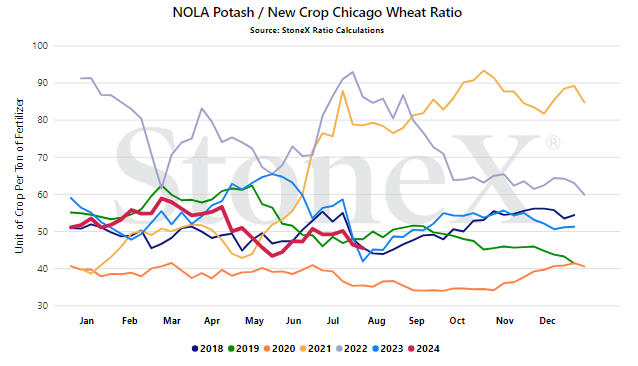
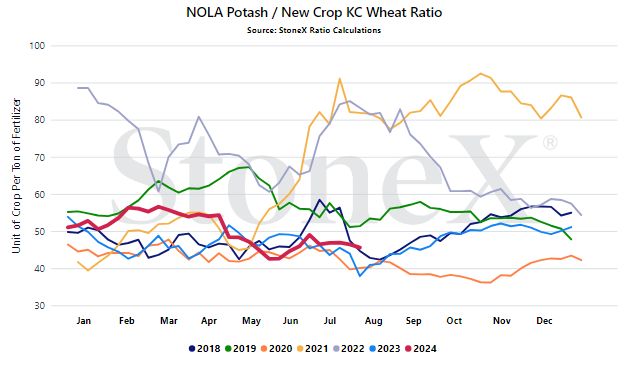
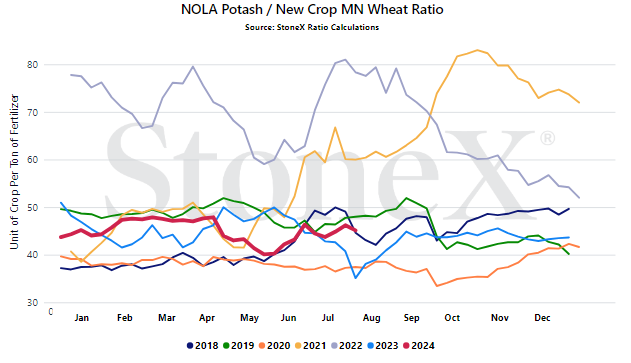
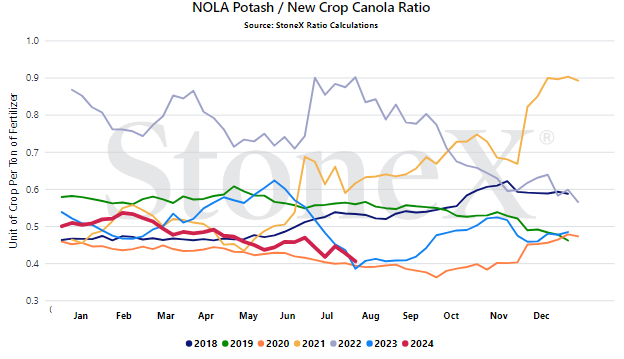
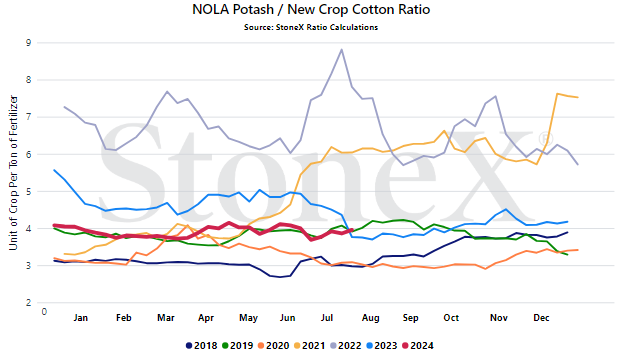
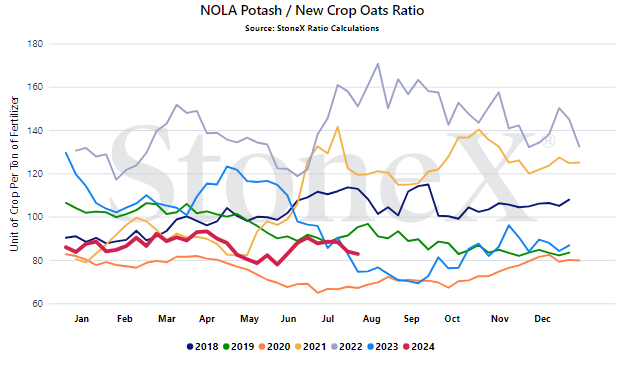
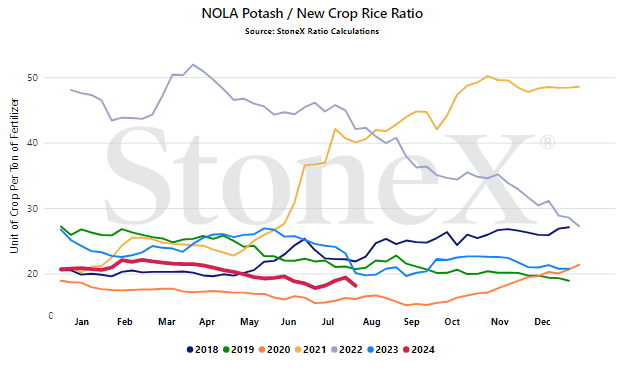
- Will farmers hold or increase potash application rates with the current values decent vs corn (check ratio charts below)?
- Will fall farmers opt to wait until spring (buys time for prices to correct but could usher in new logistical challenge)?
- Will farmers hold fall application rates steady, but wait until November 1st to make purchases?
These are the questions that no one has a solid answer to...and put suppliers in a bind. Values have been falling so why would a retailer want to put product in place just to watch it deteriorate? With so much uncertainty surrounding the 2024 crop as well as the 2025 outlook, what do you put into place for demand that may or may not be there? If you wait too long, will you be able to get it?
Now, I'm not crying wolf on "if you do not purchase it, it will not be there". We have done that before. Product always arrives...for buyers willing to pay for it but that is the issue. The more the industry takes a "just in time" approach to buying, the more it will need to pay to justify a "just in time supply" marketplace.
There is a lot of uncertainty surrounding ag in general and it is very easy to just shut down. I would implore you to have conversations with your supplier. Hopefully the response is somewhere along the lines of "we have it in stock and have you covered when you are ready". I really do.
NOLA/New Orleans Louisiana
Vs 30 days ago - -4% or approximately $10 lower
Vs 90 days ago - -13% or approximately $40 lower
Vs 6 months ago - -14% or approximately $45 lower
Vs 1 year ago - -14% or approximately $45 lower
U.S. Midwest Average (average of several points across the Midwest)
Vs 30 days ago - -3% or approximately $13 lower
Vs 90 days ago - -5% or approximately $20 lower
Vs 6 months ago - -9% or approximately $36 lower
Vs 1 year ago - -9% or approximately $34 lower
- Canadian rail strike turns into work stoppage – this is extremely low on the "possibility/probability" list, but it is a big enough deal that we have to keep tabs on it. If this strike were to turn into a longer term work stoppage and potash was not considered critical, Canadian product would mostly come to a standstill. Look at the list of exporters above. See where that could get into an issue relatively quickly?
- More manufacturers take the "curtail production" approach - so far, only one company with one location has taken this approach. All others appear to be stepping on the gas...hard. However, if prices continue to slide as they have, will they decide to join and curtail their own production? Enough locations do this and we are dealing with a fundamentally different S&D.
- Lower priced potash caused demand to jump – for me, phosphate and potash are a package deal. I know this isn't the same for everyone but I know a lot more that do look at it that way. No way around it, phosphate is extremely high priced. It does raise the question if farmers will lean more into their potash applications this year.
- Ample supplies continue to try and find price to cut production – with supplies appearing ample and prices continuing to slide, it sure has the feel of a market trying to find the high cost producer to shut off. The theory is that in a well/over supplied marketplace, the price will fall enough to cause the highest cost producer to shut down over losses. So far, I haven't heard of any mines shutting down...
- Fall application demand takes a hit due to farmer economics - it is rough out there for farmers. 2024 profitability stinks vs the last few years. 2025 isn't much better. Will farmers cut their application rate to save money? Will fall applicators drag their feet to spring? Lot of ways that farmers could surprise the market this fall in a price negative way.
- Higher priced phosphate causes demand to fall – I have yet to meet a farmer who has said anything close to "let's go ahead with applying one product now. We will apply the other later. Just charge me for two passes."!!! With phosphate being so high priced, it could easily impact fall demand. If phosphate demand takes a hit, it could easily take potash with it.
Where are the current potash/grain ratio values today
We believe that only looking at the flat price of either grains or fertilizer can be misleading:
-
Only selling grain can hurt you if fertilizer prices rise substantially
-
Only buying fertilizer can hurt you if grain prices fall
We look at the ratio "value" to get a better indication of where we are or how many bushels of X does it take to pay for 1 ton of fertilizer.
Would you rather:
-
Spend 120 bushels to pay for 1 ton of potash
-
Spend 60 bushels to pay for 1 ton of potash
When we compare the current ratio value against recent years, we start to see if we are high or low.
YOUR VALUES MAY LOOK DIFFERENT
This graph looks at the NOLA potash price vs the flat grain price. There are no logistics on either product. Your location will look different due to fertilizer logistical costs, grain basis, etc.
- Global supplies continuing to build - even when Canpotex (Canadian potash group) announces that they are committed on tonnage thru September, global values do nothing. Even when huge annual contracts are agreed to, global values do nothing. Not to say that potash cannot see prices higher, but everything is pointing to a market that is extremely well supplied right now...and there is more coming.
- Canadian rail strike - a Canadian rail strike work stoppage is still low on my list of probabilities...but it would be impactful enough that we need to continue to watch. If these mines see their rail logistics fail, they have no river capacity and trucks just cannot fill in the gap. A work stoppage lasts long enough, and suddenly we are discussing fall inventory availability. Low likelihood but high impact.
- Fall demand (will it be better or worse with phosphate high?) - I'm still not sure where I stand on this. On the one hand, I could see where farmers apply more potash with phosphate prices so high (opting to back off phosphate). I could also see where farmers pull back on potash because they pulled back on phosphate as well. Especially true if farmers delay fall application to spring. I have questions...
StoneX Ratio Calculation
The ratio calculation is derived from Bloomberg historical grains values as well as fertilizer values from StoneX, NPKFAS, and Argus.
The calculation is simply dividing the fertilizer price by each grain price.
All data was sourced from StoneX unless otherwise noted.