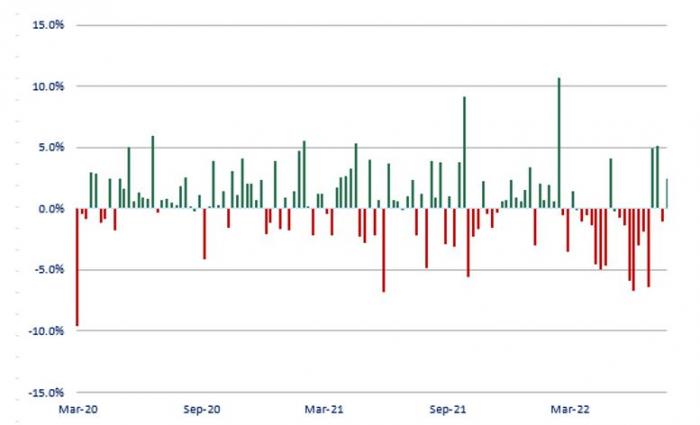
The base metal suite is a sea of red in morning trading (15th August), as the market opens to weaker than expected Chinese data for July, extending uncertainty over the timing of a recovery in the country (against a backdrop of recessionary fears in the west). In today’s commentary we highlight the latest data readings for China.
LME Base Metal Suite 3M Price Performance (W/W Change)
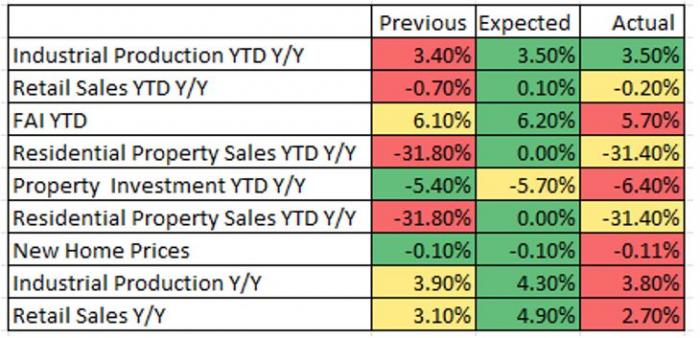
Chinese July Readings for Industrial Production, Retail Sales, Fixed-Asset Investment (FAI) & Property Investment – Actual Versus Forecast
Industrial & Retail Sales Come in Below Expectations
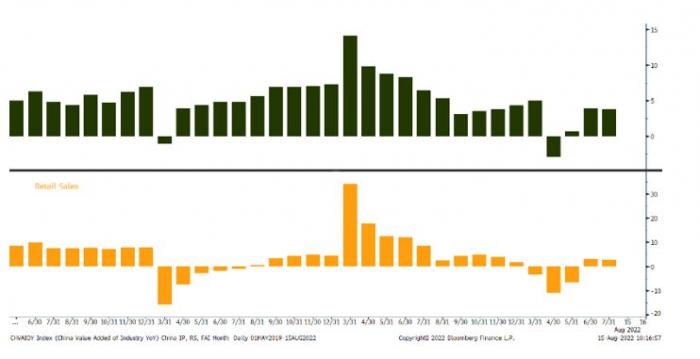
Monthly Industrial Production & Retail Sales Figures
Both retail sales and industrial production (on a Y/Y basis) came in below market expectations, reversing a June lift, as ongoing COVID-19 cases in the country (and concerns over the health of the economy) kept consumer sentiment at weak levels, while manufacturing activity has been hampered by low demand and a recent heatwave in the eastern and southern regions (resulting in power rationing).
Key Examples of Production Disruptions Within China Over the Last Week
• SMM reported on 9th August that a Chinese aluminium smelter (with 190,000t/y production) in Sichuan had suffered an accident, although injuries and fatalities were not disclosed.
• China locked down the urban area of Guixi from 10th August, due to a rise in COVID-19 cases. Please note, this is home to the country’s largest copper producer, Jiangxi Copper Company, although it is uncertain whether production will be impacted.
• One copper plant, two aluminium plants and three secondary lead smelter plants in China’s southern and eastern regions are being impacted by a heatwave, resulting in power rationing causing disruptions. Please note, the reduced run rates at the three lead secondary smelters (in Dahua, Chaowei and Tianchang) could account for a loss of ~600t/y (based on CRU data), although the impact is expected to be minimal as most secondary smelters for lead in China are underutilised. Meanwhile, Tongling Nonferrous Metals Group Co (one of China’s top copper producers) is reportedly cutting output due to reduced electricity supplies. The run rates at plants in Jinlong and Aolu (with a combined capacity of 650,00t/y) have been impacted for two days (at the time reported 11th August).
The Property Sector is Weighing on a H2 Recovery
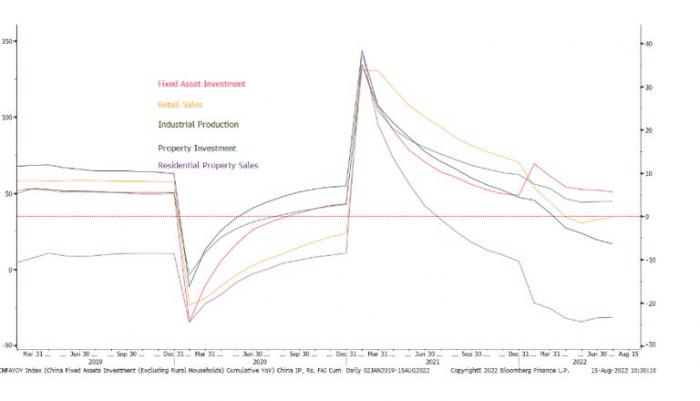
Industrial Production, Retail Sales, Property Investment, Residential Property Sales & FAI YTD Y/Y
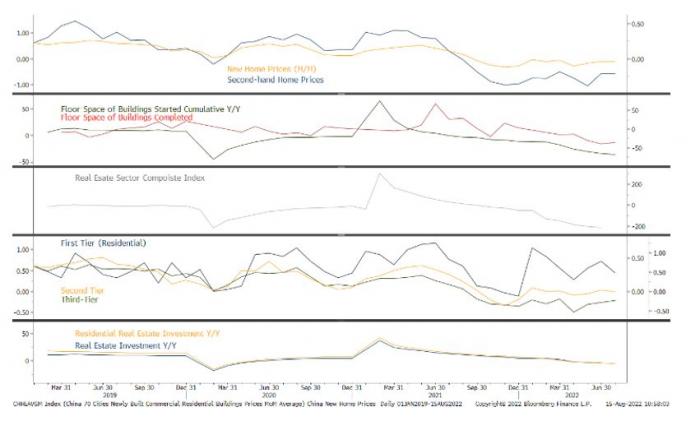
On a YTD basis, while industrial production managed to record a modest lift by July at 3.5% (from 3.4% in June), displaying the impact of easing lockdowns in the country, a slowdown was recorded over the same period for Fixed Asset Investment (FAI), retail sales and property investment, with the latter two remaining in the red. Focusing on the property sector, despite the Government signalling its largest action to help support the ailing sector in June (on an approved plan to set up a real estate fund at 80bn yuan),mortgage boycotts amid companies defaulting on their debt has resulted in both investment and sales collapsing since the beginning of 2021. As it stands, by July (on a YTD basis), property investment and residential sales had fallen by 6.4% and 31.4% respectively, limiting the construction demand outlook for this year (and likely the years to come).
New Homes Prices Remain in Contractionary Territory Since August 2021
China Unexpectedly Cuts Rates – Is This a Move of Last Resort?
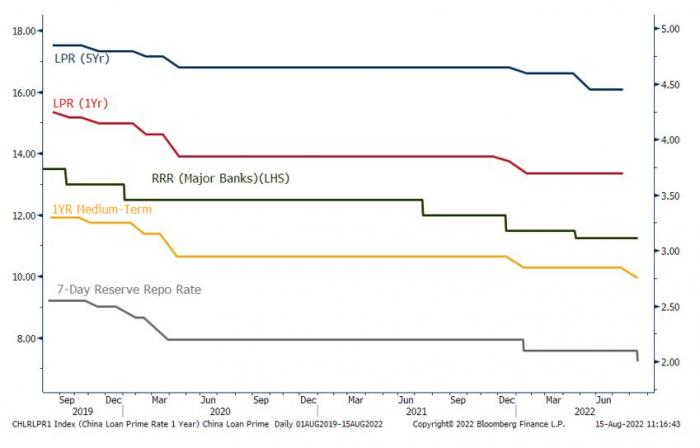
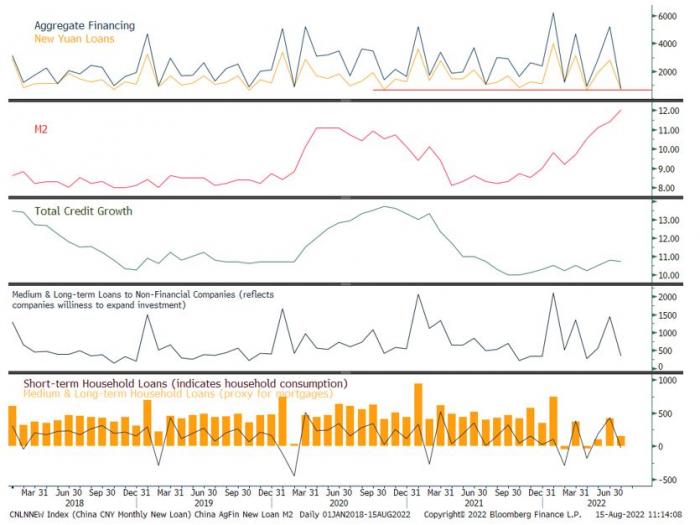
In addition to the release of weaker than expected figures for industrial, property and retail activity in July, the surprise move from the PBoC on Monday (15th August) to cut its 1Y medium-term lending facility (to 2.75% from 2.85%), arguably is demonstrating the mounting pressure the central bank and Government are facing to uphold growth in the country. Indeed, at the beginning of July, we heard from the PBoC Governor Yi Gang where he stated that stimulus would likely arise from further injections of credit over lowering interest rates (given that “real interest rate is pretty low”). However, given weak domestic demand and consumer sentiment, in addition to outright credit being limited towards the property sector (to avoid stimulating bad debt), total aggregate financing and new yuan loans in July were sharply pulled back.
Key Chinese Interest Rates
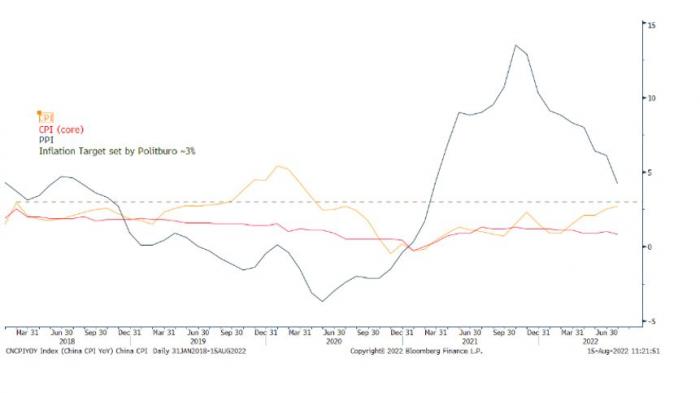
Meanwhile, it is important to note, that the decision to lower the 1Y medium-term lending rate (which provided strength to the U.S. dollar in morning trading 15th August), was made possible by falling factory-gate prices (which have been in decline since October 2021), while inflation remains below the 3% target set in the Two Sessions meeting in March for this year. Looking ahead, we expect that additional policy actions could take place in the form of further issuances of local Government bonds (supporting future infrastructure projects), while any escalation in inflation could limit further rate cuts.
Chinese CPI Versus PPI
Total Aggregate Financing & New Yuan Loans
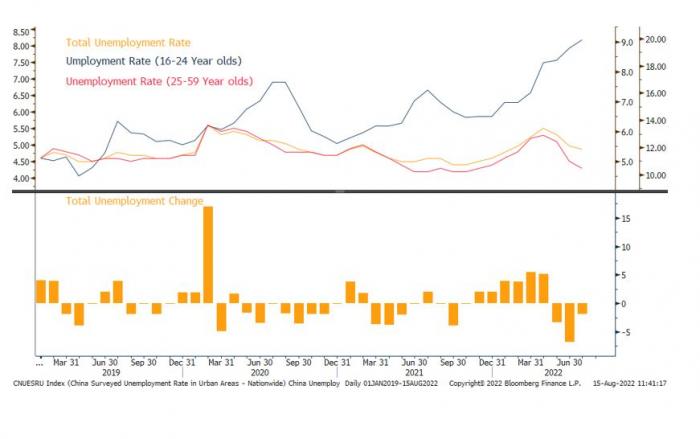
Unemployment Rates Improve Marginally in July – Although the Youth Market Hits a Record High
Domestic Production Will Be a Key Area to Watch
This week China will release its production of key commodities, with steel, aluminium and 10-nonferrous metal figures out today (15th August), while copper, lead and zinc numbers will be released by mid-week. What we can see so far:
Chinese Aluminium, Steel and 10 Non-ferrous Metal Production
• Aluminium production has recorded a record high month of output in July at 3.4Mt, up 1.2% M/M and 5.1% Y/Y. If we continue to see production at this level (in addition to what we have already recorded YTD), then output could hit a new record of 40.6Mt. However, given the high dependency of coal-produced aluminium in China (at ~75%), CRU reports that in recent weeks, as much as 50% of smelters are loss making at current SHFE prices.
Chinese Aluminium Production on Track to Hit a Record This Year
• Steel production has fallen for a second consecutive month in July, with output at its lowest monthly level since November 2021. As it stands, production (based on current levels and YTD data) is on track to record a decline of 1% in 2022 (at ~1Bnt). Please note, China’s NDRC set a target this year for steel production to come in lower than 2021’s level (in order to adhere to emission legislation). Meanwhile, the global outlook for the steel industry remains bleak, with a recovery in demand heavily reliant on a pickup in China over H2.
Chinese Steel Production