Indonesia Announces Finalised Trade Export Tariffs on Semi-Processed Materials
Background
As part of Indonesia's ‘grand strategy’ to increase its downstream industries and shipment of refined products (away from raw materials), President Joko Widodo has over the last several years announced the upcoming implementation of export bans (or tariff increases) on a host of materials. Please note, this includes most notably the implementation of an export ban on nickel ore in 2020.
“In our grand strategy, we want to downstream all commodities”, “other countries will realise that they must invest here or partner with our companies. That’s the only option” - Indonesia's President Joko Widodo – November 2021
What Commodities Are Involved?
The Indonesian Government named 21 commodities in which their downstream processing must be increased. The policy (which was announced on 6th February 2023) includes:
- Metals & intermediary products (bauxite, steel, nickel, gold, silver, tin, and copper)
- Energy (coal, natural gas, biofuel, and oil)
- Other (asphalt, rubber, coconut, logs, pine resin, fish, shrimp, seaweed, salt, and crab).
However, please note, the implementation timeline is varied per commodity.
What to Note in 2023 – Latest Developments
July 2023 – Indonesia Extends Relaxation on Export Bans
On 14th July, Indonesia delayed the implementation of an outright export ban on a host of products (including iron, lead, zinc, and copper concentrates), pushing the deadline into 2024. Indeed here, the Finance Ministry announced a progressive tax would instead be introduced, while domestic producers built smelting capacity.
The updated export tariffs from 14th July:
• 2.5-10% up to 31st December 2023
• 5-15% from 1st January to 31st May 2024
• 5-15% from 1st January to 31st May 2024
Please note here, the tax rate for each exporter will vary depending on the progress of smelter construction, with only those having reached 50% of development by January 2023, qualifying for the updated extension.
In Our View:
We expect the implementation of an export ban on copper concentrates to be limited in China, with Indonesia only accounting for 2% of global imports into the country. In addition, Freeport-McMoRan (who owns Grasberg, the largest copper mine in Indonesia) passed the 50% construction build of a copper smelter this year, allowing free flow of material from July. Meanwhile, looking to 2024, given the addition of a greenfield smelter by the company, it is forecast that all domestically produced copper concentrate material will be taken up by smelter capacity within the country.
We expect the implementation of an export ban on copper concentrates to be limited in China, with Indonesia only accounting for 2% of global imports into the country. In addition, Freeport-McMoRan (who owns Grasberg, the largest copper mine in Indonesia) passed the 50% construction build of a copper smelter this year, allowing free flow of material from July. Meanwhile, looking to 2024, given the addition of a greenfield smelter by the company, it is forecast that all domestically produced copper concentrate material will be taken up by smelter capacity within the country.
June 2023 – Indonesia Implements Export Restrictions on Bauxite
From 10th June, Indonesia moved forward with an export ban on all bauxite shipments. Please note, Indonesia is the world’s sixth larger bauxite producer, with output posting ~30Mt/y.
While there was some push back from miners, given a view that there were not enough domestic facilities to process their output, Indonesia’s Mining Minister Arifin Tasrif declared that with 14Mt of smelter grade plants, it would be enough to absorb the ore production. Please note, Indonesia has three smelter-grade alumina plants and one chemical grade alumina plant.
In our View:
While China is the largest importer of bauxite in the world (with Indonesia coming in third behind Guinea and Australia). We forecast that the impact to China would be modest given that China could increase imports from other countries to fill the gap (indeed exports have been falling in recent years after a previous ban over 2014-2017 period).
While China is the largest importer of bauxite in the world (with Indonesia coming in third behind Guinea and Australia). We forecast that the impact to China would be modest given that China could increase imports from other countries to fill the gap (indeed exports have been falling in recent years after a previous ban over 2014-2017 period).
June 2023 – Tin Export Regulations Remain Unclear
Along with bauxite, refined tin was set to face an export ban by June 2023; however, it remains unclear if this ban has been implemented, with the Indonesian’s Mining Ministry publishing exports at 7,990t in June. Please note here, originally an export ban was to be implemented for refined tin in 2024, although it was moved forward to “late” this year (based on comments from Indonesia's Minister of Investment/Chairman of Indonesia Investment Coordinating Board).
If this export ban does go into play, it would accompany a ban on tin ore/concentrates back in 2009 and could result in an increase in solder bar production (tin’s largest end use) in the country. We forecast a cap on exports to be more likely than an outright export ban. Please note, Indonesia is responsible for 20% of global tin production (with one-third of this material being exported).
Indonesian Tin Exports
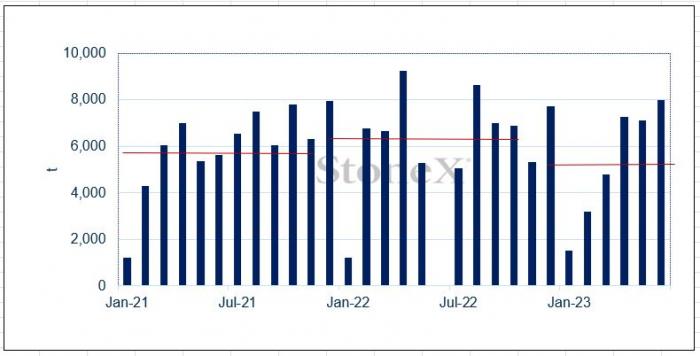
Please note: Red lines indicate annual averages.
Source Bloomberg. Design StoneX.
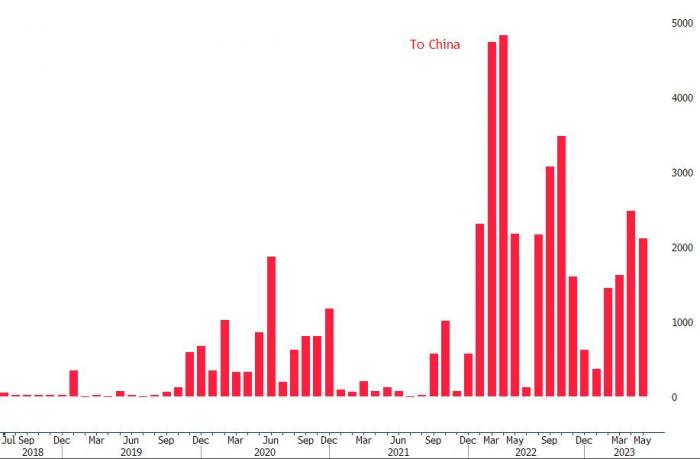
Indonesian Tin Exports Into China Have Been Pulling Back
Source Bloomberg. Design StoneX.
Nickel Intermediatory Product Export Restrictions Delayed Due to Oversupply
During the Indonesian International Nickel and Cobalt Industry China Summit (held in Jakarta in May), a senior official announced that the country will not prioritise a tax or ban on the export of low-grade nickel products in the near-term. This decision was made in light of global inflationary pressures resulting in an economic slowdown this year which has depressed nickel demand over the last 12 months, with both low-grade NPI and wider nickel markets in Indonesia in significant oversupply.
The progressive tax was to impact both NPI and ferronickel, based on the price of nickel itself (i.e., 2% tax when nickel prices lift above $15,000/t). Please note, nickel and stainless steel are the third largest export item in Indonesia (nickel refining could add up to $35Bn of added value – based on President Widodo’s comments).
The progressive tax was to impact both NPI and ferronickel, based on the price of nickel itself (i.e., 2% tax when nickel prices lift above $15,000/t). Please note, nickel and stainless steel are the third largest export item in Indonesia (nickel refining could add up to $35Bn of added value – based on President Widodo’s comments).
“If we don’t control this, later our ore reserves would be depleted quickly”, “This is a fiscal instrument that we use to extend our reserves” – Septain Hario Seto - Deputy for Mining Investment at Coordinating Ministry for Maritime and Investment Affairs
However, please note, authorities in the country are focused on the introduction of a nickel price index before year-end 2023, with any export tax to be introduced after the price index.
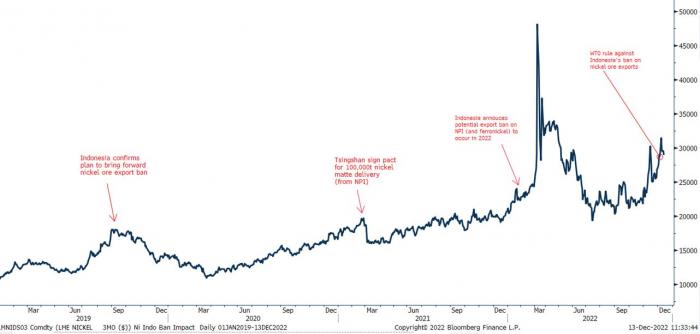
Impact of Indonesian Export Ban on Nickel
Source Bloomberg. Design StoneX.