
Base Metal Commentary - Feature Article
By: Natalie Scott-Gray, Senior Metals Demand Analyst, EMEA and Asia region
THE BASE METAL SUITE – BULLISH OR BEARISH TO YEAR-END?
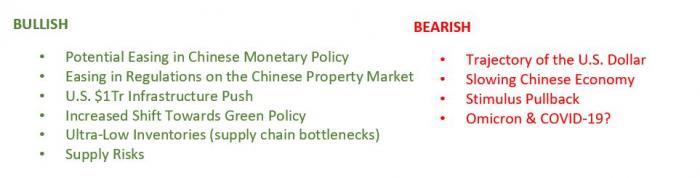
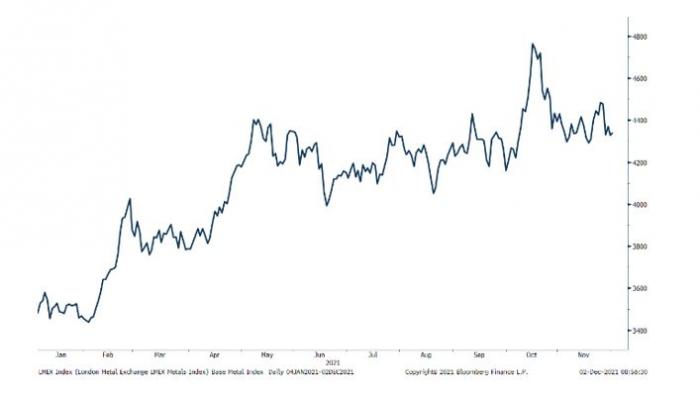
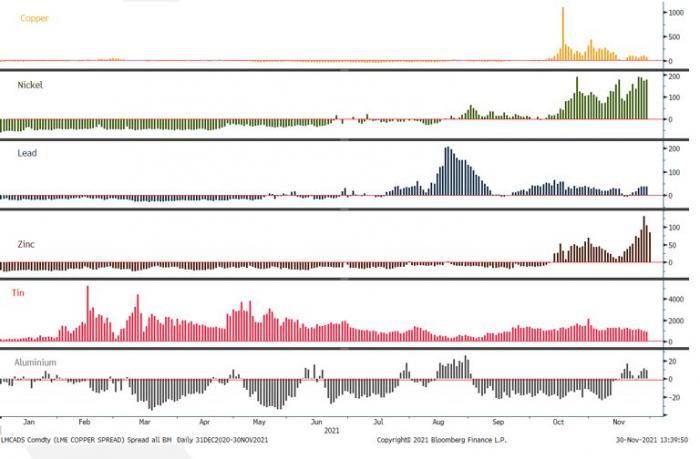
With only weeks to go until the close of 2021, it appears that key driving forces behind the impressive performance for the base metal suite (which on a YTD basis has risen by 27%), may also be drawing in, with the further uncertainty of Omicron adding to downside risk. However, on the flip side, ongoing supply chain bottlenecks amid increased demand has resulted in global inventories being pulled down to historically low levels, with each of the metals in the suite recording a backwardation on the LME, underpinning higher prices. Below is part one of a feature article that will discuss in more detail the strengths and weaknesses behind the key themes for each argument, with part two covering base metal fundamentals.
SNAPSHOT OF KEY BULLISH & BEARISH PARAMETERS FOR THE BASE METAL SUITE
Source: StoneX
LME BASE METAL INDEX YTD
Source: Bloomberg
Omicron & COVID-19 Remains the Largest Downside Risk for Recovery
Knowledge of the variant strain of COVID-19 known as Omicron was virtually unheard of until
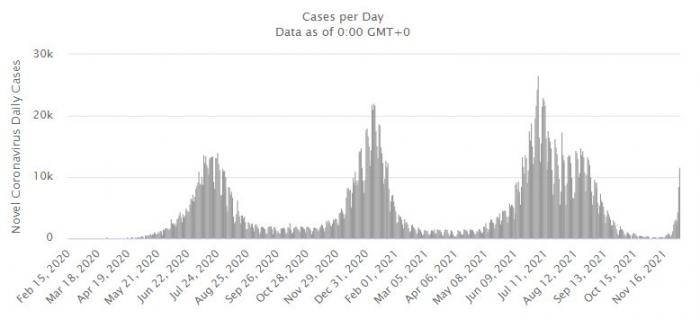
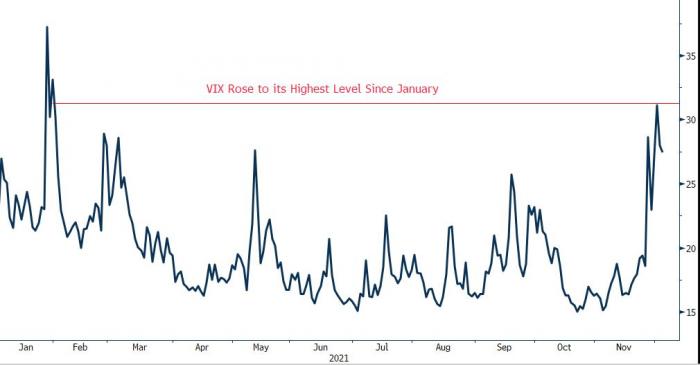
25th November, when it was announced by South Africa’s National Institute of Communicable Diseases. While different strains (or mutations) of COVID-19 are certainly not something new, the uncertainty attached to them and indeed nerviness created by second, third and fourth waves (most recently as a consequence of the delta variant), has created great downside risk to the global markets. As it stands, questions over the key parameters of the virus’s severity, transmissibility and indeed the ability of current vaccine to be effective remained unanswered, with the CEO of Moderna, World Health Organisation and top executives of Pfizer citing in recent days that it will take “weeks” before these questions can be answered. In the meantime, it will just be a waiting game, in which we can expect continued heightened volatility.
25th November, when it was announced by South Africa’s National Institute of Communicable Diseases. While different strains (or mutations) of COVID-19 are certainly not something new, the uncertainty attached to them and indeed nerviness created by second, third and fourth waves (most recently as a consequence of the delta variant), has created great downside risk to the global markets. As it stands, questions over the key parameters of the virus’s severity, transmissibility and indeed the ability of current vaccine to be effective remained unanswered, with the CEO of Moderna, World Health Organisation and top executives of Pfizer citing in recent days that it will take “weeks” before these questions can be answered. In the meantime, it will just be a waiting game, in which we can expect continued heightened volatility.
However, one key question to ask is, what could the possible impact of Omicron play on central bank policy?
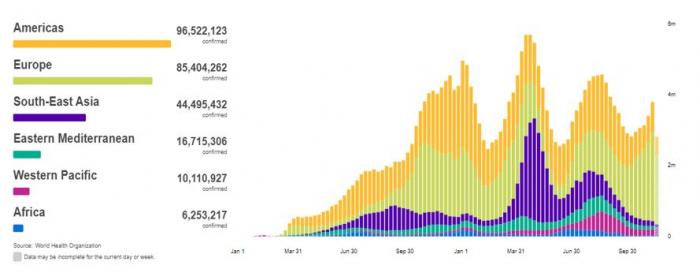
In part, this question has already been answered, with the Federal Reserve Chair Jerome Powell earlier in the week alluding to the recent rise in Covid-19 cases and emergence of Omicron posing “downside risks to employment and economic activity and increased uncertainty for inflation”. Meanwhile, we forecast that the greatest risk (with respect to delaying economic recovery), could arise from countries that practice zero-tolerance towards COVID-19, such as China. Indeed, on 2nd December it was reported that certain cities in Northern China have blocked non-container imports of material such as copper ore, iron ore, zinc and coal in order to prevent the spread of the virus. Meanwhile, regions such as Europe, which are already under tremendous economic strain from a fourth wave (please note, Europe is currently responsible for 50% of all current global infections and deaths from the virus) stand at high risk.
SOUTH AFRICAN CASES PER DAY
Source: World-o-meter
SOUTH AFRICAN CASES PER DAY
Source: WHO
VIX
Source: Bloomberg
Trajectory of the U.S. Dollar & Stimulus Pullback
U.S. DOLLAR VERSUS THE EURO
Source: Bloomberg
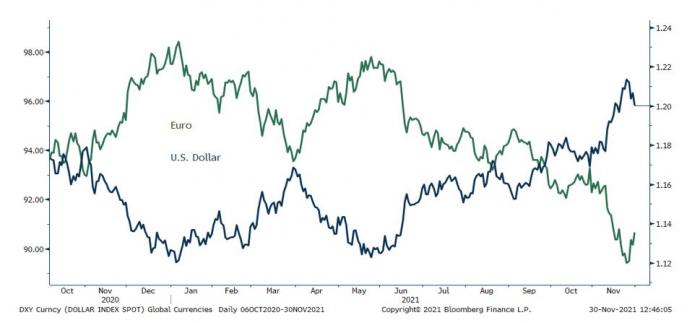
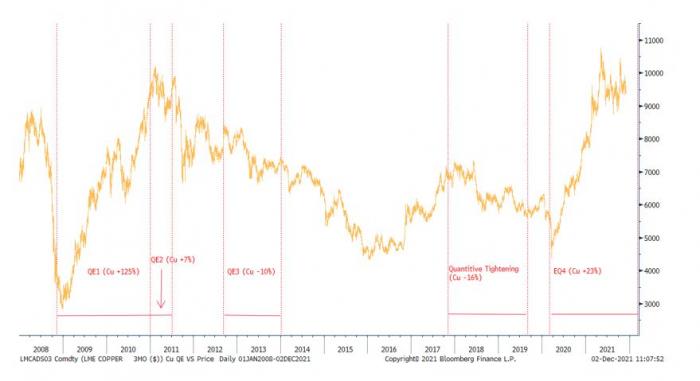
The U.S. dollar has been in a steady upward trend since May, driven in large part by expectations that the Federal Reserve would announce a timeline for tapering of its $120Bn a month quantitative easing programme (that went into effect in March 2020), while expectations towards the timeline for interest rate rises had shifted from 2023 to as early as H1 2022. However, developments over the last month have fast tracked expectations of the U.S. stimulus pullback, cementing a pathway for a stronger U.S. dollar over the next six months.
Timeline of U.S. Federal Reserve Moves Over the Last Month
2-3rd November: FOMC announced in its November meeting that the pace of asset purchases would start to be reduced (with a forecast endpoint by June 2022).
30th November: Fed Chairman Jerome Powell testified to the Senate Banking Committee stating that the use of the word ‘transitionary’ when it comes to U.S. inflation should be “retired”, while “higher prices we’re seeing are related to the supply and demand imbalances that can be traced directly to the pandemic and the reopening of the economy”, “it’s also the case that price increases have spread much more broadly…the risk of higher inflation has increased”. He further alluded that it was appropriate to consider wrapping up tapering of bond purchases a few months sooner than expected.
One final thing to point out here, is that while the pace of tapering is likely to increase, this doesn’t necessarily mean that the timeline for interest rate rises will change in step, as the Federal Reserve has always stated that it holds these decisions against strict parameters of inflation (above 2%) and unemployment (roughly at February 2020 levels ~3%). However, the outcome of the next FOMC meeting on 14-15th December will be critical to answering this question, where special economic projections (including the all-important dot-plot – which indicates Federal Reserve members’ views on the timeline for interest rate changes) will be released.
COPPER PRICE VERSUS U.S. QUANTITIVE EASING
Source: Bloomberg
FISCAL IMPULSE PULLBACK
Source: Bloomberg
Slowing Chinese Economy Versus Potential Easing in Chinese Monetary Policy & Relaxation of Regulations in the Chinese Property Market?
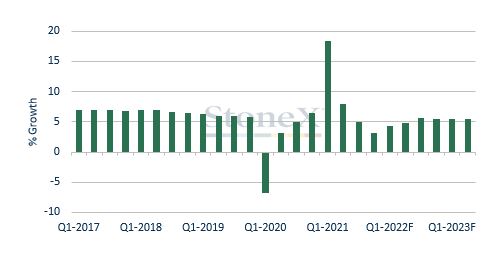
China’s economic growth has come under pressure in H2 2021 as the country grapples with an energy crisis, rising concerns over the property market and the continued presence of COVID-19 infections. While the Government have taken quick steps to try and solve these issues (please see below), the longer-term trajectory for growth under the move to cross-cyclical policy (from counter-cyclical), could equate to a further reduction in the pace of economic growth. (Please note cross cyclical reflects a move away from adding stimulus to spur a slowing economy, cutting interest rates, and boosting infrastructure, instead towards quicker action that is ‘pre-emptive’ and ‘moderate’ with a longer time frame in mind).
Key Date to Watch Out for: 16th-18th December where China will hold its Communist Party Central Economic Work Conference, which might uncover more information on future changes to policy.
CHINESE GDP FORECAST
Source: Bloomberg
China Steps to Help Boost Economic Growth
Chinese Real Estate
Chinese banks have been told by financial regulators that they have to issue more loans to property firms for project development, to ensure that outstanding loans to projects shows more growth compared to October; however, ‘relaxation of loan properties’, will have to hold to the principle set out that “homes are for living in, not for speculation”. Meanwhile, other measures are in the hands of individual cities, which will be able to change the rules surrounding land sales by December (such as refraining from asking for full payment within a month of purchases by developers).
Power Crunch
The National Development and Reform Commission have taken several steps to reduce soaring coal prices in the country, with thermal coal responsible for 54% of China’s domestic power supply. Steps include extending price limits on coal-fired power prices, liberalising the coal market, encouraging higher domestic production (in addition to recently importing coal from Australia after a one-year ban). The Chinese State Grid confirmed by the end of November that power supply and demand has returned to “normal”.
Monetary Easing
The PBoC released its quarterly policy report in mid-November, where it was highly noted that certain lines or wording in previous reports was taken out leading to expectations that an easing in monetary policy could be on the cards. The best example is, that the reference to not engaging in ‘large-scale, flood-like stimulus’ (which has been alluded to in each statement report since 2019) was removed.
Supply Chain Bottlenecks Glimpse Light at the End of the Tunnel?
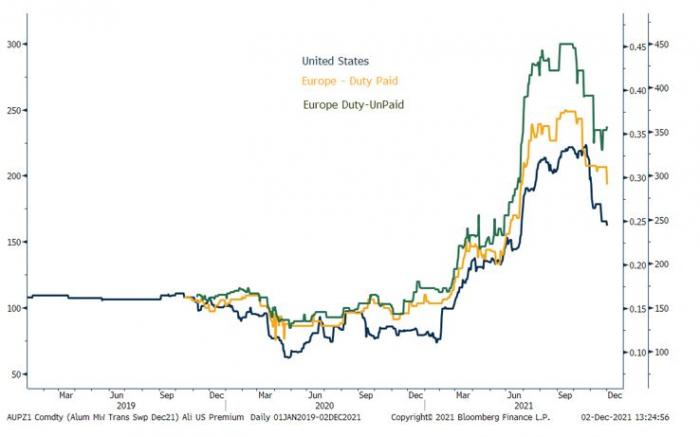
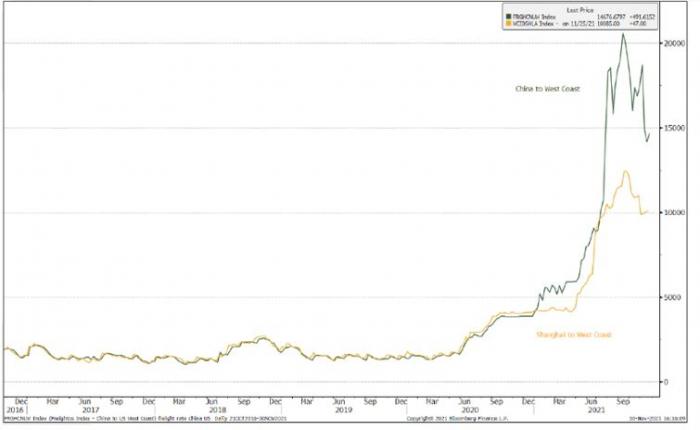
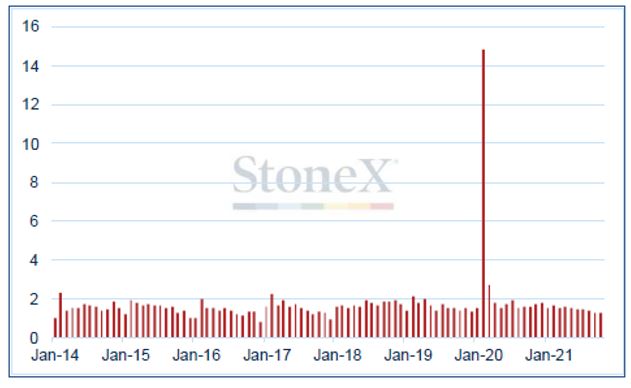
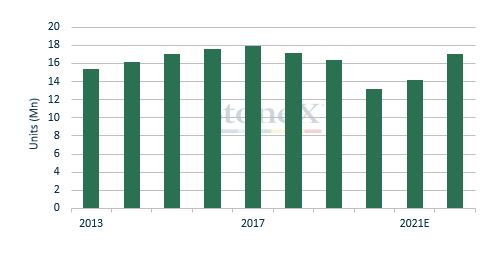
In our view, we cannot foresee supply bottlenecks (that have plagued the market over most of this year from soaring freight rates, ongoing COVID-19 regulations slowing normal working practices and indeed lack of labour force), abating over the next six months. However, we are starting to see a glimmer of light at the end of the tunnel. Focusing on the base metal market, this week it was reported that Asia’s largest importer of aluminium, Japan, is set to pay a lower import premium in Q4 ($195/t), which would mark the first decline in the premium in over a year (Q2 premium at $220/t). This sentiment is also being felt in the west, with aluminium premiums to Europe and the U.S. retreating off highs recorded over Q3. However, while there appears to be a modest improvement in the delivery of raw materials, the knock-on impact to downstream sectors such as the automotive industry, means sectors such as this will take longer to recover. Indeed, looking at China’s October release of vehicle inventory to sales ratio, it stood at just 1.29 months’ of sales, the second lowest level since December 2017 (please note this ratio stood at 1.24 in September). Meanwhile, in the United States, due to a shortage of critical components such as semiconductors, both production and profits have taken a sharp hit in the industry, although it is forecast that pent-up demand will benefit the outlook next year.
ALUMINIUM PREMIUMS
Source: Bloomberg
GLOBAL FREIGHT RATES
Source: Bloomberg
CHINA VEHICLE INVENTORY: SALES RATIO (MONTHS’ COVER)
Source: Bloomberg
U.S. AUTOMOTIVE PRODUCTION FORECAST
Source: Bloomberg
Ultra-Low Base Metal Inventories & Supply Risks
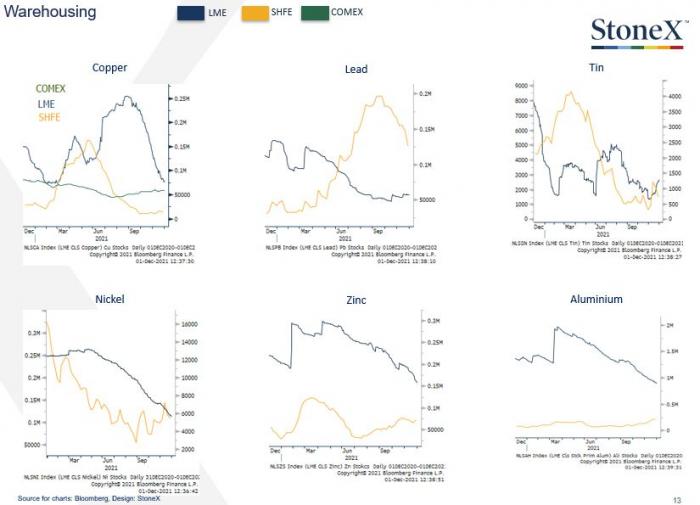
Arguably one of the largest drivers behind elevated base metal prices now (and a key parameter to watch for future price direction), is the draw down in physical metal inventories, which in turn has caused increased speculation in the market, further inflaming the narrative towards higher prices. We will discuss the pull down in metal inventories and our view on what we expect in 2022 in more detail in our next feature article, in addition to exploring what key risks are arising regarding mine production.
U.S. $1Tr Infrastructure Push & Increased Shift Towards Green Policy
While the scale of heightened demand forecast to come from green policy will far outstrip the level of demand set to arise from President Biden’s approved $1Tr infrastructure plan, both concepts (while hard to quantify accurately), are set to record impacts to the market over the medium-term rather than the near-term. To understand more on this topic, please see our presentation on ‘Green Policy and Its Impact on the Base Metals’ presentation here.
BASE METAL GLOBAL INVENTORIES
Source: Bloomberg
BASE METAL LME CASH-3M SPREAD
Source: Bloomberg
- Base Metals
This material should be construed as market commentary and represents the opinions and viewpoints of the author, and does not reflect tailored advice associated with any specific account.
The views are current only through the date stated and are subject to change at any time based upon market or other conditions, and StoneX Group Inc. (“SGI”) disclaims any responsibility to update such views. Actual results, performance, or achievements may differ materially from those expressed or implied. Information is based on data gathered from what we believe are reliable sources. Past performance does not guarantee future results.
The StoneX Group Inc. group of companies provides financial services worldwide through its subsidiaries, including physical commodities, securities, exchange-traded and over-the-counter derivatives, risk management, global payments and foreign exchange products in accordance with applicable law in the jurisdictions where services are provided.
References to certain OTC products or swaps are made on behalf of StoneX Markets, LLC (SXM), a member of the National Futures Association (NFA) and provisionally registered with the U.S. Commodity Futures Trading Commission (CFTC) as a swap dealer. SXM’s products are designed only for individuals or firms who qualify under CFTC rules as an ‘Eligible Contract Participant’ and who have been accepted as customers of SXM.
StoneX Financial Inc. (SFI) is a member of FINRA/NFA/SIPC and registered with the MSRB. SFI is registered with the U.S. Securities and Exchange Commission (SEC) as a Broker-Dealer and with the CFTC as a Futures Commission Merchant and Commodity Trading Advisor. StoneX Financial (Canada) Inc. (SFCI) is registered in Canada and is a member of CIRO and CIPF. References to certain securities trading are made on behalf of the BD Division of SFI and are intended only for an audience of institutional clients as defined by FINRA Rule 4512(c). References to certain exchange-traded futures and options are made on behalf of the FCM Division of SFI. Wealth Management is offered through SA Stone Wealth Management Inc., member FINRA/SIPC, and SA Stone Investment Advisors Inc., an SEC-registered investment advisor, both wholly owned subsidiaries of SGI.
R.J. O’Brien & Associates, LLC (RJO) is registered with the CFTC as a Futures Commission Merchant and is a member of NFA.
StoneX Financial Ltd (SFL) is registered in England and Wales, company no. 5616586. SFL is authorized and regulated by the Financial Conduct Authority (FCA) (registration number FRN:446717) to provide services to professional and eligible customers including: arrangement, execution and, where required, clearing derivative transactions in exchange traded futures and options. SFL is also authorized to engage in the arrangement and execution of transactions in certain OTC products, certain securities trading, precious metals trading and payment services to eligible customers. SFL is authorized and regulated by the FCA under the Payment Services Regulations 2017 for the provision of payment services. SFL is a category 1 ring-dealing member of the London Metal Exchange. In addition SFL also engages in other physically delivered commodities business and other general business activities which are unregulated and not required to be authorized by the FCA.
This communication is issued in the European Economic Area by StoneX Financial Europe GmbH (SFEG). StoneX is the trade name used by STONEX GROUP INC. and all its associated entities and subsidiaries. StoneX Financial Europe GmbH (“SFEG”) is a securities trading firm registered in Germany under Company No. HRB 80844.
StoneX APAC Pte. Ltd. (“SAP”) (Co. Reg. No 200616676W) is regulated as a Dealer (PS20190001002) under the Precious Stones and Precious Metals (Prevention of Money Laundering and Terrorism Financing) Act 2019 for purposes of anti-money laundering and countering the financing of terrorism. SAP is an “Approved International Trading Company” authorized to act as a “Spot Commodity Broker” under the Commodity Trading Act.
StoneX Financial Pte Ltd (Co. Reg. No 201130598R) (“SFP”) is regulated by the Monetary Authority of Singapore and is a Capital Markets Service Licence holder (for dealing in capital market products), an Exempt Financial Adviser (for advising on investment products and issuing or promulgating analyses/ reports on investment products) and a Major Payment Institution (for domestic and cross-border money transfer services).
SFP may distribute analysis/report produced by its respective foreign affiliates within the StoneX Group of companies pursuant to an arrangement under Regulation 32C of the Financial Advisers Regulations Recipients should contact SFP at (65) 6309 1000 for any matters arising from, or in connection with, this webinar.
StoneX APAC Pte. Ltd. (“SAP”) (Co. Reg. No 200616676W) is regulated as a Dealer (PS20190001002) under the Precious Stones and Precious Metals (Prevention of Money Laundering and Terrorism Financing) Act 2019 for purposes of anti-money laundering and countering the financing of terrorism.
StoneX Financial (HK) Limited (CE No.: BCQ152) (“SHK”) is regulated by the Hong Kong Securities and Futures Commission for Dealing in Securities and Dealing in Futures Contracts.
StoneX Financial Pty Ltd (ACN 141 774 727) holds an Australian Financial Service License (AFSL: 345646) for Dealing in Securities, Exchange-Traded Derivatives Contracts, OTC Derivatives Contracts and Foreign Exchange Contracts, and is regulated by the Australian Securities and Investments Commission.
StoneX Securities Co., Ltd. (“SSJ”) (Co. Reg. No 010401047199) is regulated by the Japanese Financial Services Agency as a Type-I Financial Instruments Business Operator (Kanto Local Finance Bureau (FIBO)No.291’), is a member of the Financial Futures Association of Japan for dealing and broking FX and FX Option transactions, and is a member of the Japan Securities Dealers Association for dealing and broking stock indices and option transactions.
Trading swaps and over-the-counter derivatives, exchange-traded derivatives and options and securities involves substantial risk and is not suitable for all investors. Past performance of any futures or option is not indicative of future success. Indicators are not a trading system and are not published as a specific trade recommendation. The information herein is not a recommendation to trade nor investment research or an offer to buy or sell any derivative or security. It does not take into account your particular investment objectives, financial situation or needs and does not create a binding obligation on any of the StoneX group of companies to enter into any transaction with you. You are advised to perform an independent investigation of any transaction to determine whether any transaction is suitable for you. No part of this material may be copied, photocopied or duplicated in any form by any means or redistributed without the prior written consent of StoneX Group Inc.
The report/analysis herein is not directed to, or intended for distribution to or use by, any person or entity who is a citizen or resident of or located in any locality, state, country or other jurisdiction where such distribution, publication, availability or use would be contrary to law or regulation.
© 2026 StoneX Group Inc. All Rights Reserved.
Discover more insights
Our subscribers have access to comprehensive market analysis from StoneX spanning commodities, equities, currencies and more.
Related articles for Base Metals

Weekly Base Metal Macroeconomic Slides
The global macroeconomic backdrop remains increasingly mixed, with resilient growth across the US and Eurozone contrasting against a continued slowdown in China. Strong Western economic activity, supported by robust manufacturing data, ongoing AI-driven investment, and resilient corporate earnings, has helped sustain industrial demand and improve broader market sentiment. However, China's weakening manufacturing sector, subdued domestic consumption, persistent property market challenges, and declining construction activity continue to weigh on the outlook for global metals demand.

Natalie Scott-Gray
- Base Metals
StoneX TV:Indonesia's Metal Export Ban Shocks China
Natalie Scott-Gray, StoneX Senior Metals Analyst, explains how Indonesia's tightening control over mineral exports, China's upcoming Politburo meeting and new carbon regulations are reshaping the outlook for nickel, aluminium, copper and other base metals. She discusses why supply-side risks may prove more influential than broad stimulus expectations during the second half of the year.
Natalie Scott-Gray
- Base Metals
StoneX TV: Copper's Next Move Is About Supply, Not AI
Copper prices are back in focus as physical supply tightens, inventories decline and demand strengthens. Natalie Scott-Gray, StoneX Senior Metals Analyst, explains why the copper market is becoming fundamentally tighter, how Section 232 tariff uncertainty and China's buying patterns are reshaping global flows, and why AI, electrification and grid investment continue to support the long-term outlook despite recent weakness in technology stocks.
Natalie Scott-Gray
- Base Metals
StoneX: We open markets
Our market expertise, advanced platforms, global reach, culture of full transparency and commitment to our clients’ success all set us apart in the financial marketplace.
Reach
With access to 40+ derivatives exchanges, 180+ foreign exchange markets, nearly every global securities marketplace and numerous bi-lateral liquidity venues, StoneX’s digital network and deep relationships can take clients anywhere they want to go.
Transparency
As a publicly traded company meeting the highest standards of regulatory compliance in the markets we serve; our financials and record of accomplishment are matters of public record. StoneX’s commitment to “doing the right thing over the easy thing” sets us apart in the industry and helps us build respect, client trust and new partnerships.
Expertise
From our proprietary Market Intelligence platform, to “boots on the ground” expertise from award-winning traders and professionals, we connect our clients directly to actionable insights they can use to make more informed decisions and achieve their goals in the global markets.