
Daily Coffee Report 8/5/26
Daily coffee report
StoneX Coffee Team
- Coffee
Quarterly Commodities Outlook is available for free now. Download your report →
By: StoneX Intelligence Brazil, StoneX Intelligence Brazil


The global economic environment is currently very complex for the market, which is still struggling to recover from the logistical disruptions caused by the Covid-19 pandemic, the sharp acceleration of inflation and the fear of a global economic recession. The turbulent context tends to act bearishly on coffee quotes by increasing risk aversion and decreasing investors' appetite for risky assets, such as coffee, possibly impacting coffee consumption growth.
However, the steady drop in Arabica's certified stocks has combined doubts regarding Brazilian production to support prices above the USD 200.00/lb mark. In 2022, Arabica's most liquid contract fluctuated through the end of July between US¢ 195.30/lb and US¢ 258.45/lb, with an average value of US¢ 227.60/lb over the period. For example, this is significantly higher than the 2020 and 2021 averages, which stood at US¢ 112.05/lb and US¢ 169.26/lb, respectively.
Arabica coffee certified stocks (thousand bags)
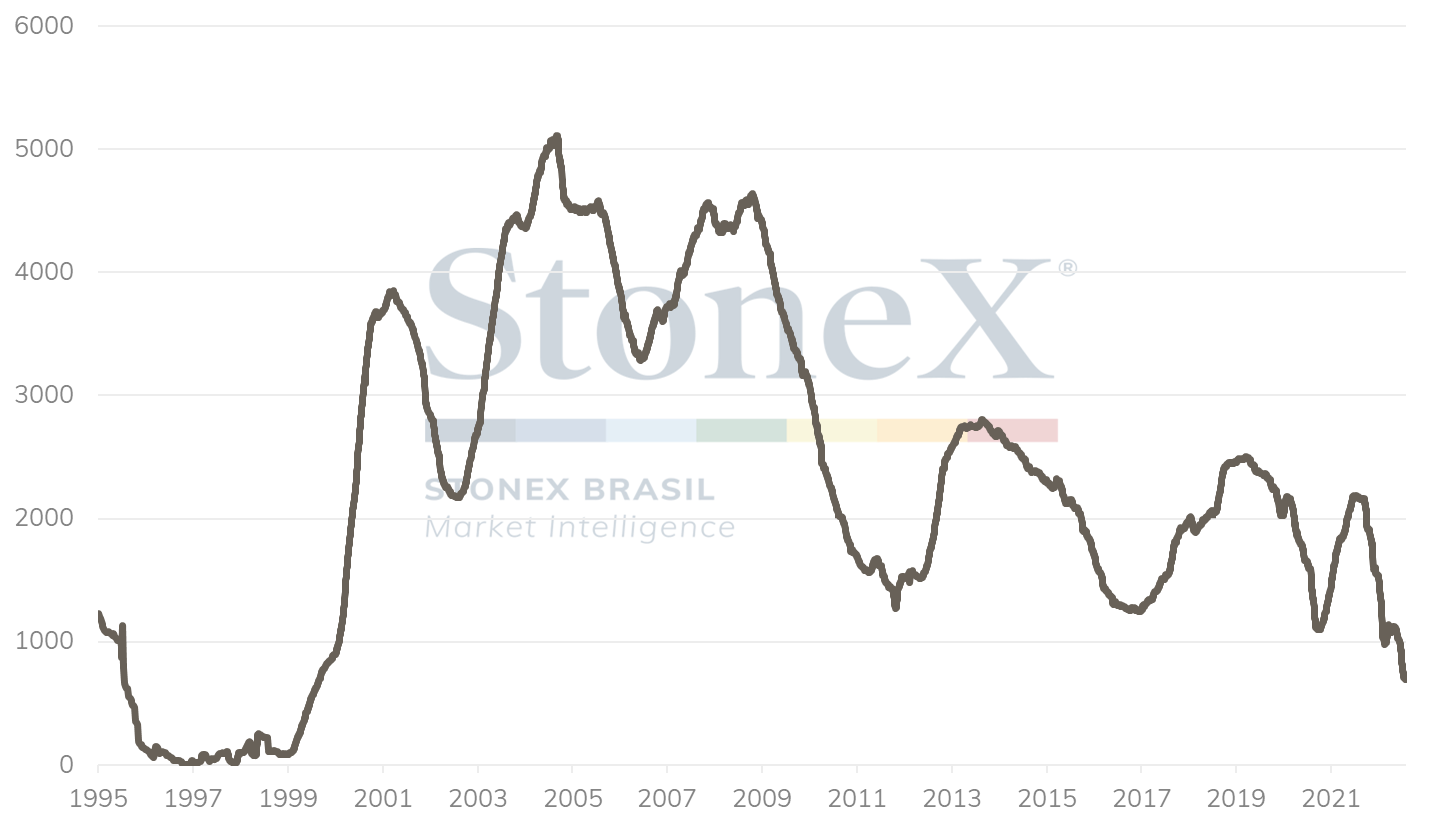
This year, certified stocks on ICE in New York have fallen from approximately 1.5 million bags to around 700,000 bags, a sharp drop of 837,000 bags, or 54.5% in volume. If we consider the time since stocks began their sharp downward trend in mid-September 2021, when ICE storage held over 2.1 million bags, the observed fall is over 1.4 million bags or 67.6%.
After July's reduction, stocks renewed their lowest level in almost 23 years, reaching levels not recorded since 1999. As can be seen in the chart, at that time, certified stocks were recovering after being at practically zero levels until 1998. Amid this scenario, agents have been asking how far these stocks can fall and whether they can repeat what happened more than two decades ago.
Certified coffee stocks by main origins at ICE NY (thousand bags)
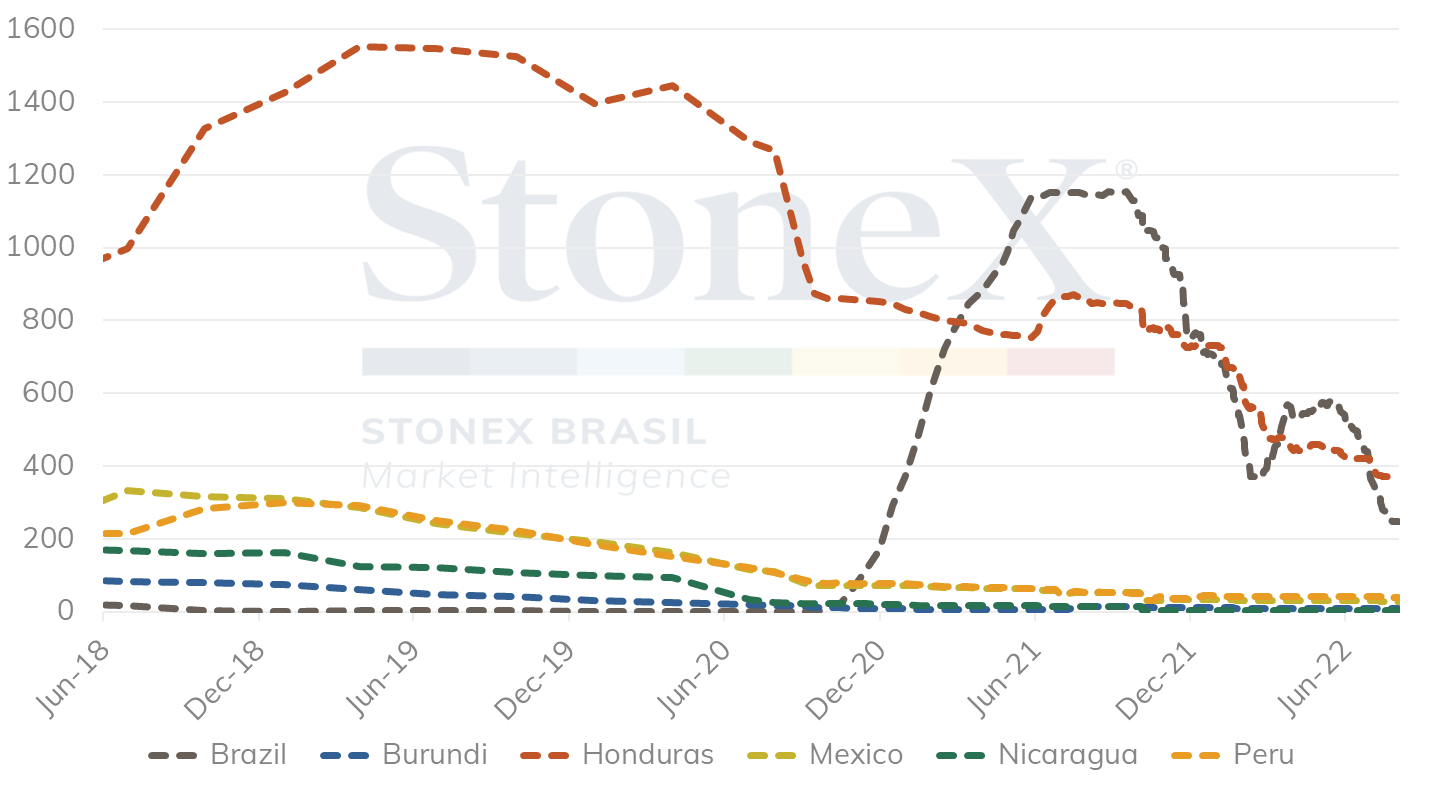
Thus, it is worth remembering how the certified stocks' dynamics work and what their impact is on the market. At first, it is necessary to understand what would raise the interest of a commercial agent to certify his coffee on the stock exchange. A coffee exporting company, for example, that has contracts sold on the Intercontinental Exchange ICE, usually has three options for marketing the coffee, exporting it in the FOB (Free On Board) format, Export it and deliver it to destination CIF (Cost Insurance & Freight) or certifying it on the Futures Exchange. Accordingly, agents seek to make the deal that will bring them the most profit.
For ICE New York, the exchange has certification rules, which can apply a premium or a discount on the value quoted on the exchange for the coffee shipped, depending on the product's origin, as seen in Table 1.
In Brazil, the exchange offers a discount of 600 points, or US₵ -6.00/lb for coffee originating in the country. For example, if a Brazilian exporter wants to certify his coffee on the exchange at a given time, and the coffee is quoted at US₵ 200/lb, the exchange will pay the value after applying the discount of US₵ -6.00/lb, that is, US₵ 194/lb. Therefore, for certification on the exchange to become interesting, exporters need to purchase their product in the domestic market at a price that makes financial sense.
The price paid to originate the coffee needs to be significantly lower than the price observed on the exchange so that it will compensate for the US₵ -6.00/lb discounted by ICE, in addition to all logistical costs to place the coffee in the certified warehouses of the exchange, which the seller bears. In addition, it is worth mentioning that the exchange requires a specific standard for certification, with a high cost, requiring processing processes to reach the standard for certification on the exchange.
According to the rules of the exchange, these are the minimum standards for delivery under the Coffee "C” Futures Contract on the ICE/NY:
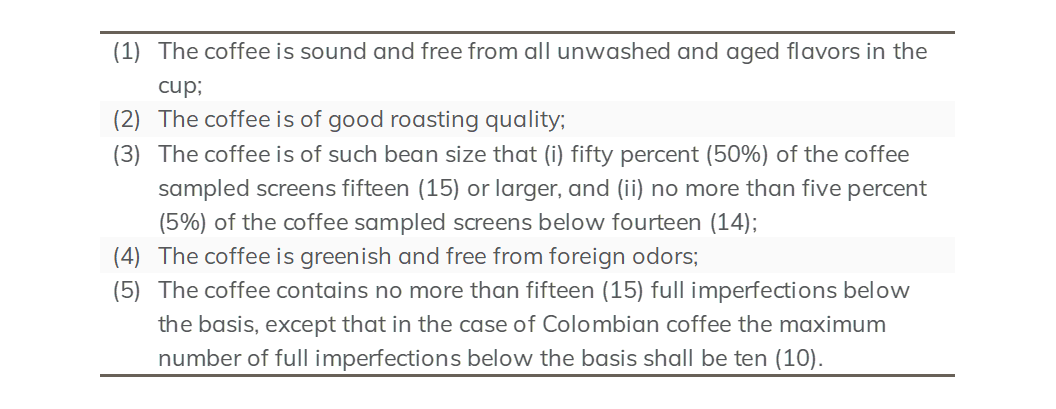
Focusing now on the main suppliers of coffee to the exchange, Brazil and Honduras. Historically, in the Brazilian case, the breakeven, that is, the differential between domestic and exchange prices to make the certification of a coffee attractive, used to be around US₵ -14/lb, in a calculation that considers the discounts that would be applied by the exchange for Brazilian coffee (US₵ -6.00/lb) and the logistical costs for the delivery, estimated then at US₵ -8.00/lb. As for Honduran coffee, there is no discount imposed by the exchange, and the logistical costs for certification were around US₵ -4.00/lb.
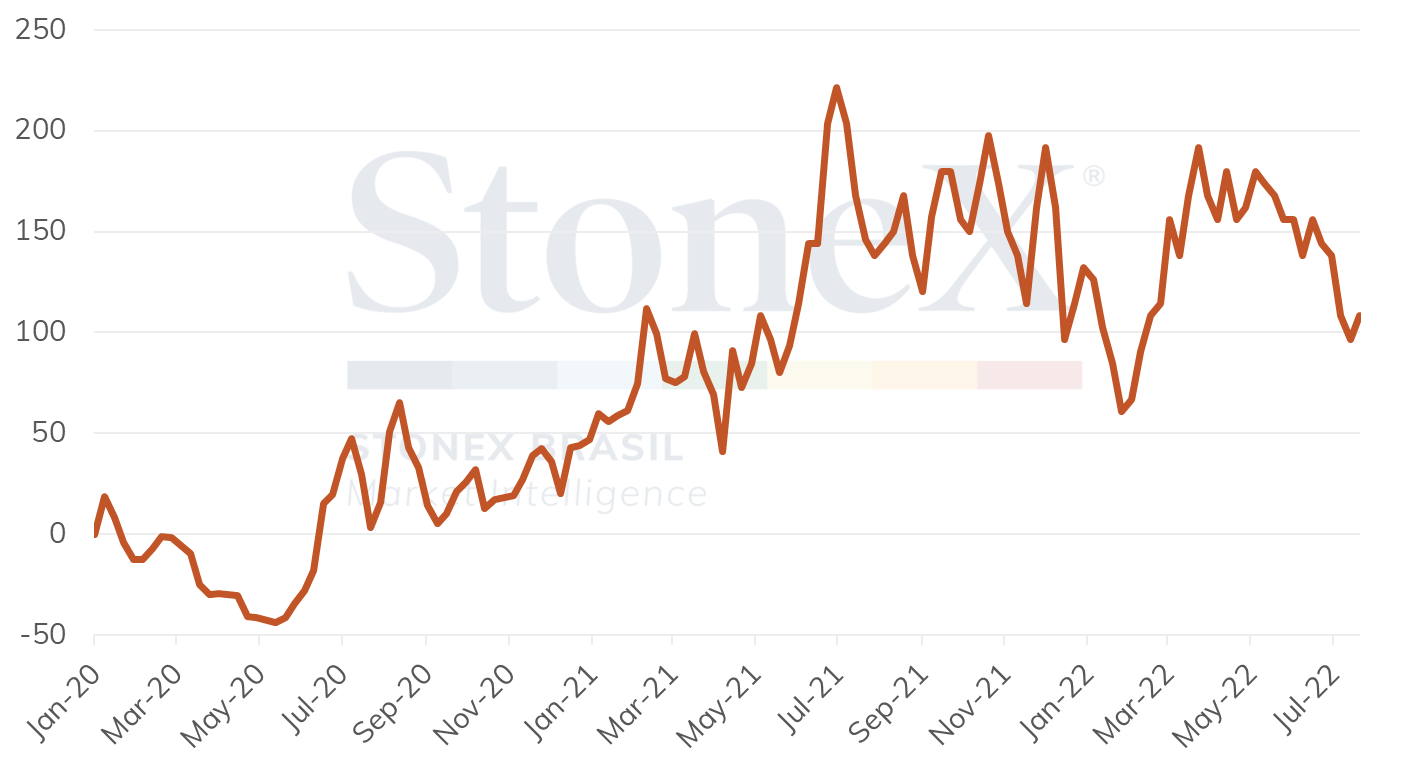
However, the reality as of mid-2021 has turned out to be quite different. Due to the severe logistical bottlenecks caused by the pandemic, export freight costs have taken off. In this context, breakeven differentials have retreated to significantly lower levels. StoneX estimates that the breakeven for certifying a Brazilian coffee on ICE is currently around US₵ -33/lb and may be even lower.
Given that the differential for an FOB coffee of Semi-Washed NY standard 2/3 FC 14/16 – which is not exactly the standard required by the exchange but comes close – was seen in mid-July at US₵ +3.00/lb, it becomes very unlikely that coffees of Brazilian origin will be certified on the exchange. In a hypothetical example, if an Arabica coffee futures contract in New York is quoted at US₵ 200.00/lb, if a company delivered the coffee to the exchange, it would receive US₵ 167.00/lb. If that same company sold that coffee FOB, it would receive US₵ 203.00/lb. Therefore, it becomes more profitable to trade the coffee FOB than to certify it on the exchange.
Prices differentials Index for mild arabica coffee in Central America, Colombia and Peru
in relation to the New York futures exchange (US¢/lb)
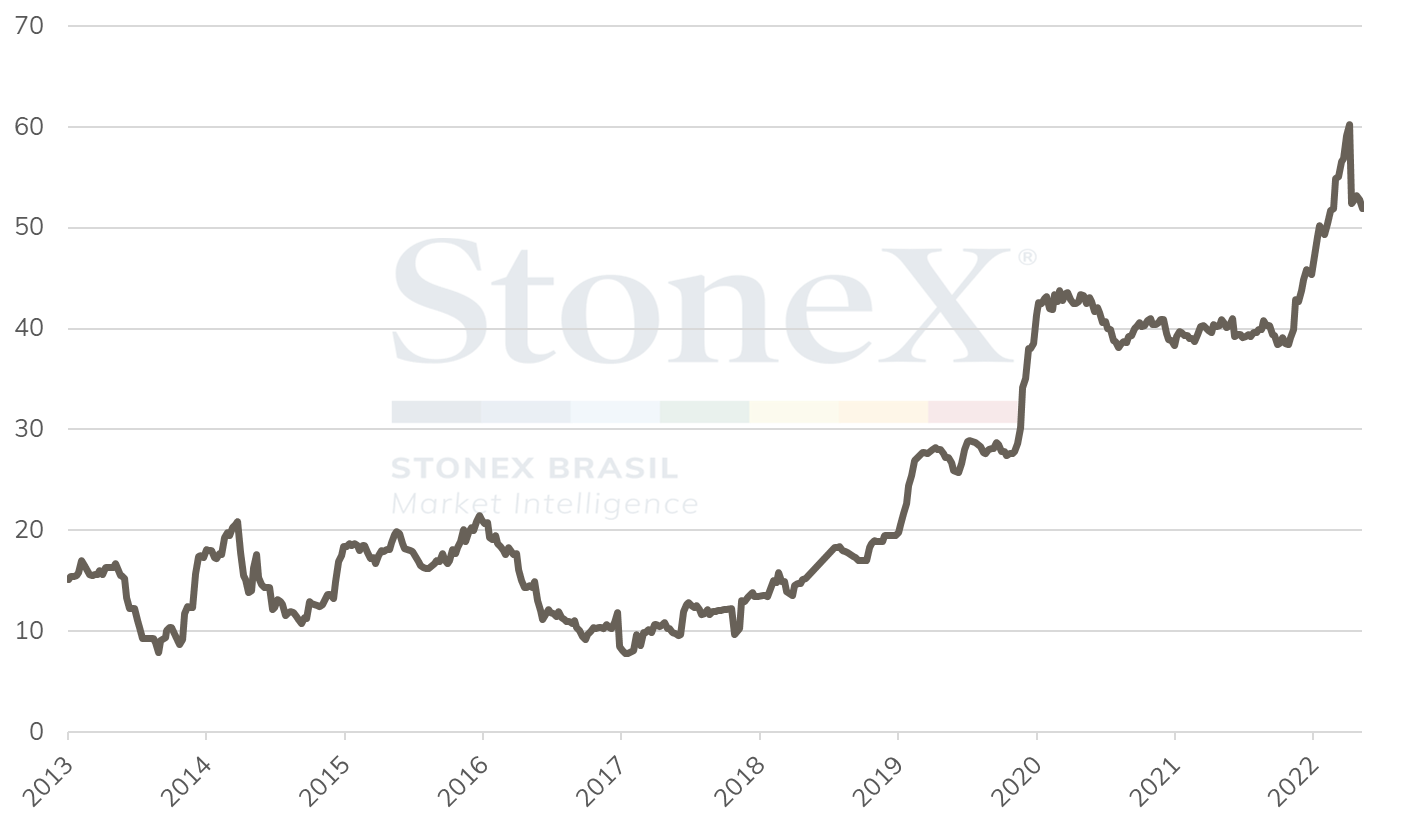
The scenario is no different from many other origins. Therefore, following the same logic presented above, it becomes unlikely that new coffees will be certified if differentials remain at current levels. Additionally, the logistical costs of imports by consuming countries, despite having dropped somewhat in recent weeks, remain significantly higher than in the pre-pandemic period. As long as this situation remains, it is more likely that new coffees will be decertified, as these coffees become the cheapest to deliver
Change of the cost of sea freight from Brazil to Europe (%)
The StoneX Group Inc. group of companies provides financial services worldwide through its subsidiaries, including physical commodities, securities, exchange-traded and over-the-counter derivatives, risk management, global payments and foreign exchange products in accordance with applicable law in the jurisdictions where services are provided. References to over-the-counter (“OTC”) products or swaps are made on behalf of StoneX Markets LLC (“SXM”), a member of the National Futures Association (“NFA”) and provisionally registered with the U.S. Commodity Futures Trading Commission (“CFTC”) as a swap dealer. SXM’s products are designed only for individuals or firms who qualify under CFTC rules as an ‘Eligible Contract Participant’ (“ECP”) and who have been accepted as customers of SXM. StoneX Financial Inc. (“SFI”) is a member of FINRA/NFA/SIPC and registered with the MSRB. SFI is registered with the U.S. Securities and Exchange Commission (“SEC”) as a Broker-Dealer and with the CFTC as a Futures Commission Merchant and Commodity Trading Adviser. References to securities trading are made on behalf of the BD Division of SFI and are intended only for an audience of institutional clients as defined by FINRA Rule 4512(c). References to exchange-traded futures and options are made on behalf of the FCM Division of SFI . StoneX is a trading name of StoneX Financial Ltd (“SFL”). SFL is registered in England and Wales, Company No. 5616586. SFL is authorized and regulated by the Financial Conduct Authority [FRN 446717] to provide to professional and eligible customers including: arrangement, execution and, where required, clearing derivative transactions in exchange traded futures and options. SFL is also authorised to engage in the arrangement and execution of transactions in certain OTC products, certain securities trading, precious metals trading and payment services to eligible customers. SFL is authorised & regulated by the Financial Conduct Authority under the Payment Services Regulations 2017 for the provision of payment services. SFL is a category 1 ring-dealing member of the London Metal Exchange. In addition SFL also engages in other physically delivered commodities business and other general business activities which are unregulated and not required to be authorised by the Financial Conduct Authority. StoneX Group Inc. acts as agent for SFL in New York with respect to its payments services business. StoneX APAC Pte. Ltd. acts as agent for SFL in Singapore with respect to its payments services business. ‘StoneX’ is the trade name used by StoneX Group Inc. and all its associated entities and subsidiaries.
Trading swaps and over-the-counter derivatives, exchange-traded derivatives and options and securities involves substantial risk and is not suitable for all investors. Past performance of any futures or option is not indicative of future success. Indicators are not a trading system and are not published as a specific trade recommendation. The information herein is not a recommendation to trade nor investment research or an offer to buy or sell any derivative or security. It does not take into account your particular investment objectives, financial situation or needs and does not create a binding obligation on any of the StoneX group of companies to enter into any transaction with you. You are advised to perform an independent investigation of any transaction to determine whether any transaction is suitable for you. No part of this material may be copied, photocopied or duplicated in any form by any means or redistributed without the prior written consent of StoneX Group Inc.
© 2026 StoneX Group Inc. All Rights Reserved.
Our subscribers have access to comprehensive market analysis from StoneX spanning commodities, equities, currencies and more.
Daily coffee report

August 5 – U.S. equities markets are on fire this week, with both the Dow Jones and S&P 500 setting new all-time highs yesterday with futures indicating further gains again today; the marketplace remains optimistic over a deal with Iran despite no evidence of such as of yet. Crude oil is working on a lower high and low today but remains slightly on the high side on the session, while the dollar is retreating back towards Monday’s nearly two-month low. The ten-year note is steady-to-lower this morning (though solidly lower so far this month) at 4.605%, while the VIX index continues to rebound into mid-week at almost a 17-point reading this morning.

Brazil could still deliver a record arabica crop, but the bigger question for growers is what the next season holds. Out of season flowering and the swing of El Niño have put the spotlight on the rains still to come.

Our market expertise, advanced platforms, global reach, culture of full transparency and commitment to our clients’ success all set us apart in the financial marketplace.
Reach
With access to 40+ derivatives exchanges, 180+ foreign exchange markets, nearly every global securities marketplace and numerous bi-lateral liquidity venues, StoneX’s digital network and deep relationships can take clients anywhere they want to go.
Transparency
As a publicly traded company meeting the highest standards of regulatory compliance in the markets we serve; our financials and record of accomplishment are matters of public record. StoneX’s commitment to “doing the right thing over the easy thing” sets us apart in the industry and helps us build respect, client trust and new partnerships.
Expertise
From our proprietary Market Intelligence platform, to “boots on the ground” expertise from award-winning traders and professionals, we connect our clients directly to actionable insights they can use to make more informed decisions and achieve their goals in the global markets.