

FX Weekly Overview (Brazil Issue)
Dollar to reflect Brazilian electoral scenario and interest rate decisions by FOMC and Copom

Leonel Mattos
- Currencies
By: John Kicklighter, Head of Market Research
Should leaders of countries have control over central banks that set monetary policy which can materially dictate the health of an economy? Some countries maintain distinct separations, some commit to political control and some are in flux.
Talking Points:
To sign up for the Trading Global Macro podcast, find it on your preferred podcast platform: Apple Podcasts, Spotify, or YouTube.
Central bank independence refers to a central bank’s ability to formulate and implement monetary policy - such as setting interest rates and managing liquidity - without direct control or interference from the political leaders of a government. This autonomy is essential because monetary policy focuses on economic objectives over long-term horizons, while politicians often face pressure to prioritize short-term results tied to election cycles.
This divergence in incentives creates a natural tension: politicians typically seek strong economic data within their term, potentially favoring policies that stimulate growth in the immediate term. But short-term stimulus can come at the cost of long-term inflation or instability. Independent central banks, by contrast, are structured to look past election timelines and focus on sustainable core tenets for a healthy economy like price stability, full natural employment, stable overall growth and financial stability.
Chart of the Federal Reserve’s ‘Dual Mandate’ Policy Target of US CPI and Jobless Rate (Monthly)
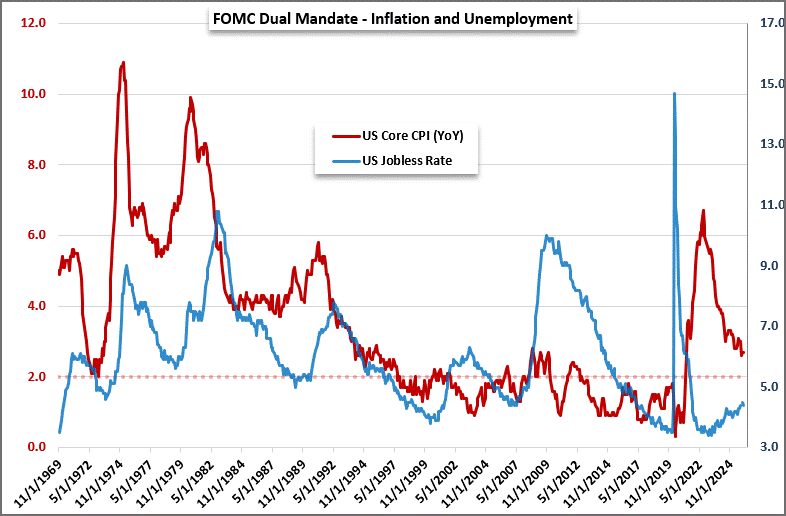
Source: John Kicklighter; US Bureau of Labor Statistics
Credibility is central to the case for independence. Credible monetary policy reinforces confidence of economic stability among citizens, businesses, and global market participants. Central banks perceived as independent tend to deliver better economic results: lower inflation expectations, stronger labor markets, and more stable growth profiles.
If a central bank loses credibility due to political interference or erratic policy shifts, a country can face elevated inflation, volatile exchange rates, weaker domestic, throttled foreign investment and ultimately stunted economic activity. There tends to be a preference split in the managed versus independent central bank model that aligns to emerging and developed economies. That preference may be applied by countries in those respective economic phases, but it can also turn out as by-product of these policies. Examples can help paint the picture.
Chart of Central Bank Independence to Perceived Credibility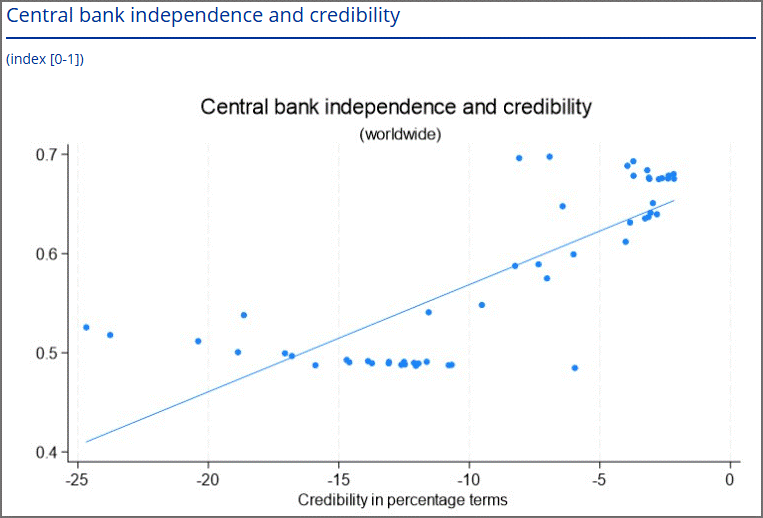
Source: European Central Bank
Turkey: A Cautionary Tale of Limited Independence
Turkey represents an example where political influence on monetary policy has had notable consequences. President Recep Tayyip Erdogan has played an active, direct role in setting monetary policy - effectively constraining the Central Bank of the Republic of Turkey’s autonomy. This loss of independence has not passed unnoticed by markets, and the results were pronounced:
Leadership instability has been a sticking point, with five central bank governors in five years.
The developments of instability are at least partially – if not wholly – related to the curb in independence and consistency, alongside a dramatically weakened currency.
Chart of USDTRY Exchange Rate with Central Bank Rate Decisions (Daily)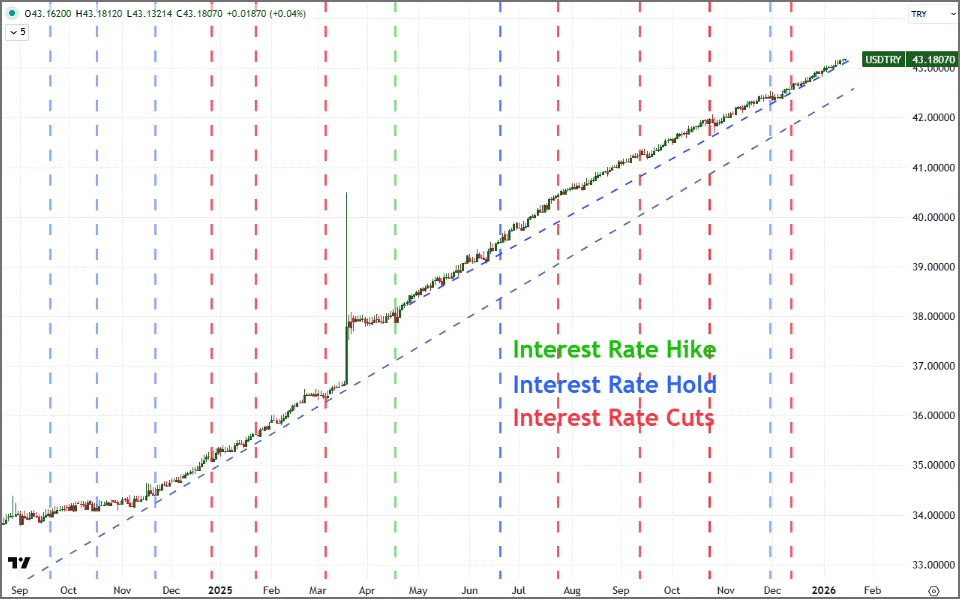
Source: TradingView.com; John Kicklighter
China: Political Direction with Longer-Term Alignment
China provides a contrasting case where the central bank operates within a government-directed framework yet has not faced the same abrupt breakdowns seen in Turkey. The People’s Bank of China’s (PBOC) monetary policy and exchange rate management reflect broader state objectives, including support for export competitiveness and economic stability.
Because China’s political leadership is not subject to short-term electoral cycles in the same way as Western democracies, directed monetary policy is not used as a rudder to troubled fiscal and economic policies in the same way as some other managed scenarios. As a result, despite the lack of independence, the PBOC’s policy course has not materially amplified troubles - at least in the current environment.
Chart of USDCNH Exchange Rate Overlaid with US-China Benchmark Rate Spread (Weekly)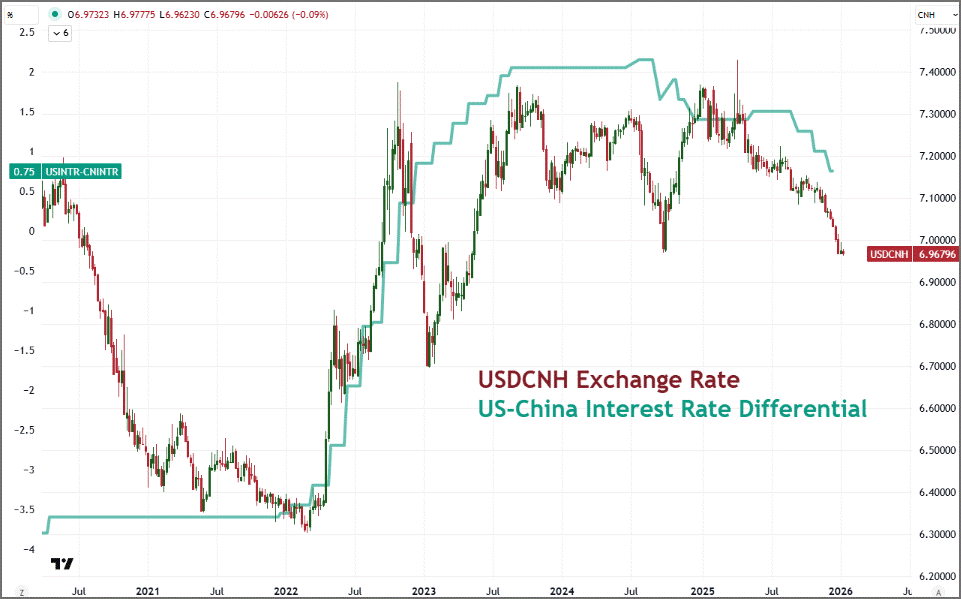
Source: TradingView.com; John Kicklighter
The Bank of Japan’s situation is one in which it falls somewhere in the middle of independence and influence from government bodies. While not a justification of the wisdom for government control, Japan has long stood as an export country with roots in a strong government-led guidance. Further, it has historically faced decades of deflation and near-zero interest rates, further influence its unique policy approach.
A point of serious contention, the Japanese Ministry of Finance has directed the Bank of Japan (BOJ) to intervene in the foreign exchange market on behalf of the Japanese Yen at various points in recent history. That is pressure that would be extremely unusual for fully independent central bank peers – and it has a been a point of contention for the G7 at different points. These interventions were typically aimed at calming extreme volatility or extreme levels in the Yen that disrupt trade, the life blood of Japan’s economy.
More recently, as Japan finally confronts a shift toward higher inflation, the Bank of Japan has raised interest rates, even amid yen weakness. This divergence - rising rates alongside a weaker currency - highlights how monetary and fiscal priorities can intersect and, at times, conflict. Even with control, monetary policy is not always a wholly effective tool.
Chart of USDJPY with Periods of Known/Expected BOJ Intervention (Monthly)

Source: Tradingview; John Kicklighter
The U.S. Federal Reserve is widely regarded as among the most renowned, independent central banks globally. It has a stated dual mandate to target steady low inflation and promote maximum natural employment – and in this pursuit, the Fed has historically maintained autonomy from direct political control. Its policy decisions shape not only the U.S. economy but – given its economic size and the Dollar’s reserve status – has also influenced global financial conditions.
Despite its role as a global policy leader, the US central bank’s independence is not immutable. Political criticism from the executive branch has intensified, particularly regarding interest rate levels. President Donald Trump publicly stated his belief in recent weeks that U.S. rates were “too high” and should be cut to levels as low as 1%.
Separately, Fed Chairman Jerome Powell, set to conclude his chairmanship in May, faces an investigation from the Department of Justice related to costs associated with the revitalization of Fed facilities – pressure that Powell himself stated was retribution for his resistance to sharper rate cuts.
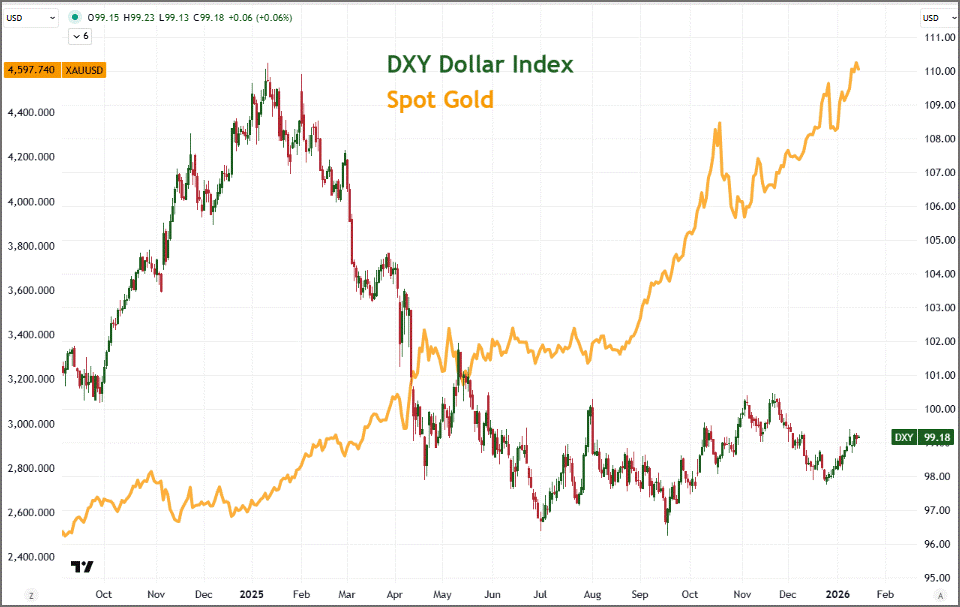
While markets have not signaled a crisis of confidence in the Fed, US interest rates and its fiat assets – the flagging of the Greenback over the past year and surge in products like gold is hard to overlook. The historical context is important: past U.S. central bank leaders have faced political pressure before, and the Fed has maintained its policy autonomy. How this episode resolves, especially with leadership transitions ahead, will be watched closely by the world.
Chart of DXY Dollar Index and Spot Gold (Weekly)
Source: Tradingview, ICE, CME
-- Experts: John Kicklighter, Global Head of Content; Matt Weller, Global Head of Market Research
© 2025 StoneX Group Inc. all rights reserved.
The subsidiaries of StoneX Group Inc. provide financial products and services, including, but not limited to, physical commodities, securities, clearing, global payments, risk management, asset management, foreign exchange, and exchange-traded and over-the-counter derivatives. These financial products and services are offered in accordance with the applicable laws in the jurisdictions in which they are provided and are subject to specific terms, conditions, and restrictions contained in the terms of business applicable to each such offering. Not all products and services are available in all countries. The products and services offered by the StoneX Group of companies involve risk of loss and may not be suitable for all investors. Full Disclaimer.
This content is not intended for residents of any particular country, and the information herein is not advice nor a recommendation to trade nor does it constitute an offer or solicitation to buy or sell any financial product or service, by any person or entity in any jurisdiction or country where such distribution or use would be contrary to local law or regulation. Please refer to the Regulatory Disclosure section for entity-specific disclosures.
No part of this material may be copied, photocopied or duplicated in any form by any means or redistributed without the prior written consent of StoneX Group Inc. The information herein is provided for informational purposes only. This information is provided on an ‘as-is’ basis and may contain statements and opinions of the StoneX Group of companies as well as excerpts and/or information from public sources and third parties and no warranty, whether express or implied, is given as to its completeness or accuracy. Each company within the StoneX Group of companies (on its own behalf and on behalf of its directors, employees and agents) disclaims any and all liability as well as any third-party claim that may arise from the accuracy and/or completeness of the information detailed herein, as well as the use of or reliance on this information by the recipient, any member of its group or any third party.
StoneX TV content is created, produced, and distributed solely by StoneX Media Ltd (“StoneX TV”) and is provided for informational and educational purposes only.
StoneX TV does not provide investment, financial, legal, or tax advice and does not make any recommendation or endorsement of any investment strategy, transaction, or financial instrument. Nothing in this content constitutes, or should be construed as, investment advice or a recommendation to buy, sell, or hold any financial instrument, including securities, futures, derivatives, digital assets, foreign exchange products, or CFDs.
This content does not constitute an offer, invitation, or solicitation to engage in any investment activity.
The information presented is general in nature and is not tailored to the financial situation, investment objectives, or risk tolerance of any specific person. You should not rely on this content as a substitute for independent professional advice.
Investing and trading in financial instruments involves significant risk of loss and is not suitable for all investors. Past performance is not indicative of future results.
Any views or opinions expressed are those of the presenter at the time of publication and are subject to change without notice. Such views may not necessarily reflect those of StoneX Media Ltd or its affiliates. StoneX Media Ltd and its affiliates, including StoneX Group Inc., may from time to time have positions in, or engage in transactions involving, the financial instruments referenced.
This content may include general market commentary and opinion. It does not constitute independent investment research and has not been prepared in accordance with legal requirements designed to promote the independence of investment research.
StoneX Media Ltd is not authorised or regulated to provide investment services and does not act in a fiduciary capacity.
StoneX Media Ltd is incorporated in Ireland and operates in accordance with applicable Irish law. It is a wholly owned subsidiary of StoneX Group Inc. and is a separate legal entity from other subsidiaries within the StoneX Group, which may be regulated in various jurisdictions. StoneX Media Ltd does not act on behalf of, or provide services for, any regulated affiliate.
This content is not directed at, and may not be distributed to, any person in any jurisdiction where such distribution would be contrary to local laws or regulations.
Supporting documentation for any claims, comparisons, statistics, or technical data may be made available upon reasonable request, where applicable.
Our subscribers have access to comprehensive market analysis from StoneX spanning commodities, equities, currencies and more.
Dollar to reflect Brazilian electoral scenario and interest rate decisions by FOMC and Copom

Strong nonfarm payrolls took labor market stress out of the U.S. dollar conversation and left inflation as the release that carries the weight. What follows is how that handover works and why the dollar's reaction function narrowed to one side of the Federal Reserve mandate.


A single inflation release is now the pivot for U.S. Treasury yields, and the currency market is where that pressure is being expressed. Alex Ridgers explains why dollar yen has become the pair carrying the weight of a fiscal argument nobody in Washington is willing to settle.

Our market expertise, advanced platforms, global reach, culture of full transparency and commitment to our clients’ success all set us apart in the financial marketplace.
Reach
With access to 40+ derivatives exchanges, 180+ foreign exchange markets, nearly every global securities marketplace and numerous bi-lateral liquidity venues, StoneX’s digital network and deep relationships can take clients anywhere they want to go.
Transparency
As a publicly traded company meeting the highest standards of regulatory compliance in the markets we serve; our financials and record of accomplishment are matters of public record. StoneX’s commitment to “doing the right thing over the easy thing” sets us apart in the industry and helps us build respect, client trust and new partnerships.
Expertise
From our proprietary Market Intelligence platform, to “boots on the ground” expertise from award-winning traders and professionals, we connect our clients directly to actionable insights they can use to make more informed decisions and achieve their goals in the global markets.