Quarterly Commodities Outlook is available for free now.  Download your report  →

StoneX logo

Coffee Crop Survey in Brazil 2025/26 | First Review

By: Fernando Maximiliano, Market Intelligence Specialist

Coffee Crop Survey in Brazil 2025/26


Update of the 2025/26 Coffee Crop Estimate

Brazil has been facing adverse weather conditions since 2020, being affected by phenomena such as La Niña, El Niño, frosts, heatwaves, and water deficits. In 2024, up until the end of July, there was a sense of optimism regarding the production potential of the 2025/26 crop, as no significant climatic adversities had been recorded in the producing regions up to that point.

However, the scenario changed drastically starting in August. Early in the month, a light frost was recorded. Shortly afterward, the coffee-producing regions faced a sequence of heatwaves and a period of severe drought. The month of September was particularly critical for arabica coffee. The dry weather and high temperatures caused vegetative damage, as well as flower and fruit abortion. However, the impact was not uniform across coffee species. Climatic conditions did not negatively affect flowering in Espírito Santo and Bahia. Moreover, the widespread use of irrigation systems contributed to the proper development of the fruits.

In November 2024, StoneX released the first estimate for the 2025/26 coffee crop, projecting total production at 65.6 million bags—a 0.4% decline compared to the previous crop. Arabica production was estimated at 40 million bags (-10.5%), while robusta was forecast at 25.6 million bags (+20.9%). In 2025, the StoneX team returned to the field for a new round of surveys, aiming to update the estimates. Due to climatic challenges and aiming to enhance data accuracy, the StoneX team decided to invest more time in collecting additional information. In addition to field visits, a detailed analysis of weather conditions was also conducted.

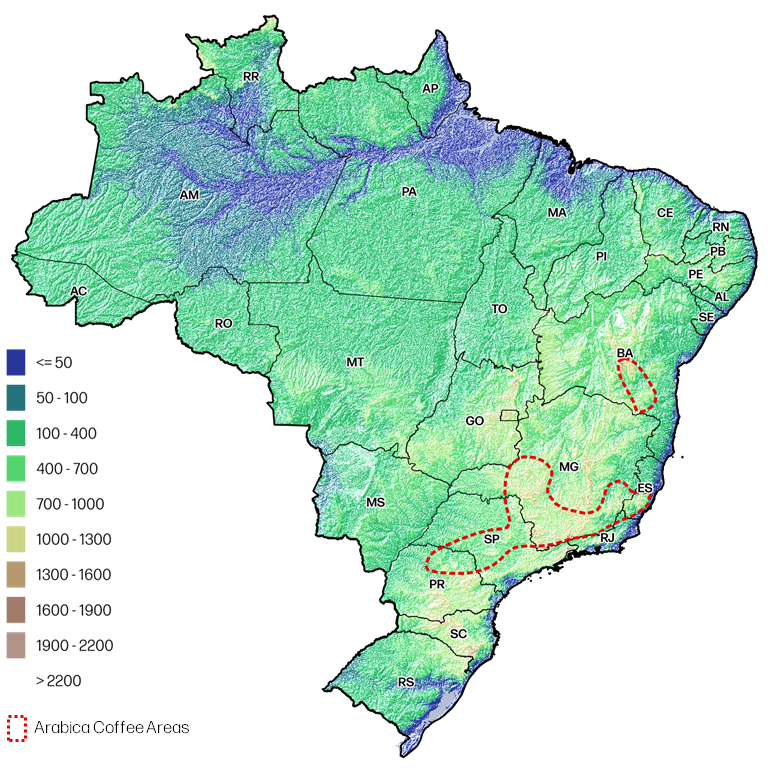
Coffee-Producing Regions in Brazil
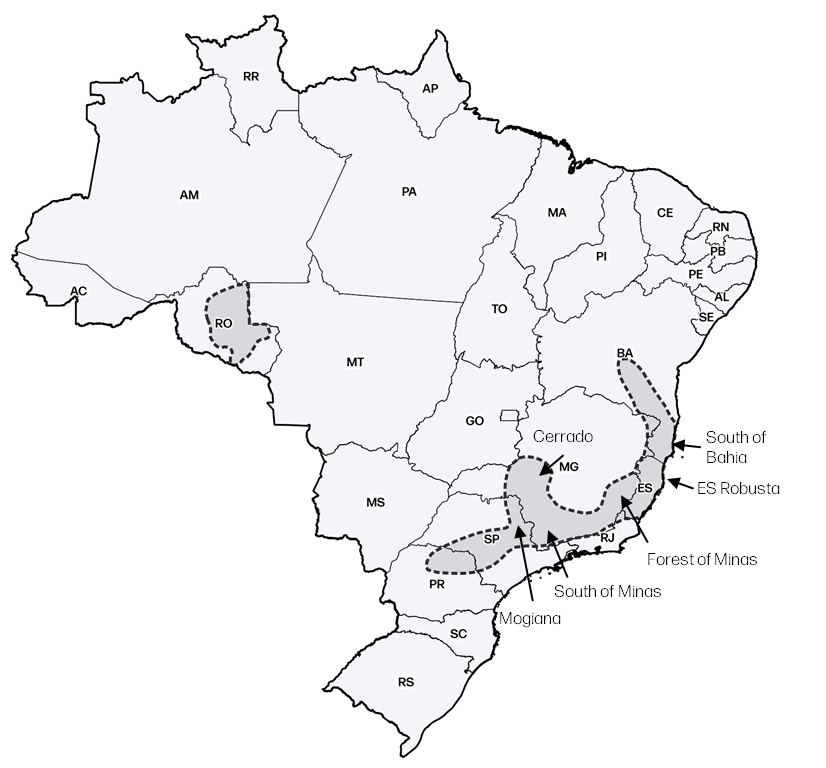
image 110511

Source: StoneX.

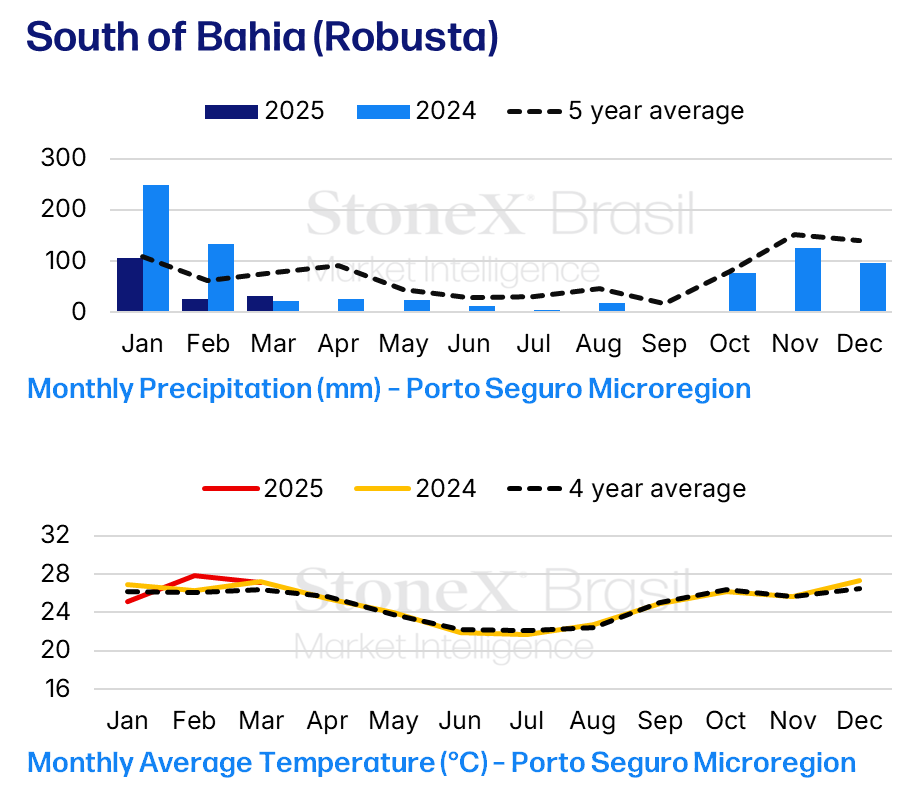
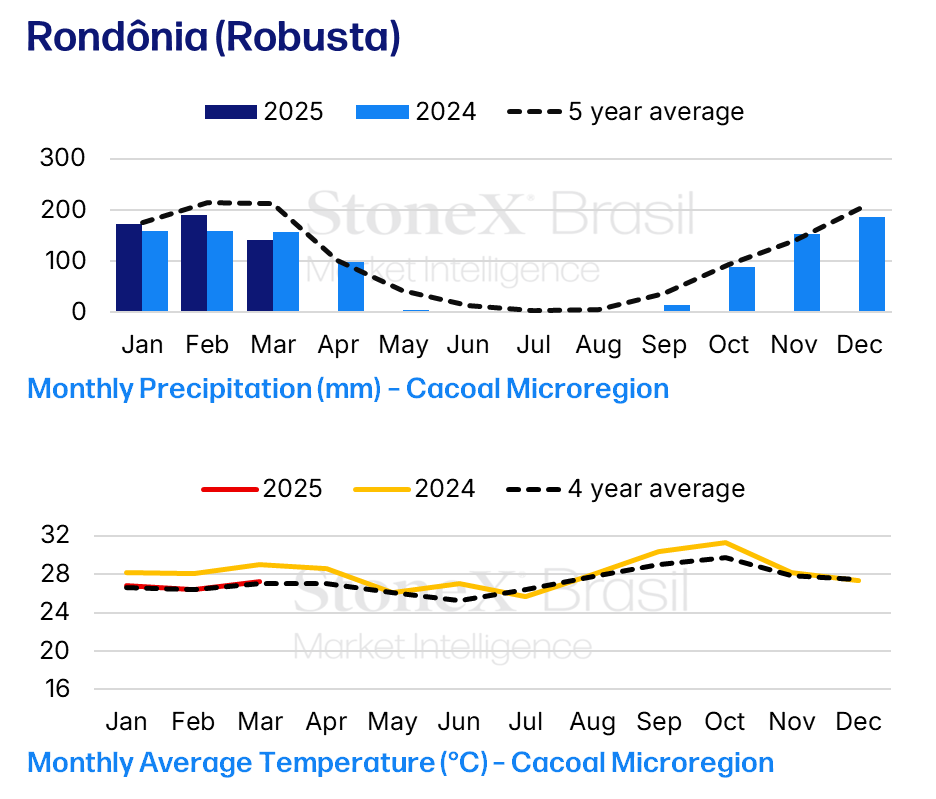
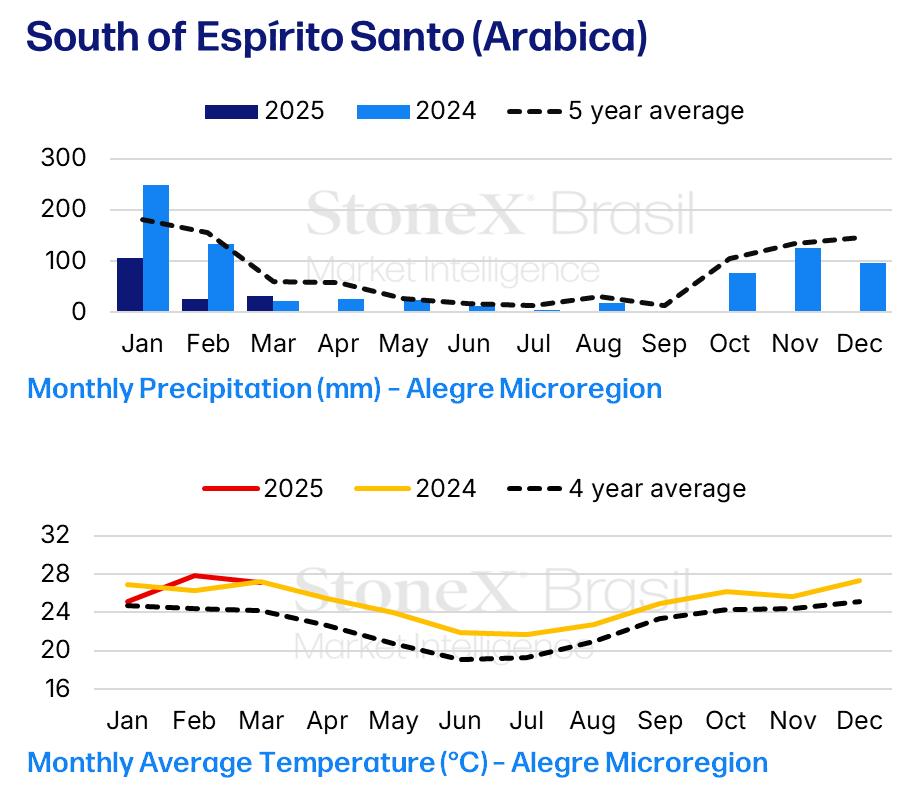
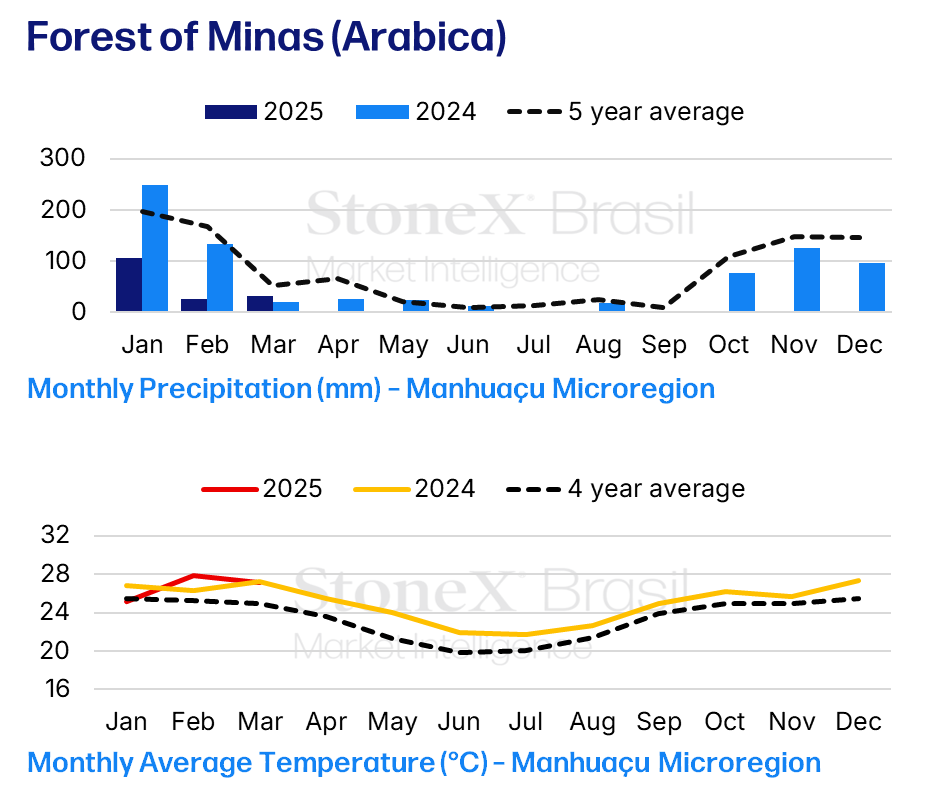
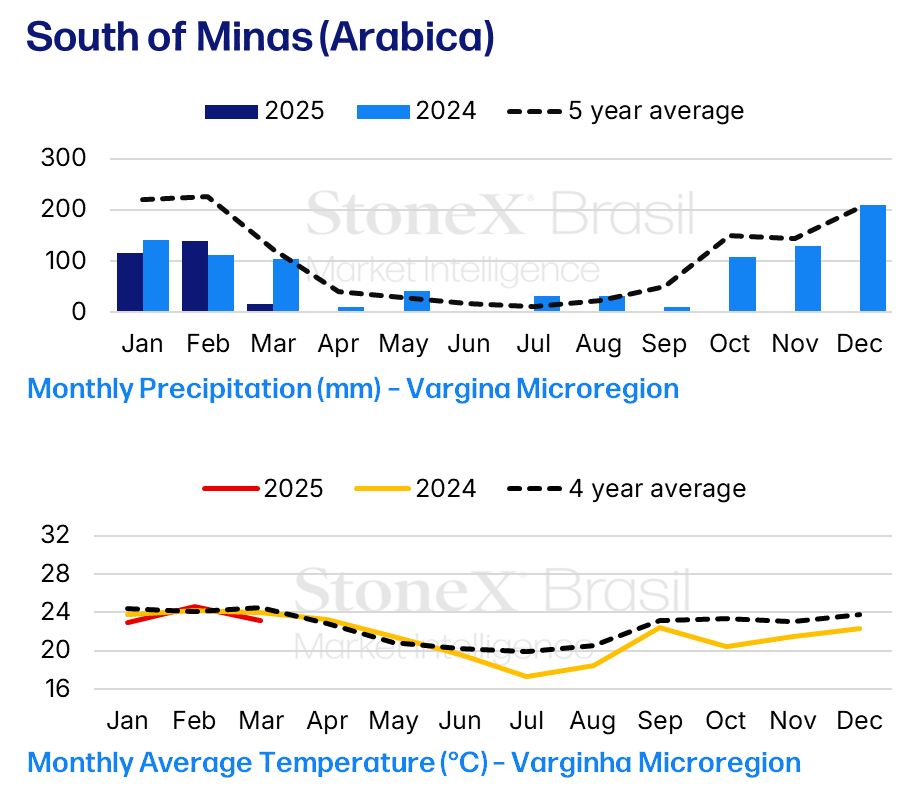
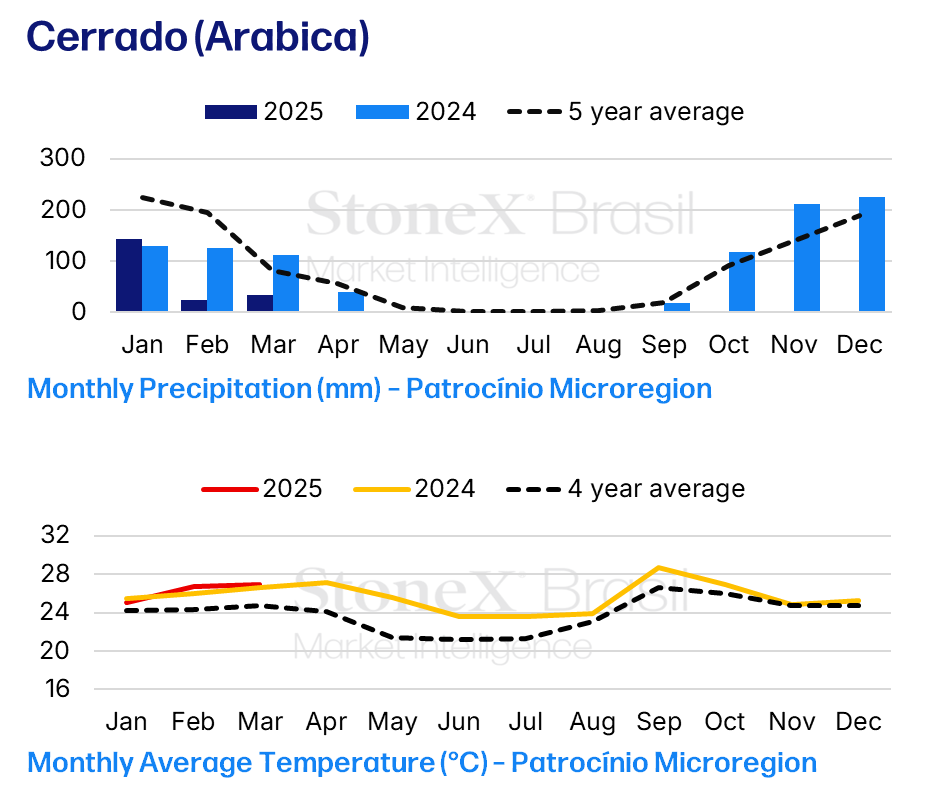
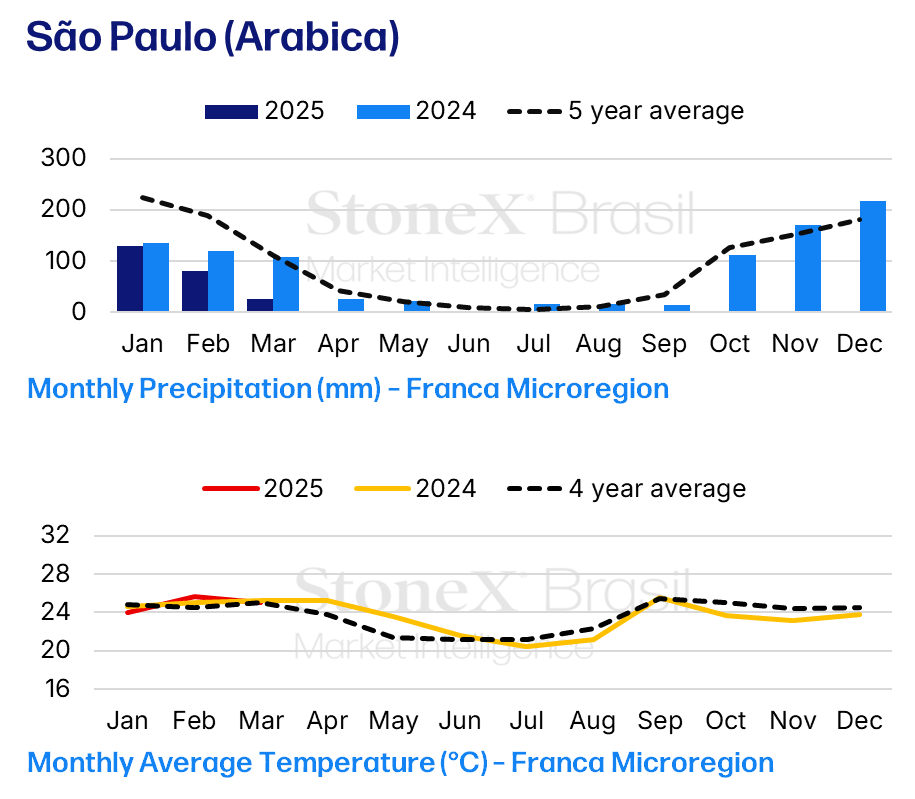
Accumulated Rainfall and Average Temperature
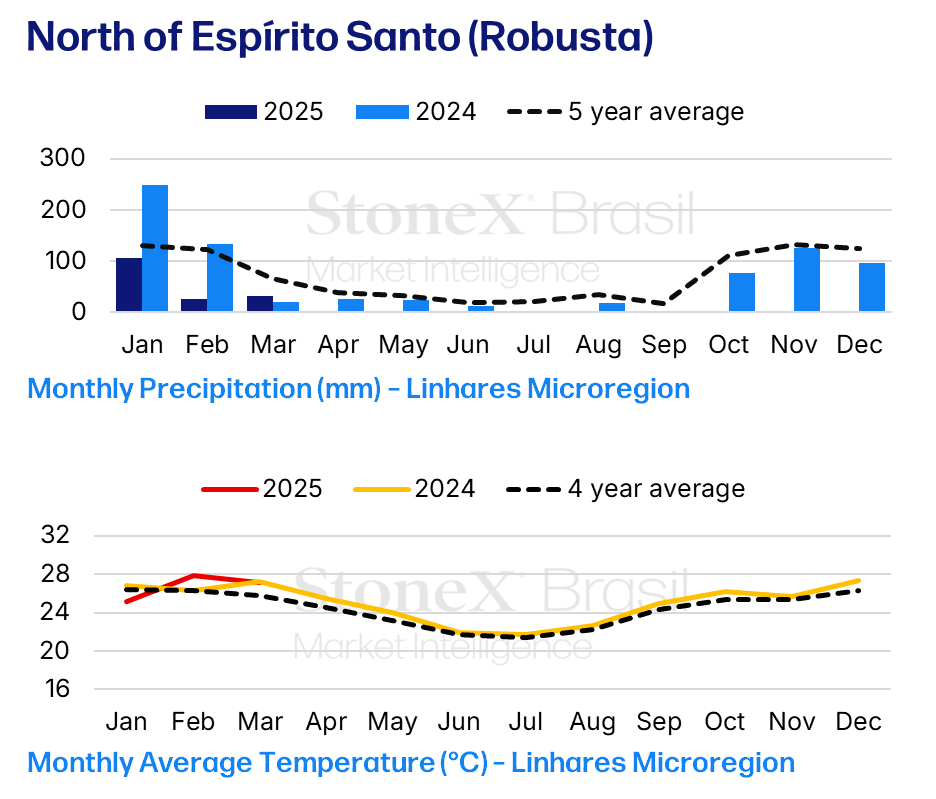
  • image 110512
  • image 110513
  • image 110514
  • image 110515
  • image 110516
  • image 110517
  • image 110518
  • image 110519
    Source: NOAA. Design: StoneX.

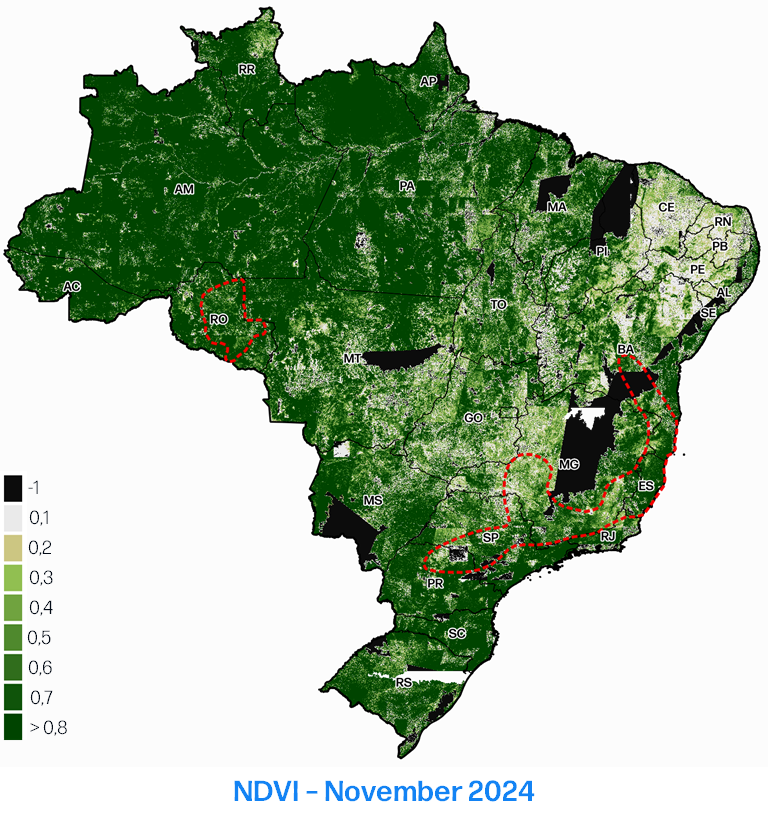
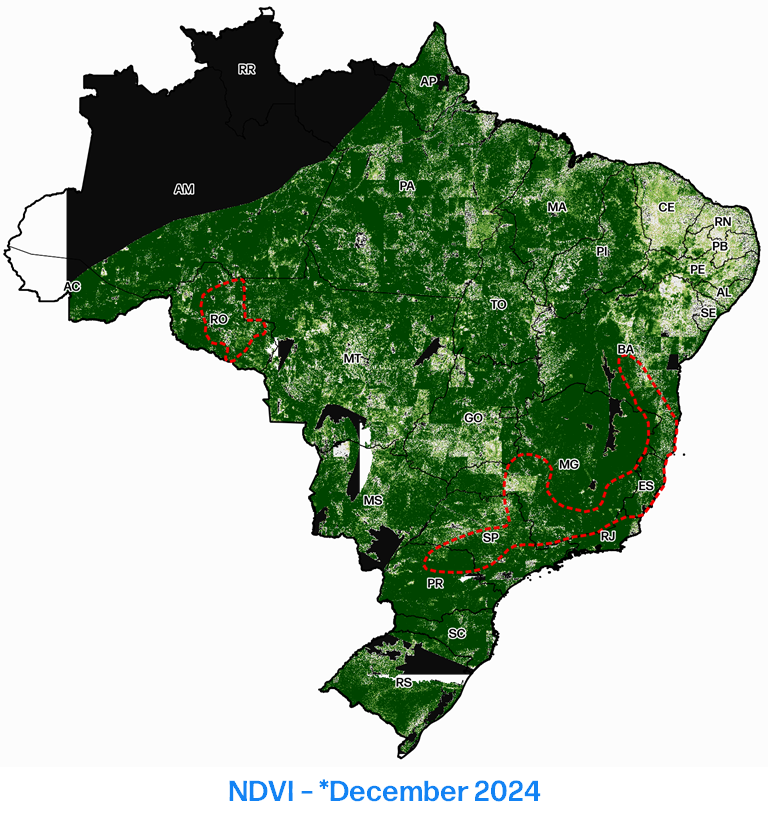
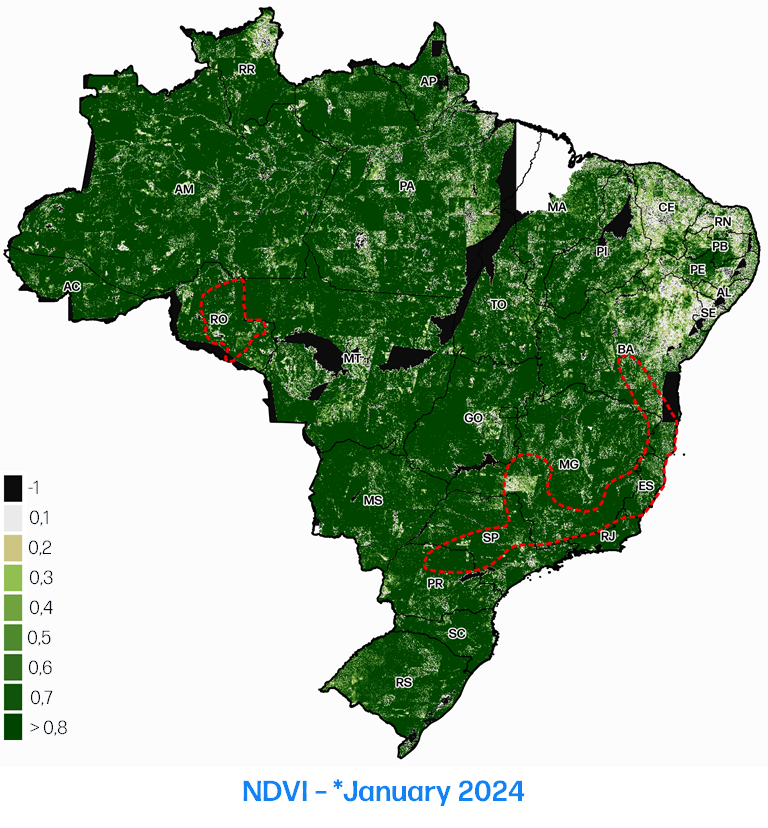
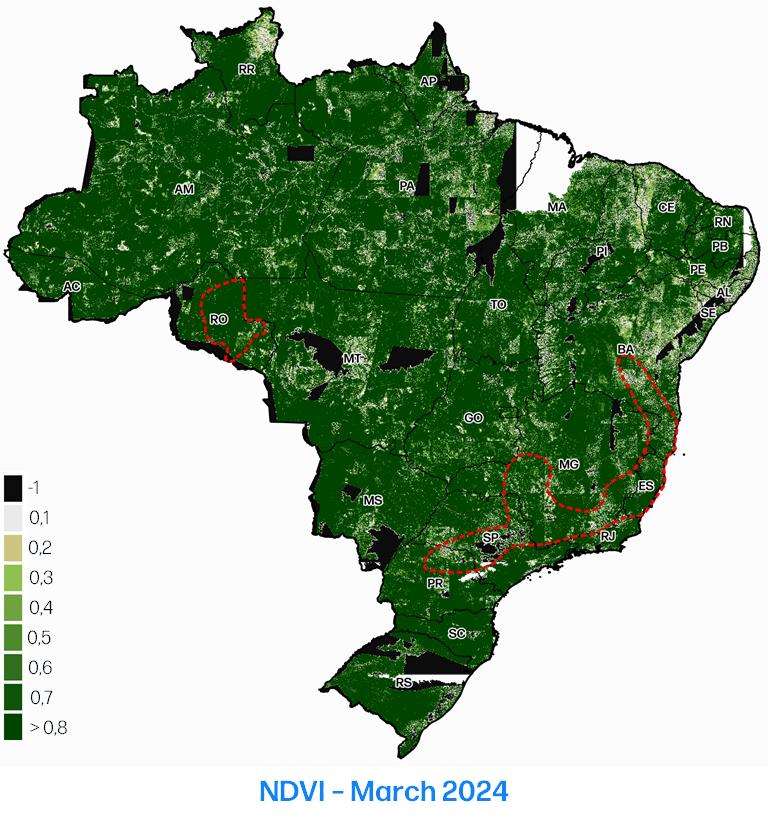
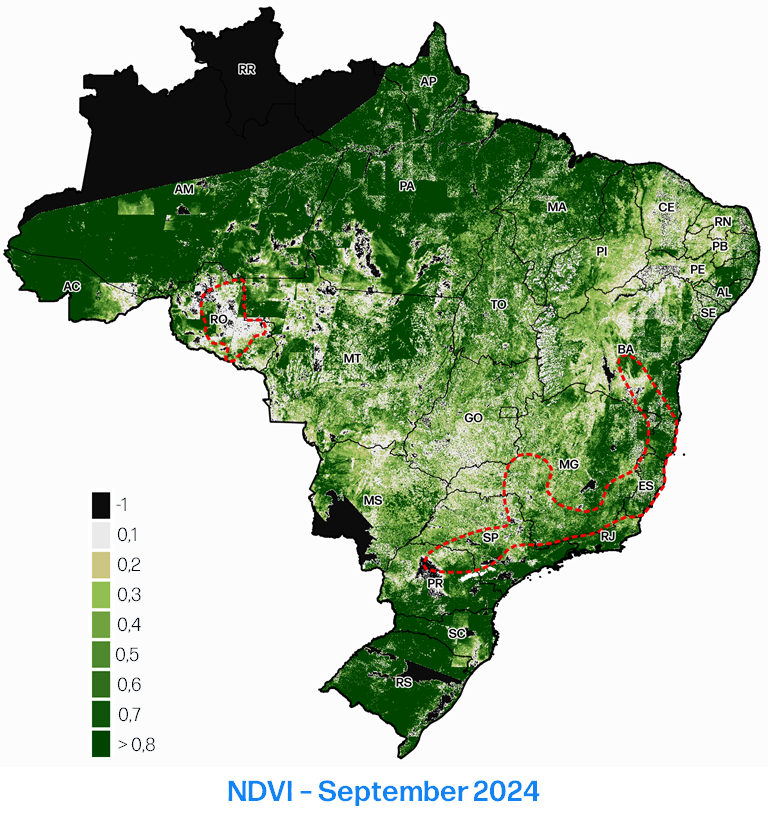
Normalized Difference Vegetation Index (NDVI)

The NDVI, which measures vegetation reflectance in the red and near-infrared bands, is an indicator of plant health status, as stress affects both the performance of the photosynthetic process and chlorophyll reflectance. NDVI values range from -1 to 1. Values close to -1 to 0.1 indicate the presence of water bodies or surfaces without vegetation; values between 0.2 and 0.5 represent stressed vegetation, ranging from degraded to weakened; and values above 0.5 indicate healthy vegetation. Values close to 1 suggest high density and vigor.

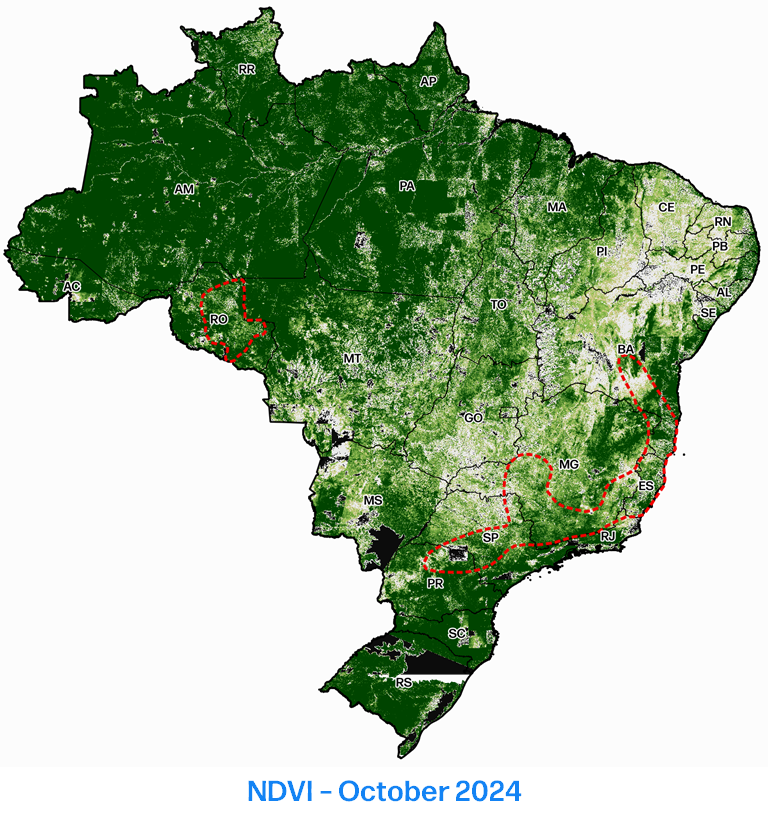
The dry winter of 2024 was one of the most intense and unprecedented ever experienced in Brazil, and the rainy season was significantly delayed in the Central-West and Southeast regions, where it normally begins in late September. Irregular rainfall in coffee-producing areas only began in late October, with more significant volumes recorded in November. By the time the rains returned, coffee fields were already showing severe signs of stress. The NDVI, with yellow-green coloring, was widespread across all coffee-growing areas. The Mogiana region, the far western portion of the Cerrado, and the Matas de Minas in the eastern border were among the most affected areas.

In November, NDVI readings improved, and Espírito Santo was the region that showed a significant recovery. Index values shifted from light green to deep green tones, indicating improvement, likely due to good agricultural practices and irrigation.

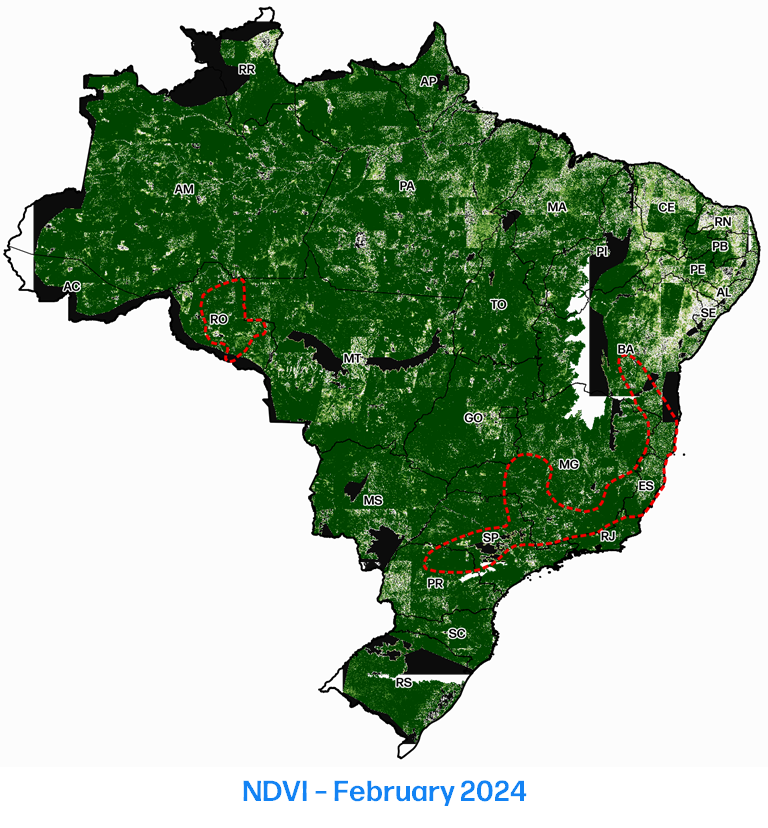
In December and January, Brazil’s coffee belt experienced a wide spatial distribution of rainfall. Rainfall amounts were below expectations in southern Bahia (50–100 mm), while the main arabica-producing regions in the South and Matas de Minas recorded volumes within the normal range for the month. The Cerrado Mineiro received above-normal rainfall. These favorable conditions were also observed in the main robusta-growing areas. As a result of adequate moisture and mild temperatures, most coffee areas showed deep green coloring and NDVI values above 0.4.Another notable variable in the 2024/2025 summer was the excessive heat. The Central-South region of Brazil experienced three heatwaves: from January 17 to 23, February 2 to 12, and March 1 to 8. Records indicate that several areas experienced more than 20 days with maximum temperatures above 35 °C, causing thermal stress.

Coffee farming is facing a new normal of extreme temperatures due to climate change. In tropical regions, prolonged periods of low rainfall can occur even during the rainy season, often accompanied by high temperatures. This phenomenon has become more intense and frequent, impacting agricultural production.

In some regions, prolonged exposure to extreme temperatures, combined with the absence of significant rainfall and low cloud cover over these months, has drastically reduced soil moisture and water availability for plants. 

  • This scenario triggered, in the middle of summer, a short-duration but high-intensity event known as a flash drought, characterized by the rapid intensification of water deficit, affecting soil moisture and compromising plant physiology within days or weeks.

    In March, when most coffee-growing areas would typically be expected to show high NDVI values, this pattern has not been observed in 2025. The analysis of NDVI imagery reveals a significant increase in yellow-green patches, indicating a reduction in index values. This decline suggests a compromise in photosynthetic activity, reflecting the extreme thermal and water stress experienced throughout the season.
  • image 110522
  • image 110523
  • image 110524
  • image 110525
  • image 110526
The light-colored patches observed in the Cerrado Mineiro region during the months of December and January are related to image noise and do not necessarily indicate that the region was experiencing water stress conditions.
  • image 110527
  • image 110528
    Source: Copernicus. Design: StoneX

Monthly Rainfall and the Coffee Growth Cycle
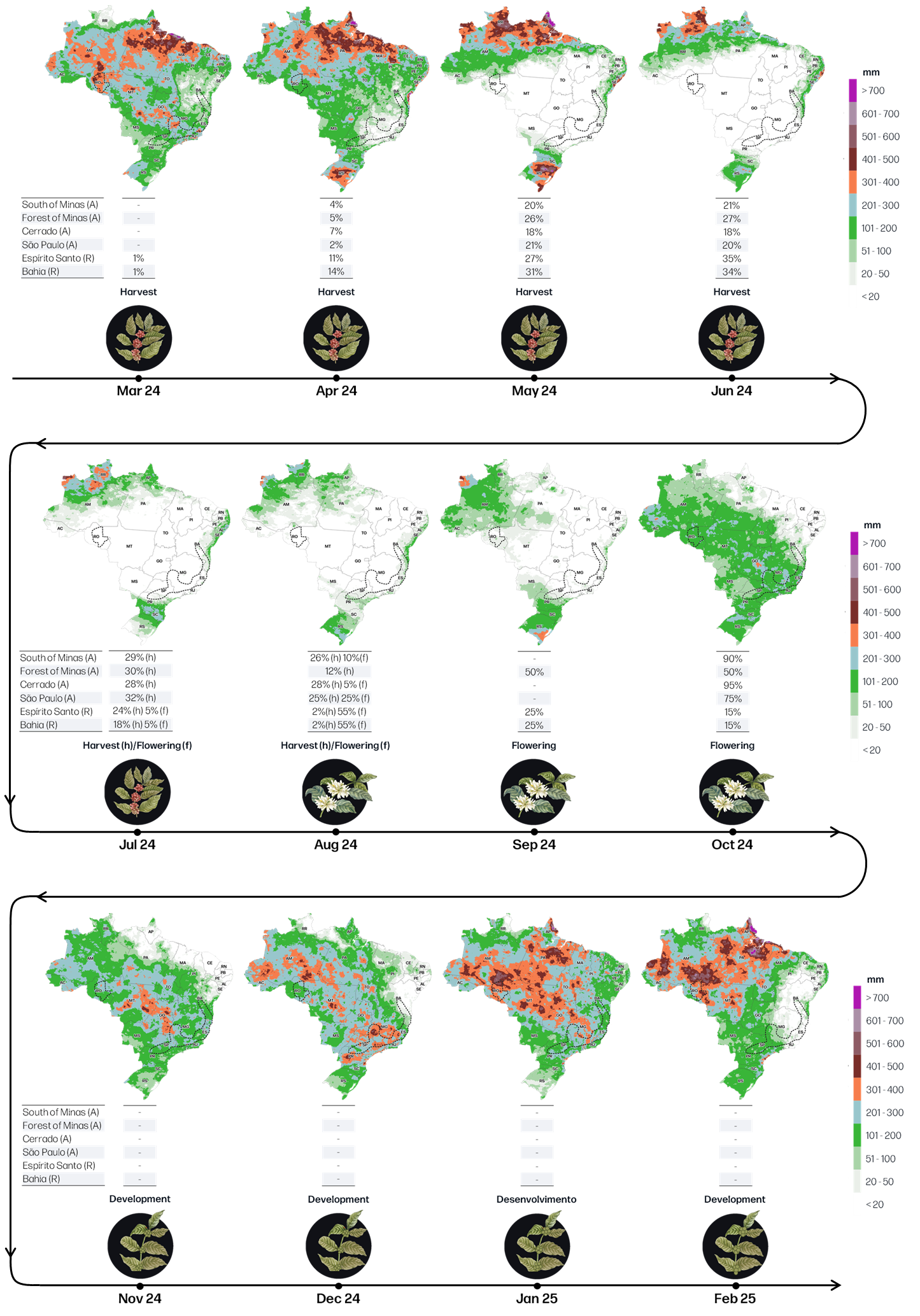
image 110529

Sources: StoneX e Chirps. Design: StoneX.

Robusta Coffee

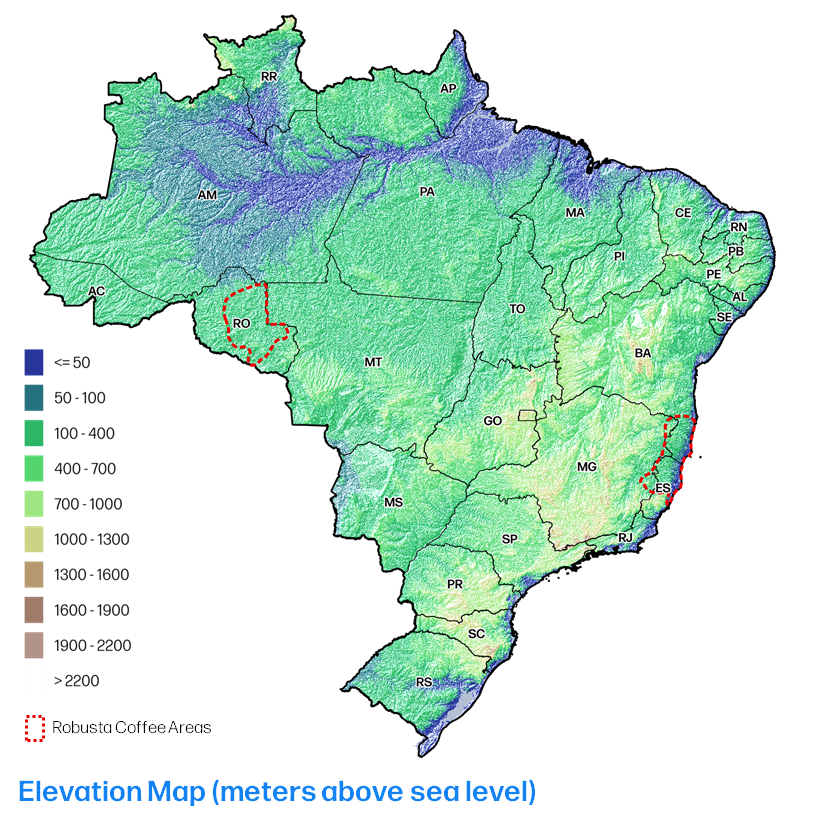
  • The conilon coffee-growing areas in southern Bahia and northern Espírito Santo generally show high productivity, uniform fruit development, and good vegetative conditions. 

    Both regions have been undergoing a continuous process of improvement in crop management, the introduction of new genetic materials, and investments in technology—factors that have significantly contributed to increased production. Based on monitoring carried out by StoneX, the 2025/26 conilon crop is expected to be the largest in history for both Espírito Santo and Bahia.

    In February, high temperatures and below-average rainfall were recorded—conditions that could have negatively affected bean filling, impacting the size and weight of the fruits.
  • image 110530
    Source: StoneX.

However, the bean-filling phase was already well advanced during that period, thanks to favorable weather conditions in previous months, especially in January. By mid-February, most of the beans were already in the final stages of filling, which helped minimize the impact of adverse weather and reduced the risk of low yields. Furthermore, the good vegetative condition of the fields and the high percentage of irrigated areas in these regions helped cushion the effects of the climate.

On the other hand, in Rondônia, problems were concentrated during the flowering period, when a prolonged dry spell combined with high temperatures caused significant flower and fruit abortion and increased plant stress. As a result, the crop is expected to fall short of initial expectations.

Arabica Coffee

  • The main arabica-producing regions recorded varying levels of impact. Naturally warmer areas were the most affected, with a particularly negative highlight on Alta Mogiana, in the state of São Paulo. The state, in fact, has a high proportion of pruned areas, especially in mechanized regions. Younger plantations—less than 8 years old but already in their productive phase—suffered significant damage, compromising their potential. São Paulo recorded the greatest losses.

    In the Cerrado Mineiro region, although production is also below expectations, some municipalities with positive biennial cycles show crops in better condition, which will help maintain productivity at slightly higher levels. The larger percentage of irrigated areas in some of these municipalities also helped to mitigate part of the losses.
  • image 110531
    Source: StoneX.

In South of Minas, the main arabica-producing hub, the scenario is mixed. Some microregions with a positive biennial cycle are expected to have better productivity. Regions with milder temperatures also experienced less impact. Still, losses are present, varying only in intensity.

In Forest of Minas and southern Espírito Santo—regions that were already expected to have a negative biennial year in the 2025/26 crop—adverse weather conditions further worsened the decline in production. Moreover, a higher incidence of coffee borer infestation was observed in these regions. However, this increase is associated with the negative biennial cycle itself, as the lower fruit load favors the concentration of the pest on the few available cherries.

StoneX Lowers 2025/26 Coffee Crop Forecast

Overall, weather conditions not only reduced production in arabica-growing regions, but also led to an increase in pruning activity, surpassing typical levels in nearly all areas. This further compromises the potential of the 2025/26 crop. Vegetative damage was also severe in many fields, especially in younger plantations. In some cases, even after the return of rainfall, the crops were unable to fully recover.

As for robusta, despite the climatic impacts in the state of Rondônia, ongoing improvements in crop management and the widespread use of irrigation systems contributed to the strong development of the crop in Espírito Santo and Bahia. This is expected to result in a significant increase in robusta production in 2025/26.

As a result, StoneX revised its production estimate downward, now forecasting a total of 64.5 million bags—1.7% lower than the previous estimate and 2.1% below the 2024/25 crop. The estimate for arabica coffee was reduced to 38.7 million bags, a 3.3% drop compared to the previous forecast and a 13.5% decline from last season. Robusta production, on the other hand, is expected to reach 25.8 million bags, representing a 0.8% increase over the previous estimate and a 21.9% increase compared to the 2024/25 crop.

StoneX Estimates for Brazilian Coffee Production (Million Bags)
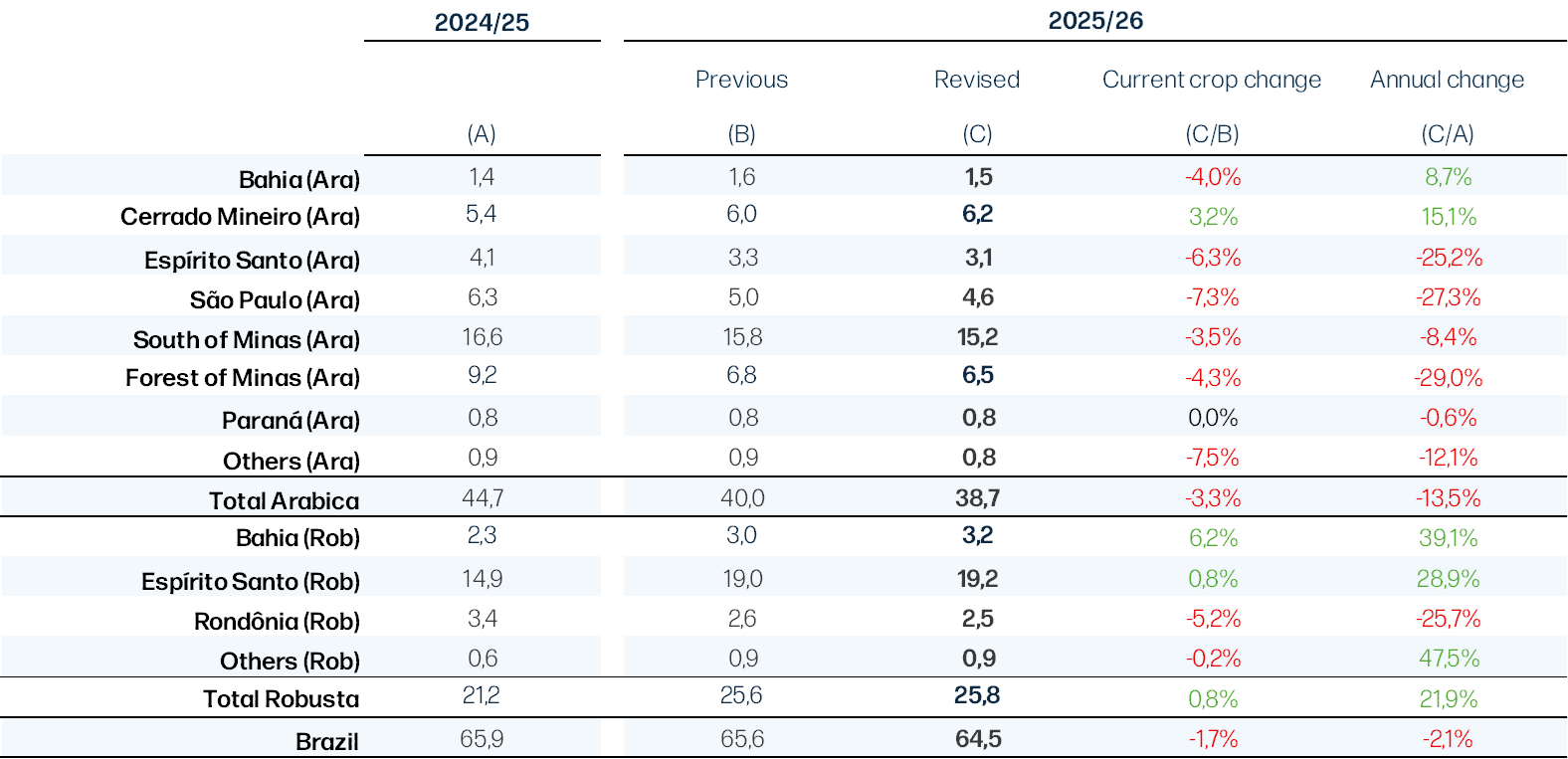
image 110532

Source: StoneX.

Brazil to Start Coffee Harvest Earlier

The 2025/26 harvest is expected to begin earlier, driven by the advanced and uniform development of the coffee cherries. In some arabica-producing regions—especially in lower, warmer areas or those with irrigation and early flowering—initial signs of ripening were already observed in February. The same is true for conilon-growing areas.

The uniformity of fruit development across all producing regions is likely to support an early start to the harvest, ensure a steady pace of operations, and enhance coffee quality. The strong development during the fruit expansion phase, supported by adequate rainfall and efficient nutritional management, is expected to result in a good percentage of larger bean sizes. Additionally, the lower number of cherries per node reduces internal competition for water and nutrients, allowing the remaining cherries to develop more fully.

The next StoneX update will be released at the end of July or early September, following fieldwork carried out by the technical team to assess the yield of the 2025/26 harvest. The subsequent report is scheduled for late October or early November and will already include the first estimates for the 2026/27 crop, after the beginning of flowering in Brazil.

StoneX Estimates for Brazilian Coffee Production (Million Bags)
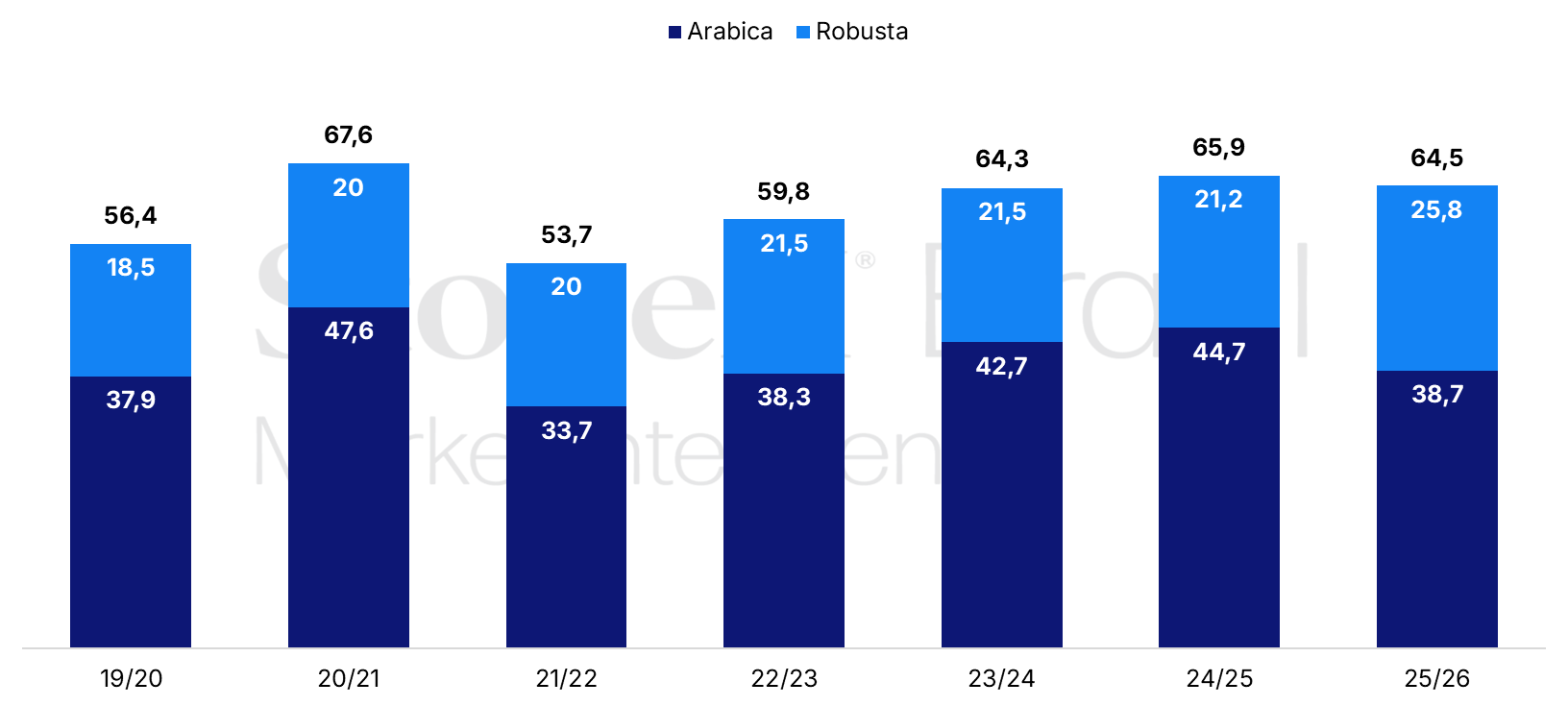
image 110533

Source: StoneX. 

  • Coffee

This material should be construed as market commentary and represents the opinions and viewpoints of the author, and does not reflect tailored advice associated with any specific account.


The views are current only through the date stated and are subject to change at any time based upon market or other conditions, and StoneX Group Inc. (“SGI”) disclaims any responsibility to update such views. Actual results, performance, or achievements may differ materially from those expressed or implied. Information is based on data gathered from what we believe are reliable sources. Past performance does not guarantee future results.


The StoneX Group Inc. group of companies provides financial services worldwide through its subsidiaries, including physical commodities, securities, exchange-traded and over-the-counter derivatives, risk management, global payments and foreign exchange products in accordance with applicable law in the jurisdictions where services are provided.


References to certain OTC products or swaps are made on behalf of StoneX Markets, LLC (SXM), a member of the National Futures Association (NFA) and provisionally registered with the U.S. Commodity Futures Trading Commission (CFTC) as a swap dealer. SXM’s products are designed only for individuals or firms who qualify under CFTC rules as an ‘Eligible Contract Participant’ and who have been accepted as customers of SXM.


StoneX Financial Inc. (SFI) is a member of FINRA/NFA/SIPC and registered with the MSRB. SFI is registered with the U.S. Securities and Exchange Commission (SEC) as a Broker-Dealer and with the CFTC as a Futures Commission Merchant and Commodity Trading Advisor. StoneX Financial (Canada) Inc. (SFCI) is registered in Canada and is a member of CIRO and CIPF. References to certain securities trading are made on behalf of the BD Division of SFI and are intended only for an audience of institutional clients as defined by FINRA Rule 4512(c). References to certain exchange-traded futures and options are made on behalf of the FCM Division of SFI. Wealth Management is offered through SA Stone Wealth Management Inc., member FINRA/SIPC, and SA Stone Investment Advisors Inc., an SEC-registered investment advisor, both wholly owned subsidiaries of SGI.

R.J. O’Brien & Associates, LLC (RJO) is registered with the CFTC as a Futures Commission Merchant and is a member of NFA.


StoneX Financial Ltd (SFL) is registered in England and Wales, company no. 5616586. SFL is authorized and regulated by the Financial Conduct Authority (FCA) (registration number FRN:446717) to provide services to professional and eligible customers including: arrangement, execution and, where required, clearing derivative transactions in exchange traded futures and options. SFL is also authorized to engage in the arrangement and execution of transactions in certain OTC products, certain securities trading, precious metals trading and payment services to eligible customers. SFL is authorized and regulated by the FCA under the Payment Services Regulations 2017 for the provision of payment services. SFL is a category 1 ring-dealing member of the London Metal Exchange. In addition SFL also engages in other physically delivered commodities business and other general business activities which are unregulated and not required to be authorized by the FCA.


This communication is issued in the European Economic Area by StoneX Financial Europe GmbH (SFEG). StoneX is the trade name used by STONEX GROUP INC. and all its associated entities and subsidiaries. StoneX Financial Europe GmbH (“SFEG”) is a securities trading firm registered in Germany under Company No. HRB 80844.


StoneX APAC Pte. Ltd. (“SAP”) (Co. Reg. No 200616676W) is regulated as a Dealer (PS20190001002) under the Precious Stones and Precious Metals (Prevention of Money Laundering and Terrorism Financing) Act 2019 for purposes of anti-money laundering and countering the financing of terrorism. SAP is an “Approved International Trading Company” authorized to act as a “Spot Commodity Broker” under the Commodity Trading Act.


StoneX Financial Pte Ltd (Co. Reg. No 201130598R) (“SFP”) is regulated by the Monetary Authority of Singapore and is a Capital Markets Service Licence holder (for dealing in capital market products), an Exempt Financial Adviser (for advising on investment products and issuing or promulgating analyses/ reports on investment products) and a Major Payment Institution (for domestic and cross-border money transfer services).


SFP may distribute analysis/report produced by its respective foreign affiliates within the StoneX Group of companies pursuant to an arrangement under Regulation 32C of the Financial Advisers Regulations Recipients should contact SFP at (65) 6309 1000 for any matters arising from, or in connection with, this webinar.


StoneX APAC Pte. Ltd. (“SAP”) (Co. Reg. No 200616676W) is regulated as a Dealer (PS20190001002) under the Precious Stones and Precious Metals (Prevention of Money Laundering and Terrorism Financing) Act 2019 for purposes of anti-money laundering and countering the financing of terrorism.


StoneX Financial (HK) Limited (CE No.: BCQ152) (“SHK”) is regulated by the Hong Kong Securities and Futures Commission for Dealing in Securities and Dealing in Futures Contracts.


StoneX Financial Pty Ltd (ACN 141 774 727) holds an Australian Financial Service License (AFSL: 345646) for Dealing in Securities, Exchange-Traded Derivatives Contracts, OTC Derivatives Contracts and Foreign Exchange Contracts, and is regulated by the Australian Securities and Investments Commission.


StoneX Securities Co., Ltd. (“SSJ”) (Co. Reg. No 010401047199) is regulated by the Japanese Financial Services Agency as a Type-I Financial Instruments Business Operator (Kanto Local Finance Bureau (FIBO)No.291’), is a member of the Financial Futures Association of Japan for dealing and broking FX and FX Option transactions, and is a member of the Japan Securities Dealers Association for dealing and broking stock indices and option transactions.


Trading swaps and over-the-counter derivatives, exchange-traded derivatives and options and securities involves substantial risk and is not suitable for all investors. Past performance of any futures or option is not indicative of future success. Indicators are not a trading system and are not published as a specific trade recommendation. The information herein is not a recommendation to trade nor investment research or an offer to buy or sell any derivative or security. It does not take into account your particular investment objectives, financial situation or needs and does not create a binding obligation on any of the StoneX group of companies to enter into any transaction with you. You are advised to perform an independent investigation of any transaction to determine whether any transaction is suitable for you. No part of this material may be copied, photocopied or duplicated in any form by any means or redistributed without the prior written consent of StoneX Group Inc.


The report/analysis herein is not directed to, or intended for distribution to or use by, any person or entity who is a citizen or resident of or located in any locality, state, country or other jurisdiction where such distribution, publication, availability or use would be contrary to law or regulation.


© 2026 StoneX Group Inc. All Rights Reserved.

Satellite view of Earth at night showing illuminated cities across Asia and the Middle East

Discover more insights

Our subscribers have access to comprehensive market analysis from StoneX spanning commodities, equities, currencies and more.

Related articles for Coffee

Perspective: Morning Commentary for August 7

August 7 – The U.S. economy unexpectedly lost 23k jobs in July, dramatically below market expectations of an 80k increase and marking the worst Non-Farm Payrolls print since February. Furthermore, May and June were both revised sharply downward, with combined revisions showing 103k fewer jobs than previously reported. Outside of the healthcare sector, which added 22k jobs in July, the losses were very broad-based. Government payrolls saw the largest decline, shedding 53k jobs in July, the largest seen since October 2025, while June was revised down to show a loss of 10k jobs as well. The private sector at least saw growth, adding 30k jobs in July, now matching the month prior after it was revised down from the 49k initially reported, and substantially missing forecasts of 78k jobs being added. This is a sharp reversal in course from the largely better than expected U.S. labor data seen earlier this week.

Mike Castle
Mike Castle
  • Grains & Oilseeds
  • Energy
  • Dairy
  • Renewable Fuels
  • Cocoa
  • Coffee
  • Cotton
  • Sugar
  • Meats & Livestock
  • Forest Products

Daily Coffee Report 8/6/26

Daily coffee report

StoneX Coffee Team
StoneX Coffee Team
  • Coffee

Perspective: Morning Commentary for August 6

August 6 – This morning’s stronger-than-expected U.S. labor data offered markets some relief, reinforcing confidence in the economy while giving the Fed greater flexibility to raise rates should inflationary pressures reaccelerate in next week’s July data. Stock futures are pointing to a mixed open to start the day, with the tech-heavy Nasdaq showing the most weakness. The VIX has fallen notably from yesterday’s spike above 18.4 as it starts the day hovering just below the 16-mark. The dollar is quietly higher as it trades just above 99.8, holding in the tight range seen thus far this week as traders continue to digest data to shape expectations for the Fed’s next move, which we’ll dive into in more depth below. Long-term treasury yields have relaxed slightly from their recent spike, with 30-year yields starting the day trading just above 5.19%, while 10-year yields trade above 4.64%, and 2-year yields sit below 4.22%. Crude oil is modestly higher to start the session after sharp declines earlier in the week, with nearby WTI up 1.8% to trade at $76.40 and nearby Brent up 2.4% to trade at $81.40. Meanwhile, the ags are quietly mixed to start the day.

Mike Castle
Mike Castle
  • Grains & Oilseeds
  • Energy
  • Dairy
  • Renewable Fuels
  • Cocoa
  • Coffee
  • Cotton
  • Sugar
  • Meats & Livestock
  • Forest Products
StoneX: We open markets

Our market expertise, advanced platforms, global reach, culture of full transparency and commitment to our clients’ success all set us apart in the financial marketplace.

Reach

With access to 40+ derivatives exchanges, 180+ foreign exchange markets, nearly every global securities marketplace and numerous bi-lateral liquidity venues, StoneX’s digital network and deep relationships can take clients anywhere they want to go.

Transparency

As a publicly traded company meeting the highest standards of regulatory compliance in the markets we serve; our financials and record of accomplishment are matters of public record. StoneX’s commitment to “doing the right thing over the easy thing” sets us apart in the industry and helps us build respect, client trust and new partnerships.

Expertise

From our proprietary Market Intelligence platform, to “boots on the ground” expertise from award-winning traders and professionals, we connect our clients directly to actionable insights they can use to make more informed decisions and achieve their goals in the global markets.