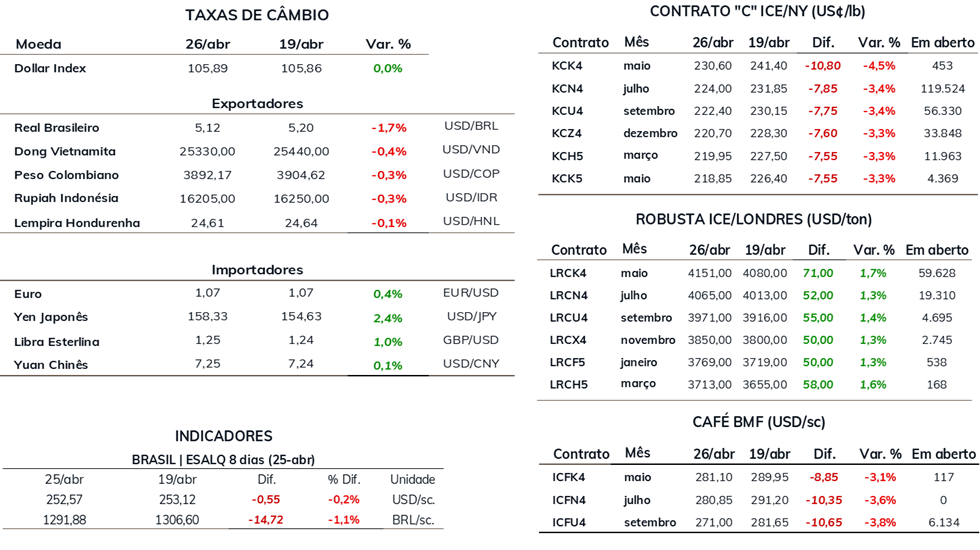
• Arabica coffee fell 3.4% this week in New York, closing at US₵ 224/lb
• On the London exchange, Robusta coffee prices advanced 1.7% to USD 4151/t
• The CEPEA indicator for Arabica coffee recorded a drop of 3.6%, quoted at R$ 1,260.03/bag
• The CEPEA indicator for Robusta coffee advanced 0.5% to R$ 1,160.91/bag
• Vietnam sees partial return of rains in part of the coffee belt
• Climate models point to accumulations of up to 200 mm in the coming weeks
• Preliminary data from the Foreign Trade Secretariat indicate a 30% increase in exports
• Reports point to inferior quality in the first lots of the new crop
• The outlook is still for a comfortable supply of Arabica and tightening in Robusta
• In the coming weeks, the USDA attaché reports will be released.
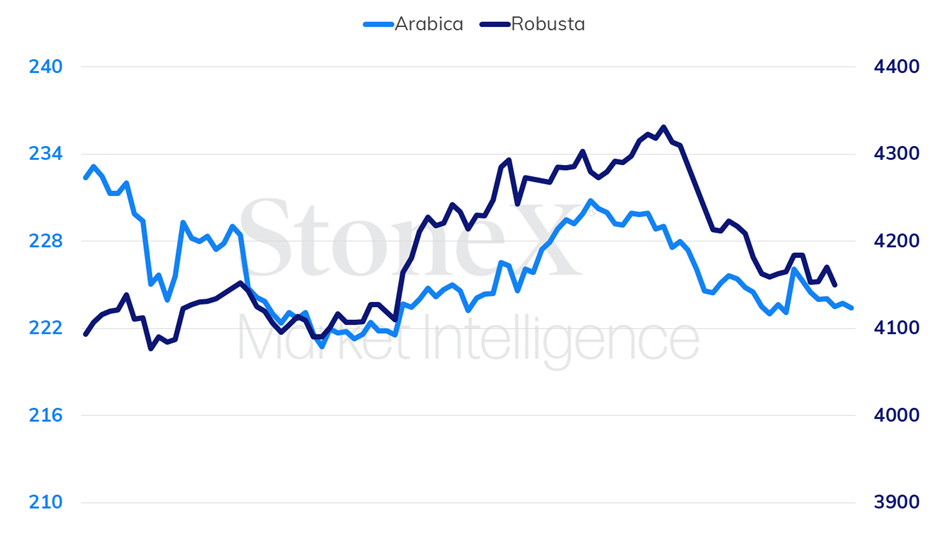
Last week, Arabica and Robusta coffee futures prices followed different paths, with quotes in New York falling amidst profit-taking and other technical factors. On the other hand, the unchanged scenario of a limited supply of Robusta coffee and concerns about weather conditions in Vietnam supported prices in London. In New York, the most active contract fell by 785 points (-3.4%), closing Friday's session (26) at US₵ 224.00/lb. The most active Robusta coffee contract in London rose USD 71/ton (+1.7%) to USD 4151/ton.
In Brazil, domestic coffee prices followed the trend observed in the international market. The CEPEA indicator for Arabica coffee decreased by 3.6% to BRL 1260.03/bag. The indicator for Robusta coffee, on the other hand, increased only 0.5% to R$1160.91 per bag. In addition to movements abroad, the 1.7% drop in the USD this week helped to pressure Arabica quotes and limit the increase in Robusta prices.
Weekly intraday (most active contract) - April 22 to 26
Amid concerns about the weather in Vietnam, the rains partially returned in part of the country's coffee belt, which eases conditions for the country's crops. In addition, climate models have pointed to significant rainfall in the region of the country's central highlands, where more than 80% of the national coffee production is concentrated. According to the models, part of the region will receive between 50 and 200 mm of accumulated rainfall in the next two weeks. The return of rainfall is crucial to ensure the suitable crop development in the country. Despite concerns, as previously presented in other editions of this report, the transition from El Niño to Neutral conditions, as indicated by NOAA models, is expected to benefit the return of rainfall in Southeast Asia.
Rainfall forecast accumulation for the next two weeks (mm)
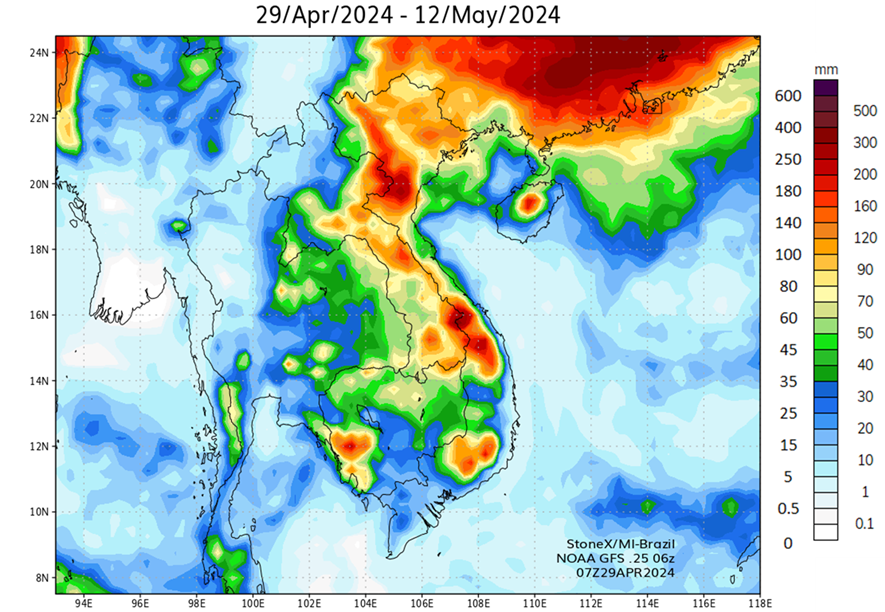
Source: StoneX, with NOAA/NCEP/EMC data
In the coming weeks, traders will monitor the release of April export data by the Brazilian Coffee Exporters Council (Cecafé). As in previous months, large export volumes are expected in the month. The preliminary data from the Foreign Trade Secretariat of Brazil (SECEX) indicate that by the third week of April, the country exported 2.98 million coffee bags, which is almost 30% higher than the volume observed in the same period in April 2023.
Another important issue has been the impressions of the first batches of the new crop in terms of quality. Last week, there were reports that the first harvested batches had lower qualitative characteristics, mainly regarding the size of the grains. Despite the reports, the perspective is that it is still too early to consider that this will be a characteristic of the 2024/25 crop as a whole. The first batches having lower quality is natural, considering that the percentage of green fruits is still very high, negatively impacting the product. In addition, the current price level has encouraged some producers to advance their harvest to commercialize coffee as quickly as possible.
In terms of fundamentals, the expectation is that the supply and demand balance will be more comfortable for Arabica coffee in the next season. In contrast, the Robusta coffee market will continue to face a condition of limited supply. The start of the crop in Brazil and Indonesia, from mid-June onwards, can be a bearish factor in the medium term. However, supply issues in Vietnam will continue to have a bullish bias, mainly because the country's next harvest will only start in mid-November.
The market will also focus on releasing USDA attaché reports in the coming weeks, disclosing their estimates for coffee-producing countries. The agency will release its final report in mid-June, which includes estimates for the global coffee supply and demand balance. The agency is expected to point to a significant increase in Brazilian coffee production and a broader global supply and demand balance. Summaries of the attachés' reports will be published on the StoneX portal as the USDA releases them.
INDICATORS