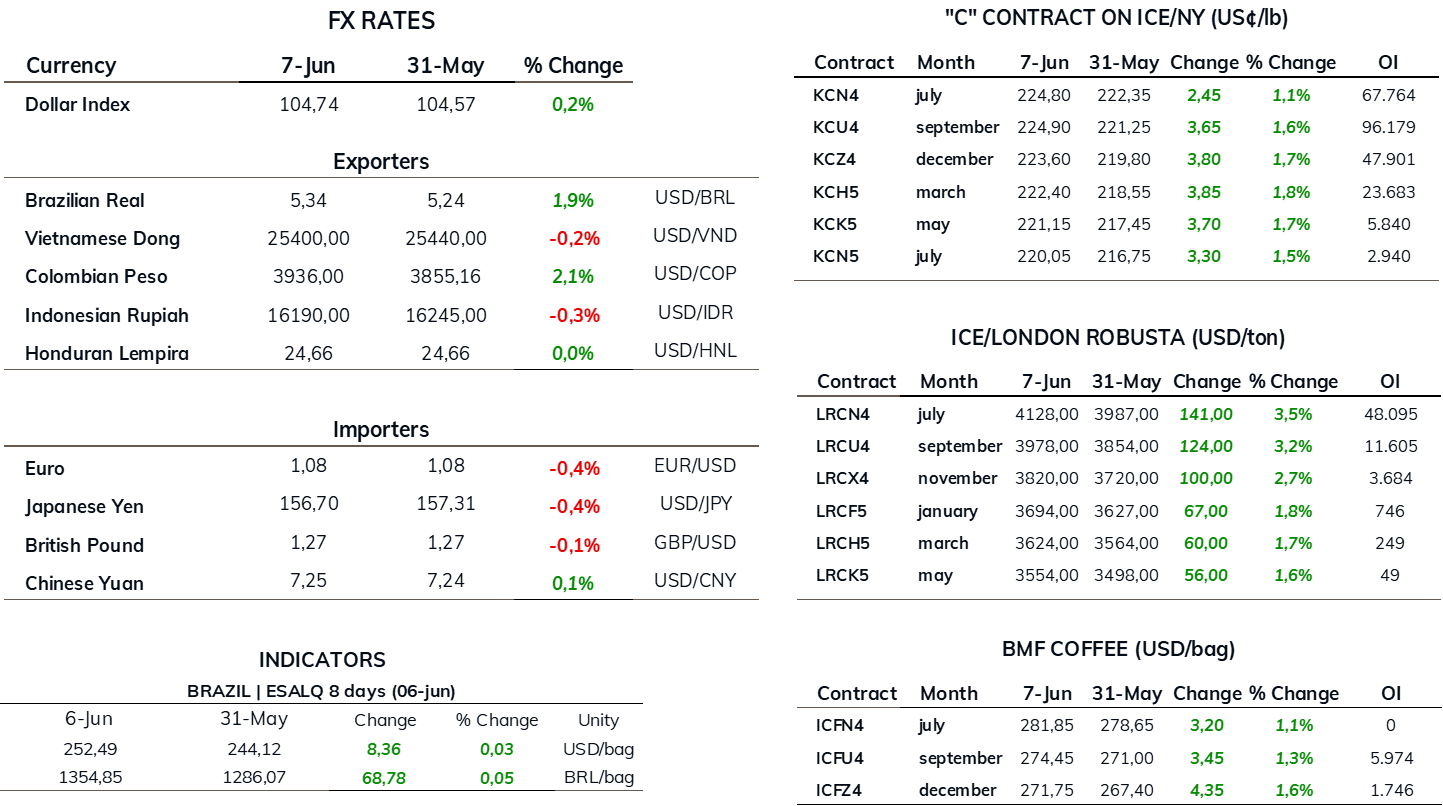
• Arabica coffee rose 1.6% on the week in New York, closing at US₵ 224.90/lb
• On the London exchange, Robusta prices rose 3.5% to USD 4128/t
• Dollar up 1.9% to USDBRL 5.34 for the week
• Cepea indicator for Arabica rises 2.4% to BRL 1,317.07/bag
• Cepea indicator for Robusta coffee up 5.5% to BRL 1,212.60/bag
• Brazilian winter may contribute to greater volatility in prices
• Vietnam received above-average rainfall in the last 30 days
• Preliminary Secex data points to 73% increase in exports
• Cecafé to release export report on Tuesday (11) at 4pm (Brasília time)
• USDA to release global supply and demand balance report on June 20
• StoneX carries out harvest progress survey in Brazil
• Honduran exports up 13.6% in May
• Colombian coffee production up 39% in May
• J.M. Smucker Co. sees 4% drop in coffee sales revenue
• Luckin Coffee commits to buying 2 million bags from Brazil
Note: Last week, it was reported that StoneX had provided estimates on Vietnamese coffee production. We would like to clarify that this information is untrue and that StoneX has not released any official estimates on Vietnamese coffee production.
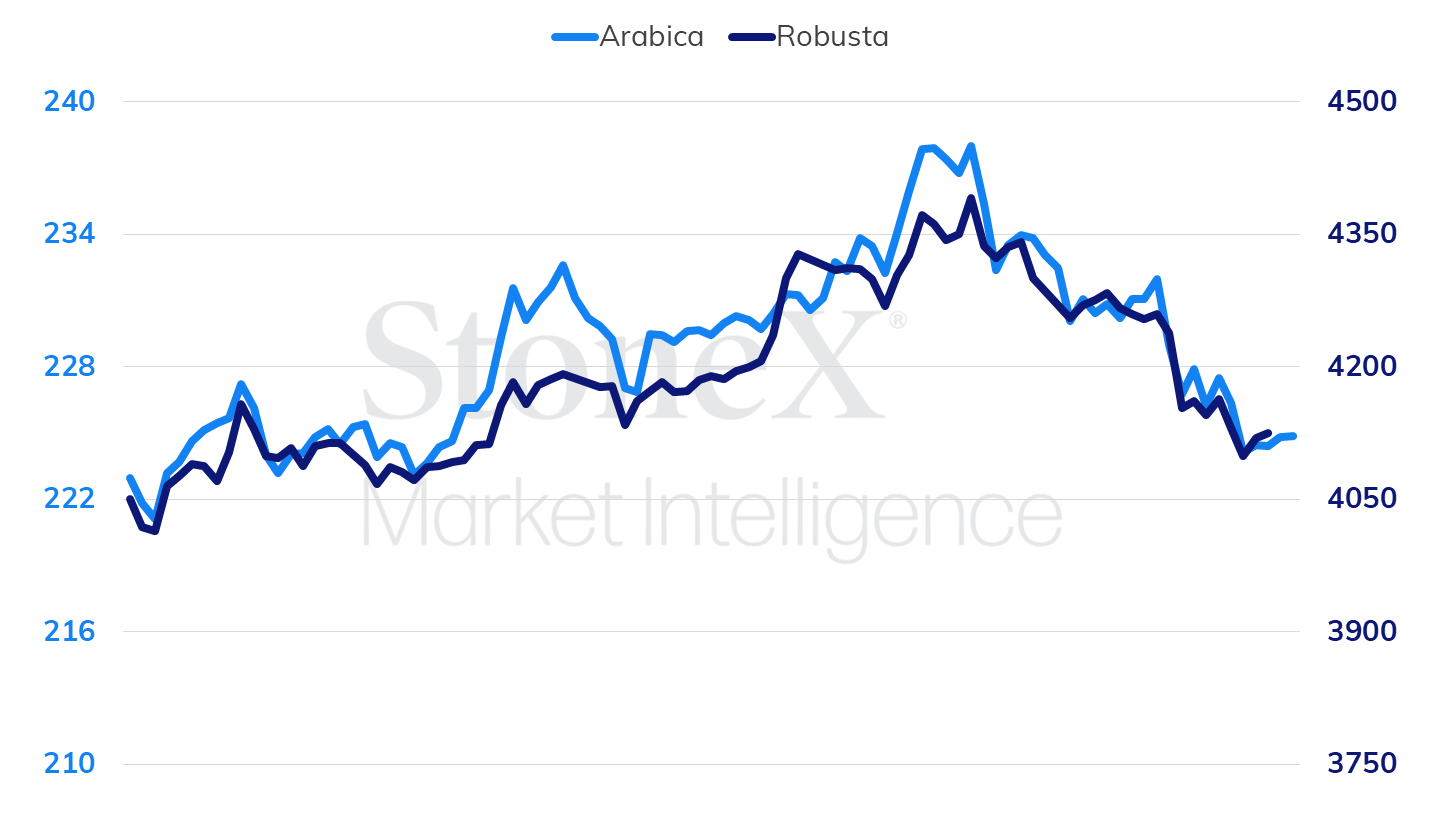
Arabica and Robusta coffee futures followed a bullish trajectory for most of the week, but fell sharply towards the end of the period. However, prices still ended the week on a positive note. Reduced supplies of Robusta coffee in Asia continue to be one of the main bullish factors for quotes on both the London and New York terminals. On the other hand, according to traders, a strong sell-off in the spread between the July and September contracts pressured prices at the end of the week.
In New York, from the start of the week until Thursday's session (06), Arabica coffee futures had already accumulated gains of 5.5%, with the most active contract closing Thursday quoted at US₵ 233.35/lb. On Friday (07), Arabica coffee futures fell by 3.6%, closing Friday at US₵ 224.90/lb, resulting in a weekly rise of 1.6%. In London, Robusta futures had gained 8.4% by Wednesday (05), but fell by 4.5% on Friday, closing the week quoted at USD 4128/t, a weekly rise of 3.5%.
Weekly intraday (most active contract) - June 03 to June 07
On the Brazilian domestic market, coffee prices followed the trend seen abroad, but to a greater extent. The Cepea indicator for Arabica coffee rose 2.4% to BRL 1,317.07/bag. The indicator for Robusta gained 5.5% to BRL 1,212.60/bag. The stronger domestic market was a reflection of the 1.9% rise in the dollar during the week, which closed Friday (07) at USDBRL 5.34.
In terms of fundamentals, the scenario remains largely unchanged, with market participants focused on weather conditions in producing countries, export data released by Cecafé, and the USDA's projections. Regarding the weather in Brazil, minimum temperatures in producing regions during the winter continue to be a major concern. Although there is no forecast of a cold wave, the proximity of polar masses in the coffee belt could support futures prices, especially considering the memory of the 2021 frost, which increases volatility. Additionally, the anticipated arrival of La Niña in the second half of the year remains a point of attention. However, the latest update from NOAA models indicates a phenomenon of low intensity, which is unlikely to negatively impact production in Brazil.
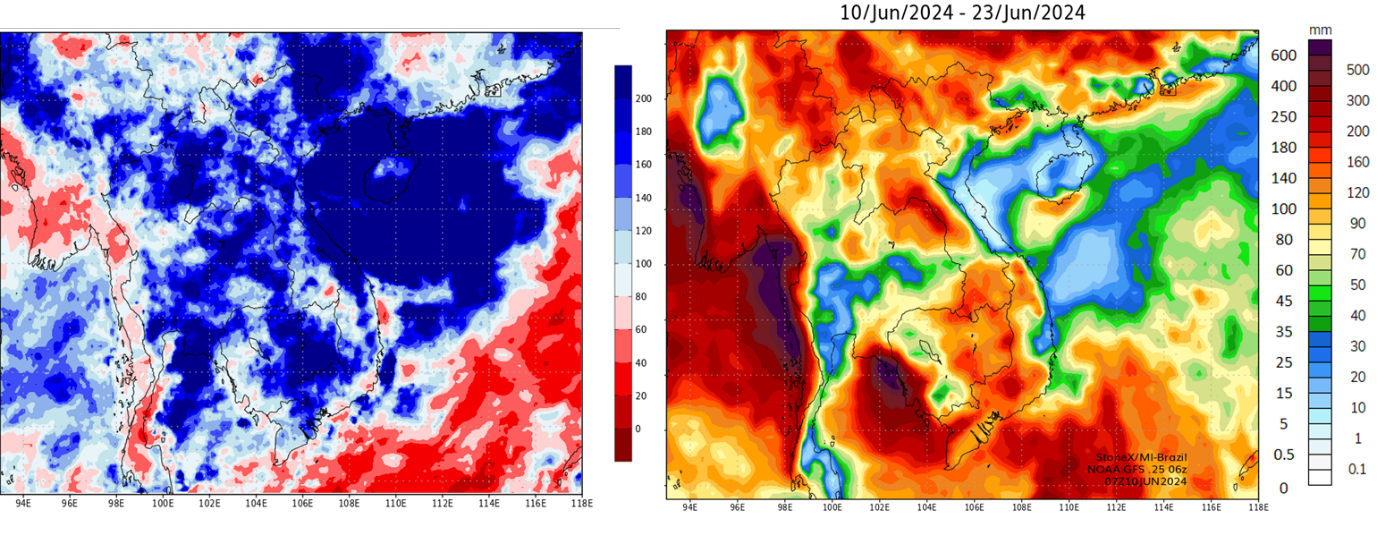
Still on the subject of weather, agents are focusing on monitoring the rains in Vietnam, whose production is going through the period of fruit set and expansion, which are crucial stages for defining potential in 2024/25. As mentioned in other editions of this report, Vietnam faced adverse weather conditions in the first few months of the year due to the effects of El Niño. However, the change to a neutral condition has favored the return of rains in the country in recent weeks. According to StoneX's weather report, which uses NOAA/NCEP/EMC data, the entire Vietnamese coffee belt has received significant volumes of up to 300 mm in the last 14 days. As such, the anomaly map shows that the country has received volumes above the historical average over the last 30 days. For the next two weeks, the models point to accumulated volumes of between 30 and 150 mm in the central highlands of the country.
Vietnam: Accumulated rainfall over the last 30 days compared to the historical average (%) and accumulated rainfall forecast for the next 14 days
Source: StoneX, with data from NOAA/NCEP/EMC (GFS: Global Forecast System), 2024.
During the week, there will be an update on Brazil's coffee export data, which, according to an official press release, will be published by Cecafé on Tuesday (11) at 4pm (Brasília time). Since the beginning of the year, Brazil has seen significant growth in the volume of exports, with increases in both Robusta and Arabica exports. For Robusta, the highlight is that Brazil continues to be the most competitive origin in the world, while other producing countries in Asia have been facing production problems. Preliminary figures from Brazil's Secretariat for Foreign Trade (Secex) point to an almost 73% increase in exports in May to 4.065 million bags.
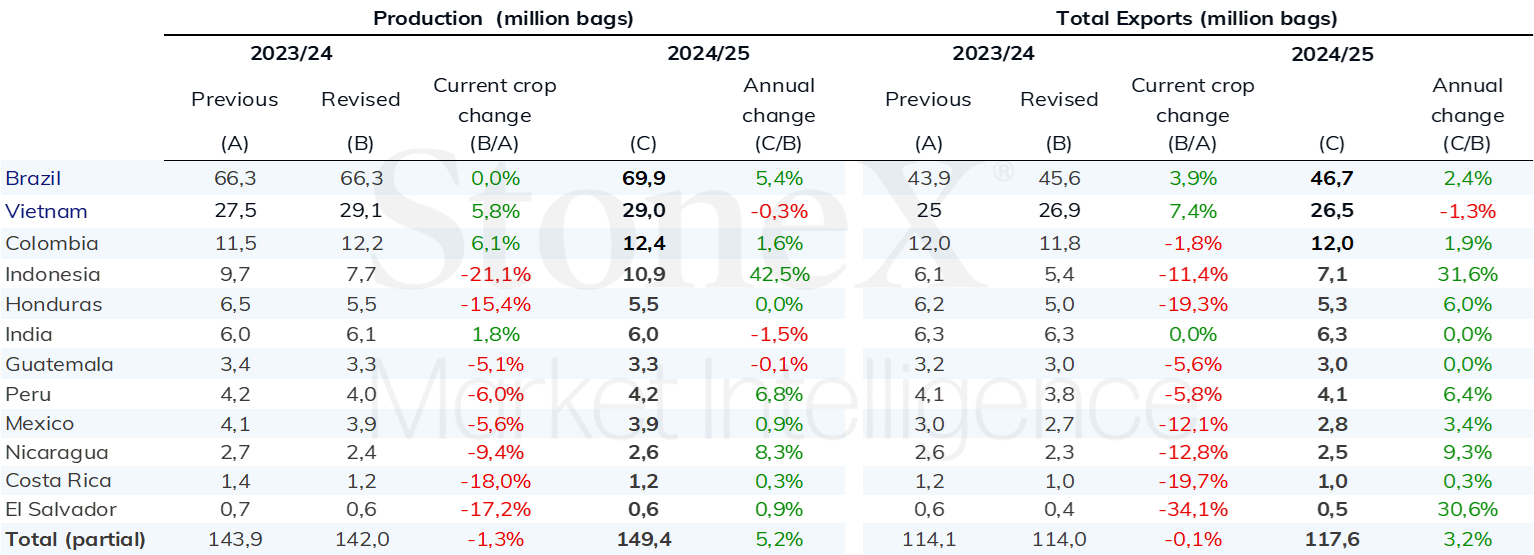
Last month, the US Department of Agriculture (USDA) released its attaché reports for coffee producing countries, ending a sequence of releases with numbers from the world's two largest coffee producers, Brazil and Vietnam. For Brazil, the department projected a 5.4% increase in production to 69.9 million bags, while for Vietnam the estimate was a drop of just 0.3% to 29 million bags. In addition to these countries, the department projected a 1.6% increase in Colombian production and a 42.5% recovery in Indonesian production. The figures for the countries that have been released point to a partial increase of 5.2% in production to 149.4 million bags. Therefore, in the final report to be released on June 20, the USDA should point to an increase in global coffee production. With regard to consumption, it is still uncertain what the USDA will indicate, but there are expectations that the agency will point to a more comfortable balance of supply and demand next season.
USDA estimates overview
Source: USDA. Design: StoneX.
With regard to Brazilian coffee production, last week StoneX conducted a crop progress survey, which indicated that the Robusta producing regions still have the most developed harvest in Brazil, especially in the state of Rondônia, where activities are about 60% complete, while in Espírito Santo the harvest has reached 46%. In the Arabica-producing regions, the harvesting pace is around 30% for almost all regions, with a slightly greater progress of 35% in the region of Matas de Minas, while São Paulo is approximately 28% harvested.
According to the Honduran National Coffee Institute (IHCAFE), the Central American country exported 938,800 bags in May, an increase of 13.6% compared to the volume exported during the same month in 2023. As a result, accumulated exports for the country's crop year totaled 3.64 million bags, an increase of 1.6%. On the other hand, for the 2024/25 season, the Honduran Coffee Exporters Association (ADECAFEH) projects an 11% drop in exports to 4.7 million bags. ADECAFEH does not justify the reduction in exports with a possible drop in the country's production, however, weather data has shown that all Central American countries have been facing adverse weather conditions, with the accumulated rainfall over the last 30 days well below the historical average. For the next two weeks, the models point to the return of significant rainfall accumulations for the countries in the region.
Central America: Accumulated rainfall over the last 30 days compared to the historical average (%) and accumulated rainfall forecast for the next 14 days 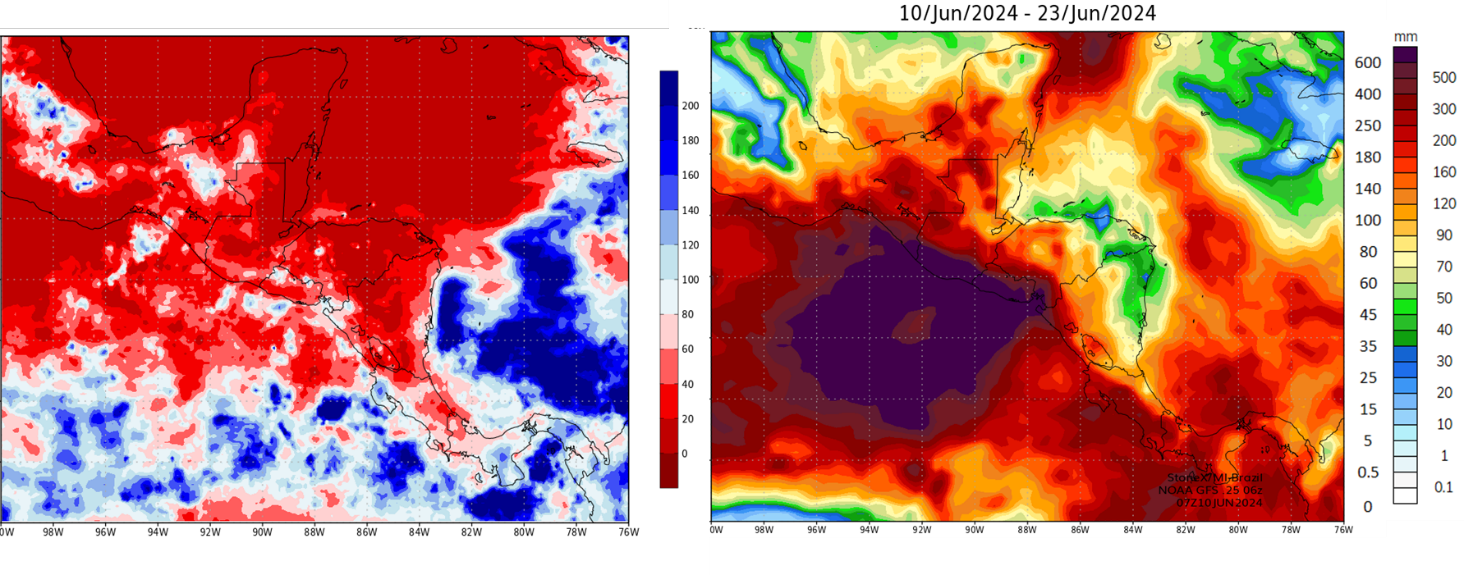
Source: StoneX, with data from NOAA/NCEP/EMC (GFS: Global Forecast System), 2024.
According to Colombia's National Coffee Growers Federation (FNC), coffee production in the South American country rose 39% in May to 1.12 million bags. As a result, accumulated production in the first five months of the year totaled 4.65 million bags, a 14% increase from the same period in 2023. With the increase in production, exports also rose to 933,000 bags (+10%). In this context, coffee stocks in May rose 6.2% to 1.039 million bags.
Also last week, the American coffee company J.M. Smucker Co., owner of Folgers, Café Bustelo and Dunkin' Brands, released its financial report for the 1st quarter of 2024. According to the report, revenue from retail coffee sales in the US fell by 4% in the quarter, reflecting a 2% drop in prices and a 2% drop in the volume of coffee sold. On the other hand, it was announced that the Chinese coffee shop chain Luckin Coffee has made an agreement with the Brazilian government pledging to buy 120,000 tonnes (2 million bags) of coffee from the country.
INDICATORS