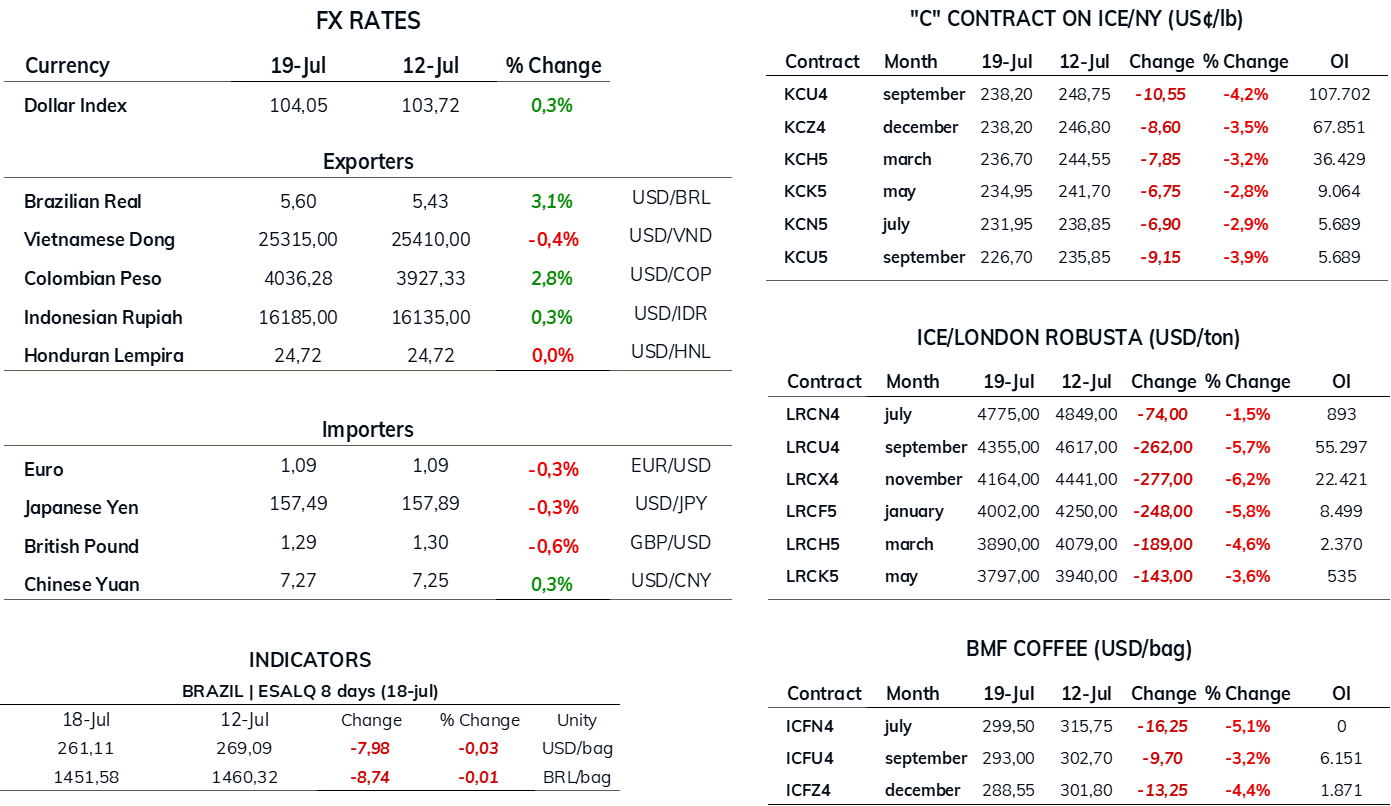
• Arabica coffee down 3.5% on the week in New York, quoted at US₵ 238.20/lb
• On the London exchange, Robusta coffee prices fell 5.7% to USD 4355/t
• Dollar rose 3.2% to USDBRL 5.60 on the week
• Cepea indicator for Arabica coffee down 2.1% to BRL 1,430.13/bag
• Cepea indicator for Robusta coffee down 1.0% to BRL 1,292.34/bag
• Cold fronts approach and should bring rain to the coffee belt in August
• Risk of frost in the most important regions is low
• With the rains in August, coffee flowering in the region could be take place earlier
Last week was marked by a downturn in coffee prices on the main trading exchanges, in a move that was mainly due to a technical correction following the strong rises recorded the previous week. The September/24 Arabica coffee contract in New York ended the period quoted at US¢ 238.2/lb, a weekly drop of 3.5%. In London, the equivalent Robusta coffee contract ended the period at USD 4355/t, a weekly drop of 5.7%. On the domestic market, the CEPEA indicator for Arabica coffee closed the period at BRL 1,430.13/bag, down 2.1%. The indicator for Robusta coffee closed at BRL 1,292.34/bag, down 1.0%.
Also noteworthy was the impact of the exchange rate devaluation on the Brazilian market, with the country's currency falling amid high levels of distrust among agents regarding the government's commitment to the country's fiscal targets, along with political uncertainties abroad as the presidential elections draw closer in the United States. In this scenario, the dollar ended the week higher on the Brazilian interbank market, closing last Friday (19) at R$5.605, a weekly increase of 3.2%. The dollar's rise helped pressure coffee prices on the NY exchange, as it contributed to higher prices for coffee priced on the Brazilian domestic market, stimulating supply on the local market.
Weekly intraday (most active contract) - July 15 to July 19
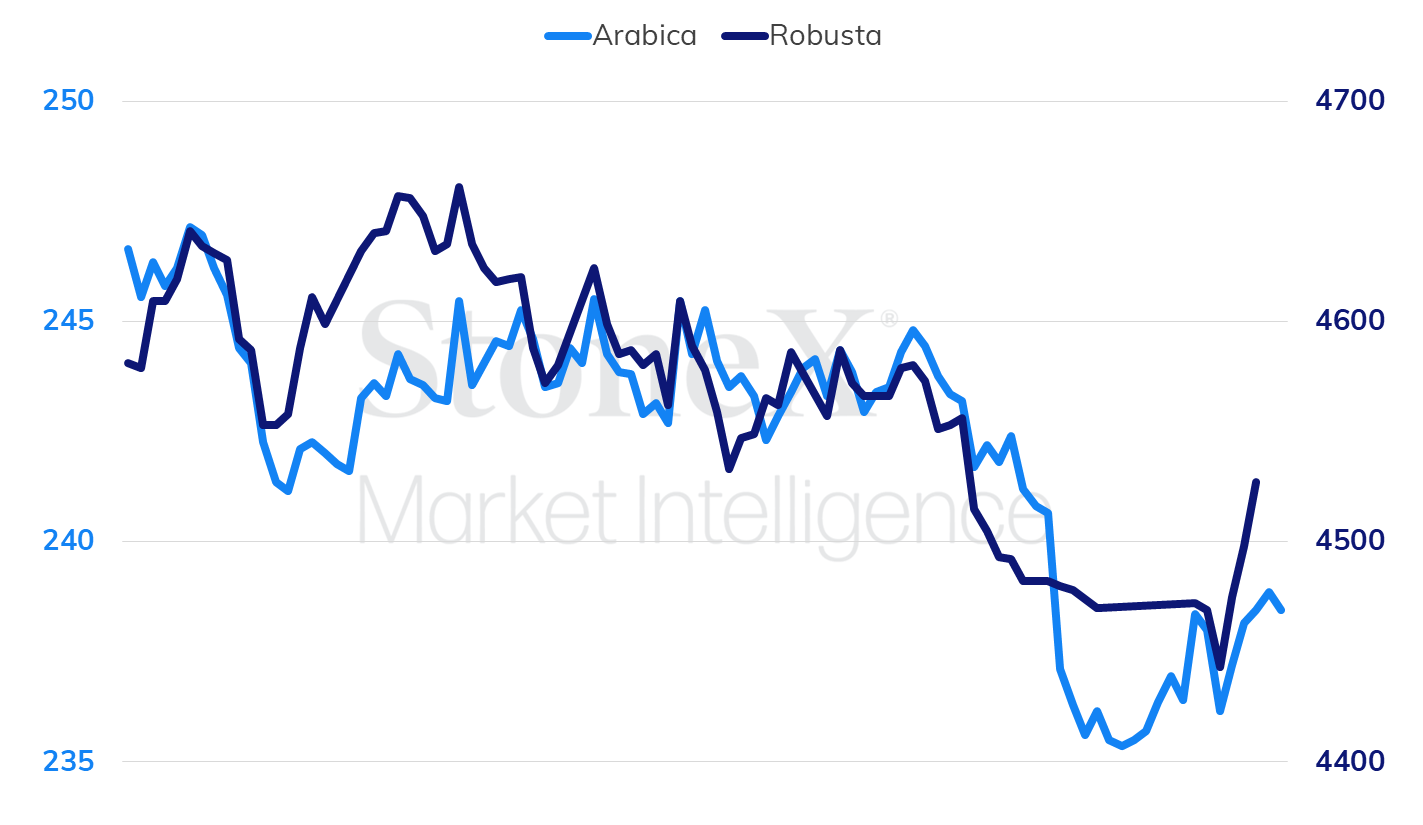
In general, the fundamentals remain unchanged, with supply concerns remaining the main factor dictating prices. Despite last week's drop, which mainly acted as a correction to the record highs registered in the previous week, coffee continues to operate in high price ranges. Since the beginning of the year, Arabica coffee has risen 25% on the New York exchange. As for robusta coffee, the high differentials, especially in Vietnam and Indonesia, continue to signal the low availability of the commodity on the Asian market, and this continues to be the main support factor in the short term, as the market waits for the harvests in both countries. Robusta coffee in London has already accumulated a significant gain of 59% over the same period. At the start of the week, prices are recovering on both exchanges, amid an upward movement in the commodities complex in general.
Coffee prices on the New York and London exchanges in 2024
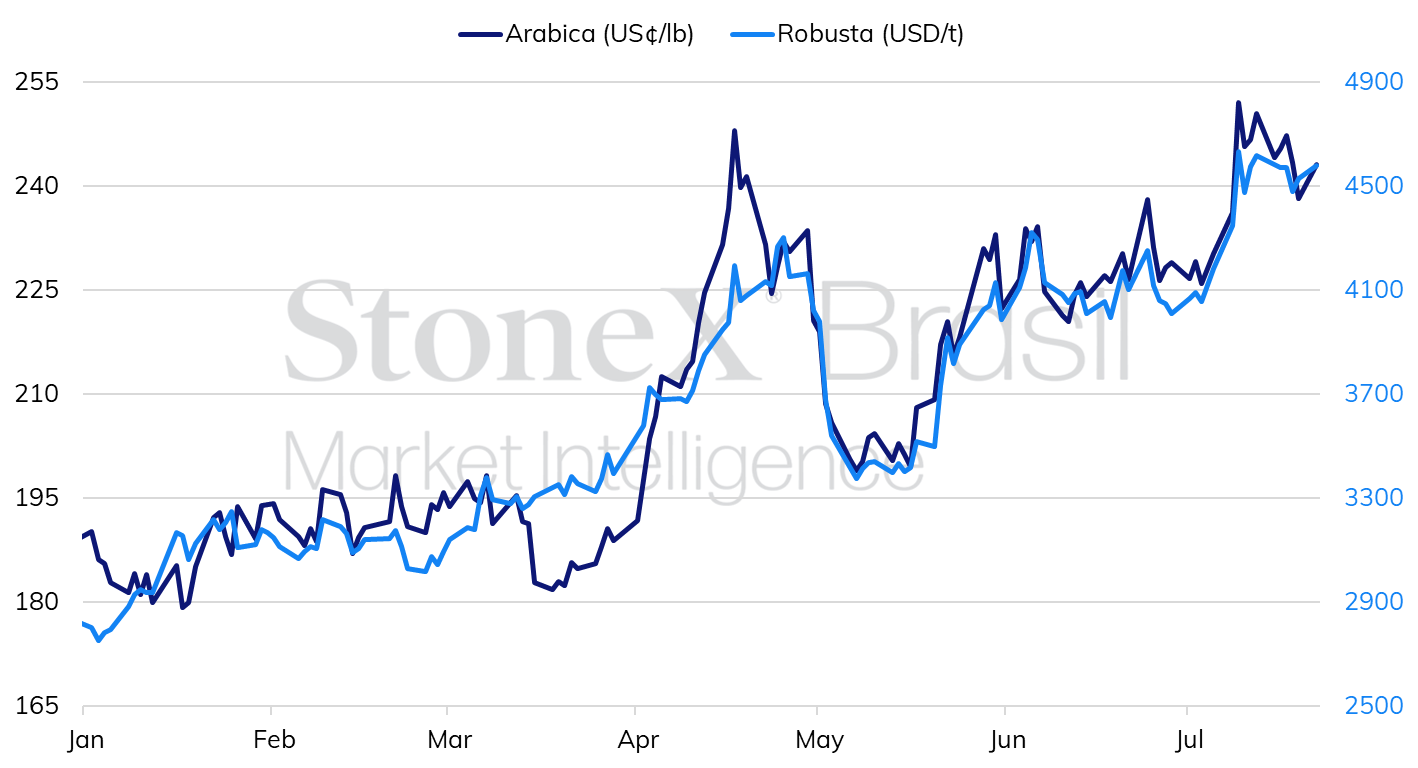
Source: CommodityNetwork Traders' Pro. Design: StoneX.
In addition, with regard to recent releases, last week's data from the Uganda Coffee Development Authority indicated that the country's exports rose by more than 18% to 667,000 bags in June. Arabica coffee exports fell by almost 30% to 52,500 bags. On the other hand, exports of Robusta coffee rose by more than 25% to 614,500 bags. The strong progress in the country's Robusta exports reflects the unchanged scenario of reduced coffee supply in Asia, which has favored Robusta exports from other countries such as Brazil and Uganda.
Cold fronts draw closer and could bring rains to the coffee belt in August
The dry weather in recent weeks has favored the harvesting pace of the 2024/25 crop in Brazil. According to the latest StoneX report, 79% of the Brazilian coffee crop has been harvested, with a more advanced pace for Robusta coffee, which is 96% harvested while Arabica coffee areas have already reached 70%. The next stage of the production cycle in Brazil involves the flowering of both Arabica and Robusta coffee.
Crop monitoring - Brazil
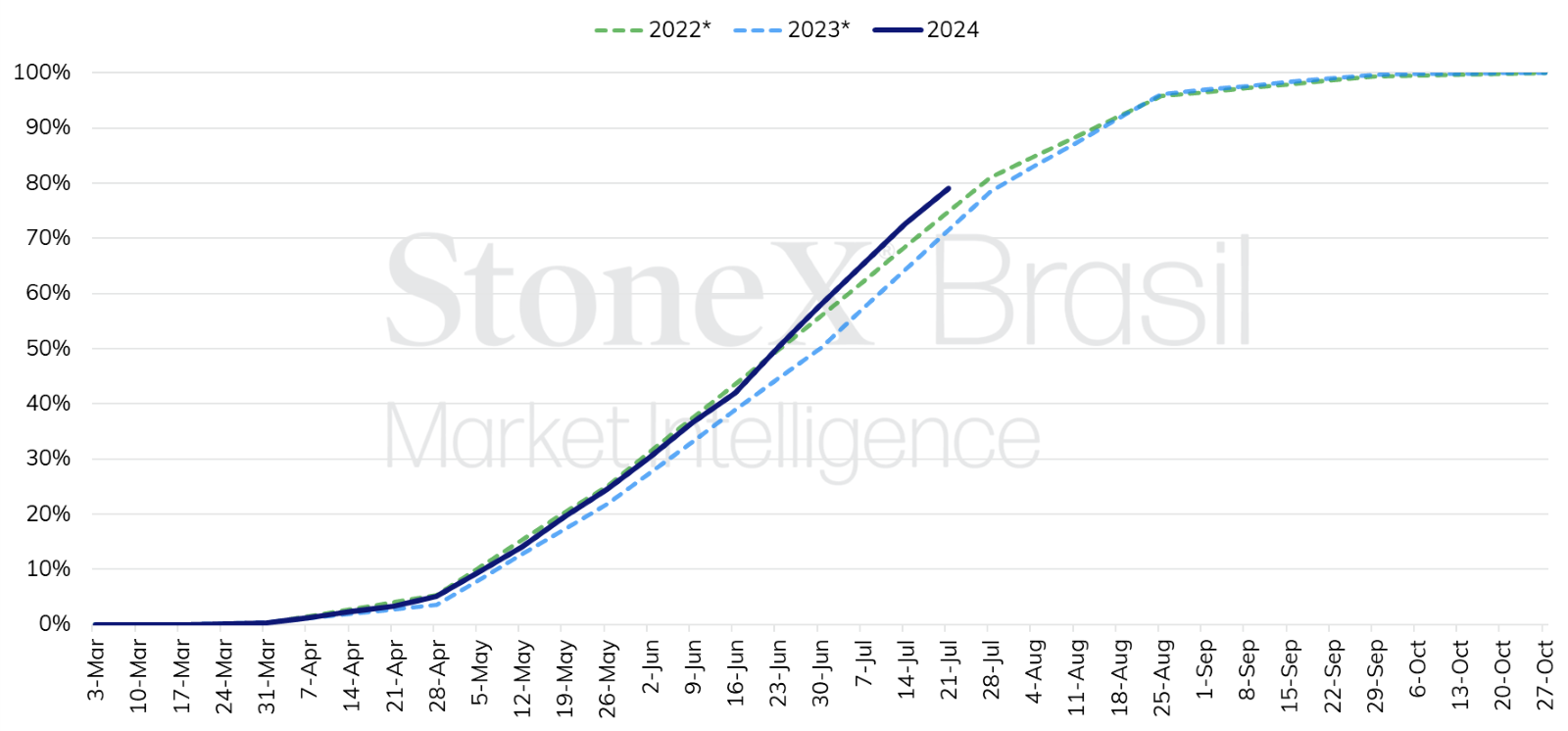
Source: StoneX. *Calculated based on Conab's harvest rate.
StoneX's field team has already noticed the start of flowering in some Robusta coffee regions, which is normal since the flowering of this variety is more advanced than that of Arabica coffee. However, some Arabica coffee areas have also started to flower, although this is not very representative, but it could indicate that flowering is ahead of schedule this season. In the coming weeks, the proper return of the rains is essential to guarantee the success of flowering in Brazil and to determine the production potential of the 2025/26 season.
Short-term weather models have pointed to a cold front arriving at the end of July, which should drop temperatures in the south and bring moisture to the southeastern coastal region of the country. Temperatures should also plummet in the Southeast, but the risk of frost for the entire coffee belt is low and will be monitored. On the other hand, medium-term models predict a second cold front to hit Brazil in August and bring substantial volumes of rain from the second half of the month. According to the models, almost all producing regions will receive some volume of rain, such as the coffee areas of São Paulo, southern Minas Gerais, Cerrado Mineiro, Matas de Minas and the state of Espírito Santo. However, the rains should not reach the producing regions of Bahia and Rondônia.
Cumulative rainfall forecast for August (mm)
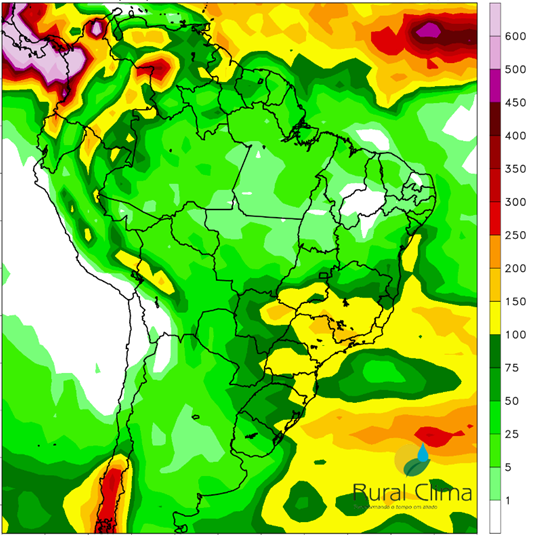
Source: RuralClima.
If this scenario is confirmed, the expected volumes would be enough to trigger the first major flowering in the coffee-growing regions, starting the development of the production that will be harvested from mid-2025 onwards. With the start of the flowering stage, adequate rainfall distribution is needed to ensure that the fruit sets and the next flowering stages open. It should be noted that this stage is crucial and could set the tone for production potential in 2025/26. If the weather is favorable and contributes to a wide flowering stage in Brazil, this could fuel a sense of optimism about next season's production and act as a bearish factor for coffee prices. However, other bullish factors will still be present, such as reduced supply in Asia and lower-than-expected production in Brazil.
INDICATORS