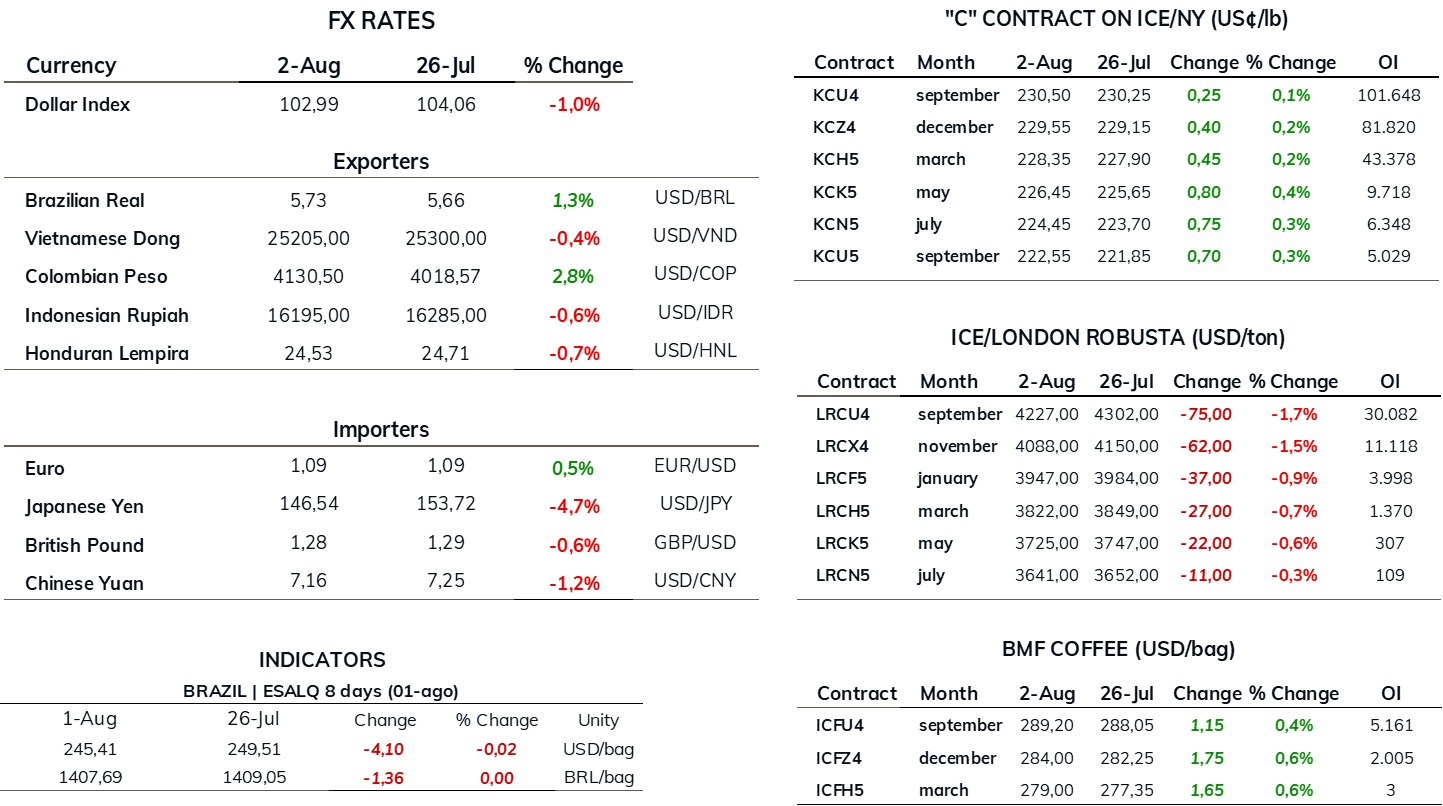
• Arabica coffee rose 0.1% on the week in New York, quoted at US₵ 230.50/lb
• On the London exchange, Robusta coffee prices fell 1.7% to USD 4227/t
• Dollar advanced 1.3% to USDBRL 5.73 on the week
• Cepea indicator for Arabica coffee up 1.3% at BRL 1,427.76/bag
• Cepea indicator for Robusta coffee up 0.5% to BRL 1,285.19/bag
• Global business environment marked by intense risk aversion
• Coffee stocks in European ports were 27% lower in June
• Stocks in Japan registered an increase of more than 6%
• Illycaffè and JDE post revenue increases, but Starbucks disappoints
• Vietnamese coffee exports fell by almost 37% in July
• Cold front expected to drop temperatures and bring sporadic, localized rainfall
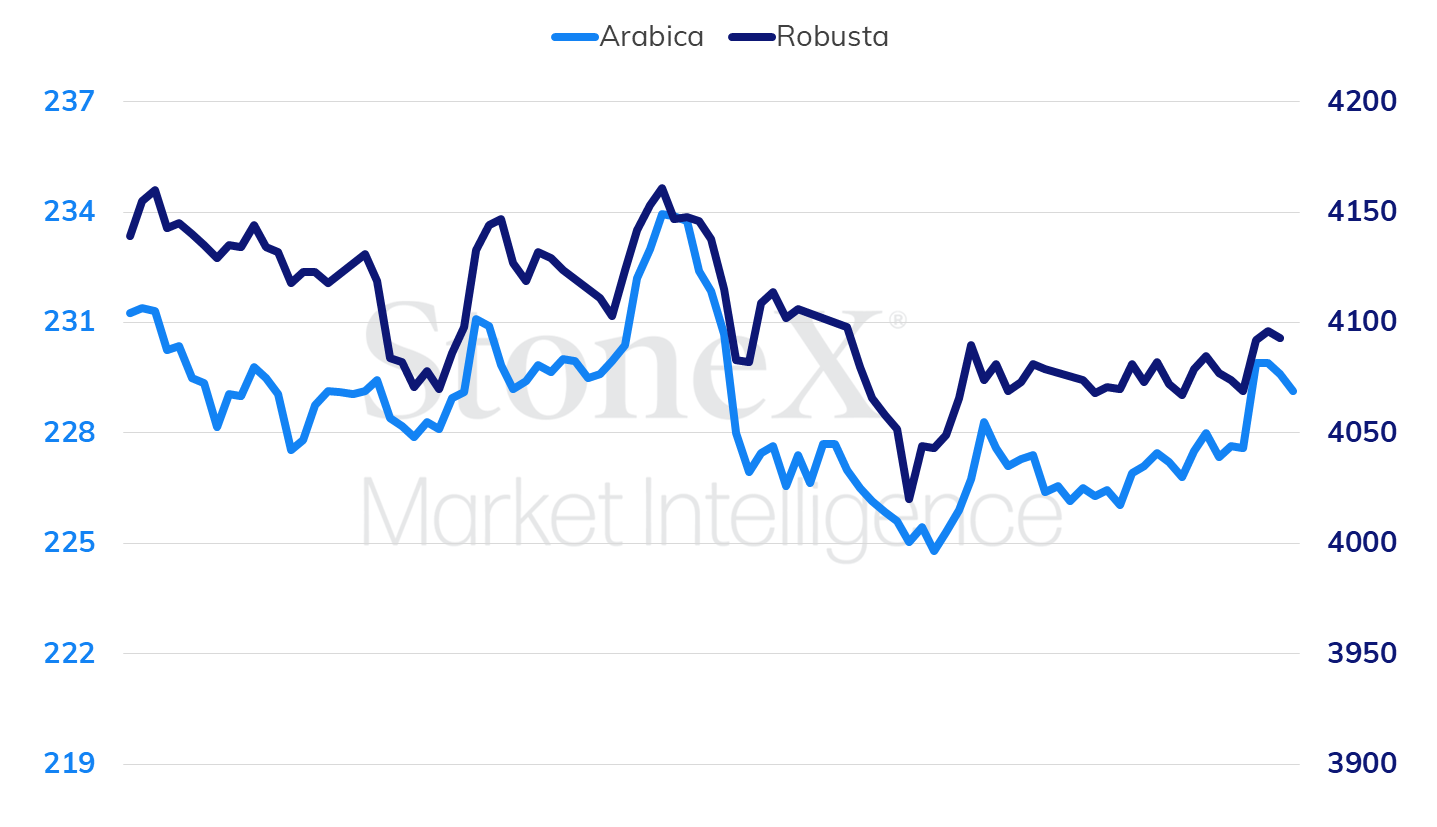
Without much change in terms of fundamentals, Arabica coffee futures ended the week almost unchanged. For Robusta coffee, the progress of the harvest in Indonesia and the advance in Brazilian exports of the variety contributed to putting pressure on prices. Preliminary data from Cecafé pointed to an export volume of almost 1 million bags of Robusta coffee in July, the highest volume exported for the month. In addition, the sharp rise in the dollar during the week acted in a bearish way for prices abroad, but in a positive way for prices on the Brazilian domestic market, especially for Arabica coffee.
In New York, the most active Arabica coffee contract rose by just 0.1% to US₵ 230.50/lb. On the other hand, in London, the most active Robusta coffee contract fell by 1.7% to USD 4227/t. While the dollar rose 1.3% to USDBRL 5.73 on the week, the Cepea indicator for Arabica coffee rose 1.3% to BRL 1,427.76/bag. For Robusta coffee, the indicator pointed to an increase of 0.5% to BRL 1,285.19/bag.
Last week, the global business environment was marked by strong volatility and intense risk aversion, with the search for safe-haven assets as a defensive strategy to protect investments. The main driver of the reduction in risk appetite was the weaker-than-anticipated figures for US economic indicators, resulting in a resurgence of fears of an abrupt slowdown in activity in the country or even a recession - the so-called "growth scare".
Weekly intraday (most active contract) - July 29th to August 2nd
According to a report released last week by the European Coffee Federation (ECF), coffee stocks in some European ports fell sharply year-on-year in June, but increased compared to the previous month. According to the report, coffee stocks totaled 8.4 million bags, 27% lower than in June 2023, but 4.5% higher than in May. On the other hand, data on coffee stocks in Japan, released by the Japan Coffee Association, showed that stocks totaled 2.5 million bags in June, representing an increase of more than 6% year-on-year and a decrease of just 0.2% compared to the previous month.
Last week saw the release of the financial results of three more important companies in the sector, Illycaffè, JDE and Starbucks. According to Illycaffè's report, the company's revenue totaled € 289 million in the first half of the year, representing an increase of 3.8% compared to the same period last year. Revenue growth came from progress in all of the company's main markets, with a particular focus on the United States, where revenue rose by 11% due to sales growth in hotels, restaurants, coffee shops and online sales channels.
For JDE, sales grew organically by 3.6%, part of which (+2.4%) was the result of price increases while 1.2% was the result of an increase in sales volume. The company's outlook is for organic growth of between 3 and 5% in 2024. On the other hand, Starbucks' results point to a drop in sales in the second quarter of the year. The company's total sales fell by 3%, the result of a 5% drop in the number of sales which was partially offset by a 2% increase in the average ticket. There was a drop in all markets, with sales in the US and China falling by 2% and 14% respectively.
In the coming weeks, there will be a lot of talk about export data from countries, especially Brazil and Indonesia. For Vietnam, official figures from the Vietnamese government show that 1.16 million bags of coffee were exported in July, representing a drop of almost 36% compared to July 2023. The data shows that since the beginning of 2024 the country has exported 16 million bags, which represents a drop of almost 14% compared to the same period in 2023. The drop in Vietnamese exports is related to the production problems faced by the Asian country, which ended up directing demand for Robusta coffee to other countries such as Brazil and Uganda, which have shown a significant increase in Robusta coffee exports.
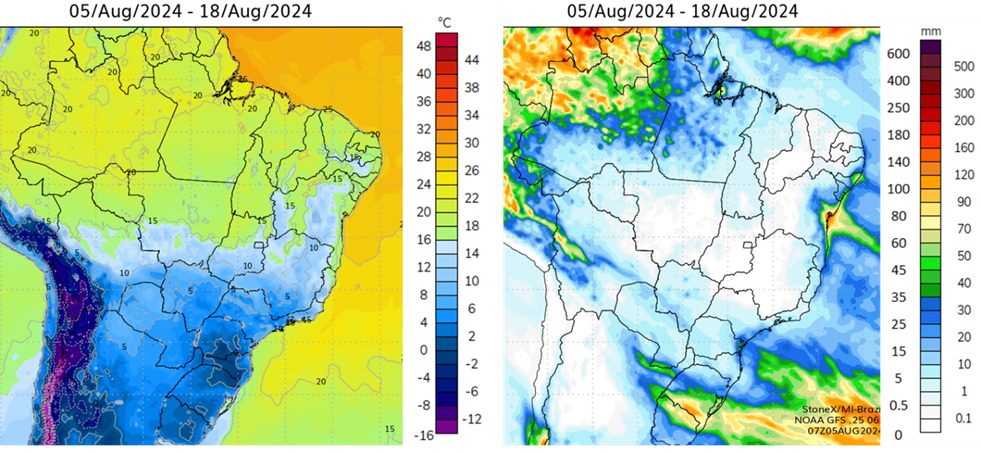
Cold front expected to drop temperatures and may bring sporadic, localized rain to part of the coffee belt
With the end of the harvest approaching in Brazil, agents are focusing on the weather conditions in the country and the opening of the coffee flowering season in the coming weeks. While Robusta coffee continues to bloom at a more advanced stage, Arabica coffee regions will depend on the return of the rains to stimulate the opening of the first large blooms of 2024. It should be remembered that a regular return of rainfall is essential to ensure the proper setting of the flowers and the development of the initial stages of the 2025/26 crop.
Minimum temperature (ºC) and rainfall (mm) forecast for the next 14 days
Source: StoneX.
August is characterized by being one of the driest months of the year, especially throughout the coffee-growing region. According to the European model ECMWF, from August 5 to August 9, the Southeast as a whole will continue to experience dry weather, which will last until the end of the week. After the passage of a cold front from August 9, the temperature could be drastically reduced in the southernmost regions of Brazil and in some high-altitude regions in Paraná, possibly triggering frosts, with the most significant minimum temperature recordings forecast for August 13. This condition will be monitored, especially in terms of intensity and spatial amplitude, due to the possibility of it spreading to the coffee-growing regions of southern São Paulo, Matas de Minas, southern Minas and southern Espírito Santo.
The passage of this cold front may favor the appearance of some sporadic rains with accumulations of 10 mm for five consecutive days, in the regions of Matas de Minas and southern Espírito Santo during the week of August 10 to August 14, which may induce the flowering of Arabica and Robusta in localized areas. However, this flowering may be affected, as the weather may remain dry after the rains, until August 19. In other regions, such as the south of Minas Gerais and the Cerrado, the likelihood of rain is minimal for the month of August, with drought prevailing, especially in the Cerrado, until the end of the month. Forecasts indicate that regular rainfall for the state of Minas Gerais as a whole should only occur during the month of September.
INDICATORS