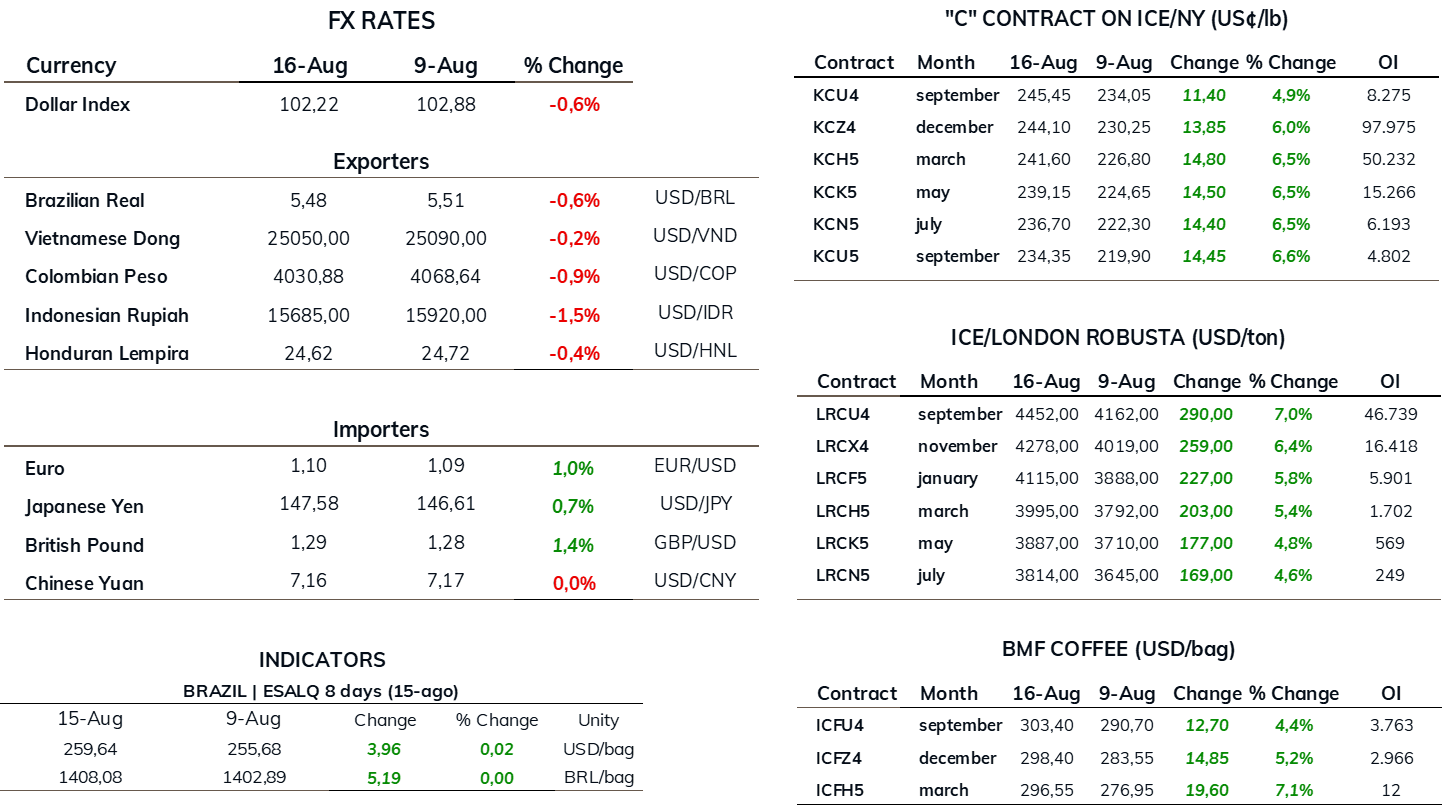
• Arabica coffee rose 6.0% on the week in New York, quoted at US₵ 244.10/lb
• On the London exchange, Robusta coffee prices climbed 7.0% to USD 4452/t
• The Cepea indicator for Arabica coffee rose 1.5% to BRL 1424.43/bag
• Cepea indicator for Robusta coffee up 2.9% to BRL 1324.62/bag
• Passage of polar mass caused frost and supported coffee prices
• StoneX team visits regions hit by frost in São Paulo, Cerrado and southern Minas Gerais
• Market focus will continue to be the weather and the opening of flowering in Brazil
• Brazilian exports up almost 26% in July
• Dry weather in recent months has had a negative impact on crops
Last week, the passing of a polar mass, which dropped temperatures in Brazil's coffee-growing regions at the start of the week and caused localized frosts, as will be detailed below, acted in a bullish manner for coffee prices on both the US and UK terminals. As will be analyzed below, after the crossing of the polar mass, the condition of dry weather has generated concerns and acted in a bullish fashion for prices.
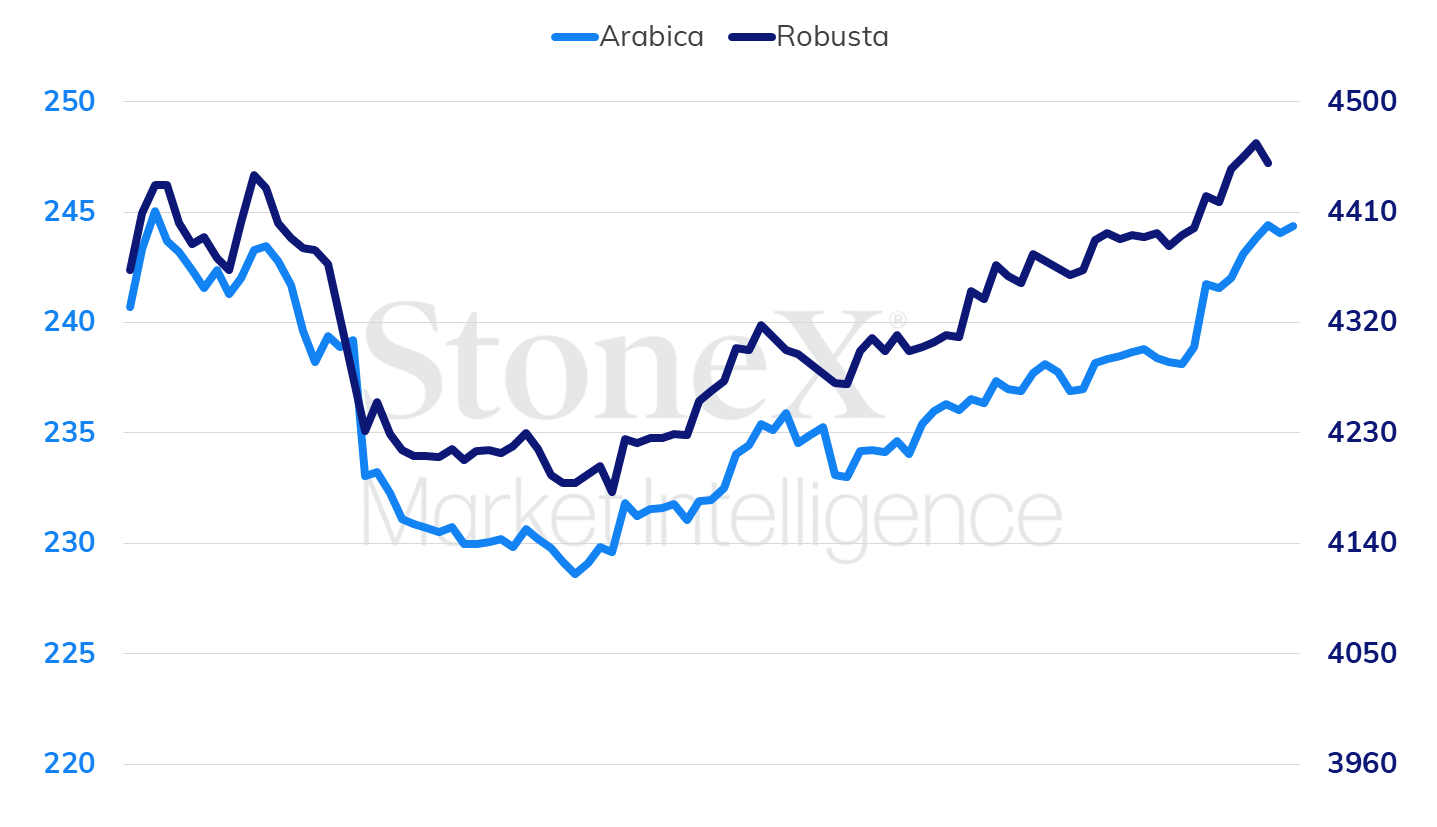
Considering the weekly variation, the most active contract for Arabica coffee was up 6.0%, closing Friday (16) at US₵ 244.10/lb. In London, as well as at the New York terminal, Robusta coffee futures ended the week up 7.0%, closing Friday (09) at USD 4452/t. On the Brazilian domestic market, prices were less intense amid a 0.6% drop in the dollar. The Cepea indicator for Arabica coffee rose by 1.5% to BRL 1424.43/bag and the indicator for Robusta coffee by 2.9% to BRL 1324.62/bag.
Weekly intraday (most active contract) - August 12 to 16
From a fundamentals point of view, the weather will continue to be the market's main focus. With flowering more advanced in the robusta producing regions and in progress in the arabica producing regions, an adequate return of rainfall is essential to ensure the proper development of the 2025/26 crop. For the Robusta regions of Espírito Santo and Bahia, the greatest risk is related to the occurrence of high temperatures, given that most of the plantations use irrigation systems. For the Arabica producing regions, in addition to high temperatures, the delay in the return of the rains is also critical, since most of the crops do not have irrigation systems in place. For more details on the outlook for the weather, read the latest edition of this report.
On the other hand, the release of export data in Brazil, which pointed to a 25.7% increase in Brazilian exports in July, has a bearish bias for prices as it feeds the feeling of greater supply in Brazil. Cecafé data showed that Brazil exported 3.77 million bags in July, representing an increase of 25.7%. Robusta coffee exports rose by more than 82% to 900,800 bags and Arabica exports by 13% to 2.49 million bags. Exports of processed coffee also rose by more than 26% to 382,000 bags. Total revenue from exports rose by more than 70% to almost BRL 5.2 billion. With this performance, accumulated exports in 2024 have now exceeded 28 million bags (+46%), with Robusta coffee totaling almost 5.2 million bags (+314%) and Arabica coffee, 20.7 million bags (+31%).
Brazilian coffee exports (million bags)
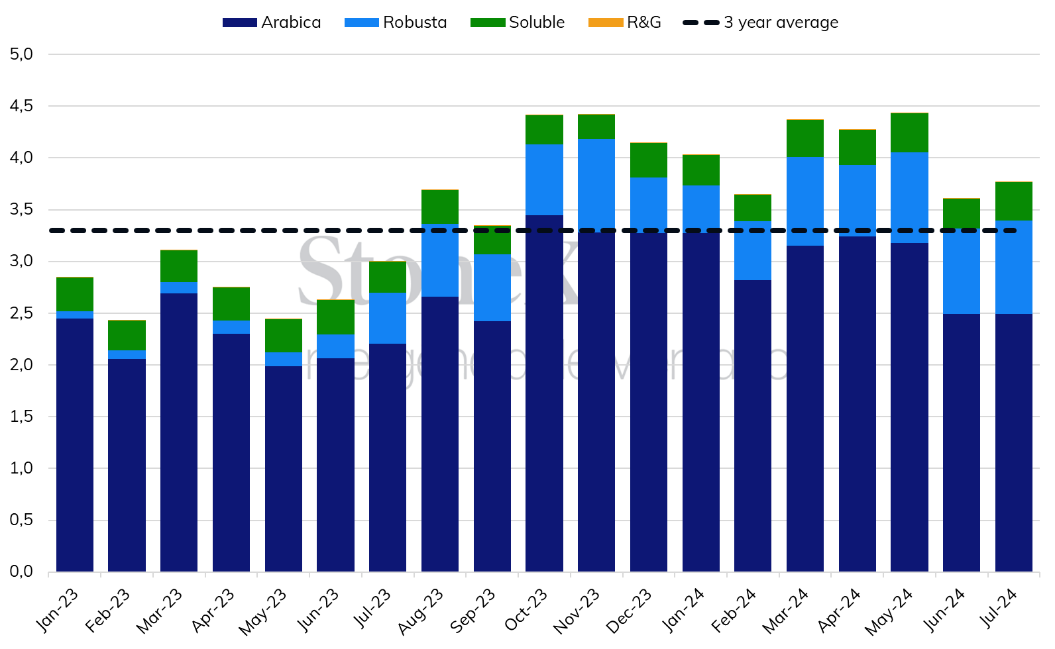
Source: Cecafé. Design: StoneX.
StoneX team visits plantations in São Paulo, Cerrado and southern Minas Gerais
The polar mass that arrived in some regions brought frosty nights between August 11 and 15, causing a light frost to hit some coffee areas in the South of Minas Gerais, Cerrado and São Paulo. Among the days with the lowest temperatures, the night of Sunday (11) was the coldest and favored the formation of frost in some coffee areas. There was physical damage to the plantations, but the percentage of areas affected by the frost was small.
The phenomenon affected a few coffee areas in each of the three regions mentioned, with the Cerrado having the highest percentage of the area affected and the most severe damage. Patrocinio and Serra do Salitre were the cities in the Cerrado region of Minas Gerais with the highest incidence of frost. The damage seen in the regions of São Paulo and southern Minas Gerais was isolated and less severe. Therefore, considering the production potential of these regions, the impact was very small.
Although the damage caused by the frost to the crops was generally small, it is necessary to pay attention to the effects of the cold on flower buds that are already well developed and which were exposed to very low temperatures for a few days. In 2021, in addition to the impact of the frost, the exposure of the plants to low temperatures for a prolonged period had a negative impact on the flowering that year. The temperatures seen in the last week were not as low as in 2021, but it will be necessary to monitor the development of the flowering stage in the coming weeks to understand the possible impact of the cold on the flowers.
During a visit to the regions of southern Minas Gerais, Cerrado and São Paulo to monitor the damage caused by the frost, the vegetative condition of the coffee plantations was also observed. There were already signs of defoliation in the fields caused by the adverse weather conditions, and leaf loss was more pronounced in the warmer cities or micro-regions. The months of June and July saw temperatures that were higher than average for the period, which reduced the soil's water reserves. Added to the arrival of cold waves, the crops are already showing more pronounced signs of depletion and a possible loss of production potential. The return of the rains in the coming weeks is therefore essential.
Dry weather has characterized the month of August and rains should only return in mid-September
August is usually a hot, dry month and, so far, the accumulated rainfall over the last 14 days for the coffee-growing regions in southern Espírito Santo and Minas Gerais as a whole has been extremely limited (ranging from 5-10 mm) compared to historical values. For example, in the Matas de Minas, cities like Espera Feliz and Simonésia should record 28 and 31 mm/month, respectively, while in the south of Minas Gerais, Machado and Alfenas usually receive between 31 and 25 mm/month of rainfall. However, these volumes have not materialized. For the week of August 19-23, southeastern Brazil will face yet another heatwave, with minimum and maximum temperatures being between 5 ºC and 7 ºC above average. This phenomenon will establish an atmospheric blockade, which will once again keep the weather hot and dry during the week.
Rainfall accumulated over the last 14 days and forecast for the next two weeks (mm)
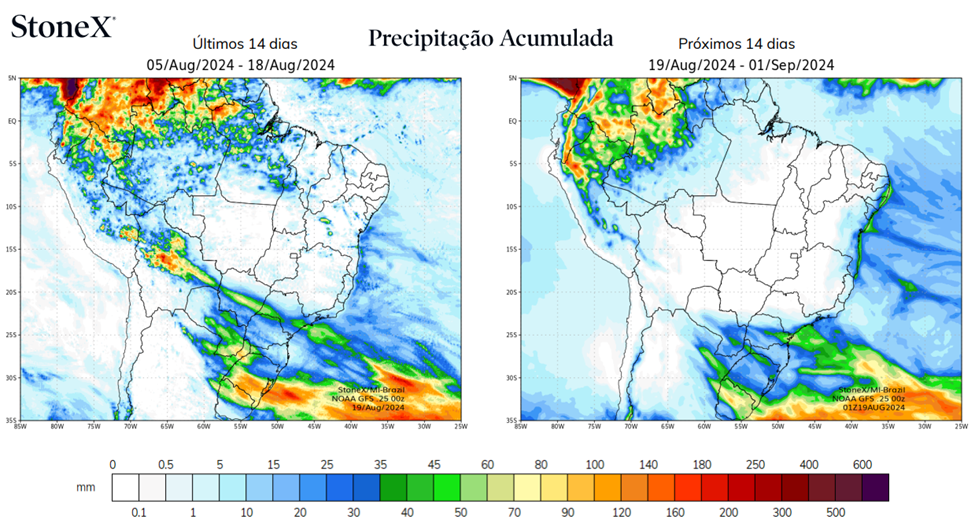
Source: StoneX.
Cemaden's (National Center for Natural Disaster Monitoring and Alerts) Integrated Drought Index (IIS3) forecast for this month indicates that the Cerrado and southern Minas Gerais regions vary between severe and extreme drought, while in Espírito Santo the situation oscillates between moderate and severe drought. In other words, the rainfall deficit, soil moisture and vegetation condition are in a critical state after three consecutive months of deficit, a situation that will increase the stress on crops, especially reproductive ones.
Cemaden: Forecast for the integrated drought index
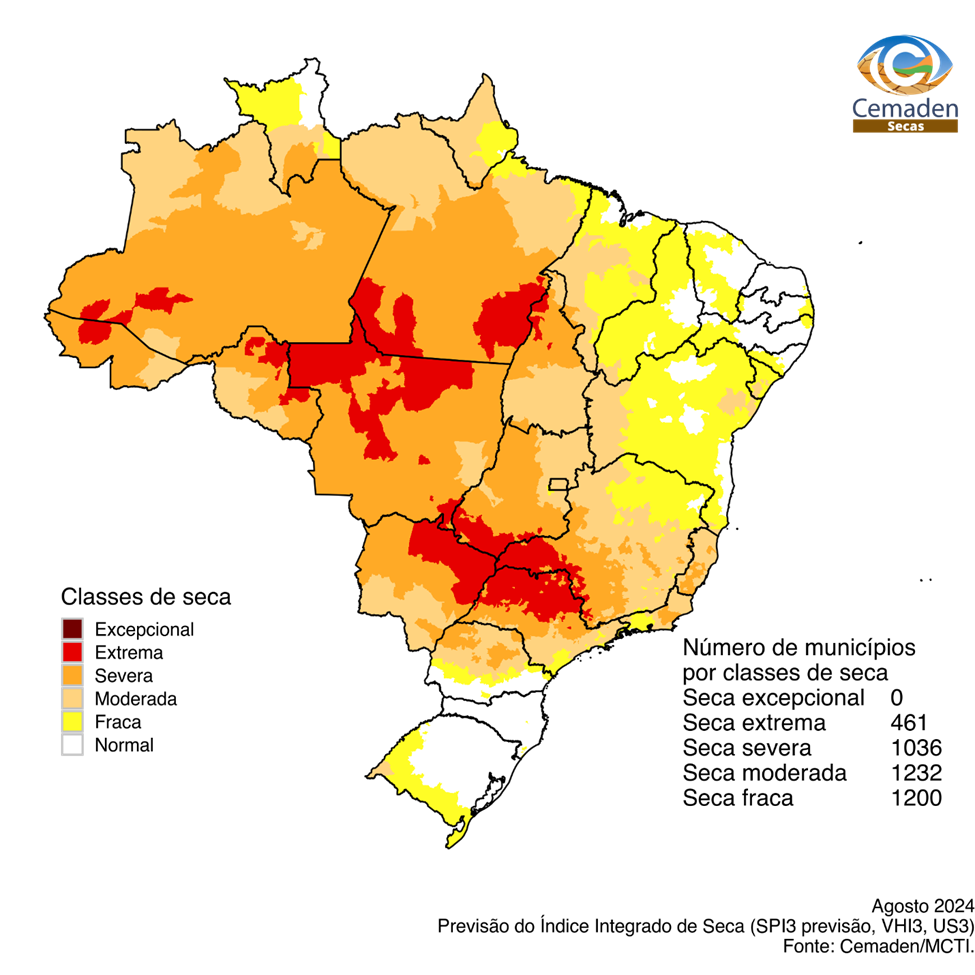
Source: Cemaden/MCTI.
Forecasts from American and European models indicate that a cold front could pass through the Mogiana region of São Paulo and the south of Minas Gerais over the weekend and into the beginning of the last week of August, changing the weather, reducing temperatures and cooling the regions. This cold front could bring passing humidity, but not significant. Regular rainfall for the coffee-growing region is only forecast for mid-September, but this has yet to be confirmed, and its distribution, as well as significant volumes, could be observed once La Niña is fully consolidated.
The models also predict the emergence of a polar mass in southern Brazil from August 23, which could extend to the state of Paraná and Mogiana, drastically reducing temperatures. There are differences between the models consulted as to whether this mass will reach the high-altitude coffee-growing areas of the Cerrado and southern Minas Gerais, and its intensity will depend on the cold front and the moisture that remains in the atmosphere, which will be monitored. However, the scenario is that these events will quickly pass over the continent.
In short, from what we have seen from the models so far, the risk of critical temperature drops over the next few weeks is low, and should be no worse than that seen between August 11 and 13. However, the prospect of a delay in the arrival of the rains is still very worrying for the productive potential of the Brazilian crop, which tends to continue to provide support for prices, especially for Arabica coffee.
INDICATORS