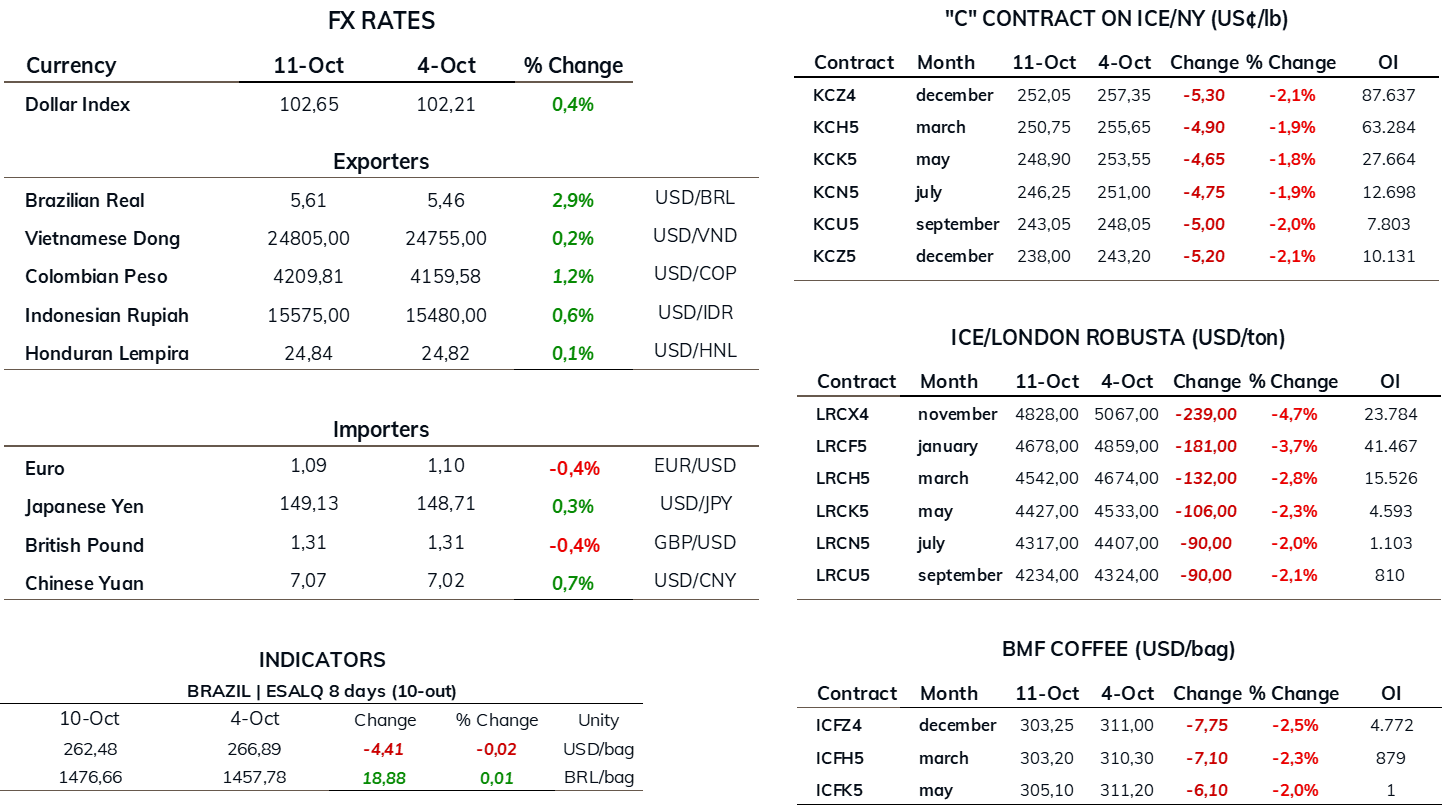
• Arabica coffee falls 2.1% on the New York exchange, quoted at US¢ 252.05/lb
• Robusta coffee prices fall 3.7% to USD 4678/t on the London exchange
• Dollar up 2.9% on the week to USDBRL 5.61
• On the domestic market, Arabica rose 1.4% and Robusta fell 1.2%
• Rain forecasts and increased exports put pressure on prices
• ICO: world exports up 8.8% in August
• Cecafé: total exports reach almost 4.5 million bags in Brazil
• StoneX continues to monitor coffee plantations in Brazil
• Flowering in Brazil will reach almost 100% by the end of the month
After ending the previous week on a downward trend, following the European Commission's signaling to postpone anti-deforestation legislation and the prospect of a return to rain, coffee futures prices fell again last week, impacted by forecasts of rain and an increase in world coffee exports. In addition, the 2.9% rise in the dollar against the Brazilian real contributed to putting pressure on prices on the international market – the USDBRL pair ended the week quoted at BRL 5.61.
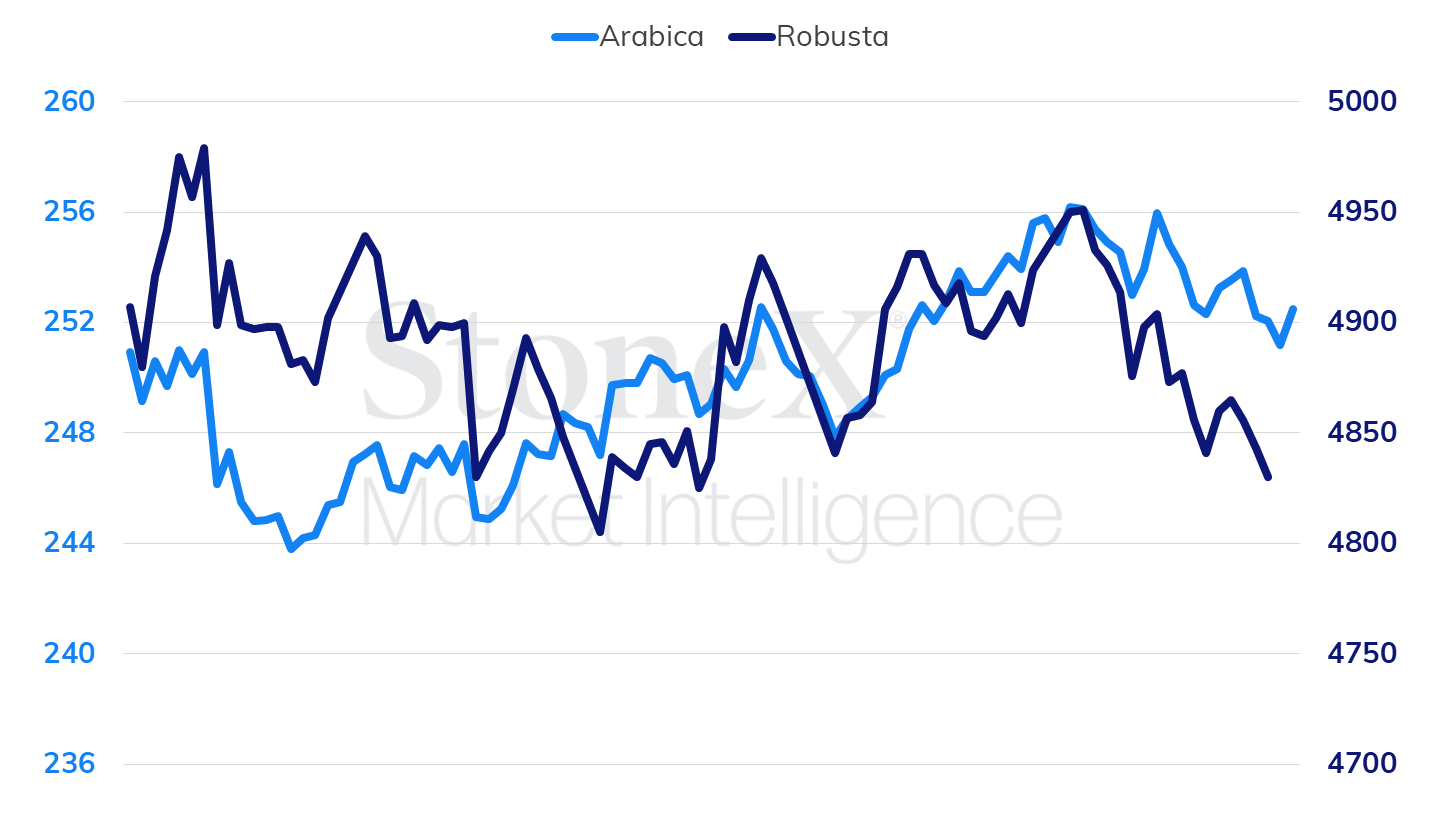
In New York, the most active contract ended the week down 530 points (-2.1%) to US¢252.05/lb. In London, the contract expiring in January fell by USD 181/t (-3.7%) to USD 4678/t. On Monday (14), prices rose again after the models showed a delay in rainfall compared to the previous week's forecasts.
On the Brazilian domestic market, Arabica and Robusta coffee prices followed a different path, with Arabica prices advancing and Robusta showing a smaller decline than that seen abroad, due to the strong rise in the dollar in the period. In addition, prices reversed a trend seen in September, when Robusta coffee prices were higher than Arabica prices. The Cepea indicator for Arabica rose by 1.4% to BRL 1478.89/bag. For Robusta, the indicator fell by 1.2% to BRL 1394.96/bag, 5.7% lower than the indicator for Arabica.
Weekly intraday (most active contract) - October 7 to October 11
In addition to the weather issue, the strong advance in exports also contributed to putting pressure on coffee prices. According to the International Coffee Organization (ICO), world exports of raw coffee rose 8.8% year-on-year in August to 9.9 million bags. In addition, accumulated exports for the 2023/24 season up to August (abroad, the crop year began in October 2023 and ended in September 2024) rose 10.5% to 113.8 million bags.
For the month of September, global export data is not yet available, but Cecafé data showed that Brazil exported a total of almost 4.5 million bags, representing an increase of more than 33%. Exports of raw coffee rose 33.8% to 4.1 million bags, with 911,800 bags of robusta coffee (+40.9%) and 3.19 million bags of arabica coffee (+31.9%).
Brazilian raw coffee exports (million bags)
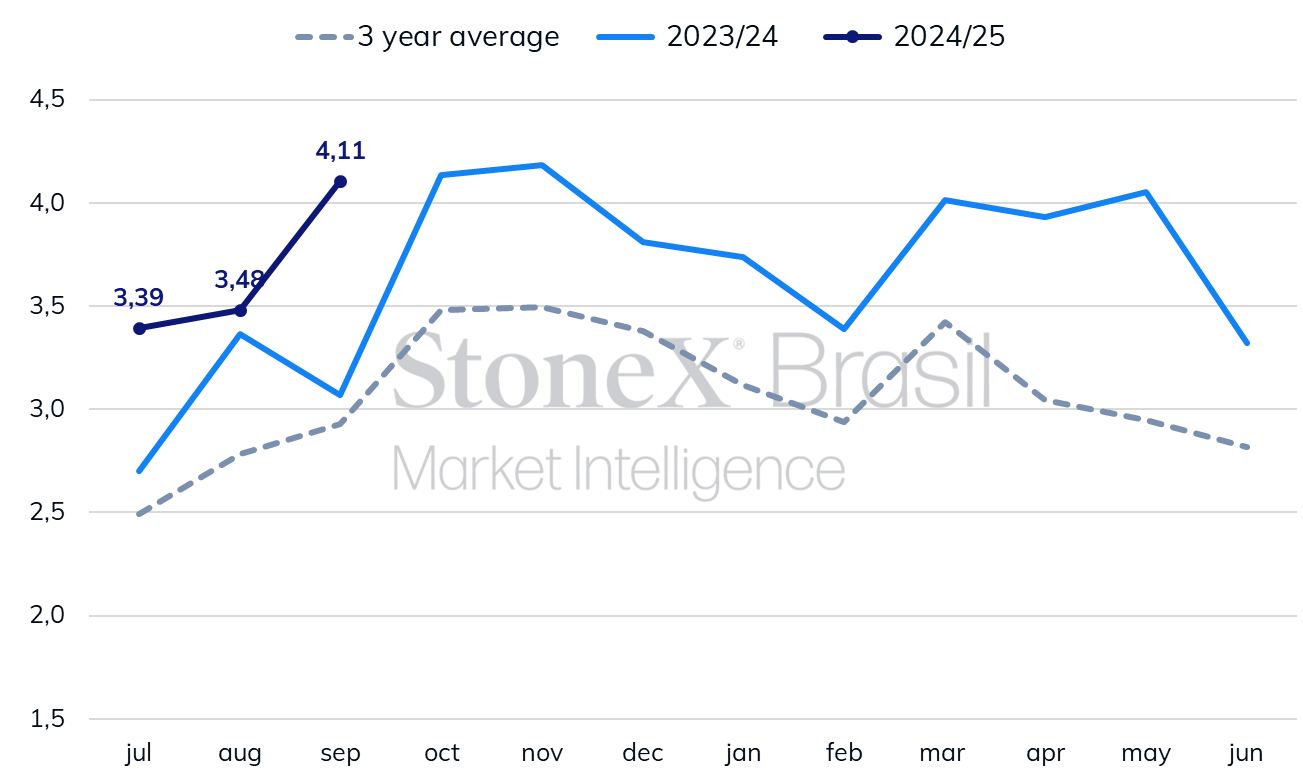
Source: Cecafé. Design: StoneX.
Exports of processed coffee rose by almost 28% to over 358,000 bags, of which 354,800 bags were soluble coffee (+28%). The strong advance in Brazilian exports may be related to an easing of logistical bottlenecks in recent months. According to Cecafé, almost 2 million bags of coffee were not exported in July and August due to logistical problems.
In the coming weeks, the weather in Brazil and the early stages of development in the country will continue to be the focus of attention for market participants. Any climatic adversity at this stage could have an irreversible impact on production potential in 2025/26. In addition, the first estimates for Brazilian production next season will be discussed more carefully in the coming months.
In addition, the market may be somewhat relieved by the progress of the harvest in Colombia and Central American countries, and by the start of the harvest in Vietnam, scheduled to begin in mid-November. However, while the advance of the harvest may provide some relief in the short term, the country's crop is expected to be even smaller this season. According to the Vietnam Coffee and Cocoa Association (VICOFA), the country's production is expected to fall by 8.2% this crop, from 26.7 to 24.5 million bags.
-
October field conditions update
-
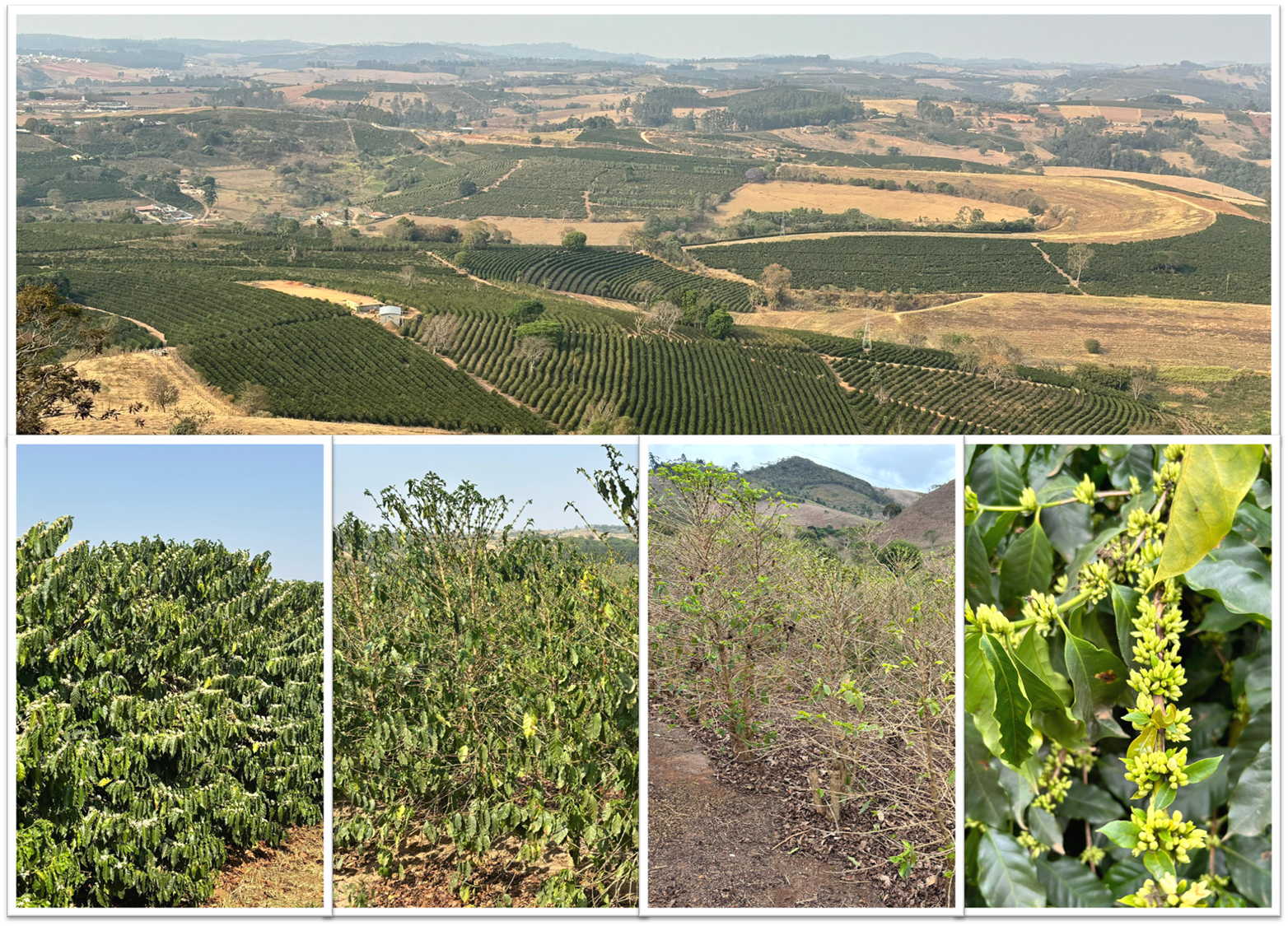
StoneX has been constantly monitoring coffee areas in Brazil. At the beginning of the field monitoring in June, with the aim of understanding the scenario for the 2024/25 and 2025/26 crops, the coffee plantations in the main producing regions were generally in good vegetative condition. However, this scenario gradually changed due to adverse weather conditions, with the exception of the Robusta areas in Espírito Santo and Bahia, which had small volumes of rain from June onwards and have a large percentage of irrigated areas.
We had above-normal temperatures in June and July, followed by days of low temperatures in August, which caused a slight frost in the southern regions of Minas Gerais, Cerrado and São Paulo, as well as a long period of drought, especially in the Arabica areas. These adverse conditions caused defoliation and loss of potential in the plants. The most affected crops were the youngest and those that had produced in the previous harvest. On the other hand, crops that were coming back from pruning and new plantations at the start of the production cycle did not suffer such severe effects.
A higher percentage of pruning was also observed in Arabica coffee areas, especially in the more mechanized regions, due to the delay in the rains, expected for mid-September, and the loss of crop potential. Some of these areas were not included in producers' initial pruning plans, mainly because of the price of a bag of coffee, but the sharp loss of productive potential meant that they had to be pruned.
With the arrival of rains, large percentages of flowering have been or will still be emitted in the coming days. By the end of October, practically 100% of the flowering will probably have taken place in all the producing regions. From then on, we will have more clarity to assess the level of damage and the impact on the next crop.
-
Source: StoneX.
INDICATORS