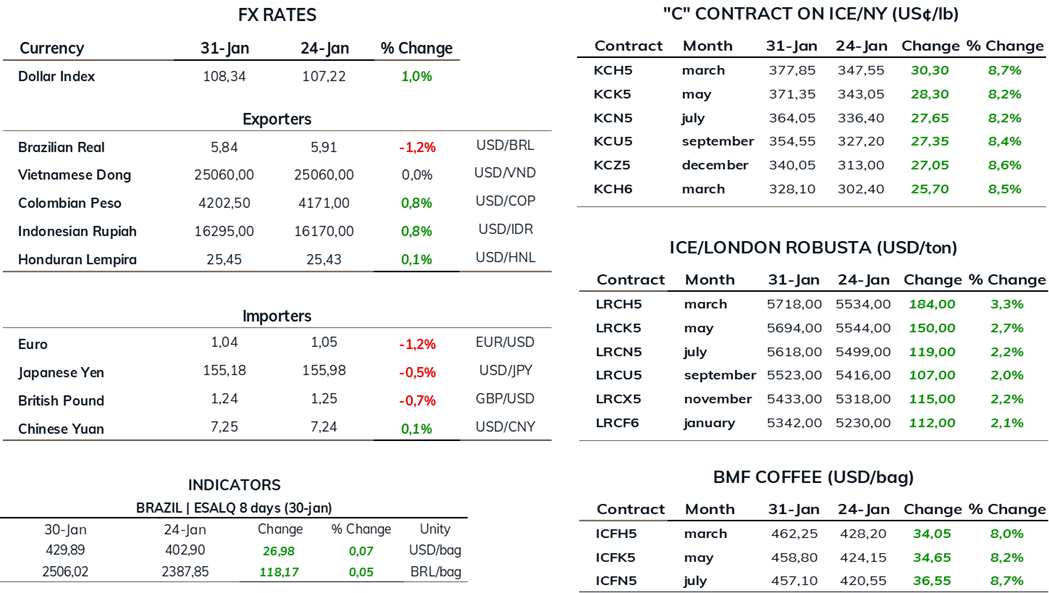
• Arabica coffee futures rose 8.7% for the week and 18.2% for the month
• In London, robusta prices advanced 3.1% for the week and 17.3% for the month
• In Brazil, coffee prices ended the month higher
• The U.S. dollar fell 1.2% for the week and 5.5% for the month
• European Coffee Federation (ECF) stocks grew 25% at European ports
• Starbucks reported a drop in sales in the last quarter
• Inflation on consumer coffee prices rose in Brazil and Europe
• Espírito Santo recorded a record coffee export volume in 2024
Last week, coffee prices showed significant movements, influenced by a combination of geopolitical and market factors. Arabica coffee futures rose at the beginning of the week, driven by uncertainties over the threat of tariffs being imposed by the United States on Colombia. Volatility was amplified by concerns about production in Brazil, where drought impacted the arabica harvest, and by logistical challenges that continue to pressure exports.
In New York, arabica futures recorded an increase of 8.7% for the week and 18.2% for the month. In London, robusta coffee futures registered an increase of 3.1% for the week and 17.3% for the month. The advance in the foreign market was also linked to the drop in the U.S. dollar (USDBRL), which declined by 1.2% in the last week and 5.5% over the course of January.
In the Brazilian domestic market, coffee prices also showed strong gains at the end of the month. The Cepea indicator for arabica coffee increased by 5% for the week and 12.5% for the month. On the other hand, the robusta indicator registered a decline of 0.6% for the week but an increase of 13.2% in the monthly balance.
Intraday weekly (most active contract) – 01/27 to 01/31
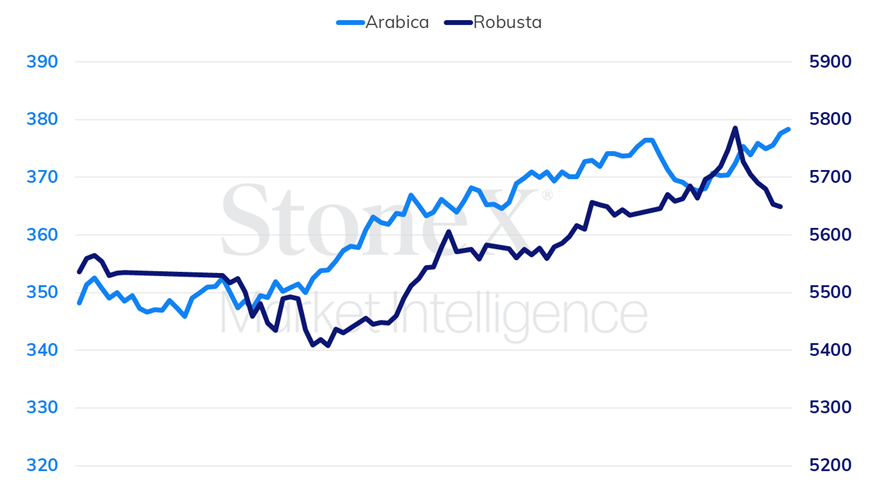
At the beginning of last week, arabica coffee futures rose, driven by uncertainties surrounding the Trump administration in the United States. The threat of 25% tariffs on Colombian coffee imports raised concerns, as Colombia is one of the main exporters to the U.S., shipping around 5 million bags annually. However, after an agreement between the two countries, the tariffs were suspended, temporarily easing fears of supply disruption.
The European Coffee Federation (ECF) released data on coffee stocks at major European ports in December 2024. The total volume reached 546,124 tons (9.1 million 60-kg bags), an increase of 25% compared to the same period in the previous year.
However, logistical challenges persist. The Brazilian Coffee Exporters Council (Cecafé) reported that 1.6 million bags of coffee were awaiting export at Brazilian ports in November 2024. The lack of containers and delays in shipments continue to pressure exporters, who are seeking alternatives such as bulk transport to ensure compliance with commitments to international buyers.
Starbucks Corporation reported mixed results for the first fiscal quarter of 2025. Global comparable sales fell 4%, driven by a 6% decline in comparable transactions, partially offset by a 3% increase in the average ticket size. In China, sales fell 6%, reflecting economic challenges in the Asian market. The company opened 377 new stores in the quarter, totaling 40,576 locations globally.
In the United States, the Consumer Price Index (CPI) for coffee recorded a slight decrease in December 2024, dropping from 11.3% in November to 11.2%. The average price of coffee per pound fell to $6.776, after reaching a record $6.868 in November. In the European Union, coffee prices rose 6.6% in December, the highest increase since August 2023. In Brazil, in December, roasted and ground coffee prices accumulated a 39.6% increase over the past 12 months.
Accumulated 12-month inflation on consumer coffee prices
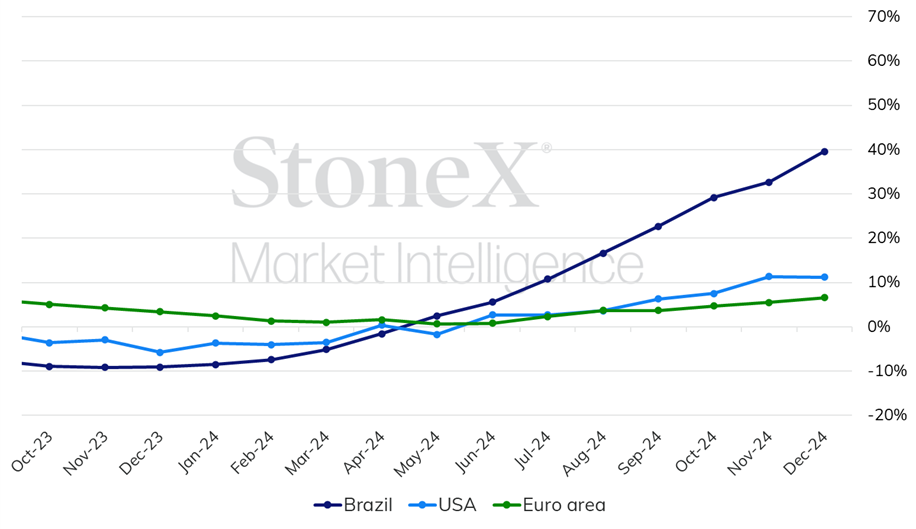
Sources: BLS, IBGE, and Eurostat. Design: StoneX.
The ports of Espírito Santo recorded a record coffee export volume in 2024, with 8.38 million bags shipped, an increase of 1.21% compared to the previous record in 2002. Conilon coffee accounted for 84% of the total, followed by arabica (9%) and soluble coffee (7%). The main destinations were Belgium, Mexico, the United States, Italy, and Spain. China emerged as a growing market, with a 1,729% increase in conilon coffee imports.
The foreign exchange revenue from Espírito Santo’s coffee exports reached $1.8 billion in 2024, a growth of 119% compared to the previous year. The average coffee price rose 37%, with conilon registering the largest increase (43%). Despite logistical challenges, bulk operations and the use of alternative ports allowed exporters to fulfill their commitments to international buyers.
-
What we are reading:
-
NCA, Colombia’s Coffee Growers Federation Outline Key facts of Coffee Trade Amid Diplomatic Spat
-
Inflation of Coffee Prices Remain Near Record Highs in Major Consuming Regions
-
Starbucks Reports Q1 Fiscal Year 2025 Results, Global Store Sales Decline 4%
-
Firm Demand Keeps Brazil’s Coffee Inventories Tight, Cooperatives Struggle with Shipment Delays
-
Check out our new features:
TABLE OF INDICATORS