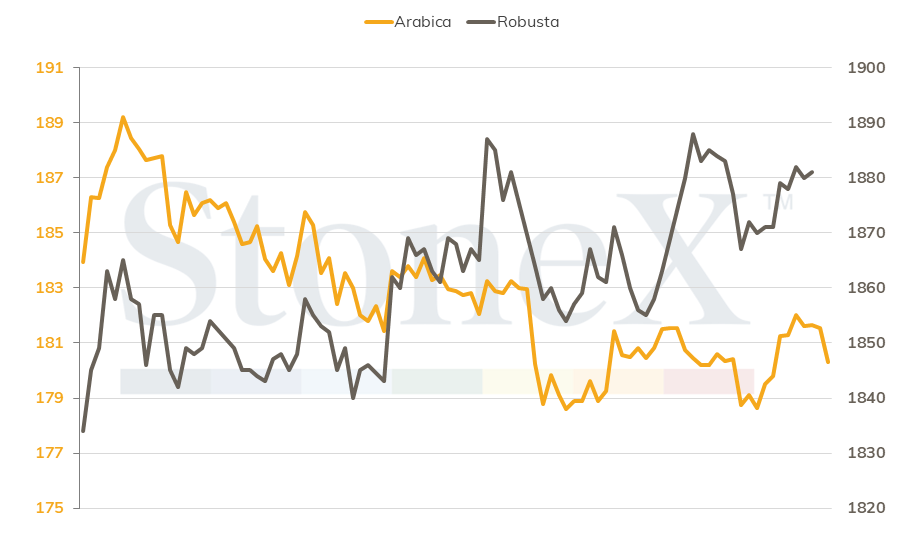
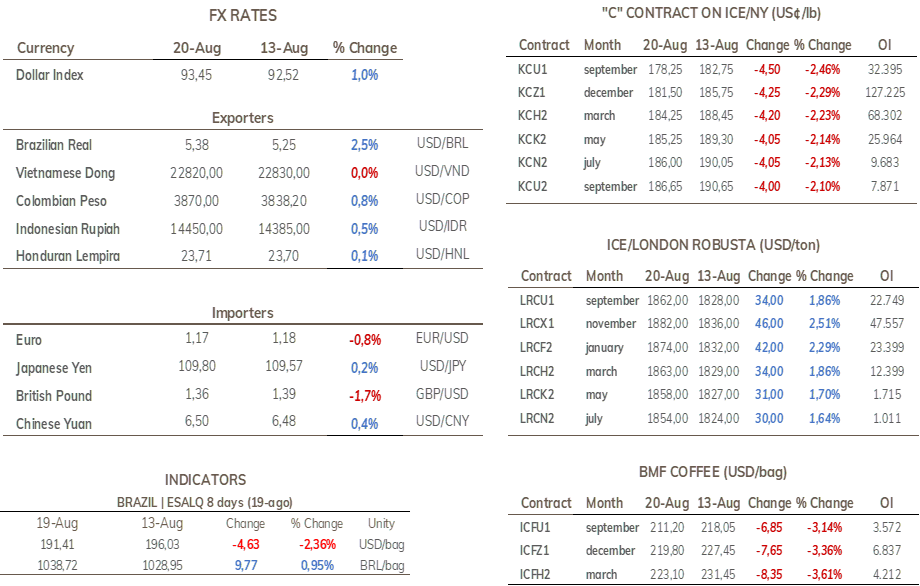
Last week, Arabica coffee prices retreated 425 points (-2.28%) from the previous Friday (13), with the most active contract (December) ending the period at US₵ 181.50/lb.
Arabica coffee prices followed a relatively stable trend. Due to a sharp reduction in Brazilian production, the tighter supply and demand balance, coupled with the impacts of frost events in the country and the dry weather in recent months, led to appreciations in the coffee market. However, the increase of over 290 thousand bags in coffee stocks at US ports in July, released on Monday (16) by the GCA, and the rainfall forecast for Brazil's producing belt contributed to weighing on prices during the week.
WEEKLY INTRADAY (MOST ACTIVE CONTRACT) - 08/16 TO 08/20
Even with the decrease in New York prices, the strong USDBRL supported new coffee prices gains in the domestic market. The CEPEA indicator pointed to an increase of 1.4% in Arabica coffee prices, which closed the week at BRL 1043.41 per bag. The Robusta coffee ended the week quoted at BRL 652.13 per bag, showing an increase of 3.3% in the week. Robusta coffee prices continue to advance in the domestic market due to the increased demand for the variety by the country's industry, which is trying to offset the strong increase in Arabica coffee prices.
The weather will continue to be in the market spotlight. In Brazil, models already point to the rainfall return from the end of August and the beginning of September. In the next 14 days, producing municipalities in the Southern Minas Gerais, Cerrado Mineiro, in the state of São Paulo and Paraná regions should accumulate between 40- and 100-mm. Municipalities in the Matas de Minas, Espírito Santo and Bahia regions should receive lower volumes, totaling between 20 and 50 mm. The rainfall volumes should be enough to benefit the first Arabica flowering and the Conilon flowering. The start of a large flowering period and the maintenance of favorable weather tend to lead coffee prices to a bearish trend, as this stage is crucial to define the production potential for 2022/23. In addition, the return of rainfall reduces concerns linked to the dry weather observed in recent months.
However, suppose on the one hand the rainfall forecast has brought some relief to the Brazilian production. In that case, the risks of adverse weather in other producing countries continue to maintain some apprehension among the agents. In the last NOAA release, the agency pointed to a 70% probability of La Niña occurrence at the end of the second half of 2021 and the beginning of next year. In Brazil, the La Niña occurrence between December and February is associated with milder weather during the summer. On the other hand, however, the event is associated with wetter weather in Colombia, Central America and Asia. It can be a point of attention because several countries in these regions will harvest at the end of the year, including Vietnam, Colombia, Indonesia, Honduras, India, Guatemala, and Costa Rica.
The Potential Impact of La Niña on Colombia’s Coffee Crop
La Niña is sometimes referred to as the cold phase of ENSO and El Niño as the warm phase of ENSO. These deviations from normal surface temperatures can have large-scale impacts not only on ocean processes, but also on global weather and climate, and thus, global coffee production.
Many of the global weather centers are forecasting La Niña possibly emerging during the August-October season and lasting through the 2021-22 Northern Hemisphere winter.
Every La Niña is different, so the impact on Colombia’s coffee crop will have a lot to do with timing and severity, but historically, a La Niña event could cut Colombia’s crop by more than 5%.
Generally, La Niña in Colombia means heavier than normal rainfall, which was devasting during the 2010-2011 weather phenomenon as higher humidity levels meant more incidence of roya, the coffee leaf rust disease. Since then, 83% of the country’s coffee trees are now resistant varietals, and are therefore not susceptible to the disease.
However, should La Niña emerge, this would coincide with the beginning of the picking of the country’s main harvest in Colombia, which accounts for as much as 65% of the country’s total coffee output.
Heavy rainfall could block roads and trigger landslides, causing challenges and delays with transport.
For the secondary harvest, flowering could be negatively impacted if rains are too torrential, as this would reduce the critical sunlight and stress coffee plants, which most likely could reduce coffee output in 2022.
The La Niña coupled with the country’s second rainy season that begins in mid-September and lasts until mid-December could increase rainfall between 60% and 80% above normal in some regions.
Robusta finds support amid wider macroeconomic and technical factors
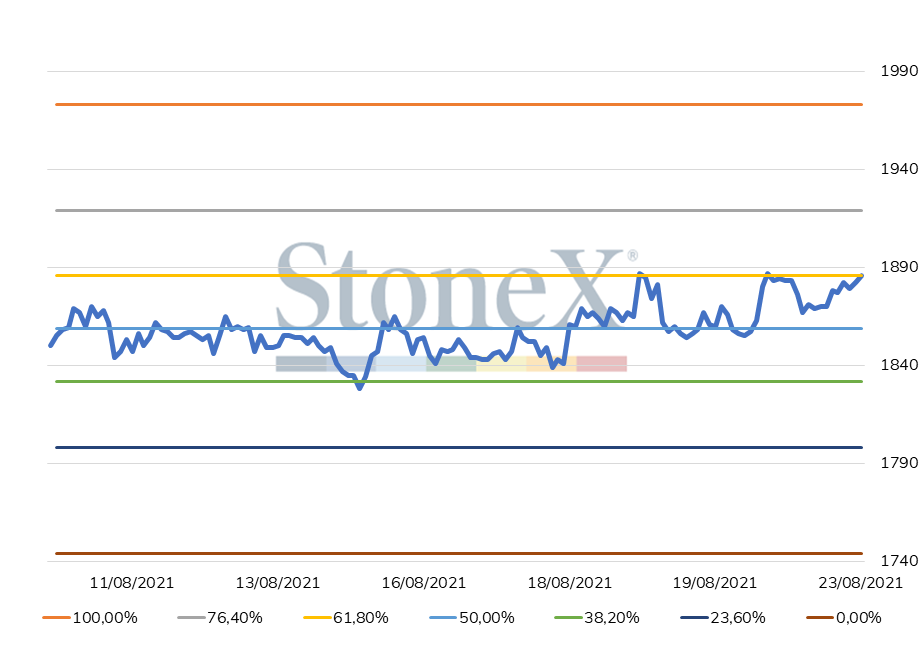
The September Robusta contract posted marginal W/W gains last week, climbing by 1.4% to settle at $1,828/t, while the most active November contract climbed by 2.5% to settle at $1,836/t. Amid an absence of prominent fundamental developments over the past week, the Robusta complex has been driven by technical and wider macro factors alongside weather developments in Brazil, where dry and hot weather lends some support. The Green Coffee Association report published on Tuesday showed a larger than expected increase in US stocks for the end of last month which provided pressure for the wider complex in the first half of the week, which was followed by a recovery in Wednesday’s session on evidence of short covering essentially reversing Tuesday’s losses. The November contract finds technical support around the 20day moving average with the contract closing last week between support at $1,860/t and $1,885/t.
Robusta September w 1 Month Retracement
Source: Bloomberg. Design: StoneX.
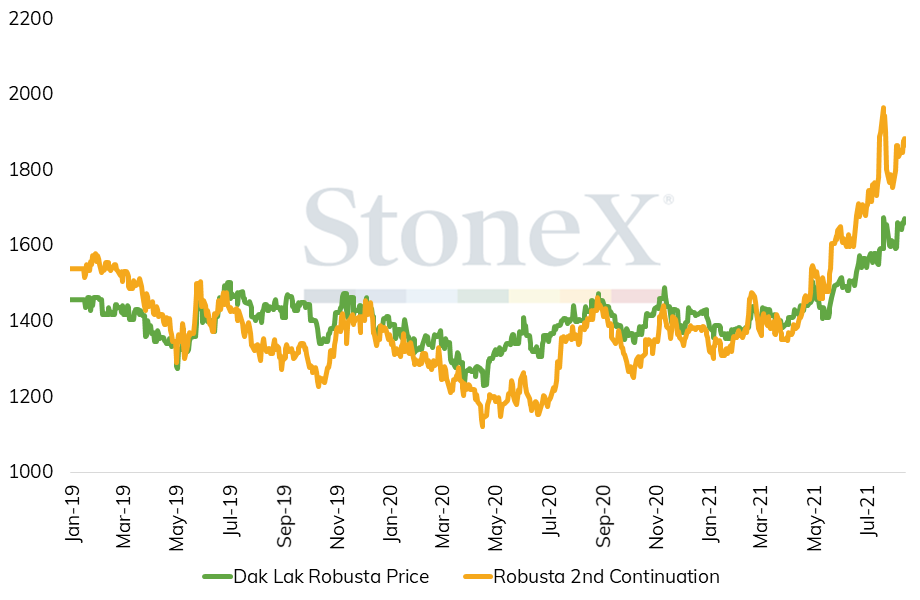
Reports continue to indicate that trade in Vietnam remains slow as tight supply and the ongoing container issues inhibits trading activity. Furthermore, the spread of the delta variant through southeast Asia also presents difficulties, with cases in in Vietnam continuing to increase with 11,352 new cases recorded yesterday, a fresh record for the country. Domestic prices in Vietnam continue on the steady upward trajectory, reaching $1,670/t in Dak Lak at the end of last week, although this still remains at an approximate $210/t discount against the London November contract.
Robusta 2nd Continuation vs Dak Lak Price (USD/ton)
Source: ICE London; Giacaphe. Design: StoneX.
The Central Highlands is forecast for moderate to heavy rainfall in the week ahead with temperatures averaging in the mid-twenties. Following on from a drop in vegetation density earlier in the month, recent rains have aided crop development. The good levels of rainfall in the week ahead should continue to promote crop development.
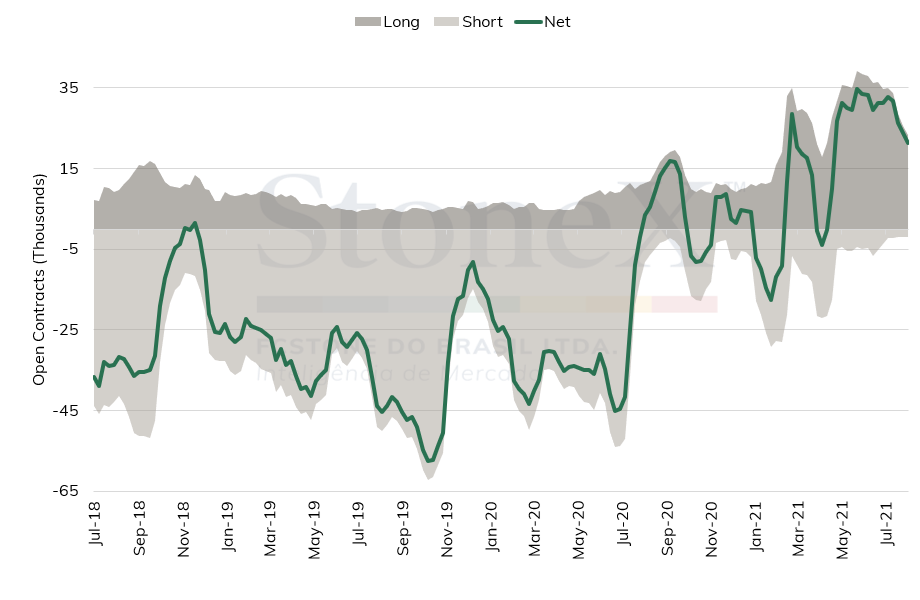
Money managers reduced the net long in Robusta futures and options by 1,631 bags last week, marking a fifth consecutive weekly reduction to the position. The reduction was driven predominantly by an increase to the gross short position which increased by 1,028 contracts W/W.
CFTC Robusta Futures + Options (Managed Money Positions)
Source: ICE London. Design: StoneX.
Certified Robusta stocks fell by 19,000 bags W/W to settle at 2.34M bags as of Friday with an absence of fresh gradings continuing to drive a steady downward trend in the certified stockpile.
BULLISH SCENARIO FOR THE USD WEIGHS ON COFFEE QUOTES DURING THE WEEK
The dollar appreciation last week contributed to the coffee prices plunge in New York. Affected by a greater risk aversion both in the domestic market and abroad, the American currency ended the week with an appreciation of 2.6% in the Brazilian exchange market, quoted at BRL 5.385. Significant dollar increases affect the profitability of Brazilian coffee exporters, encouraging an increase in supply in the short term, which puts pressure on prices on the stock exchange.
In the domestic scenario, fiscal and political risks continued to affect the business environment. On the fiscal side, the government members' insistence on approving the proposed constitutional amendment (PEC) allowing the installment payment of the judiciary bonds worth BRL 90 billion, as well as the possibility of paying off these payments with revenues that would not be accounted for in the spending ceiling, have raised concerns about the health of national public accounts. The judiciary bonds are payment requisitions issued by the courts after final defeats suffered by the government in lawsuits. In addition, the proposed expansion of the Bolsa Família program, which plans to add BRL 35 billion to the 2022 annual budget (PLOA), has also raised investors' concerns.
The absence of a firm stance towards the commitment to fiscal sustainability, and President Bolsonaro's inclinations to populist measures, which have become increasingly frequent, have worsened market outlooks for the country.
In addition, the continued turbulence in Brasilia, with the frequent clashes between the President and the ministers of the Federal Supreme Court (STF), has increased uncertainties in the political environment. Furthermore, last Friday (20), Bolsonaro filed a request for impeachment of STF Minister Alexandre de Moraes in the Senate. This theme should remain on investors' radar this week, frustrating hopes of a truce among the Powers. The instability in the political scenario, as a whole, increases uncertainty in the business environment, which may result in investors demanding higher risk premiums. As a consequence, the attractiveness of the Brazilian currency may be negatively affected.
In the foreign scenario, the doubts regarding the global economic recovery, caused by the spread of the delta variant of Covid-19 worldwide, and the release of the minutes from the last Federal Reserve's Federal Open Market Committee (FOMC) meeting also affected agents' risk aversion. The minutes showed a great division of opinions among the collegiate members as they started to consider the spread of the delta variant as a new element of unpredictability ahead of the activities and employment resumption in the country. However, in general, members showed a greater inclination to start tapering as early as 2021.
Amidst the uncertainties and fears about reducing monetary stimulus, global agents increased their demand for USD safety and liquidity as it appreciated against most global currencies. As a result, the dollar index closed Friday quoted at 93.5 points, a weekly increase of 1.1% and its highest level since November 2020. The greater global search for safe-haven assets tends to drive away investments in emerging markets, considered riskier, such as Brazil.
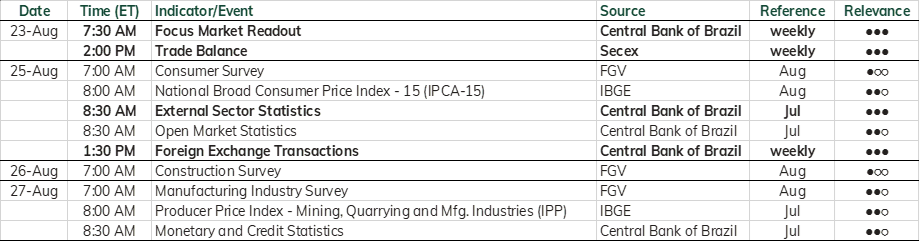
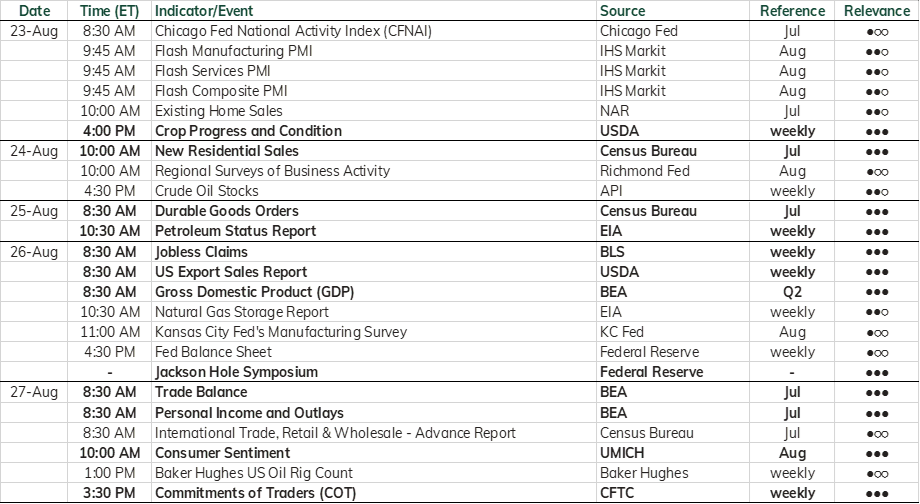
Agents should follow the release of the National Broad Consumer Price Index-15 (IPCA-15) by the Brazilian Institute of Geography and Statistics (IBGE) on Wednesday since the uncontrolled inflation increase in the country has limited the prospects for the Brazilian economy recovery and has become increasingly present in public debates. In addition, the market should also follow the Central Bank of Brazil's publication of the External Sector and Open Market Statistics for July on Wednesday and the Monetary and Credit Statistics on Friday. If they signal continuity of the positive flow of foreign exchange in the country, they may contribute constructively to the BRL this week. Abroad, the highlight is the Jackson Hole Symposium, which will bring together representatives of the central banks of the world's major economies, and may bring new information about the US monetary policy handling.