

Daily Coffee Report 8/13/26
Daily coffee report

StoneX Coffee Team
- Coffee
Quarterly Commodities Outlook is available for free now. Download your report →
By: StoneX Intelligence Brazil, StoneX Intelligence Brazil


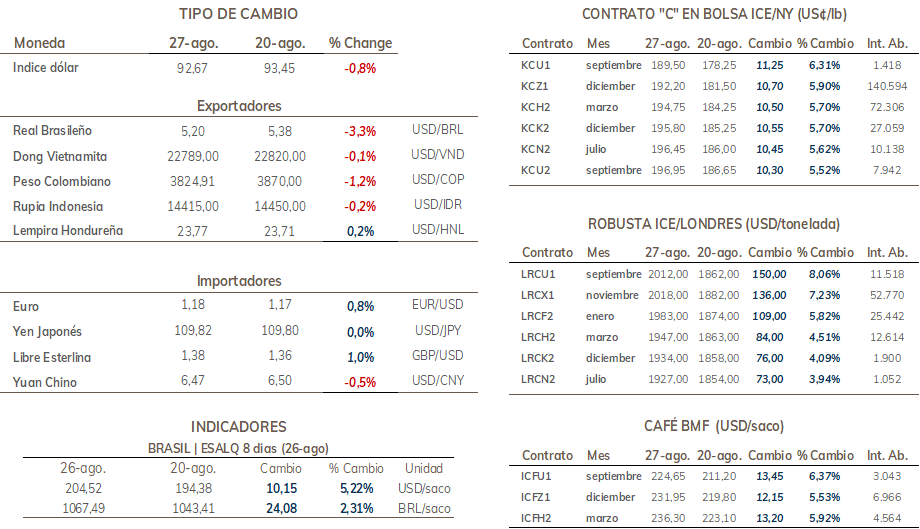
• Arabica coffee prices increase 1070 points in NY, while the Cepea indicator increases 3.1% to BRL 1,075/bag;
• Robusta advances USD 136 (7.2%) in London, 1,700 VND/kg (4.5%) in Dak Lak and BRL 31.52/bag (4.8%) in Brazil;
• USDBRL ended the week down by 3.3%, closing the week at USDBRL 5.196;
• Forecast of dry weather in Brazil continues to worry the market;
• Negative S&D balance in 2021/22 supports quotes;
• Frost damage estimated between 2 and 10 million bags. Emater -MG points to frost damage of 3.5 million bags in MG;
• Global logistics crisis causes a strong increase in freight costs and worries the market;
• New Covid-19 outbreak in Vietnam lead to new lockdown, increasing logistical problems;
• La Niña may cause losses, and it worries agents;
• Expectations for growth and inflation in the Brazilian economy in 2021 worsen;
• Brazil Q2 GDP and the US August jobs report should influence the exchange rate during the week.
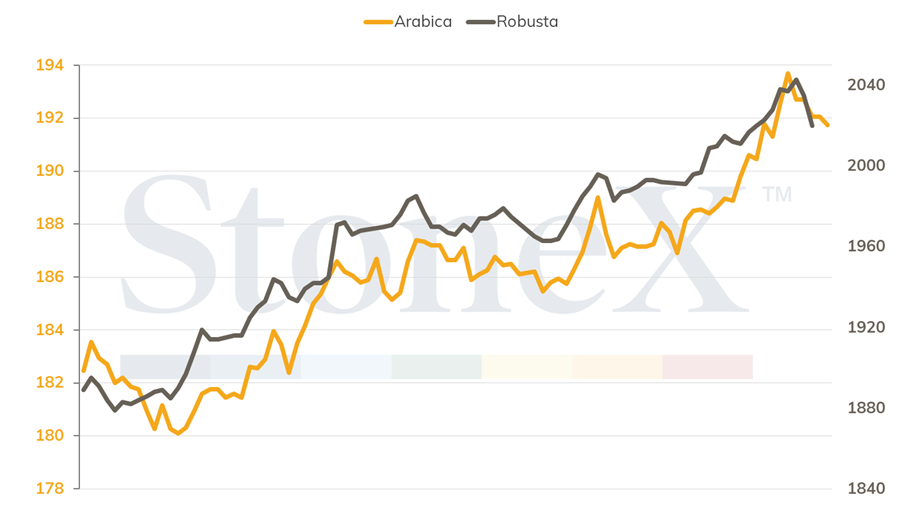
In addition, the frost occurrence has affected the potential for the country's next coffee crop. Several organizations point to losses between 2 million and 10 million bags, while the market sentiment is that losses would be around 5 million bags. The Technical Assistance and Rural Extension Company of the State of Minas Gerais (Emater-MG) recently released its estimates for frost-related losses. According to the company, 19% of the coffee areas were affected, representing 173.7 thousand hectares, with a potential loss of 3.47 million bags.
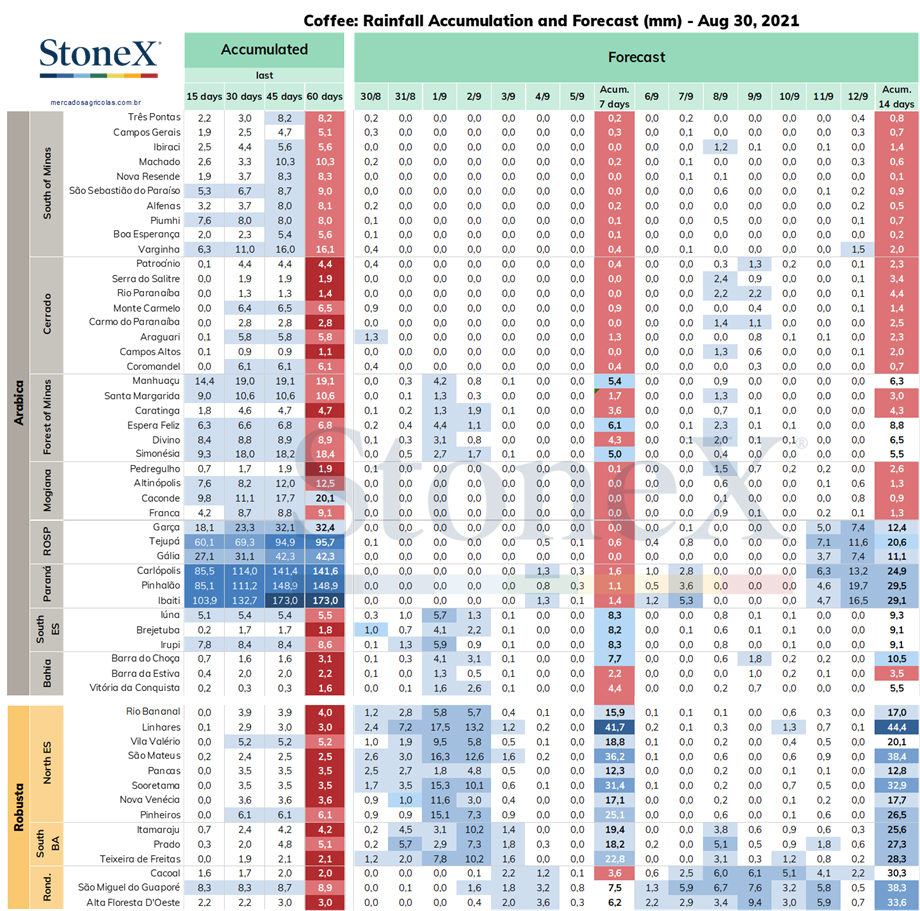
Early last week, the weather models pointed to the return of rainfall at the beginning of September. However, updates show a different scenario. The StoneX weather report, which is based on data from the US National Oceanic and Atmospheric Administration (NOAA), through the GFS model, indicates that this rainfall should not materialize in the coming days. Despite this scenario, rainfall is expected to return in the producing regions in the second week of September. Still, it is important to note that these models can change, so daily monitoring is necessary. The rainfall return at this time would contribute to the recovery of the crops under water stress, besides promoting the flowering development. In addition, it is important to remember that the NOAA models point to a 70% probability of La Niña occurrence at the end of the second semester and the beginning of 2022, which could result in excess rainfall in Central America, Colombia and Asia, a factor that should also be monitored.
The coffee market has been reacting to the serious logistical problems resulting from the Covid-19 pandemic. In addition, a new outbreak has caused serious problems in Vietnam, the world's largest producer and exporter of Robusta coffee.
In the coming weeks, weather-related problems in Brazil, logistics struggles and the new Covid-19 outbreak in Vietnam will be in the agents' spotlight as these factors favor prices' bullish movement. In addition, it is worth paying special attention to export data from some countries to be released in the coming weeks, highlighting exports from Vietnam, Brazil and Colombia.
In addition, the market has been keeping an eye on the hurricane Ida landfall, as it hit the Louisiana coast on Sunday afternoon and was classified as a category 4 hurricane, i.e., with winds north of 210 km/h. At the time of writing this report, the hurricane category had been downgraded to level 3. For coffee, the biggest concern is the commodity's warehouses that are located on the US coast. According to GCA data, more than 350,000 bags of coffee are stored in New Orleans, Louisiana. In 2005, the warehouses at the New Orleans port were severely damaged by Hurricane Katrina.
"Brazilian coffee is still in dispute to conquer space on ships and be shipped at the right time. The delays that have generated unprecedented operational struggles for exporters and, above all, a financial burden resulting from the lack of planned cash flow for this unimaginable scenario. It is worth remembering that this occurs simultaneously with a market reality in which prices reach the highest levels recorded in recent years and the harvest of the Brazilian crop is around 80%", said the president of Cecafé, Nicolas Rueda.
In Colombia, disruption of shipping containers are once again preventing Colombian coffee to reach its destination because some shipping companies are not docking on Colombian Pacific ports, prompting a delay of coffee exports. The disruption begun on August 20 when the shipping agency Hamburg Sud declined to dock on the Pacific port of TcBuen, one of the four terminals that host the city of Buenaventura. Other shipping companies, including MSC are not docking in Sociedad Portuaria de Buenaventura.
China is paying US$10,000-$15,000 in freight charges per container, while coffee exporters pay as much as US$2,500 per container, prompting shipping companies to prefer the customer that pays the most for the cargo, resulting in a shortage of container ships willing to take Colombian coffee to international markets from Buenaventura. A total of 47 vessels were cancelled or rescheduled in 2021 earlier this year while 171 containers were affected.
In Vietnam, coffee producers are struggling with tightening COVID-19 restrictions along with continued container shortages. Additionally, the Suez Canal blockage earlier this year disrupted ships being able to get back to China to resume their rotations, added to the shipping container shortage. This was compounded with an increase in containerized goods during the lockdown in the US as imports surged during stay at home orders were in place.
We have seen a consolidation of ocean carriers, which has led to a capacity reduction. Vessels are relatively small from South America to North America, the route of most of the world's coffee, and deploying larger vessels wasn't justified financially. Additionally, coffee containers are heavy, so consequently, carriers demanded a premium of 300-400% or more to make room for coffee.
Plus, maritime containers are manufactured in China, so when China is on lockdown, there are no containers. It is estimated that there are 51 available vessels in the whole world with no capacity available at this moment in time. While new vessels being built, it is expected that these won't become available until 2023-2024.
The Central Highlands is forecast for moderate to heavy rainfall in the week ahead with temperatures averaging in the mid-twenties. Following on from a drop in vegetation density earlier in the month, recent rains have aided crop development. The good levels of rainfall in the week ahead should continue to promote crop development and provide hopefully suitable moisture reserves for the filling stage.
As of Thursday's settlement the most active November contract had gained 7.0% W/W, with the contract managing to break past $2,000/t for the first time in four years on Friday amid growing concern over the impact the lockdown in Ho Chi Minh will have on Vietnamese shipments. Prices in Dak Lak (Vietnam) were also affected, increasing 4.5% on the week. Reports indicate that exporters are struggling to move beans to the ports for shipment, compounding with the ongoing container shortage and high freight rates, as well as an overall tightness in supply as we approach the end of the season. The Vietnamese Coffee-Cocoa Association has petitioned for the Government to ease the restrictions, with the Transport Minister ordering authorities in the south of the country to aid the movement of agricultural products, including coffee.
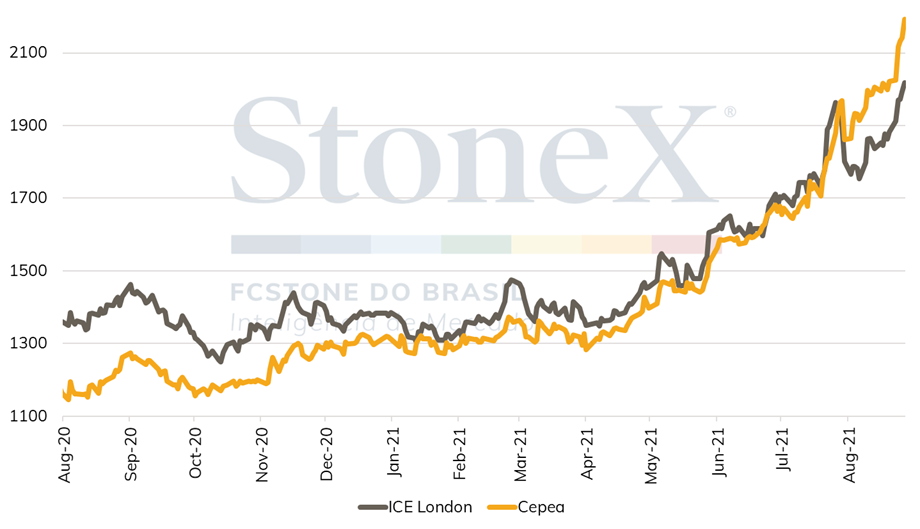
In this context, the Robusta coffee differentials between the domestic and the stock exchange prices, which have been negative constantly over the last few years, have been inverted since the beginning of the month, pointing to coffee being worth more in Brazilian markets than on the stock exchange. If they continue at these levels – which seems the case – the reflection of this effect tends to be observed in Brazilian Robusta exports as it should weaken in the coming months.
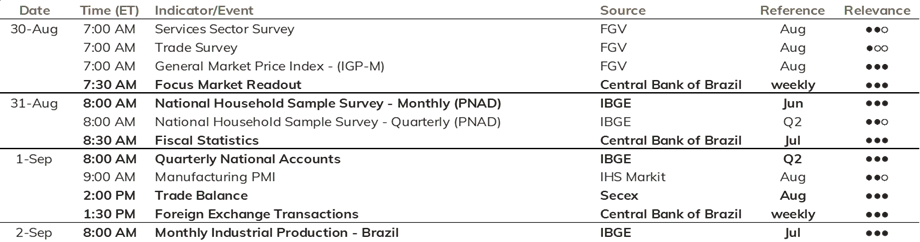
In Brazil, despite the BRL recovery, it is important to highlight a worsening in agents' perception regarding the main economic indicators. The market survey conducted by the Central Bank of Brazil's Focus Bulletin on Monday indicated a deterioration in expectations for the Brazilian GDP for the third week in a row. The median of the projections indicates that agents expect Brazil's GDP to grow by 5.22%, against 5.27% last week and 5.3% four weeks ago. On Wednesday (1), the Brazilian Institute of Geography and Statistics (IBGE) will release the result of the second-quarter GDP, which should be fundamental for the formation of the agents' expectations regarding the Brazilian economic recovery. Analysts' projections indicate that GDP should decrease from 1.2% in the first quarter to 0.2%.
The Focus Bulletin also increased inflation projections for the 21st consecutive week. The median of market projections indicates that the IPCA should end 2021 at 7.27%, against 7.11% last week and 6.79% four weeks ago. The result reflects last week's publication of the August IPCA forecast, which pointed to an acceleration in inflation, driven mainly by increases in the transport, food, household goods and housing sectors.
The signs that electricity will become more expensive again continue as a point of concern in this regard. According to media reports, the Brazilian Electricity Regulatory Agency (ANEEL) will soon make a new adjustment of up to 58% in the value of the red flag level 2, raising the amount charged for each 100kWh from BRL 9.49 to about BRL 14.00. ANEEL had already put into effect in July a 52% increase in the price of the red flag 2. The decision should be confirmed due to the worsening water crisis because of the continued reduction in the reservoirs of the hydroelectric plants in recent months. This increase may negatively affect economic activity, impacting the industry's production costs and further harming the population's purchasing power. It is worth mentioning that electric energy is the second heaviest sub-item in the IPCA index calculation (weight of 4.4%), following gasoline (weight of 5.1%).
The StoneX Group Inc. group of companies provides financial services worldwide through its subsidiaries, including physical commodities, securities, exchange-traded and over-the-counter derivatives, risk management, global payments and foreign exchange products in accordance with applicable law in the jurisdictions where services are provided. References to over-the-counter (“OTC”) products or swaps are made on behalf of StoneX Markets LLC (“SXM”), a member of the National Futures Association (“NFA”) and provisionally registered with the U.S. Commodity Futures Trading Commission (“CFTC”) as a swap dealer. SXM’s products are designed only for individuals or firms who qualify under CFTC rules as an ‘Eligible Contract Participant’ (“ECP”) and who have been accepted as customers of SXM. StoneX Financial Inc. (“SFI”) is a member of FINRA/NFA/SIPC and registered with the MSRB. SFI is registered with the U.S. Securities and Exchange Commission (“SEC”) as a Broker-Dealer and with the CFTC as a Futures Commission Merchant and Commodity Trading Adviser. References to securities trading are made on behalf of the BD Division of SFI and are intended only for an audience of institutional clients as defined by FINRA Rule 4512(c). References to exchange-traded futures and options are made on behalf of the FCM Division of SFI . StoneX is a trading name of StoneX Financial Ltd (“SFL”). SFL is registered in England and Wales, Company No. 5616586. SFL is authorized and regulated by the Financial Conduct Authority [FRN 446717] to provide to professional and eligible customers including: arrangement, execution and, where required, clearing derivative transactions in exchange traded futures and options. SFL is also authorised to engage in the arrangement and execution of transactions in certain OTC products, certain securities trading, precious metals trading and payment services to eligible customers. SFL is authorised & regulated by the Financial Conduct Authority under the Payment Services Regulations 2017 for the provision of payment services. SFL is a category 1 ring-dealing member of the London Metal Exchange. In addition SFL also engages in other physically delivered commodities business and other general business activities which are unregulated and not required to be authorised by the Financial Conduct Authority. StoneX Group Inc. acts as agent for SFL in New York with respect to its payments services business. StoneX APAC Pte. Ltd. acts as agent for SFL in Singapore with respect to its payments services business. ‘StoneX’ is the trade name used by StoneX Group Inc. and all its associated entities and subsidiaries.
Trading swaps and over-the-counter derivatives, exchange-traded derivatives and options and securities involves substantial risk and is not suitable for all investors. Past performance of any futures or option is not indicative of future success. Indicators are not a trading system and are not published as a specific trade recommendation. The information herein is not a recommendation to trade nor investment research or an offer to buy or sell any derivative or security. It does not take into account your particular investment objectives, financial situation or needs and does not create a binding obligation on any of the StoneX group of companies to enter into any transaction with you. You are advised to perform an independent investigation of any transaction to determine whether any transaction is suitable for you. No part of this material may be copied, photocopied or duplicated in any form by any means or redistributed without the prior written consent of StoneX Group Inc.
© 2026 StoneX Group Inc. All Rights Reserved.
Our subscribers have access to comprehensive market analysis from StoneX spanning commodities, equities, currencies and more.
Daily coffee report

August 13 – The major stock indices traded quietly mixed overnight ahead of this morning’s weekly job numbers and producer price index data. Like Wednesday, this morning’s data was considered good as well, providing support for stocks while generally allowing Treasury yields to slip a bit lower. The VIX is trading near 14.4, which is just above yesterday’s new low for the year. The dollar index is trading near 99.8. Yields on 10-year Treasuries are trading near 4.64%, while yields on 2-year Treasuries are trading near 4.15%. WTI crude oil is trading near $81 per barrel, while Brent trades near $87 per barrel. Wheat prices again firmed overnight on geopolitical risks in the Black Sea Region, while corn and soybean prices pulled back modestly from yesterday’s big gains.

Daily coffee report
Our market expertise, advanced platforms, global reach, culture of full transparency and commitment to our clients’ success all set us apart in the financial marketplace.
Reach
With access to 40+ derivatives exchanges, 180+ foreign exchange markets, nearly every global securities marketplace and numerous bi-lateral liquidity venues, StoneX’s digital network and deep relationships can take clients anywhere they want to go.
Transparency
As a publicly traded company meeting the highest standards of regulatory compliance in the markets we serve; our financials and record of accomplishment are matters of public record. StoneX’s commitment to “doing the right thing over the easy thing” sets us apart in the industry and helps us build respect, client trust and new partnerships.
Expertise
From our proprietary Market Intelligence platform, to “boots on the ground” expertise from award-winning traders and professionals, we connect our clients directly to actionable insights they can use to make more informed decisions and achieve their goals in the global markets.