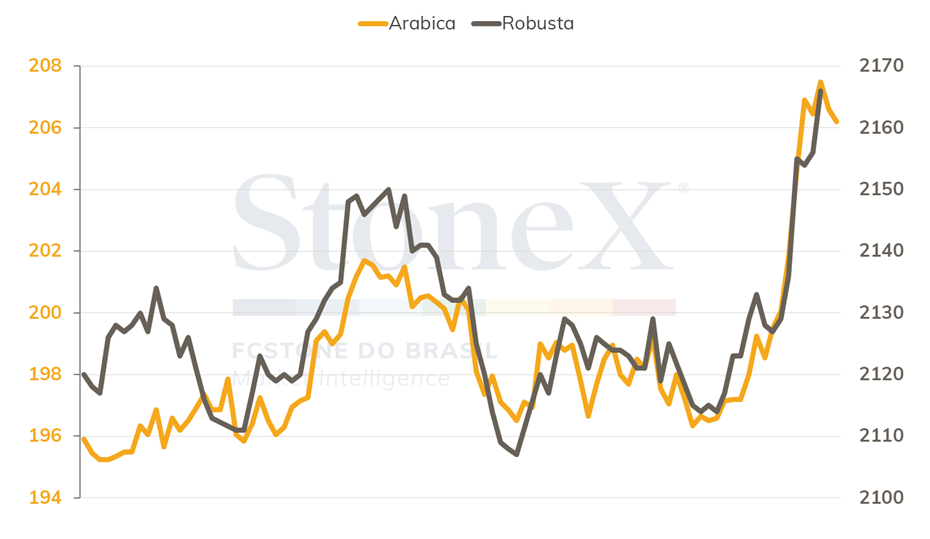
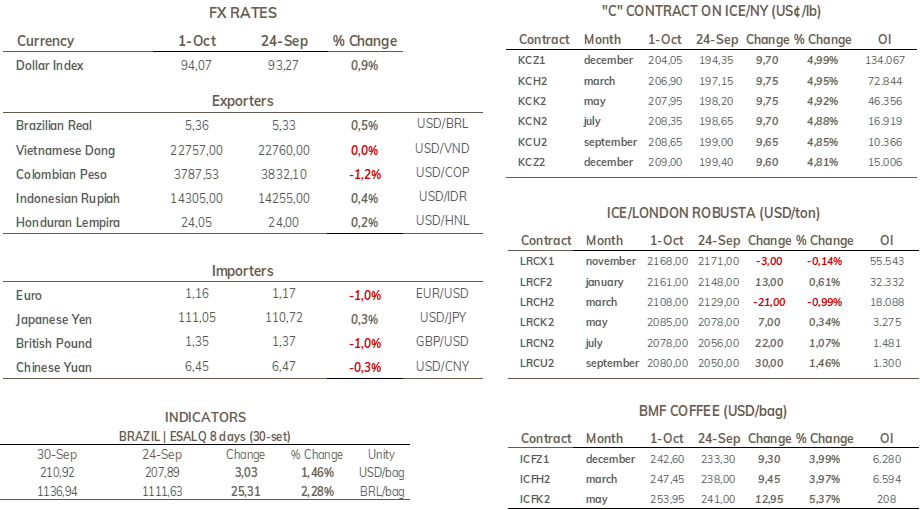
On the other hand, the Robusta coffee showed lower variation, with an appreciation of USD 13 (0.6%) for the second contract in London, which ended the period quoted at USD 2161/t. Prices in London have also been supported at high levels, reaching their third weekly close above USD 2100/t, the highest level since mid-2017. Arabica coffee prices have been maintaining a bullish trend with concerns about Robusta coffee supplies, especially mainly due to logistical difficulties in Vietnam and the return of stricter social distancing measures due to the surge in Covid-19 cases in the country, which has generally affected the flow of goods in the country.
Due to fears about global supply and disruptions in global logistics chains, which have forced the postponement of shipments in major global producers such as Brazil, Colombia and Vietnam, the difficulties in obtaining physical coffee have forced the market to seek other short-term alternatives. One of these movements has been observed in the fall of certified stocks. In London, reflecting the difficulties since the beginning of the year in obtaining containers and maintaining the flow of exports, especially of Robusta coffee from Vietnam, some participants have opted to receive certified stocks from the Exchange, which have been falling steadily since May. As a result, from May to October 1, stocks on the London futures market fell from their highest level in four years (2.659 million bags) to 2.048 million bags, a drop of 610,000 bags, or 23.0% of total volume.
In New York, given the recent difficulty in Brazilian and Colombian exports, both due to a lack of containers and ships, with freight companies prioritizing more lucrative routes between North America, Asia and Europe after the surge in futures prices, this movement of falling stocks has only taken shape in recent weeks. Since September 22, just over 68,000 bags (3.2%) have been withdrawn from ICE NY certified stocks, which have fallen to a level of 2.076 million bags. Thus, it seems that while the level of uncertainty regarding the 2021/22 and 2022/23 seasons remains high, this movement may continue in the coming months, which would act as a bullish factor for quotes.
Last Friday (1), the consolidated result of the Brazilian trade balance in September, released by the Secretariat of Foreign Trade (Secex), showed a volume of 2.826 million bags of green coffee shipped last month, a 23.2% drop compared to September 2020, when 3.682 million bags were shipped. The result is seen as a preview for Cecafé's official data, which should be released early next week and confirm a significant drop for the second consecutive month in Brazilian bean exports.
The return of pre-pandemic consumption patterns in the main consuming countries is also configured to support prices. According to the US National Coffee Association (NCA), since January, Americans have increased their coffee consumption at work by 55% and 20% in restaurants, with an overall increase of 16% in consumption out of home, as restrictive measures against Covid-19 were reduced. In this regard, given that the pace of imports into the country could be affected by the complications in the global logistics chain, the monitoring of stocks at US ports, which are already at historically low levels, could have even more weight in the coming months on the analysis of the demand dynamics in the major global coffee consumer.
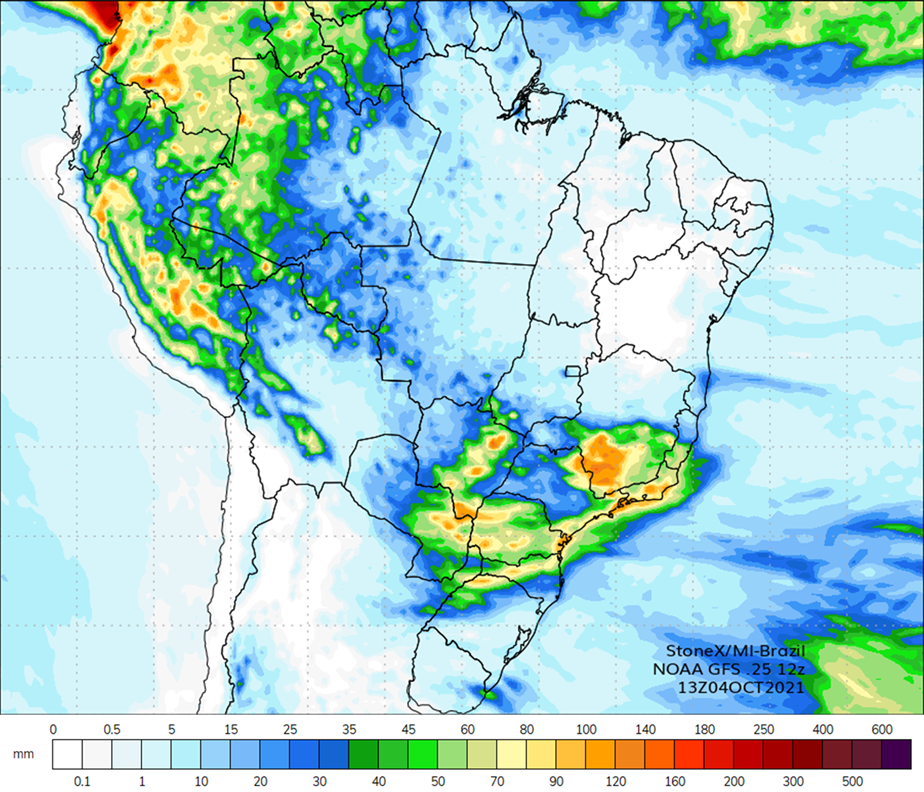
ACCUMULATED PRECIPITATION FORECAST FROM OCTOBER 4 TO OCTOBER 10
Source: StoneX, with data provided by NOAA/NCEP/GFS.
On the other hand, in the context of the expected tightening of the global S&D balance, the return of rainfall is configured as the main factor that can put pressure on prices in the coming weeks. According to StoneX's forecast models, based on data from the US National Oceanic and Atmospheric Administration, the next seven days are expected to register more significant rainfall volumes in the main producing regions. The accumulated rainfall is expected to exceed 100 mm in several Southern Minas Gerais and Matas de Minas municipalities and to approach 90 mm in part of the Cerrado and Mogiana, with most of the volume expected for the weekend. There are doubts if the rainfall will replenish the adequate water stock in the soil and fully repair the damage caused by the adverse weather in recent months. Still, they should trigger the 2nd stage of the flowering process in these regions, which will need continued rainfall to occur properly in the second half of the month.
Robusta Market Reacts to Reopening of Vietnam
The Robusta market fell under pressure last week as Vietnam eased its COVID-19 restrictions and
lockdown measures eased. The reopening of many businesses should jump start the economy, begin to
clear up backlogs and congestion at ports and diminish major challenges with internal logistics.
In Vietnam, farmers remain sidelined ahead of the new crop season that begins this month. Harvesting
activities are also set to begin for the 2020-2021 crop, which, is expected to be around 30 million bags,
before focus shifts to the 21-222 crop. In a recent interview with the Executive Director of the Vietnam
Coffee Association, VICOFA, he told CoffeeNetwork that the new crop has been adversely impacted by
weather and could be up to 15% smaller.
Vietnam’s coffee shipments in September were estimated at 120,000 tonnes, up 20.3% against the same
period last year, although exports in the first nine months of this year were expected to show a 4.2%
drop, official data showed.
In Indonesia, harvesting is nearly completed, with production expected around 10.6 million bags.
Colombian Coffee Growers Fail to Fulfill Deliveries
As internal prices in Colombia rally, Colombian coffee growers, who had committed to deliver beans in
the futures’ market, have failed to deliver 50 million kilos of parchment coffee, or about 549,450 bags of
coffee.
Small and medium-sized coffee growers, who months ago had committed to sell their beans to the
cooperatives in the future’s market, are unfulfilling with the delivery of beans because they sold beans
in the future’s market at around COP1 million pesos for ($263). But when the delivery period arrived,
local coffee prices where almost twice as much higher than the initial price set.
As coffee has failed to reach cooperatives, the Colombia’s coffee growers federation and private
exporters, the estimated cost for the non-delivery of beans is estimated at around COP350 billion
Colombian pesos in losses.
The growers committed to sell beans in the futures market at an average of 1 million and 1.2 million
pesos per bag, but coffee prices closed at COP1.745 million today. The sharp 74.5% increase has been
driven by the strong depreciation of the Colombian peso, rising international coffee prices and rising
differentials on coffee quality, all factors that have pushed up Colombian internal coffee prices to
historic record highs so far this year.
Large international coffee roasters are also extremely worried with the unfulfillment of contracts and
fear that this situation will worsen.
The financial books of some coffee cooperatives are already being hit, reflecting part of those losses as
they must report financial result each month to the regulator.
DESPITE HIGHS IN THE SELIC RATE, BRAZIL'S TROUBLED ENVIRONMENT DOES NOT ALLOW FOR A SIGNIFICANT BRL RECOVERY
The last week was quite volatile for the American currency, following an increase in risk aversion in the domestic and international markets, which led the real/dollar pair to close the week quoted at BRL 5.37, high by 0.6%. Given this context, the USDBRL recorded its fourth consecutive week of appreciation, closing September high by 5.6% from the previous month and accumulating a 4.8% appreciation in 2021.
Abroad, the dollar index traded above 94.0 points during part of the week, reaching its highest level in about a year. Among the biggest motivators for the increased caution of global agents, which should remain to some extent this week, are possible delays in the economic recovery caused by the delta variant of Covid-19; the difficulties in controlling the advances in global inflation in the face of logistical and supply problems; price hikes and tightening in the supply of important energy matrices such as oil and natural gas; the expectation of a soon reduction in monetary stimulus in the United States economy; the still present risks of insolvency of the Chinese property developer Evergrande, with fears of a possible domino effect.
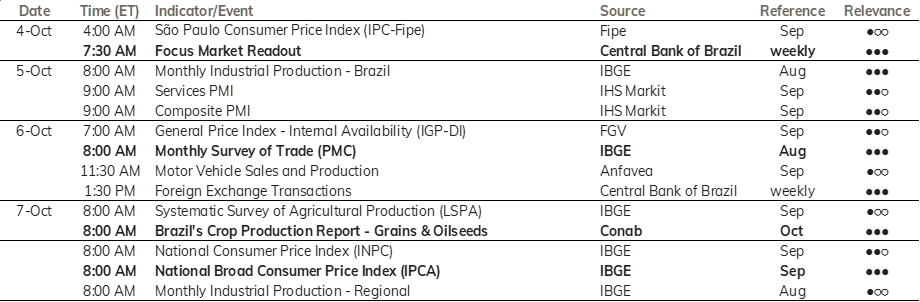
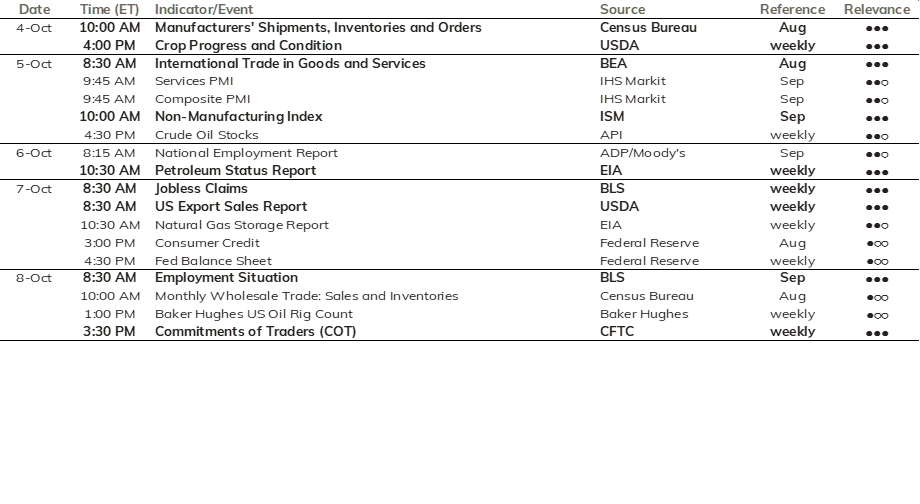
The difficulties of members of US Congress in avoiding a government shutdown by failing to agree on a resolution to extend the Executive's spending capacity has added some apprehension in global markets. It should remain on the radar this week. This week, global investors should follow the release of the September services and consolidated PMIs for the United States and the eurozone on Tuesday (5) to ascertain whether they will confirm a slowdown in the pace of economic activity growth signaled in the preliminary reports. The market also awaits the US Employment Situation Report with some caution, released by the Bureau of Labor Statistics (BLS) on Friday (8). The first-time claims for unemployment benefits the last few weeks have indicated a difficulty faced by the country in reducing the number of new claims, currently around 350,000 per week, to pre-pandemic levels of around 200,000, a factor that has generated some concern about the pace of recovery of the American labor market.
In Brazil, fiscal uncertainties and uncertainties regarding the recovery of the economy remained on the agenda. According to data released by the IBGE, the unemployment rate fell from 14.7% in the quarter ending in April to 13.7% in the quarter ending in July. However, job growth occurred in the most informal and lowest income categories, with the real income of the employed population decreasing in all categories surveyed, falling 2.9% from the quarter ended in April and 8.8% from the same period in 2020.
The government has also been facing difficulties in passing bills in Congress that would alleviate the risk of the Federal Government violating the spending cap rule. The proposed constitutional amendment (PEC) of judiciary bonds, which postpones part of the payment of debts due to final defeats suffered by the government in lawsuits, is considered the main way to make room in the Budget to accommodate the creation of the new social income transfer program Auxílio Brasil proposed by the government. The difficulties in moving forward with the proposal, and investors' fears that the program could be financed through extraordinary credit, which would further increase public debts, have reduced investors' risk appetite in the Brazilian currency in recent days.
Finally, this week, inflation should also be in the market's spotlight as agents await the Broad National Consumer Price Index (IPCA) for September next Friday (8). The accelerated inflation in the country (9.68% in the last 12 months) stimulates stronger increases in the Brazilian benchmark interest rate, making the country's public bonds more attractive to international investors, acting favorably to the BRL. But, on the other hand, the economic and political instability, the reduction in the population's purchasing power and perspectives of lower growth in economic activity and employment prevent the Brazilian currency from recovering in an orderly manner.