HIGHLIGHTS
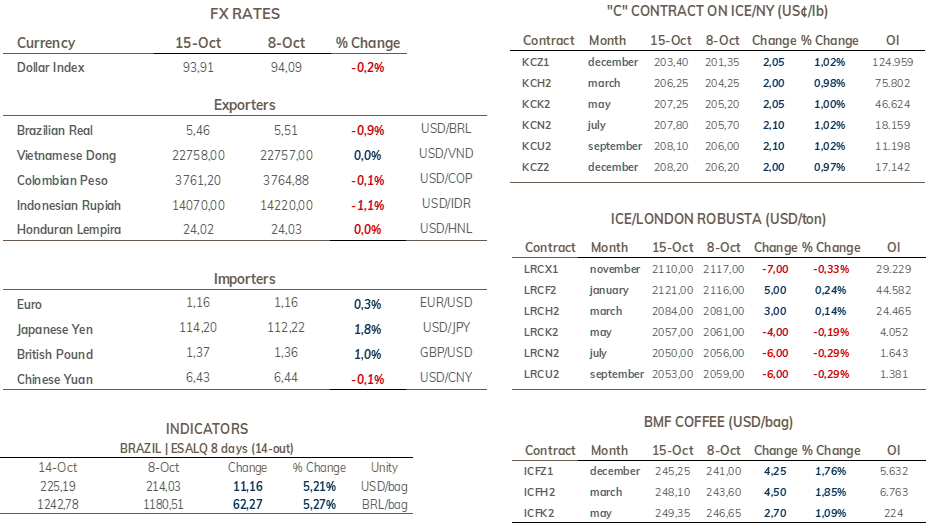
• Arabica coffee prices increase by 200 points (0.97%) in NY and Cepea indicator to BRL 1233/bag, high by 2.9%.
• Robusta ramps up by USD 5 (0.2%) in London but depreciates BRL 22.73/bag (2.7%) in Brazil to BRL 811.68/bag.
• Rainfall returns to the coffee belt, and even higher volumes are expected for the next two weeks ▼
• NOAA: the last bulletin indicated that the El Niño region was under La Niña effect since last month; the phenomenon is expected to continue until February ▲
• NOAA changes La Niña intensity outlook from weak to moderate ▲
• Brazilian exports dropped by 29.6% in September ▲
• GCA stocks retreat less than expected ▼
• US imports in August increase significantly ▼
• Concerns about rainfall excess in Vietnam continue to worry agents due to risks of delayed harvest and quality problems ▲
• Trading estimates coffee stocks in Vietnam at 8.6 million bags ▼
• USDBRL retreats after central bank interventions ▲
• High US inflation in September and FOMC minutes indicate the likely start of the Fed's contractionary monetary policy soon ▼
• Vote on PEC of judiciary bonds should impact the FX market this week ▼
▼ Bearish factors ▲ Bullish factors
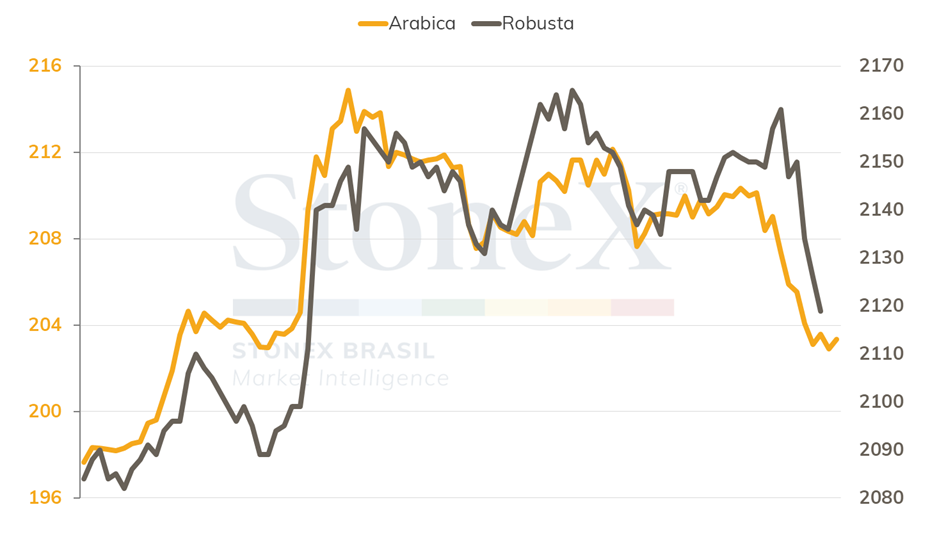
Despite the rainfall return in Brazil's coffee belt, which cooled agents' concerns, the positive scenario on the fundamentals side supported the appreciation during the week. On Tuesday (12), the Arabica coffee prices appreciated more than 800 points, in response to the positive scenario and the reduced activity in Brazil, due to the holiday on October 12. For the rest of the week, prices retreated following increased activity from origins, in addition to technical factors. The most active coffee contract in New York (December) retreated 200 points (0.97%), ending the week quoted at US₵ 206.25/lb. In the Brazilian domestic market, the Arabica prices appreciated by 2.9%, according to the Cepea indicator, closing the week at BRL 1,233.994/bag.
WEEKLY INTRADAY (MOST ACTIVE CONTRACT) - 10/11 to 10/15
The latest weather bulletin from StoneX continues to indicate good rainfall volumes for Brazil's coffee-producing regions. According to the report, the Southern Minas Gerais and Mogiana regions should receive around 200 mm in the next 14 days. Likewise, the Cerrado, Matas de Minas, Western São Paulo, and Paraná regions should receive around 150 mm in the next 14 days. In addition, the rainfall observed in recent weeks have contributed to improving the water situation in these regions – the anomaly map already shows that the accumulated rainfall over the last 60 days is above average for the period for almost all regions, except for Espírito Santo, part of São Paulo and Bahia.
The latest bulletin issued by the American agency, NOAA, indicates that the El Niño region was already under the effect of La Niña since last month, which was noted by the below-average ocean surface temperature. Furthermore, according to the report, La Niña is expected to continue through the December-February quarter, with the intensity outlook being raised from weak to moderate. As already commented in other editions of the weekly coffee report, the La Niña occurrence between December and January could be associated with excessive rainfall in Colombia, Central America and Asia – most countries in this region will be in their harvest period.
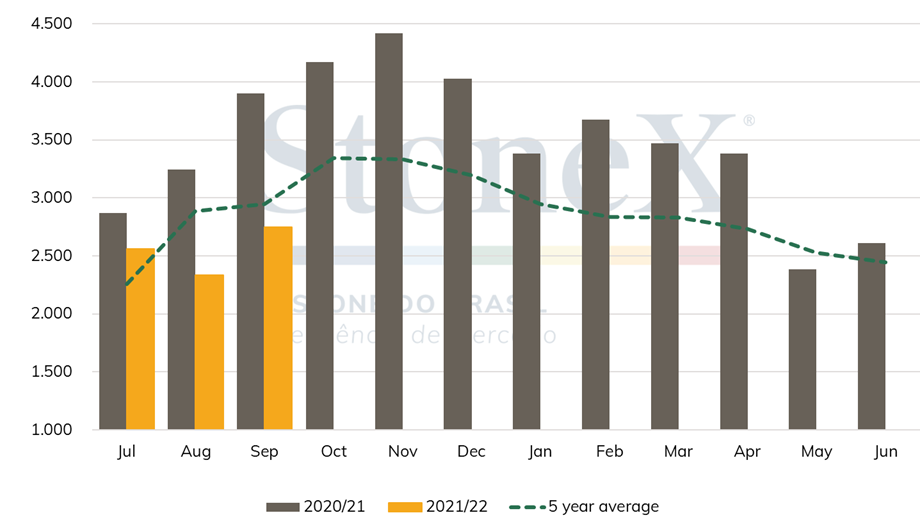
Last week, Cecafé released the data for Brazilian coffee exports in September, which pointed to a strong reduction. As anticipated, coffee exports were 29.6% lower in September, totaling 2.75 million bags. As it is a negative biennial year, it is natural to see lower export volumes in 2021/22, but the scenario was accentuated by the logistical problems caused by the Covid-19 pandemic. Like other countries, Brazil has been facing serious logistical problems, which have limited the supply of containers and caused an increase in ocean freight costs.
BRAZIL'S MONTHLY GREEN COFFEE EXPORTS
Source: Cecafé. Design: StoneX.
Overall, from a fundamental perspective, the market sentiment is still positive. Despite the rainfall return, several bullish factors, such as the supply and demand balance tightening, the La Niña occurrence and logistical complications, contribute to maintaining a positive outlook for the market.
GCA stocks drop below expected for September, going against expectations
On Friday (15), GCA stock at US ports data for September were released. The latest report pointed to a reduction of 107,000 bags in September, a volume still 5.9% lower than observed in September 2020. For September, stocks have retreated by approximately 124 thousand bags on average over the last five years.
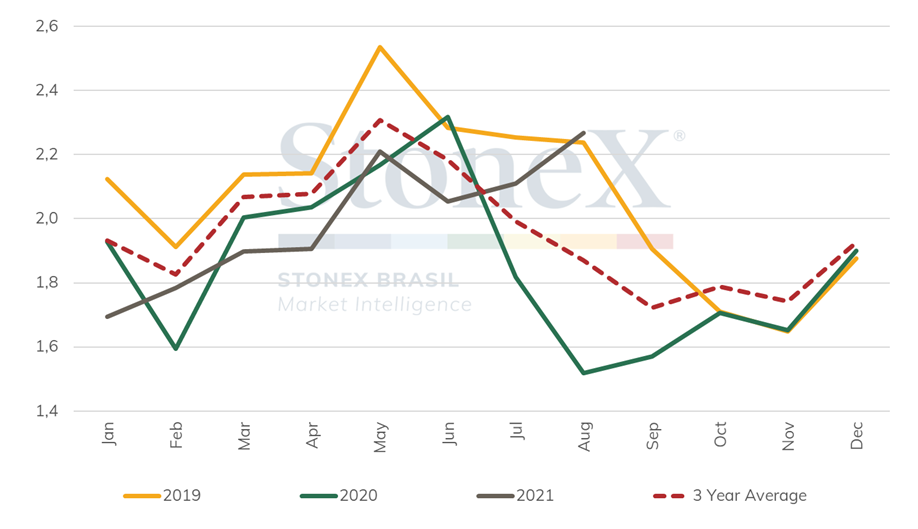
Given the recovery in coffee consumption in the US and the logistical problems observed, an even sharper fall in GCA stocks was expected, which did not consolidate in September. Therefore, it is important to analyze the volumes of coffee imported by the US during the period to understand this scenario. However, September import data for the country are not yet available. Nevertheless, looking at the previous month, August, it is possible to notice a strong increase in US coffee imports, according to USDA data, which indicated an increase of over 156,000 bags (7%) compared to the previous month totaling 2.26 million bags. Furthermore, imports in August showed an increase of almost 750 thousand bags (49.2%) compared to August 2020.
US MONTHLY COFFEE IMPORTS
Source: USDA. Design: StoneX.
These increases in imports seem to contradict the current global logistics disarray observed in recent months. However, it is important to note that the coffee imports accounted for in August were shipped in previous months due to the time required for ocean transport – shipping can take weeks or even months. According to USDA import data, the big increase in US imports in August came from Brazil, Colombia, and Vietnam. In the case of Brazil and Vietnam, there were arrivals of coffee that were in sea transport. However, the biggest increase was in coffee from Colombia; there was a 47% rise in coffee imports from the country, with a total increase of almost 150,000 bags in August alone.
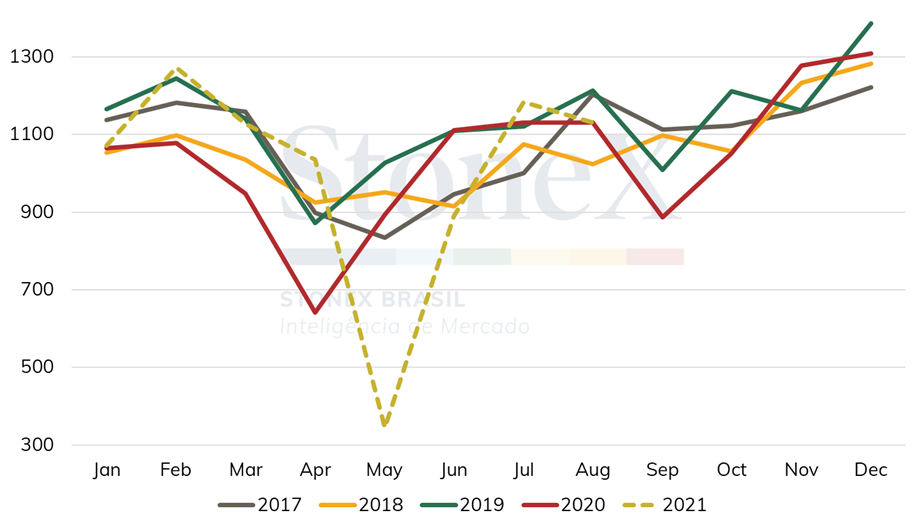
COLOMBIA'S MONTHLY COFFEE EXPORTS
Source: National Federation of Coffee Growers of Colombia. Design: StoneX.
Despite the logistical problems faced by the countries, Colombian exports had increased in recent months, showing a recovery in exports that stopped leaving the country in May, when it suffered from a widespread strike. On that occasion, there was a 67% reduction in exports, as it stopped shipping more than 690 thousand bags, according to data from the National Federation of Coffee Growers of Colombia. In addition, Colombia is still in the harvest period of its main crop, which runs from mid-September to mid-February next year. Therefore, even without US import data for September, which should be released early next month, it is possible to infer those increased arrivals of coffee from Colombia may have contributed to limiting the declines in stocks reported by the Green Coffee Association.
Logistical Issues Leave Roasters Looking to Coffee Stocks
Since the start of the COVID-19 pandemic, the global coffee supply chain has been grappling with logistic issues, including shipping delays, limited space on ships, rising freight costs and a lack of available containers.
From Vietnam to Brazil, mostly all coffee-producing nations have felt the impact in some way, and roasters have expressed concerns regarding availability of coffee and fulfillment of contracts.
The most recent data from the Green Coffee Association, for example, showed consumer stocks in the US fell for the first time in three months. The drawdown can most likely be attributed to roasters running to stocks to ensure appropriate supply in the face of uncertainties of global freight and shipping.
This new level of stock reported at the end of September 2021, is near the lower point registered in June 2015, when stocks were reported at 5.51 million bags.
The current levels of coffee stocks however would equate to more than twelve weeks of roasting activity, which most would consider to be a safe reserve and is still significantly higher than the historic low which was registered by the U.S.A. Green Coffee Association in 2011 at a total 4 million bags.
Similar activity could be observed in other major coffee consumers, including Japan, where coffee stocks are currently down 8.3% year on year.
It is important to note, however, that ICE Arabica certified stocks are up a staggering 71.4% year on year.
London ends the week slightly lower amid technical weakness
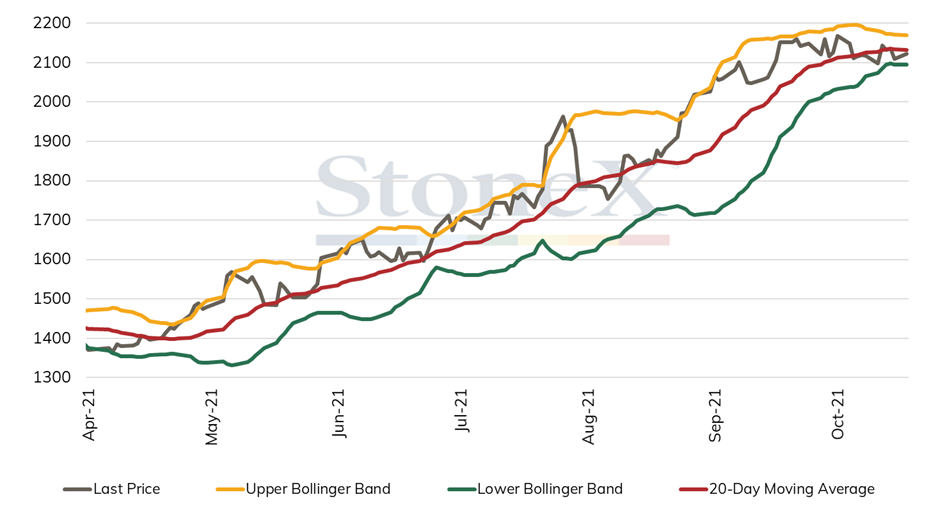
London’s front month November contract traded essentially sideways through the course of the past
week, ending 0.3% lower, unable to sustain its tests of the $2,150/t level which had been tested in four
of the last five sessions. From a technical standpoint the one- month retracement study shows
resistance at $2,155/t while Friday’s sharp falls, which essentially wrote off the gains sustained in the
middle of the week, mean that November moves into this week with technical support around the
$2,100/t level. Easing upside momentum was evident through the course of last week with the
November contract trading in a sideways fashion since breaching the $2,100 level. Indeed, the Bollinger
band study also points to easing upside momentum, with the upper band now trending lower and
converging towards the lower band, a signal of a potential price breakout should these indicators
continue to narrow (graphic below).
Robusta November w. Bollinger Bands
Source: Bloomberg. Design: StoneX.
From a fundamental standpoint, reports suggest that the Vietnamese harvest is not yet fully underway
with expectations that it will be closer towards November before it gets into full swing due to heavy
rains forecast through October. Looking ahead the Central Highlands is forecast for progressively heavier
volumes of rain through this week, with cumulative daily volumes reaching approximately 10mm by the
beginning of next week. Indeed, these heavy rains are reported to have resulted in flooding to some
unspecified areas of the Central Highlands over the weekend. Potential damage to coffee crops at this
stage is yet to be specified. From a trade standpoint the delays that heavier rains could present would
mean that availability could be tighter until fresh beans are readily available with most of last year’s
supplies now exhausted. ComCo Trading reported on Friday that approximately 514Kt (8.6M bags) of
stock remains in Vietnam with 240kt (4M bags) held by local suppliers, 3.6M bags in bonded zone and
1M bags held by farmers. ComCo also estimated that this harvest will yield 30.8M bags. Once again
container availability was cited as a cause of logistical disruption with reports that only 30% of port staff
and labourers are allowed to work on site. Indeed, even as fresh supplies begin to arrive at the farm gate
the real issue is getting the crop out of the country.
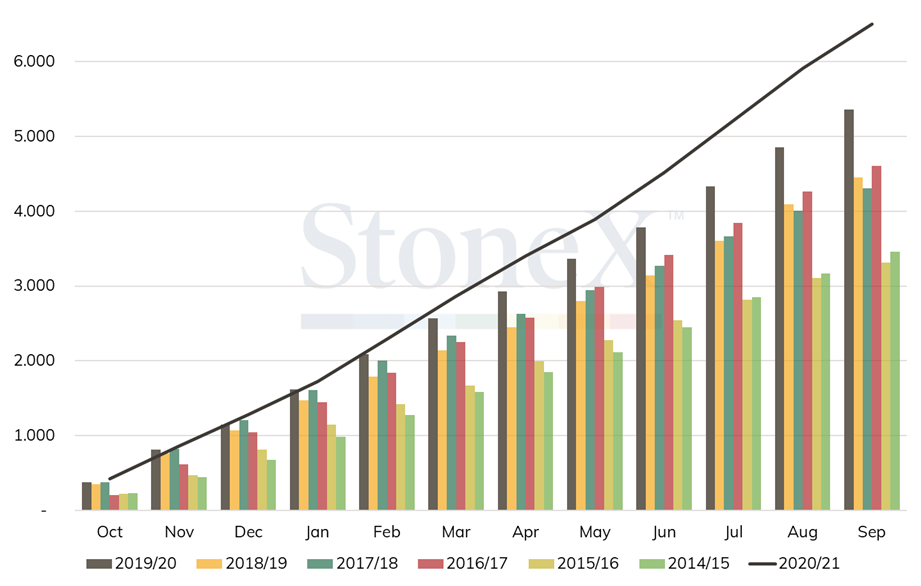
Ugandan coffee exports for September totalled 585,576 bags last month, increasing by 15.6% Y/Y and
bringing cumulative shipments for the 2021/22 season to 6.5M bags, a record.
Cumulative Ugandan Coffee Exports
Source: Bloomberg, Giacaphe. Design: StoneX.
USDBRL drops after a sequence of Central Bank interventions
In a week marked by strong action by the Central Bank to contain an excessive devaluation of the Brazilian real, the USDBRL ended the week down by 0.9%, with the real/dollar pair closing at BRL 5.46.
Last Wednesday (13), the USDBRL started the session with a strong upward movement to offset the American currency appreciation abroad, when the foreign exchange market was closed in Brazil due to the national holiday of Our Lady of Aparecida and reflecting domestic concerns about the impacts of accelerating inflation and fiscal risks to the Brazilian economy. In this scenario, when the USDBRL was approaching the BRL 5.60 level, reaching a daily high of BRL 5.57, the Central Bank of Brazil made a surprise intervention, promoting an auction of 20 thousand traditional foreign currency swap contracts, injecting the equivalent of USD 1 billion in the futures market to contain the devaluation of the Brazilian currency.
The swap is a derivative that allows the exchange of rates or profitability of financial assets. In the case of the traditional currency swap offered by the Central Bank, the bond pays the buyer the exchange rate variation plus an interest rate (called the foreign exchange coupon). In exchange, the Central Bank receives the Selic rate variation. The Central Bank also held scheduled auctions of the same proportions on Thursday and Friday mornings. The performance in the FX market for three consecutive sessions, with an injection of USD 3 billion, was the main factor for the dollar to end the week lower.
Abroad, the agents reflected the disclosure of the Consumer Price Index (CPI) in the United States, which showed an increase of 0.4% in September, above the analysts' projections of 0.3%, accumulating an increase of 5.4% in the last 12 months and 4.0% in 2021. In addition, the Producer Price Index (PPI) posted a monthly increase of 0.5%, with the accumulated over 12 months reaching 8.6%. The continued increases in consumer prices, with inflation significantly above the Federal Reserve's target of an average of 2.0% per year, corroborates the expectation that the monetary authority will soon begin the process of reducing its asset purchase program.
The minutes for the last Federal Open Market Committee (FOMC) meeting contributed in the same direction. Although there is still divergence among the collegiate members, the biggest consensus is that if the economic recovery remains "on track," the Fed should soon start tapering. The Fed has been making monthly purchases of USD 120 billion in Treasury securities and USD 80 billion in mortgage-backed securities. The report pointed to an example given by members of a possible initial move, decreasing purchases by USD 10 billion in Treasury securities and USD 5 billion in mortgage-backed securities per month. Reducing the program would mean less injection of dollar liquidity into the market and closer proximity to an eventual interest rate hike next year, which tends to act bullishly for the US currency.
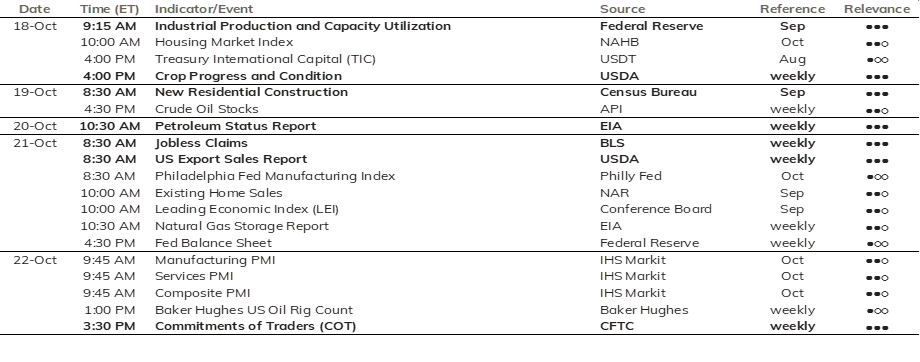
With the schedule of domestic indicators emptied this week, the market's attention should turn to the foreign scenario and political news. On Tuesday (19), the proposed constitutional amendment (PEC) of judiciary bonds should be voted on by the special committee that evaluates the proposal in the Chamber of Deputies, with the House president Arthur Lira (PP-AL) stating that the proposal should be voted on in plenary on Thursday (21). If approved, the measure would allow the government to pay in 2022 only R$ 39.9 billion of the R$ 89.1 billion of the Union's debt with judiciary bonds, which are debts incurred by the government in lawsuits. Accordingly, the government would open up space of almost BRL 50 billion in next year's budget, more than enough for the implementation of the Auxílio Brasil income transfer program, which should expand the current Bolsa Família program.
Despite the recognized need for greater support to the most vulnerable part of the population, with high unemployment rates and a drop in average income, the maneuver of postponing an expense (the judiciary bonds) to create a new expense (Auxílio Brasil) is seen negatively by investors, interpreted as and harmful to the health of the country's public accounts. Thus, approval in the current form may have a bullish effect on the exchange rate in the short term.