Quarterly Commodities Outlook is available for free now.  Download your report  →

StoneX logo

Coffee Weekly Report

By: StoneX Intelligence Brazil, StoneX Intelligence Brazil

Arabica coffee prices retreat amid good rainfall and USDBRL appreciation 
 
Fernando Maximiliano
Leonardo Rossetti
William Rutherford-Roberts
Alexis Rubinstein
USD sharp appreciation in the Brazilian exchange market weighed on New York prices during the week
HIGHLIGHTS 

•   Arabica coffee prices drop by 355 points (1.75%) in NY, while Cepea indicator at BRL 1246/bag, high by 1.0%.
•   Robusta prices increase by USD 24 (1.1%) in London but depreciate BRL 56.25/bag (6.9%) in Brazil to BRL 755.43/bag.
•   USDBRL appreciation weighs on prices in the week
•   Coffee producing regions receive good rainfall, which should remain at good levels until the end of October
•   Soil moisture stock data are still concerning for post-flowering development
•   Colombia Cooperatives struggle with coffee not delivered by producers
•   Coffee problems in Colombia could affect US imports in the coming months
•   CFTC report points to reduced spec fund net longs
•   Logistics and Covid-19 risks drive Robusta higher in London
•   Funds reduce long positions in Robusta coffee for the fourth consecutive week
•   Amid rising fiscal risk, USDBRL registers a 3.5% rise in the Brazilian FX market
•   Worsening economic indicators could lead Copom to a more contractionary stance in this week's decision

   Bearish factors       Bullish factors


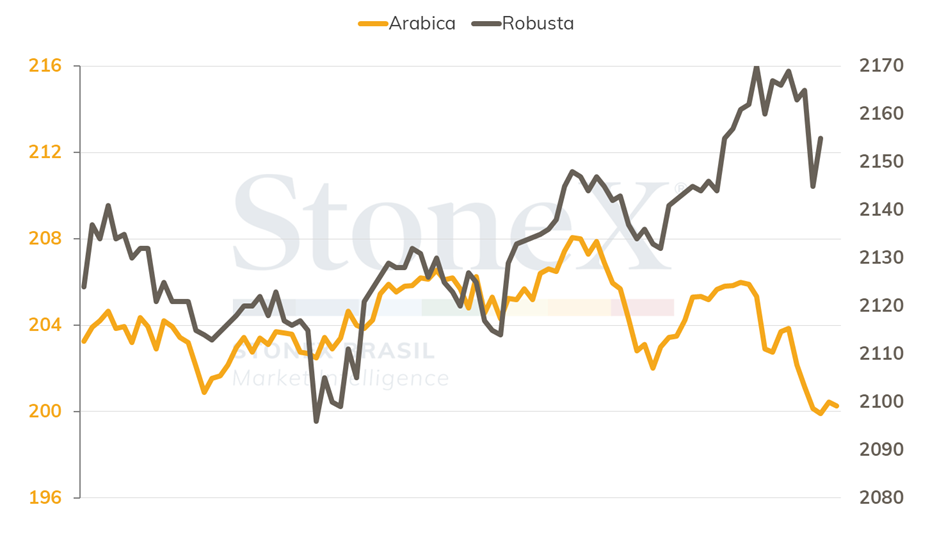
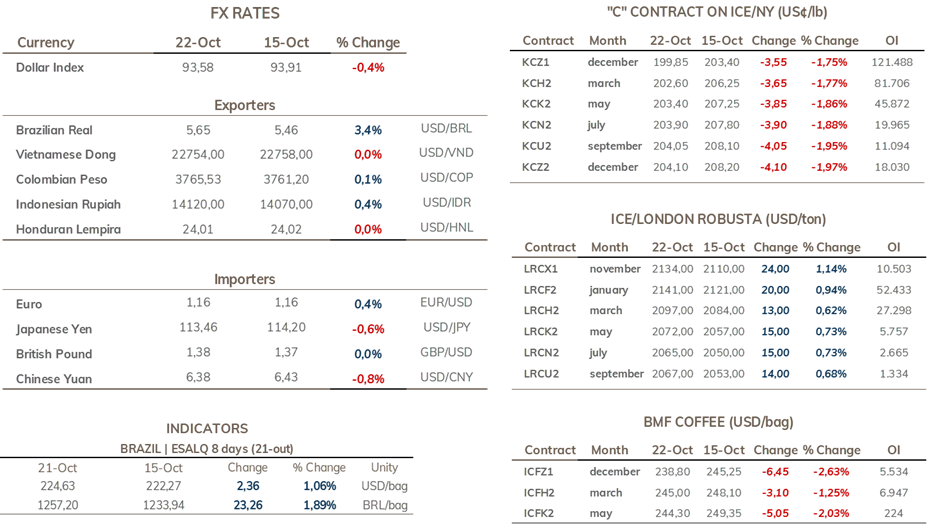
Amid little news in terms of fundamentals, coffee futures contracts retreated in New York last week, ending the week below the US₵ 200.00/lb level for the first time since the week ended September 27. The most active contract, December/21, ended last Friday (22) quoted at US₵ 199.85/lb, a variation of -355 points (-1.75%) from the previous Friday (15).
WEEKLY INTRADAY (MOST ACTIVE CONTRACT) - 10/18 TO 10/22
image 20514
Source: Commodity Network Trader's Pro. Design: StoneX.

Among the main factors that contributed to weighing on prices were technical factors, the good rainfall volumes in most coffee-producing regions, and the sharp USDBRL appreciation, which will be further elaborated on in the macroeconomic section.

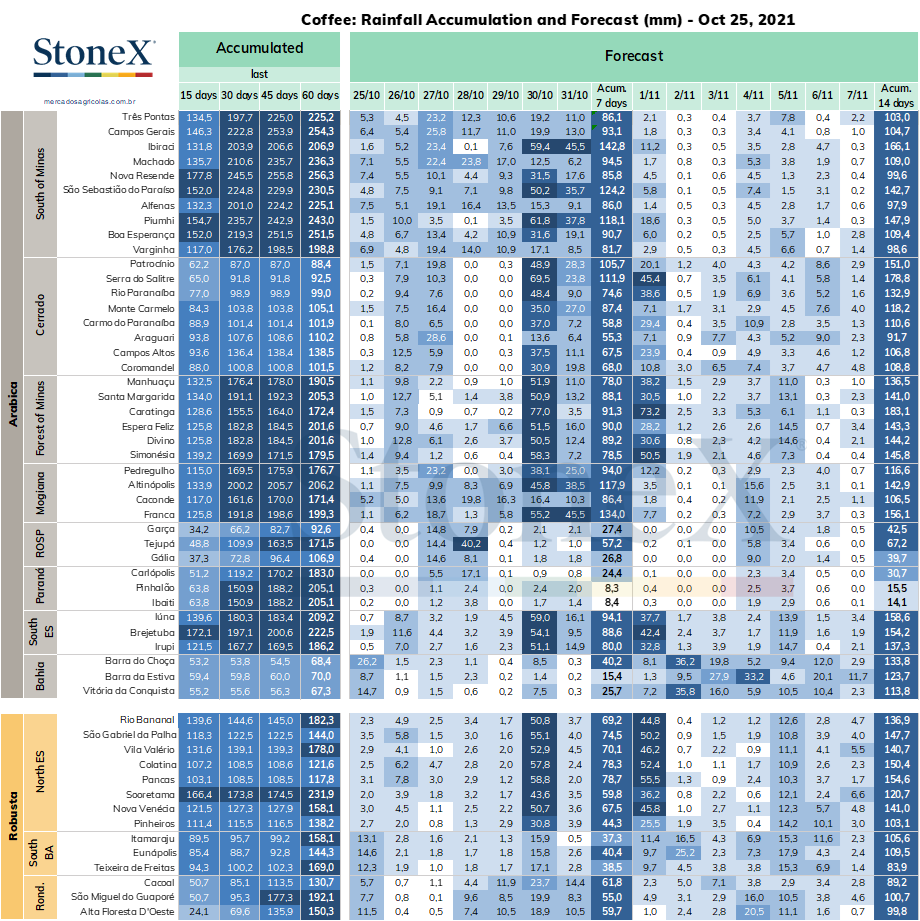
According to the forecast and historical precipitation model published by StoneX, based on NOAA data, most producing regions have shown good rainfall volumes in recent weeks.  According to the indicators, most producing regions in Southern Minas registered volumes of around 130 mm to 175 mm over the last 15 days, with volumes up to 140 mm for the Matas de Minas region and up to approximately 130 mm in the Mogiana region, with the Cerrado region indicated to have received up to 100 mm of rainfall over the period. Rainfall is expected at good levels until the end of the month, contributing to downward pressures in the coming days.

image 20515
Source: StoneX, with data provided by NOAA/NCEP/EMC (GFS: Global Forecast System), 2021.                                                                                            

However, although precipitation in October has been favorable for the development of coffee production in general, it is still difficult to say whether it will compensate for a long period of hot weather and soil moisture deficit. Furthermore, due to the water crisis and drought in Brazil, the data for soil moisture stock from the middle of the first semester to September continue below the historical average in most producing areas, which also experienced delays in the rainy period for flowering due to the La Niña effects in the region. In this sense, the actual conditions of the 2022/23 crop can be better evaluated from the end of this year, after fruit formation and expansion.

Given the signs of firm global demand, short-term coffee supply continues to be a concern for the industry. According to an article published by Coffee Network last week, many coffee cooperatives in Colombia are running the risk of bankruptcy for not being able to meet their export commitments due to the non-delivery of coffee sold in the futures market by the country's producers, which may reach a volume of 500,000 bags. In this sense, the consumer market in the United States, the major importer of Colombian coffee, responsible for importing over 5 million bags of Colombian coffee per year, is positioned as the market most susceptible to this impact.

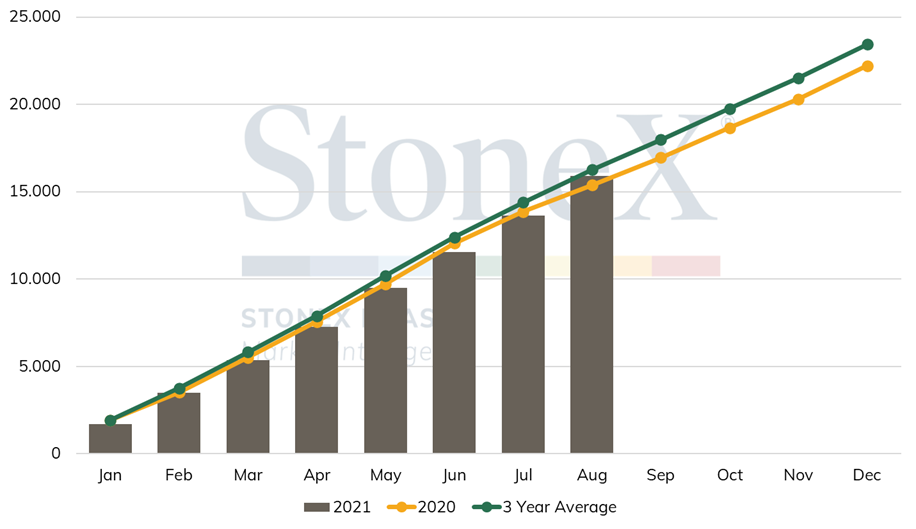
In the first eight months of 2021, the United States has recorded 15.9 million bags of coffee imports, a figure that already exceeds the accumulated figure for the same period last year by 536,000 bags and is only 336,000 bags below the average of the last three years, despite all the logistical difficulties that still affect a large part of the global supply chains. In August, the largest global consumer surprised by recording imports above the average of recent years for the month, with Colombian exports weighing heavily above the average for the month, with the shipment of coffee that could not be shipped in May due to the wave of protests in the country. On Thursday of next week (September 4), the USDA will release US import data for September, and it will be important to ascertain whether these figures indicate a significant drop in arrivals of Colombian coffee, which could increase short-term pressures on other major suppliers of soft coffees, as Brazil and Central America.  

US COFFEE IMPORTS (THOUSAND BAGS)
image 20516
Source: USDA. Design: StoneX.

Despite the depreciation in New York quotes, the USDBRL appreciation led the Arabica coffee price to register a weekly increase of 1.0%, with the CEPEA Arabica type 6 indicator closing at BRL 1,246.22/bag.

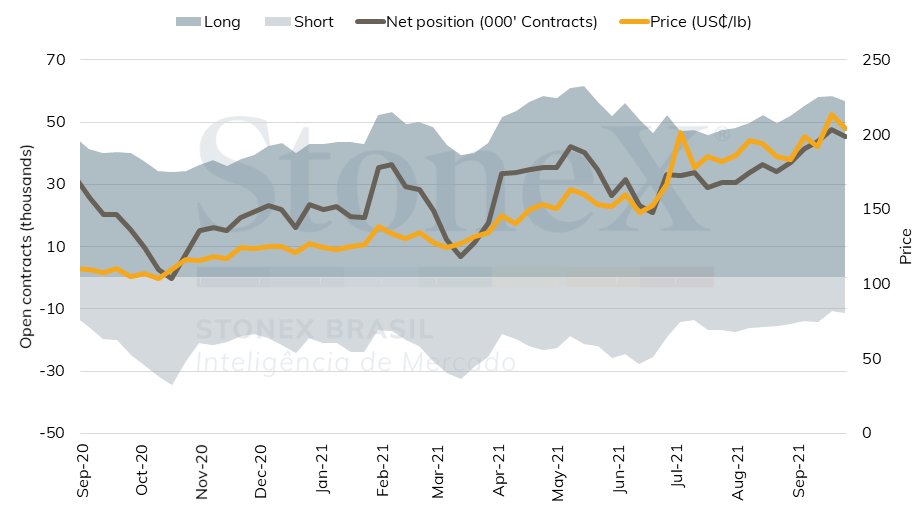
The latest CFTC report indicated a reduction in the net long position of spec funds in New York. After reaching their largest net long position since November 2016 last week, when they totaled 47,618 net long positions in futures and options, last Friday's (22) report indicated that between October 12 and 19, spec funds reduced 1,629 long positions and expanded 649 short positions, going to a net long balance of 45,340. During this period, the prices of the most active contract recorded a drop of 890 points, retreating from US₵ 213.15 to US₵ 204.25, indicating a profit-taking move by the funds after prices advanced to levels significantly above the psychological value of US₵ 200.00. Although fundamentals remain mostly bullish for long-term prices, the historically high long position of the funds is a cautionary factor, with the potential to provoke eventual sharper downward movements in the short-term in case of a more intense sell-off by the funds.

CFTC FUTURES + OPTIONS (MANAGED MONEY POSITIONS) in NEW YORK 
image 20517
Source: CFTC. Design: StoneX.


USDBRL sharp appreciation weighs on coffee prices and increases concerns about Copom this week


The real/dollar pair showed an appreciation of 3.4% last week, contributing to the depreciation in coffee prices when it advanced by almost 20 cents to close the week at BRL 5.65. Amid investors' perception of growth of fiscal risks in the country, after successive demonstrations of the federal government's intention to defy the laws of fiscal responsibility, the USDBRL reached BRL 5.75 on Friday (21), when it renewed its highs since April after the news of the resignation of four Ministry of Economy's secretaries.

The movements in the Brazilian market last week were largely influenced by the domestic political scene. The last few sessions were based on the consolidation of a change in the government's stance, which until mid-2021 was firmly positioned toward respecting the fiscal responsibility laws. Between comings and goings, and showing a certain amount of improvisation, the Executive started looking for loopholes in the laws to create new expenditures for the "Auxílio Brasil" basic income transfer program, which seeks to expand the Bolsa Família program from BRL 191 to BRL 400  to December 2022, an election year.

Roughly speaking, two principles regulate public spending in the country: the Fiscal Responsibility Law (LRF) and the constitutional spending limit (spending cap). The LRF requires that every expenditure indicate a revenue to finance it (or an expenditure that will no longer be executed), except for temporary expenses. Since the government is proposing a temporary increase - until December 2022 - there is no violation of the LRF. On the other hand, the spending cap imposes that all government expenses obey a maximum limit, adjusted annually by inflation, i.e., there is no real growth. In this case, the economic team proposes to anticipate revisions on the constitutional spending limit, expected to be made only in 2027, through new text added in the proposed constitutional amendment (PEC) of judiciary bonds, approved by the Special Committee of the Chamber of Deputies last Thursday (21). The text should now be voted in Plenary.

The market's perception of deterioration in the Brazilian public accounts is already reflected in the Focus Bulletin published this Monday by the Central Bank of Brazil, which indicated a worsening in the main economic indicators. The report indicated the 29th consecutive week with agents' higher expectations for the IPCA in 2021, who raised their projections from 8.69% to 8.96% for the accumulated over 12 months. On the other hand, the projections for GDP growth retreated from 5.01% to 4.97% in 2021 and from 1.50% to 1.40% in 2022. Expectations for the USDBRL, on the other hand, showed a significant increase, rising from BRL 5.25 to BRL 5.45 by the end of the year.

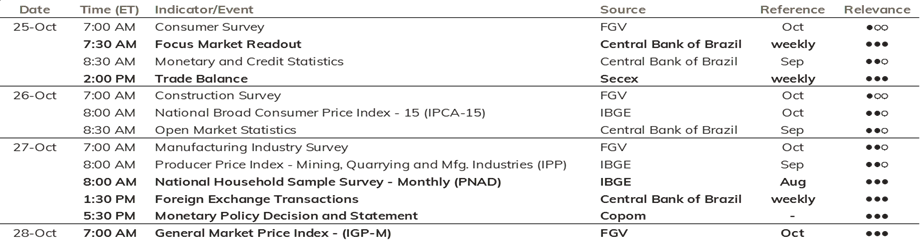
The most important factor regarding the Focus Bulletin is the agents' expectations for the Selic rate, which rose from 8.25% p.a. to 8.75%, creating greater concerns about the Monetary Policy Committee (Copom) meeting be held this Wednesday (27). As of last week, the Focus projections were in line with the signals of the Committee's latest minutes, that it intended to raise rates by one percentage point over the next few meetings, which would lead the interest rate to end the year exactly at the median of the projections made by Focus (8.25% p.a.). After last week's events and the demonstration of greater fiscal fragility in the country, the Central Bank of Brazil is expected to take a more contractionary stance, raising the Selic this week by 1.25 p.p. or 1.50 p.p., to contain the strong depreciation of the Brazilian currency. Should this scenario be confirmed, despite the need to follow up on the content of the communiqué of what was discussed in the meeting and the turbulence in Brasilia, the raising of interest rates above 1.00 p.p. could bring some relief to the BRL in the short term.
 

Robusta ends the week higher amid the ongoing logistical issues in Vietnam coupled with heightened risk from COVID-19 in some major producing regions

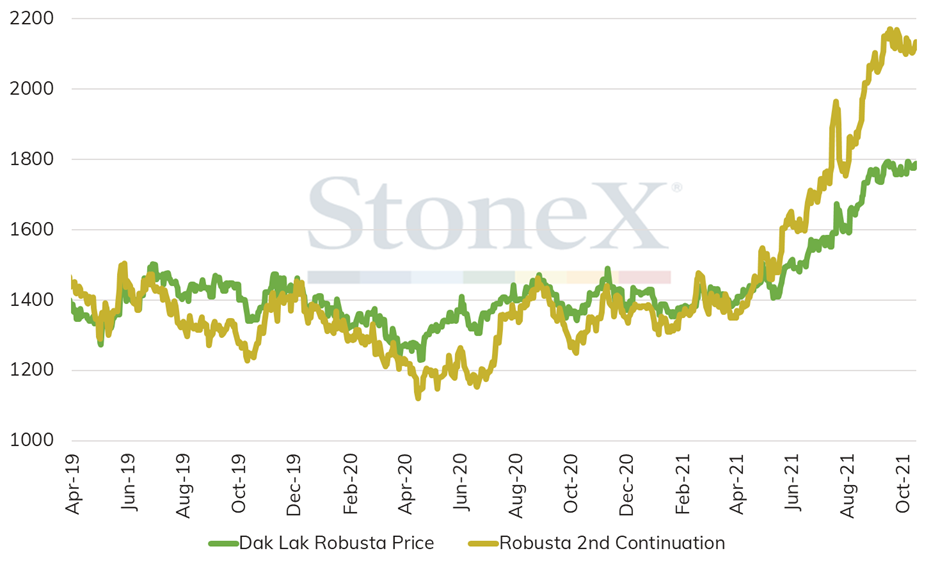
Robusta settled higher basis the November contract last week, gaining 1.1% to settle at $2,134/t. With respect to the forward curve, November remains at a $5/t premium to January moving into this week which itself is trading at a near $50/t with the sharp backwardation between second and third months reflecting the ongoing concern surrounding the logistical disruptions in south east Asia. With wet weather in recent weeks expected to delay the harvest to the latter end of this month supplies may be delayed in getting to the farm gate. Despite this, weather last week brought a good mixture of rain and sun, which is expected to help the beans ripen. Moving forward rainfall will be a key factor in the progression of this harvest while also having an impact on the quality of the beans. Excessively wet weather will not only bring delays in getting beans off the trees, but it would also serve to impact the quality of the crop.

The week ahead is forecast to bring a mixture of heavy rain and dryer spells with the extended forecast currently showing light volumes as we move into the first week of November. Indeed, this forecast would indicate favourable conditions for the harvesting of beans over this period, which is expected to be when the harvest will get fully underway. With La Niña conditions expected to persist through at least the December-February period this brings the risk of higher-than-normal rainfall patterns for Vietnam. There are reports of clusters of COVID cases in the major coffee producing province of Dak Lak as well as Gia Lai, which do risk travel restrictions and potentially field work delays if not contained. At this stage there is no official report of these provinces being locked down, but this is something that should be monitored as we move closer to the harvest. Given the ongoing delays from logistical issues, restrictions would only serve to provide further delays in getting new beans to market. Reports suggest that supplies in Vietnam are not the issue, rather getting the beans out of the country.

Robusta 1st Continuation vs Dak Lak Price
image 20518
Source: Bloomberg, Giacaphe. Design: StoneX.
Currently, prices in Dak Lak are hovering around $1,790/t, a discount of approximately $345/t as of Friday’s settlement. In Brazil Robusta prices in Espirito Santo posted sharp falls for grade 6 beans, losing 6.9% W/W. This can be attributed to the sharp weakening of the Brazilian real which lost 3.5% W/W, with the weaker currency presenting greater revenue generating opportunities in BRL terms.

Robusta 2nd Continuation Candlestick 
 
image 20519
Source: Bloomberg. Design: StoneX.
 
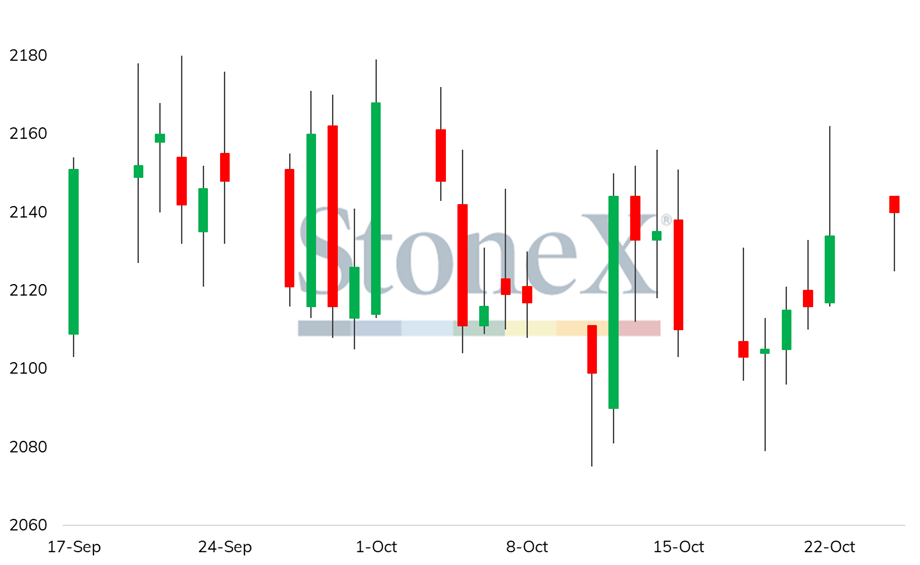
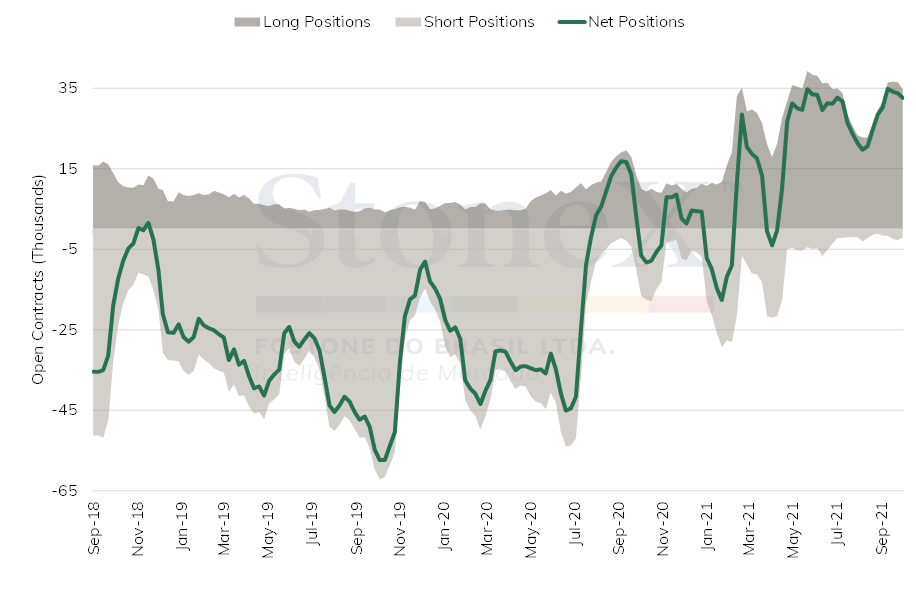
From a technical standpoint the November contract has posted some volatile moves in the past week, breaking down to its lower resistance level before breaking into the upper band towards the end of last week. The Bollinger band study shows a continued narrowing of the upper and lower bands, with the November contract settling $14/t below the upper band. With first notice on the November contract tomorrow open interest fell by 14,332 contracts as of Thursday’s settlement with an increase of 8,568 in open interest for the January contract as participants roll positions down the curve. As of 26th October 2020 (day before first notice) OI on the Nov 20 contract was 2,672 compared to 14,897 as of last Thursday. Friday’s Commitment of Traders report showed that money managers reduced the net long in Robusta futures and options for a fourth consecutive week, lowering the position by 400 lots to 32,095. 

CFTC Robusta Futures + Options (Managed Money Positions) in London
image 20520
Source: ICE. Design: StoneX.
 
WEEKLY AGENDA
BRAzIL
image 20521
UNITED STATES
image 20522
 
TABLE OF INDICES
image 20523
Sources: ICE/NY; ICE/EU; B3; Commodity Network Trader’s Pro.
 
 
  • Coffee

The StoneX Group Inc. group of companies provides financial services worldwide through its subsidiaries, including physical commodities, securities, exchange-traded and over-the-counter derivatives, risk management, global payments and foreign exchange products in accordance with applicable law in the jurisdictions where services are provided. References to over-the-counter (“OTC”) products or swaps are made on behalf of StoneX Markets LLC (“SXM”), a member of the National Futures Association (“NFA”) and provisionally registered with the U.S. Commodity Futures Trading Commission (“CFTC”) as a swap dealer. SXM’s products are designed only for individuals or firms who qualify under CFTC rules as an ‘Eligible Contract Participant’ (“ECP”) and who have been accepted as customers of SXM. StoneX Financial Inc. (“SFI”) is a member of FINRA/NFA/SIPC and registered with the MSRB. SFI is registered with the U.S. Securities and Exchange Commission (“SEC”) as a Broker-Dealer and with the CFTC as a Futures Commission Merchant and Commodity Trading Adviser. References to securities trading are made on behalf of the BD Division of SFI and are intended only for an audience of institutional clients as defined by FINRA Rule 4512(c). References to exchange-traded futures and options are made on behalf of the FCM Division of SFI . StoneX is a trading name of StoneX Financial Ltd (“SFL”). SFL is registered in England and Wales, Company No. 5616586. SFL is authorized and regulated by the Financial Conduct Authority [FRN 446717] to provide to professional and eligible customers including: arrangement, execution and, where required, clearing derivative transactions in exchange traded futures and options. SFL is also authorised to engage in the arrangement and execution of transactions in certain OTC products, certain securities trading, precious metals trading and payment services to eligible customers. SFL is authorised & regulated by the Financial Conduct Authority under the Payment Services Regulations 2017 for the provision of payment services. SFL is a category 1 ring-dealing member of the London Metal Exchange. In addition SFL also engages in other physically delivered commodities business and other general business activities which are unregulated and not required to be authorised by the Financial Conduct Authority. StoneX Group Inc. acts as agent for SFL in New York with respect to its payments services business. StoneX APAC Pte. Ltd. acts as agent for SFL in Singapore with respect to its payments services business. ‘StoneX’ is the trade name used by StoneX Group Inc. and all its associated entities and subsidiaries.
 
Trading swaps and over-the-counter derivatives, exchange-traded derivatives and options and securities involves substantial risk and is not suitable for all investors. Past performance of any futures or option is not indicative of future success. Indicators are not a trading system and are not published as a specific trade recommendation. The information herein is not a recommendation to trade nor investment research or an offer to buy or sell any derivative or security. It does not take into account your particular investment objectives, financial situation or needs and does not create a binding obligation on any of the StoneX group of companies to enter into any transaction with you. You are advised to perform an independent investigation of any transaction to determine whether any transaction is suitable for you. No part of this material may be copied, photocopied or duplicated in any form by any means or redistributed without the prior written consent of StoneX Group Inc.
 
© 2026 StoneX Group Inc. All Rights Reserved.

Satellite view of Earth at night showing illuminated cities across Asia and the Middle East

Discover more insights

Our subscribers have access to comprehensive market analysis from StoneX spanning commodities, equities, currencies and more.

StoneX: We open markets

Our market expertise, advanced platforms, global reach, culture of full transparency and commitment to our clients’ success all set us apart in the financial marketplace.

Reach

With access to 40+ derivatives exchanges, 180+ foreign exchange markets, nearly every global securities marketplace and numerous bi-lateral liquidity venues, StoneX’s digital network and deep relationships can take clients anywhere they want to go.

Transparency

As a publicly traded company meeting the highest standards of regulatory compliance in the markets we serve; our financials and record of accomplishment are matters of public record. StoneX’s commitment to “doing the right thing over the easy thing” sets us apart in the industry and helps us build respect, client trust and new partnerships.

Expertise

From our proprietary Market Intelligence platform, to “boots on the ground” expertise from award-winning traders and professionals, we connect our clients directly to actionable insights they can use to make more informed decisions and achieve their goals in the global markets.