

Daily Coffee Report 8/4/26
Daily coffee report

StoneX Coffee Team
- Coffee
Quarterly Commodities Outlook is available for free now. Download your report →
By: StoneX Intelligence Brazil, StoneX Intelligence Brazil


▼ Bearish factors ▲ Bullish factors
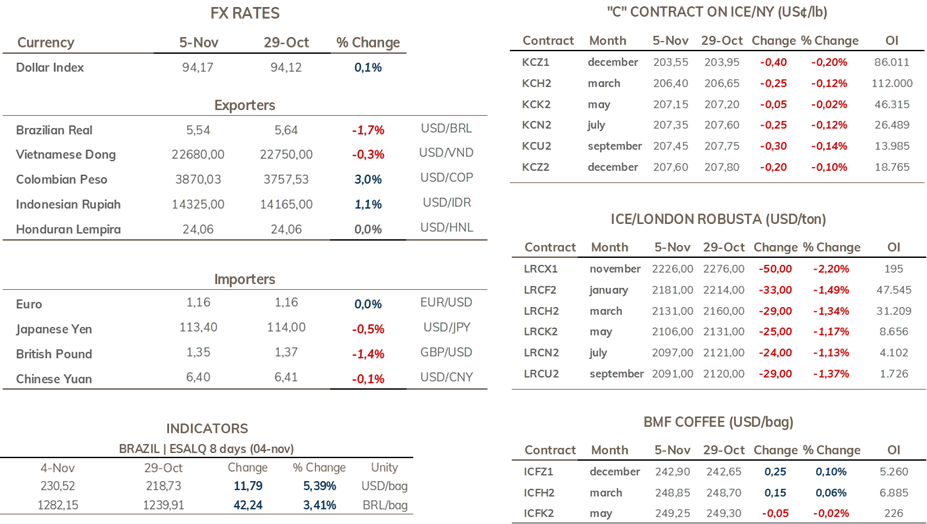
In New York (ICE), the most liquid March/22 contract closed last week quoted at 206.40 c/lb, down 25 points (-0.12%) from the previous Friday (29). In Brazil, the CEPEA indicator for Arabica ended the week quoted at BRL 1,265.50/bag, up 0.73%.
Without major changes in the fundamentals field, the coffee market was under great influence from technical factors. Prices sustained at current levels have been the result of a sequence of positive fundamentals such as the tight supply and demand balance, problems in Brazilian production, logistical bottlenecks, and La Niña.
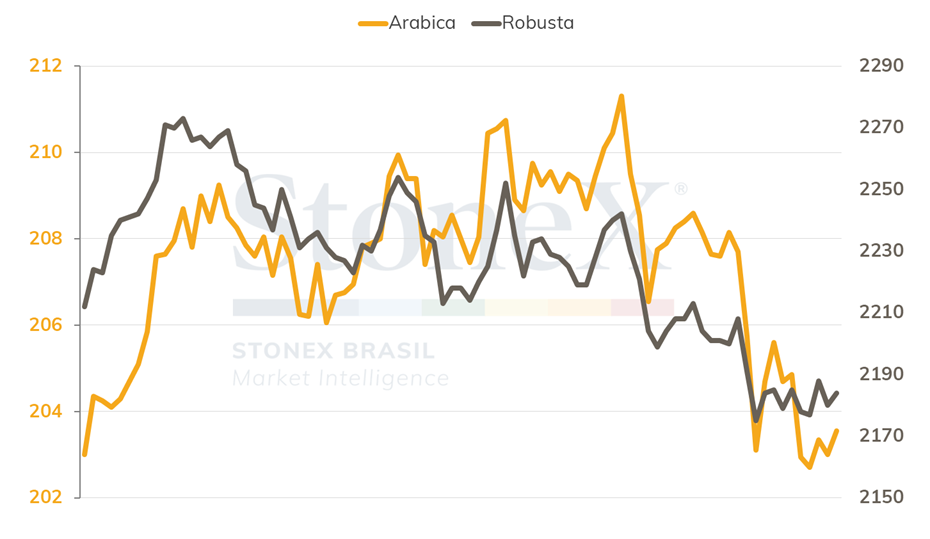
The weather in Brazil, in Central America and in Vietnam remain on agents’ radar, however, the release of new estimates for Brazilian production in 2022 should receive greater attention. There are still uncertainties regarding the country’s coffee production, which struggled with a long period of dry conditions and frost events in 2021. Throughout the end of the current year and the first few months of 2022, several estimates will be released that may affect market movements.
Recently, Itaú BBA Bank released its estimates for the 2022/23 crop in Brazil, pointing to production between 60 and 64 million bags. StoneX is preparing to start another round of the crop tour in the producing regions of Brazil, which will result in official estimates from the company for the 2022/23 crop-year, with new details being released over the next few issues of this report.
In Brazil, coffee-producing regions received abundant rainfall, which contributed to the development of production, and it is important to mention that despite the return of rains, some crops have suffered damage that is irreversible at the moment. Historical data show that the southern region of Minas Gerais received volumes between 300 and 400 mm over the last 60 days. The Cerrado region of the state received volumes between 150 and 200 mm. All other regions received accumulated volumes around 200 mm in the last 60 days. For the next 14 days, the whole coffee belt should receive volumes between 70 and 200 mm of rain, which will continue to favor the development and recovery of the crops.
The most recent data show that coffee production in Colombia had a 13% decline in October, reflecting the excess rainfall that the country has received in recent weeks. The weather in Colombia has been adverse, as a result of La Niña effects, which is associated with excessive rainfall in Colombia and Central America. According to a CoffeNetwork release, 27 departments in Colombia are suffering from excessive rainfall. Furthermore, the story also indicates that, until the release date (Nov. 03), over 40 people had died, 12 were missing and 87 homes had been destroyed. Considering this scenario, the National Federation of Coffee Growers reduced its estimates for Colombian production in 2021, from 14 million bags to something between 13 and 13.5 million bags.
Last week, the USDA released US import data for September. After a volume significantly above average in August with the arrival of late shipments from a number of countries such as Brazil, Colombia, Vietnam, Honduras, Guatemala and Ethiopia, September’s figures returned to more moderate volumes. According to data, US imports of green coffee totaled 1.662 million 60-kg bags in September, 3.5% below the three-year average for the month (1.721 million bags). Brazil was one of the main causes of the fall, with exports of 469,000 bags in the month, 15.8% below average (557,000), reflecting the logistical difficulties and the postponed shipments from the country in recent months. Coffee originating from Colombia totaled 341,000 bags, an 11.4% drop compared to the average of 385,000 in recent years, with Peru posting a significant decline of 49.4% with only 76,000 bags, compared to 151,000 on average.
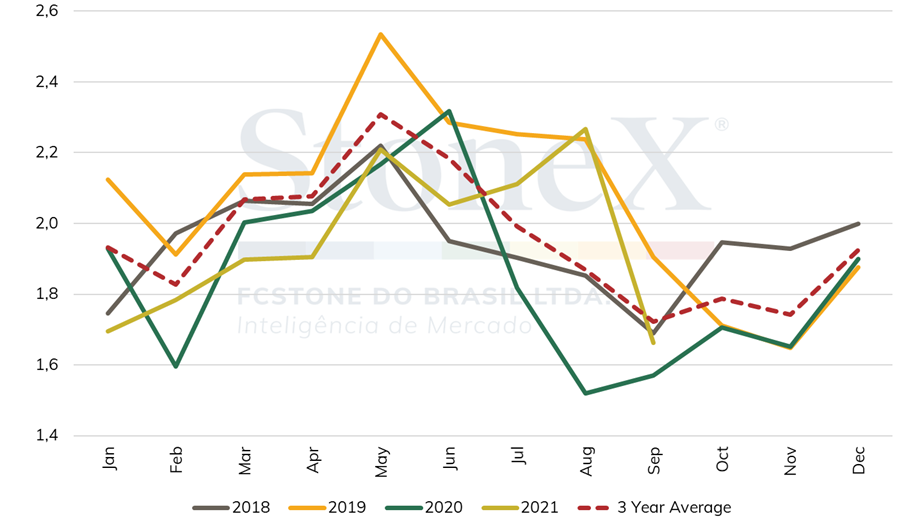
In general, data are in line with the global trend of reduced imports due to logistical bottlenecks and containers shortage. According to the International Coffee Organization (ICO), global exports totaled 10.07 million bags in September, 4.9% below the 10.59 million exported in the same month of 2020. In addition to Brazil’s export data this week, agents should wait for the released of inventory data in the United States in October by the Green Coffee Association (GCA), in order to better assess the rate of consumption in the main global consumer. The figures for the last five years point to an average 2.5% drop in stocks in the transition from September to October. Considering the producing countries’ difficulties in shipping the product, an historically low level of stocks, and surveys pointing to a return of US consumption to pre-pandemic levels, a drop in stocks that is more intense than average may indicate pressures on the consumption side and be bullish for prices.
The latest CFTC report indicated a cut in speculative funds’ net long position in New York. Last Friday’s report (05) indicated that between October 26 and November 02, funds reduced long positions by 890 and expanded short positions by 1,104 to a net long balance of 42,864. In this period, the nearby contract quotes posted a drop of only 5 points, to 208.05 cents. Although fundamentals continue to be mostly bullish for prices in the long term, the historically high long position of funds is a factor of attention, with the potential to provoke eventual sudden short-term downward movements in the event of a more intense liquidation of funds.
Last week, Ethiopia, the so-called “birth place of coffee,” declared a six-month state of emergency as forces from the northern region of Tigray were gaining territory and considering marching on the capital Addis Ababa.
The Prime Minister, Abiy Ahmed, has urged citizens to take up arms to defend themselves against the Tigray People's Liberation Front (TPLF). According to local news sources, major roads are closed and operations at ports have ceased.
Additionally, the United States government recently announced that it plans to suspend Ethiopia from the Free-Trade Deal, the African Growth and Opportunity Act (AGOA), on human rights violations.
Ethiopia was the fifth top exporting nation under the act, according to U.S. International Trade Commission data. Under AGOA, Ethiopia exported $245 million worth of goods to the United States last year.
Ethiopia is the largest coffee producer in Africa, with production forecast to reach to 7.62 million bags (457,200 MT) in 2021/22. 50-55% of Ethiopia’s production is consumed domestically. Local consumption is estimated to increase to 3.55 million bags in MY 2020/21.
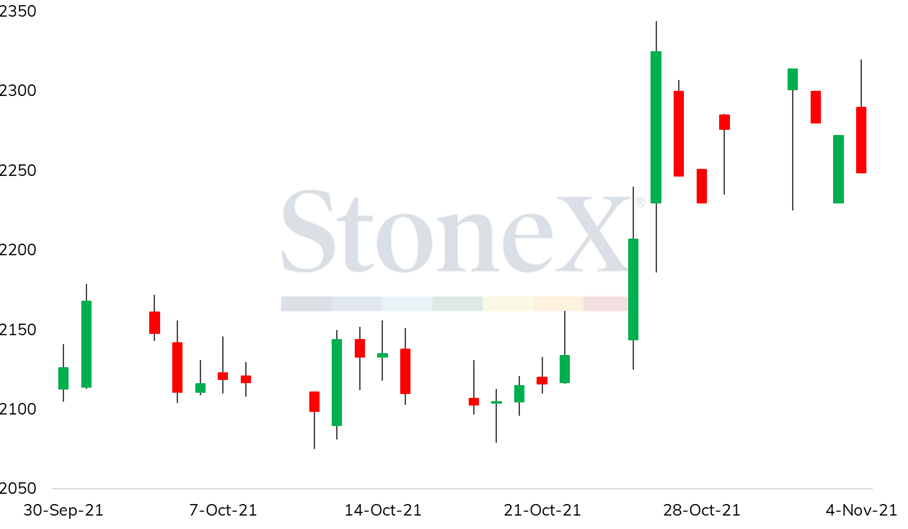
The most active Robusta January contract settled lower last week, losing 1.5% to close at $2,181/t. This followed an initial move higher with the contract pushing close to the contract highs made in the week prior, although it was unable to hold ground at these levels amid technical resistance at this contract high as well as weak upside momentum in the Arabica contract. January comes into this week hovering around its 50% support band at $2,181/t on the one-month retracement study, trending around the mid-way point of the RSI study (14-day) and the Bollinger band study, demonstrating technical neutrality moving into this week.
From a fundamental perspective the ongoing rise of COVID-19 cases in Vietnam poses a potential threat to the progress of the harvest there, with cases now being reported in the coffee belt. Indeed, some reports indicate a shortage of pickers in some areas, which could provide further delays in beans arriving to the farm gate following a wet month in October. New beans are expected to begin arriving in volume in the second half of this month, although the delays provided by a lack of pickers and the potential imposition of restrictions could extend that time frame even further. From a supply standpoint it seems that while coffee supplies are tight coming out of the end of the last marketing season, the difficulties in actually getting shipments out of Vietnam is where the real bottleneck is found. Nonetheless, delays in harvesting the cherries from the trees has implications for the quality of the beans, while also leaving more to chance in terms of exposure to adverse weather for example.
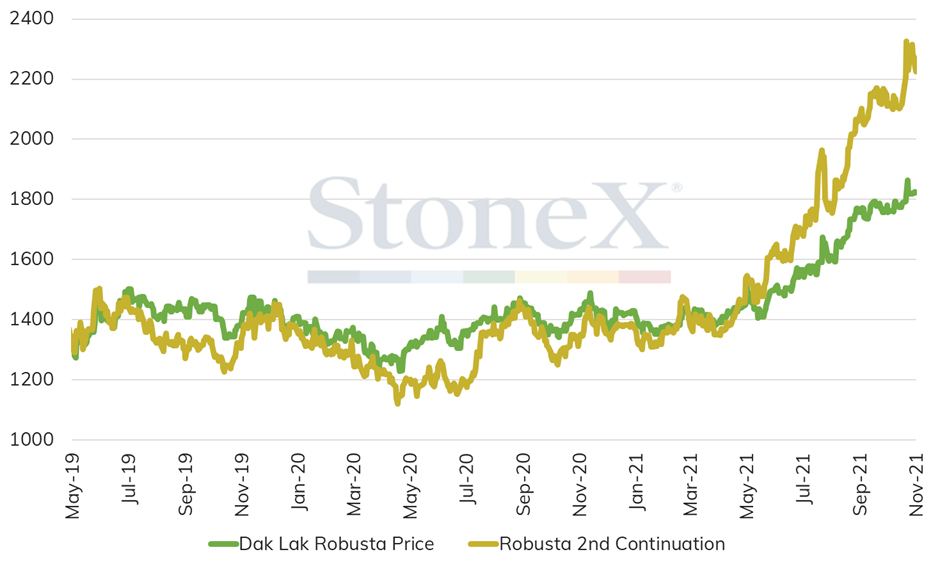
Domestic prices in Vietnam are hovering around $1,830/t as we move into this week, a gain of around $4/t W/W as of Friday’s settlement, marking a narrowing of the discount against the front month London contract. The discount narrowed by $54/t W/W which can be attributed to the $50/t decline in the November contract as we moved into the notice period. The comparative gains made in the domestic market reflect rising demand for new crop amid the delays to the start of the harvest, while growing concerns surrounding rising COVID cases may also be prompting some fresh demand in anticipation of potential logistical disruption.
Grade 4 Indonesian Robusta was offered at a near $380/t discount to the January contract last week, narrowing the discount against London last week from $400/t on the previous Friday. This is once again due to the downward momentum in the futures market rather than a drastic change in the domestic price. Sumatran Robusta exports were reported at 12,349.6t for October last week, declining by 51.5% Y/Y.
The Central Highlands is set for progressively heavier rainfall in the week ahead with a potential 55mm+ expected to fall on Saturday under the current GFS model, with up to 36mm on Saturday. This situation should be monitored as further heavy rains moving on from last month could provide further delays to the harvesting of the crop at a time when there are already fewer than normal workers, while also potentially impacting the quality of the crop.
The real/dollar pair ended last week with a 1.7% fall from the previous Friday (29), quoted at BRL 5.543, with agents reacting mostly to the minutes of the last meeting by Brazil’s Monetary Policy Committee (Copom), which indicated a stronger stance from the monetary authority. It is important to note that the BRL ended October with a 3.5% devaluation against the greenback and that despite the weekly fall it has remained at its highest levels since April.
In the last Copom meeting minutes, released on Wednesday (3), the group indicated that it considered promoting higher Basic Interest Rate (Selic) increases than the last 1.5-percentage-point hike (from 6.25% to 7.75%). Unlike the statement issued on the day of the decision, the meeting minutes indicated a firmer stance by the Committee regarding the economy’s fiscal risks, pointing out that “lower fiscal credibility may raise inflation expectations for the economy,” and that reduced efforts to pursue structural reforms and adjust public accounts can raise the structural interest rate of the economy.
The members stance and the suggestion that adjustments above 1.5 p.p. may be considered if the fiscal scenario continues to deteriorate favored the Brazilian currency in the week. In general, an increased differential between interest rates in Brazil and the United States raises the attractiveness of investment in BRL-denominated assets, which tends to attract foreign exchange to the nation’s market.
During a busy week, agents are expected to also follow the domestic political scenario, with a vote on the Precatory PEC, approved in the Chamber of Deputies on a first round last week, and with a second-round vote scheduled for Tuesday (9). As per our FX Weekly Report, according to estimates released by the Ministry of Economics on October 29, the PEC adds BRL 91.6 billion to the 2022 budget, with BRL 47 billion coming from the change in the spending cap calculation and BRL 44.6 billion from postponed government debts. According to the Ministry, of the BRL 91.6 billion, the Executive intends to allocate BRL 50 billion to temporarily increase the average benefit of the Auxílio Brazil assistance program (which will replace the Bolsa Família) from BRL 191 to BRL 400 until December 2022, the year of election.
The scenario of likely PEC approval was impacted after the preliminary ruling by Supreme Court (STF) Minister Rosa Weber last Friday (5), in which she suspended the budget execution of general rapporteur amendments. Rapporteur amendments allow resources to be passed on to parliamentary amendments in an informal and non-transparent manner, and were central tools in the articulation for the PEC’s approval, with the government directing around BRL 1.2 billion in rapporteur amendments to parliamentarians over the last two weeks in an attempt to gather support. Minister Weber’s decision should be voted on between Tuesday (9) and Wednesday (10) by the other STF ministers, which should remain on the market’s radar, causing new political noises and possibly postponing the second-round vote.
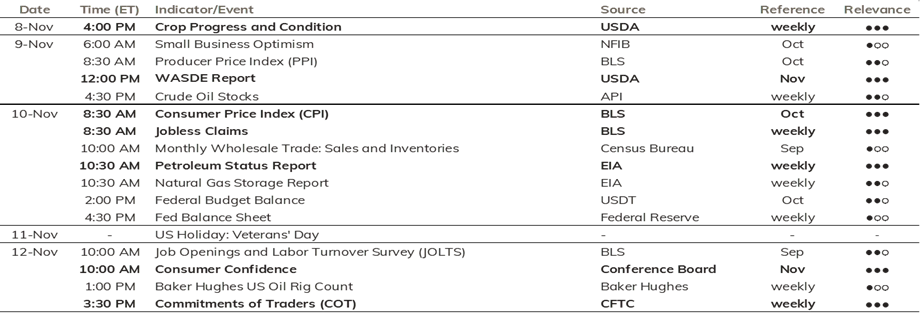
Among the main indicators abroad this week, agents should follow the release of the October Producer Price Index (PPI) and Consumer Price Index (CPI) on Tuesday and Wednesday, respectively. It will be important to monitor the possible continuity of price acceleration in the country and the position of the monetary authorities as to the transitional or permanent nature of inflation.
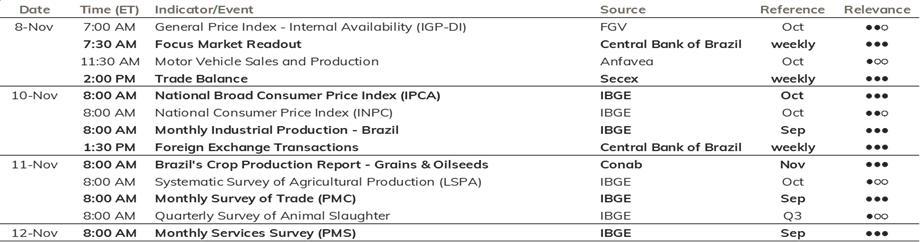
Internally, investors should monitor the release of the October National Broad Consumer Price Index (IPCA) on Wednesday (10), with expectations that inflation will remain above 1.0% in the month. Throughout the week, the IBGE will release its monthly surveys for the Industry, Trade and Services sectors in September in Brazil, with expectations of negative results for Industry and Trade. Taking into account most of the analysts’ bets indicating a scenario of continuing deterioration of inflation and recovery of the Brazilian economy, and the political noises and uncertainties in the nation’s capital, the Brazilian exchange market tends to have a more bullish bias for the US currency this week.
The StoneX Group Inc. group of companies provides financial services worldwide through its subsidiaries, including physical commodities, securities, exchange-traded and over-the-counter derivatives, risk management, global payments and foreign exchange products in accordance with applicable law in the jurisdictions where services are provided. References to over-the-counter (“OTC”) products or swaps are made on behalf of StoneX Markets LLC (“SXM”), a member of the National Futures Association (“NFA”) and provisionally registered with the U.S. Commodity Futures Trading Commission (“CFTC”) as a swap dealer. SXM’s products are designed only for individuals or firms who qualify under CFTC rules as an ‘Eligible Contract Participant’ (“ECP”) and who have been accepted as customers of SXM. StoneX Financial Inc. (“SFI”) is a member of FINRA/NFA/SIPC and registered with the MSRB. SFI is registered with the U.S. Securities and Exchange Commission (“SEC”) as a Broker-Dealer and with the CFTC as a Futures Commission Merchant and Commodity Trading Adviser. References to securities trading are made on behalf of the BD Division of SFI and are intended only for an audience of institutional clients as defined by FINRA Rule 4512(c). References to exchange-traded futures and options are made on behalf of the FCM Division of SFI . StoneX is a trading name of StoneX Financial Ltd (“SFL”). SFL is registered in England and Wales, Company No. 5616586. SFL is authorized and regulated by the Financial Conduct Authority [FRN 446717] to provide to professional and eligible customers including: arrangement, execution and, where required, clearing derivative transactions in exchange traded futures and options. SFL is also authorised to engage in the arrangement and execution of transactions in certain OTC products, certain securities trading, precious metals trading and payment services to eligible customers. SFL is authorised & regulated by the Financial Conduct Authority under the Payment Services Regulations 2017 for the provision of payment services. SFL is a category 1 ring-dealing member of the London Metal Exchange. In addition SFL also engages in other physically delivered commodities business and other general business activities which are unregulated and not required to be authorised by the Financial Conduct Authority. StoneX Group Inc. acts as agent for SFL in New York with respect to its payments services business. StoneX APAC Pte. Ltd. acts as agent for SFL in Singapore with respect to its payments services business. ‘StoneX’ is the trade name used by StoneX Group Inc. and all its associated entities and subsidiaries.
Trading swaps and over-the-counter derivatives, exchange-traded derivatives and options and securities involves substantial risk and is not suitable for all investors. Past performance of any futures or option is not indicative of future success. Indicators are not a trading system and are not published as a specific trade recommendation. The information herein is not a recommendation to trade nor investment research or an offer to buy or sell any derivative or security. It does not take into account your particular investment objectives, financial situation or needs and does not create a binding obligation on any of the StoneX group of companies to enter into any transaction with you. You are advised to perform an independent investigation of any transaction to determine whether any transaction is suitable for you. No part of this material may be copied, photocopied or duplicated in any form by any means or redistributed without the prior written consent of StoneX Group Inc.
© 2026 StoneX Group Inc. All Rights Reserved.
Our subscribers have access to comprehensive market analysis from StoneX spanning commodities, equities, currencies and more.
Daily coffee report

August 4 – The benchmark Dow Jones Industrial Average surged into the close yesterday to finish almost 700 points higher, at a record close of 53,178 points – easily clearing the previous top from almost a month ago. The S&P 500 is on the brink of its own record as well, while the NASDAQ index is short of June highs but working on a strong three-session rally. All three are pointing to positive openings today. Palantir (a U.S. software company) reported better-than-expected earnings yesterday afternoon post-close to boost the tech sector, though a host of other firms reported strong earnings as well. The ten-year note continues to retreat from Friday’s high, now at 4.67%, with the dollar on the high side of level-par, while the VIX index now under 16 shows reduced volatility.

Daily coffee report
Our market expertise, advanced platforms, global reach, culture of full transparency and commitment to our clients’ success all set us apart in the financial marketplace.
Reach
With access to 40+ derivatives exchanges, 180+ foreign exchange markets, nearly every global securities marketplace and numerous bi-lateral liquidity venues, StoneX’s digital network and deep relationships can take clients anywhere they want to go.
Transparency
As a publicly traded company meeting the highest standards of regulatory compliance in the markets we serve; our financials and record of accomplishment are matters of public record. StoneX’s commitment to “doing the right thing over the easy thing” sets us apart in the industry and helps us build respect, client trust and new partnerships.
Expertise
From our proprietary Market Intelligence platform, to “boots on the ground” expertise from award-winning traders and professionals, we connect our clients directly to actionable insights they can use to make more informed decisions and achieve their goals in the global markets.