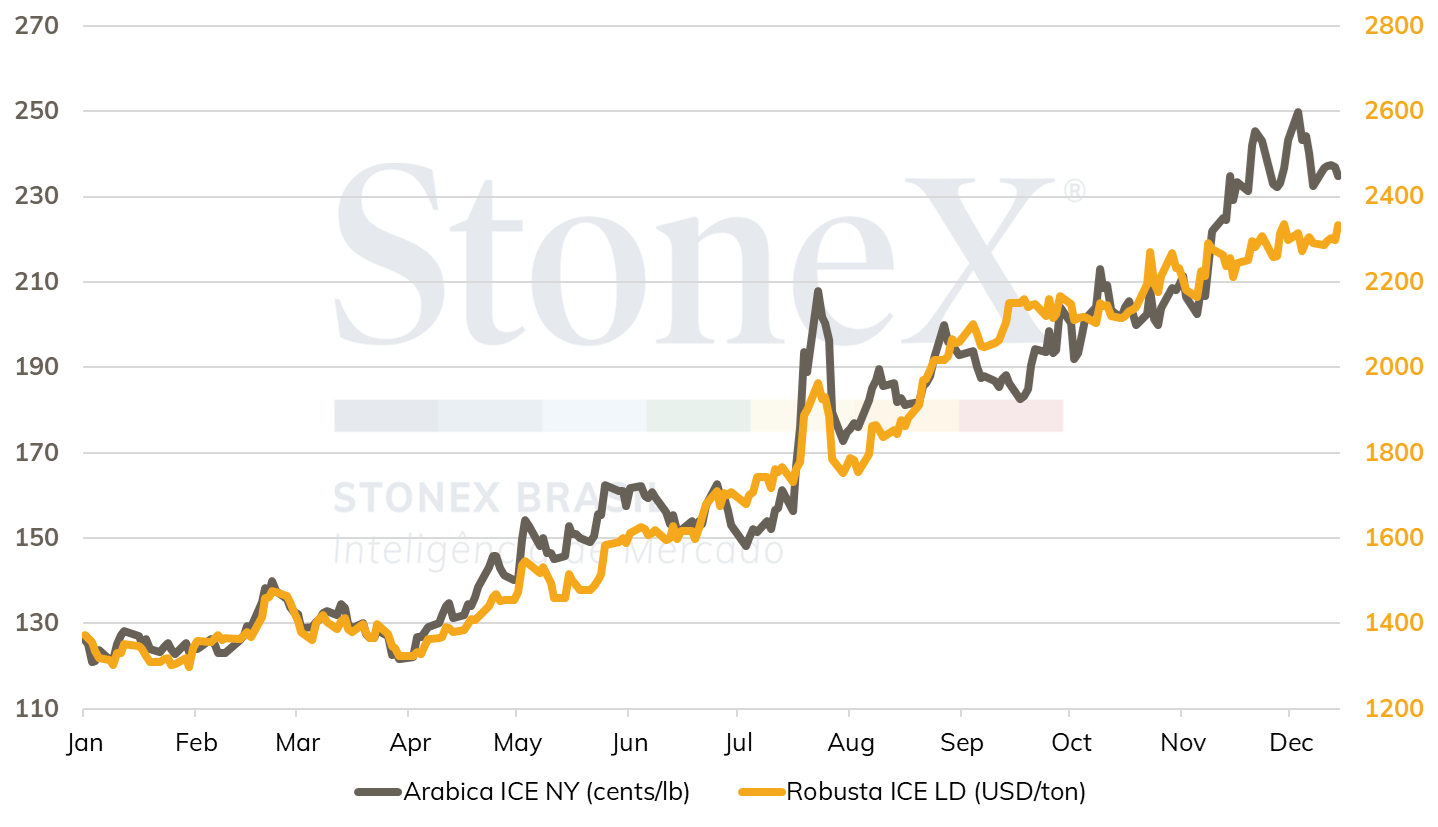
The Robusta coffee market also appreciated significantly during the period. From the beginning of the year until last Friday (17), Robusta coffee prices in London showed an increase of 70%, when they went from USD 1,372/ton to USD 2,333/ton. As observed for the Arabica market, the advances in Robusta coffee prices in Brazil were more intense than the values observed in London. According to the Cepea indicator for the Robusta variety, prices advanced more than 103% from the beginning of the year until Friday, when they went from BRL 407/bag to BRL 830/bag. Besides the depreciation of the Brazilian currency, Robusta prices were also supported by the strong demand for variety in the Brazilian industry.
Last week, the coffee market had a very sideways movement while waiting for new information to give a new direction to quotes. Last week, several crucial pieces of information were released, such as the GCA stock data, the supply and demand balance estimates from CoffeeNetwork, Conab's updated estimates for Brazilian production, and the USDA's estimates on Friday (17) for the global supply and demand balance.
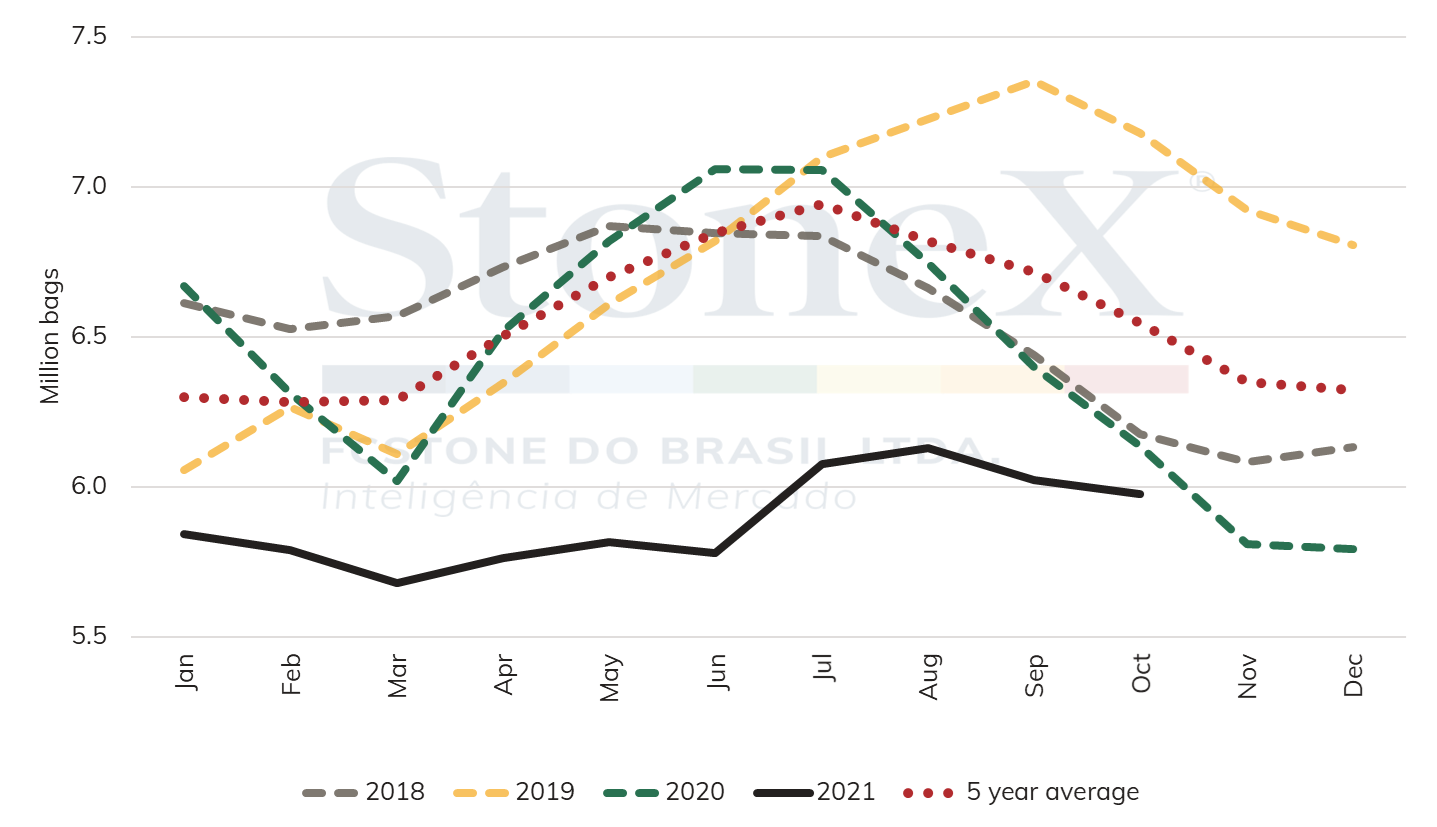
Last Wednesday (15), the Green Coffee Association released the stocks at US ports report, which showed a decrease of over 132 thousand bags (2.2%) in November, totaling 5.8 million bags, 0.6% lower than the volume observed in November 2020. The volume observed in the month is below the average November stocks in the last five years, 6.3 million bags. Moreover, although the drop is less intense than the average observed from October to November in the last five years (197,000), the variation is the most intense monthly drop in the year to date, which, together with the maintenance of stocks at historically low levels, contributes to maintaining the current feeling of supply constraints.
evolution of GREEN COFFEE ASSOCIATION (GCA) COFFEE STOCKS
Source: Green Coffee Assocation. Design: StoneX.
Regarding Brazilian production, we can re-emphasize, as we have always said, that the great challenge of the coffee market is the lack of transparency in its statistics. Last Thursday (16), Conab estimated the Brazilian production at 47.7 million bags, with Arabica production at 31.4 million bags and Robusta at 16.3 million bags. Regarding Conab's estimates for Robusta coffee production, the figures presented are far from the estimates that the market has seen, with the consensus being that Robusta production was around 20 million bags. The estimate for Arabica coffee production is also lower than the figures the market has been seeing, with expectations pointing to a production substantially higher than the 31.4 million indicated by the government agency. About transparency, there is a clear discrepancy between estimates, ranging from 47.7 million bags by Conab to 56.3 million bags by the USDA, a variation of 8.6 million bags. For 2021/22, StoneX estimated Brazilian production at 53.7 million bags, of which 33.7 million bags for Arabica and 20 million bags for Robusta production.
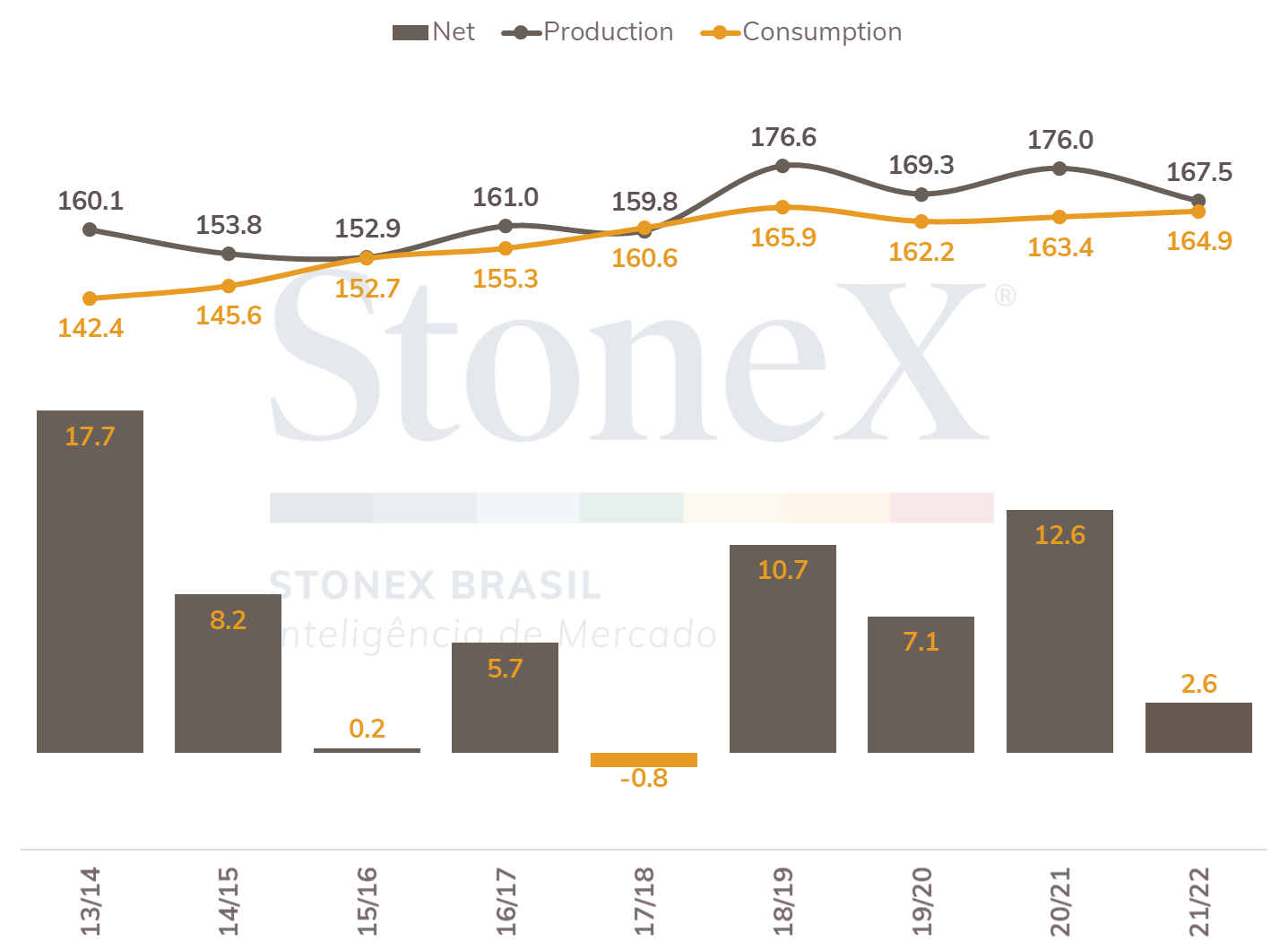
Last week also saw the release of CoffeeNetwork and USDA estimates for the global coffee supply and demand balance. More details on the CoffeeNetwork estimates can be found in the specific report as pointed out above, and comments on the USDA estimates can be found in the specific section below. In any case, it is worth noting that the USDA has changed its estimate that previously indicated a balanced supply and demand in 2021/22 to a balance with a surplus of 2.6 million bags, even in a year with a strong reduction in Brazilian production. The CoffeeNetwork estimates point to a possibly negative balance, but not as intense.
These estimates add to a context that market participants have already digested. From now on, the attention of the coffee market will continue to turn to concerns regarding coffee supply, especially in the context of the global logistics crisis. The logistical problems have been the participants' focus, and such condition is not expected to improve in the short term. In addition, the attention is on the weather and the Brazilian production in 2022/23, whose potential has already been affected by frost and dry weather. From the beginning of 2022, new production estimates will be released and will dictate the direction of the market; StoneX will release its estimate for Brazilian production in 2022/23 in the first half of February, when we will be able to have a more tangible sense of what the country's production will be next year.
USDA Pegs Global Production Down Nearly 5% Year on Year
Last week, the USDA released their global coffee report, where they forecast global production for the 2021-2022 crop at 167.5 million bags. This is 1.6% higher than their May forecast and represents a 4.8% decline from the 2020-2021 coffee crop.
USDA estimates FOR THE GLOBAL SUPPLY AND DEMAND BALANCE
(MILLION BAGS)
Source: USDA. Design: StoneX.
The consumption forecast was unchanged from their May report to their final forecast last week, at 164.9 million bags.
The revision in production, however, shifted their forecast for the global balance sheet from a mere 13,000 bag deficit to a 2.6 million bag surplus.
In May, the USDA forecast that global ending inventories would drop 7.9 million bags to 32.0 million, an estimate that perplexed the industry following the record crop from Brazil and such a balanced supply and demand expectation. Now, the USDA says that inventories will drop 6.3 million bags to 30 million, revising lower their forecast for ending stocks from 2020-2021 from 39.9 million bags to 36.3 million bags.
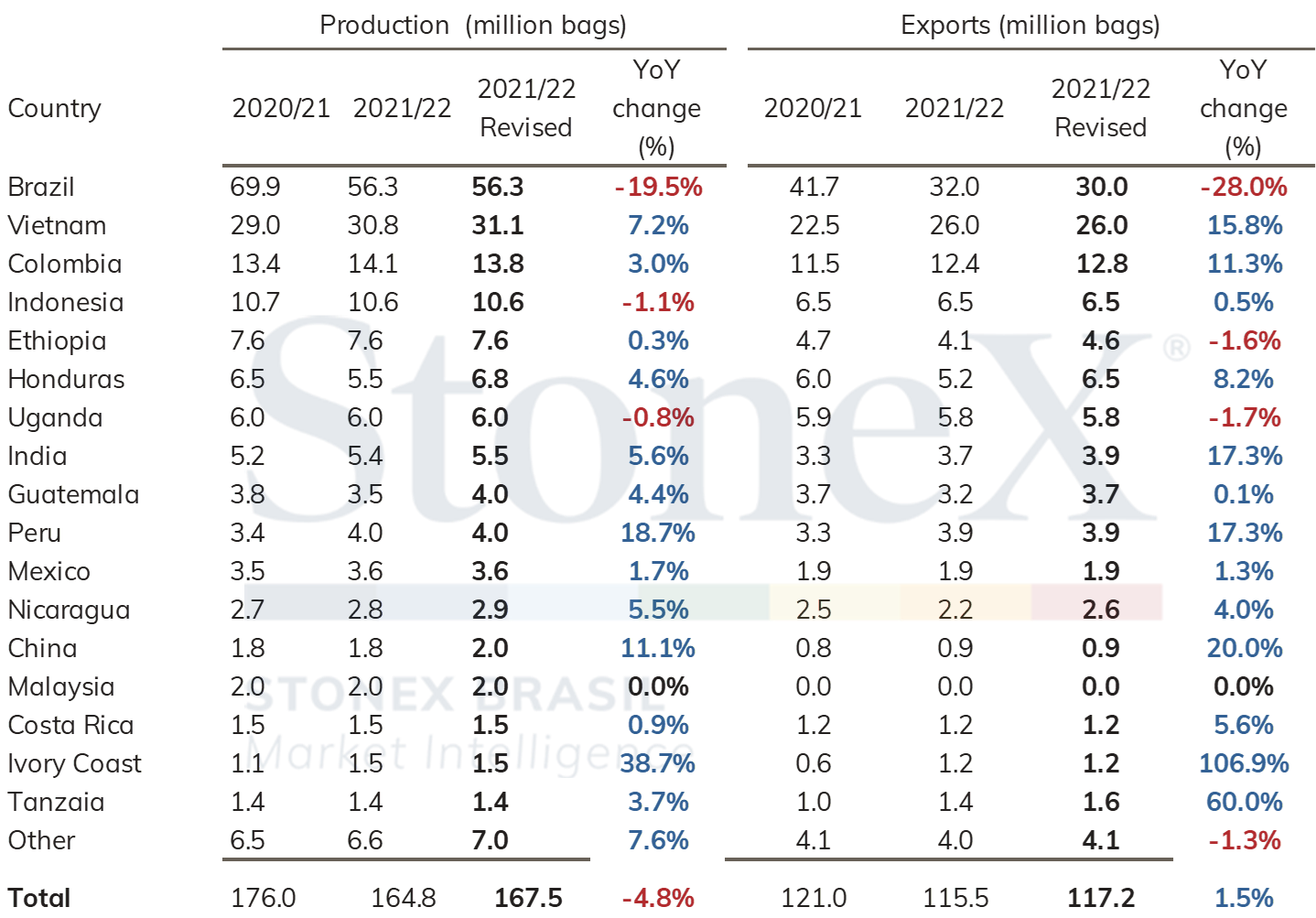
World coffee bean exports are expected down 3.8 million bags to 117.2 million as lower exports from Brazil more than offset higher shipments from Vietnam.
For the main producers, Brazil’s forecast remained unchanged from their May report, at 56.3 million bags with 35 million bags of Arabica and 21.3 million bags of Robusta. Vietnam production is forecast to rebound to 31.1 million, up from their previous forecast of 30.8 million bags.
ESTIMATES OF COFFEE PRODUCTION AND EXPORTS BY COUNTRY
Source: USDA. Design: StoneX.
European Union imports are forecast down 1.1 million bags to 42.5 million and account for nearly 40 percent of the world’s coffee bean imports. Top suppliers include Brazil (34 percent), Vietnam (24 percent), Honduras (8 percent), and Colombia (6 percent). Ending stocks are expected to drop 2.5 million bags to 11.3 million to support a modest increase in consumption.
The United States imports the second‐largest amount of coffee beans and is forecast up 700,000 bags to 25.0 million. Top suppliers include Brazil (30 percent), Colombia (21 percent), Vietnam (11 percent), and Nicaragua (5 percent). Ending stocks are forecast to slide 200,000 bags to 5.8 million.
Robusta Market Eyes Vietnam Harvest
The Robusta market touched a one week high last week after the chairman of the Vietnam Coffee Association said that the crop for 2021-2022 might be smaller than expected as aging trees show their impact on yields.
Record high freight rates and a scarcity of containers continue to slow the flow of coffee from Vietnam, Brazil and Indonesia. The latest data showed that Vietnam’s coffee exports were down 4.4% year on year. On Friday, the USDA cut its estimate for exports from Vietnam to 25.8 million bags from their previous forecast of 28.8 million bags.
In the same report, however, the USDA raised its forecast for production for Vietnam from 30.8 million bags to 31.1 million bags. The report also projected ending coffee stockpiles in the country will surge 73% to 6.57 million bags due to the impact of logistical challenges.
Also in main producer Vietnam, the weather has turned drier, which has allowed the ongoing harvest to resume at a quicker pace. However, weather forecasts show the potential for a new storm to hit the Central Highlands this week, which could disrupt any field activities as well as the drying of coffee.