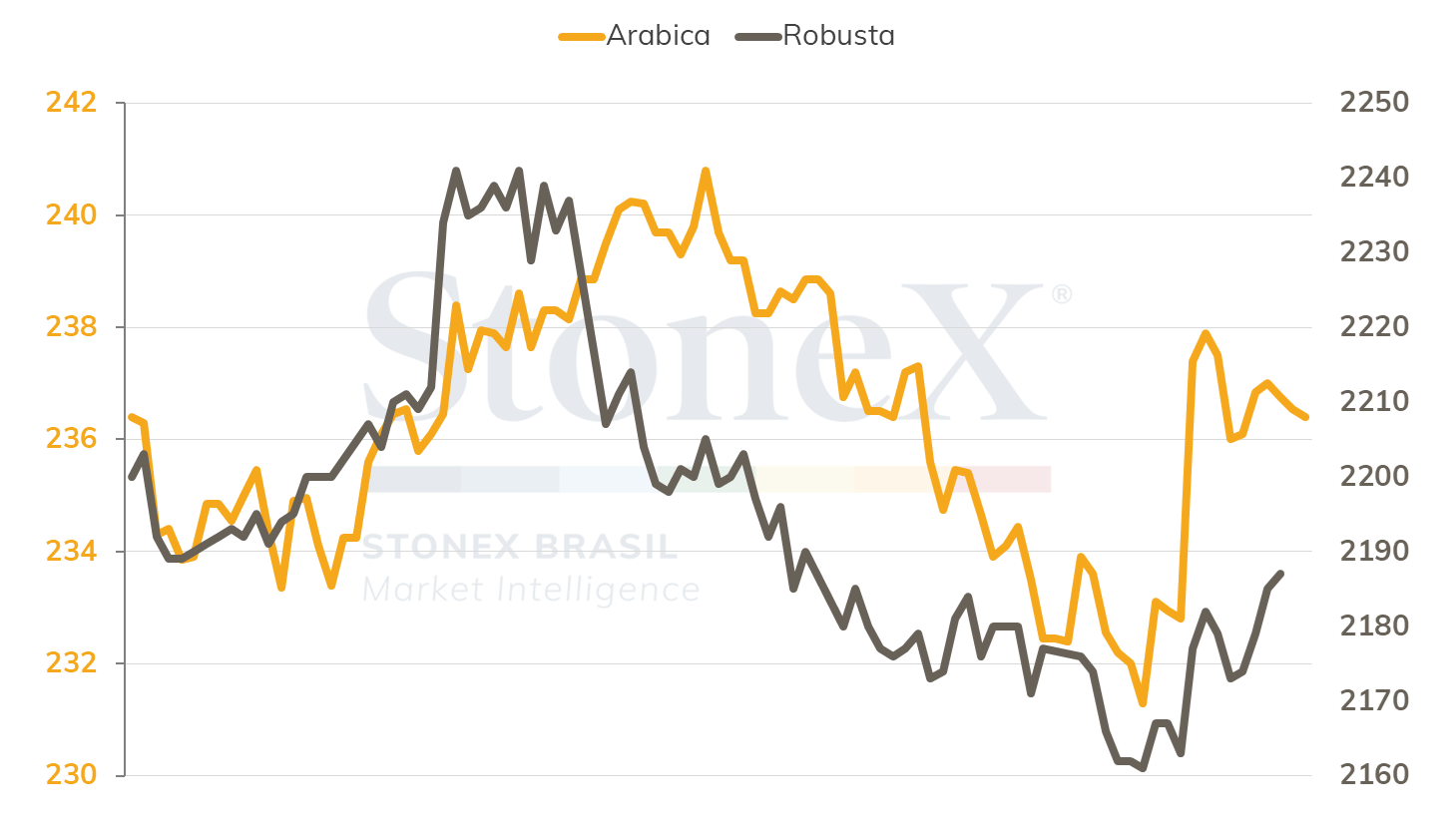
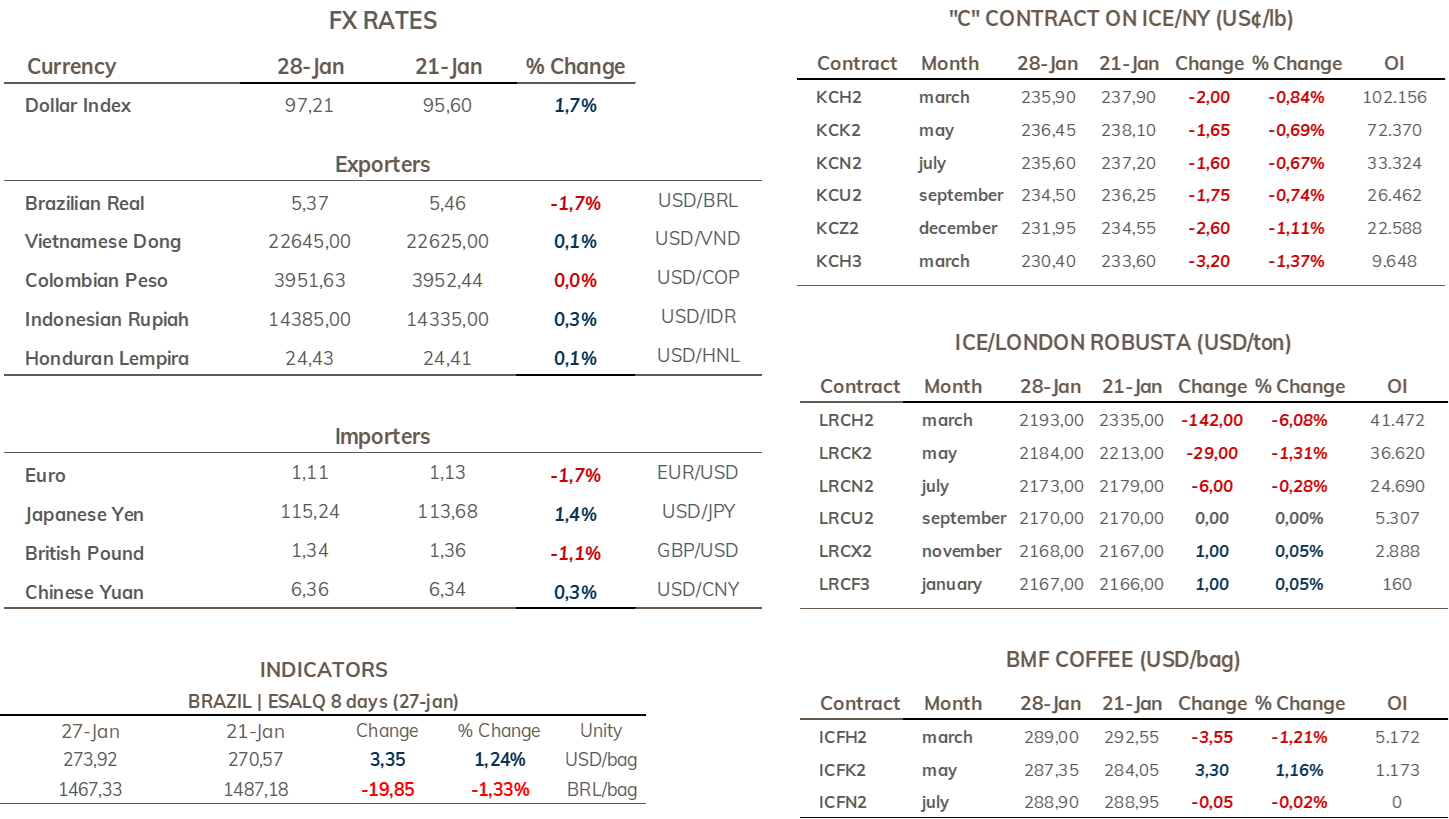
The Robusta market followed the downward trend that started in January, with prices being pressured by signs of increased coffee availability in Vietnam, with the harvest nearing its end and the Lunar New Year approaching. The 57% increase in Vietnamese exports in December was the main fundamental behind the declines. In addition, in recent weeks, the market has been under pressure with sales in Vietnam on the eve of the country's most important holiday, the Tết. Robusta's most active contract (March/22) retreated USD -20 (-0.9%) to close the week quoted at USD 2193/ton. The Cepea Robusta indicator ended the week at BRL 828.35/bag, practically stable.
On the fundamentals side, the coffee market is still supported by several positive factors, such as a tight balance for the current 2021/22 crop year and expectations of limited supply in 2022/23, due to the reduced potential due to weather problems during the Brazilian production. In addition, the market is supported by logistical problems and the impacts of La Niña on coffee production in Colombia, especially.
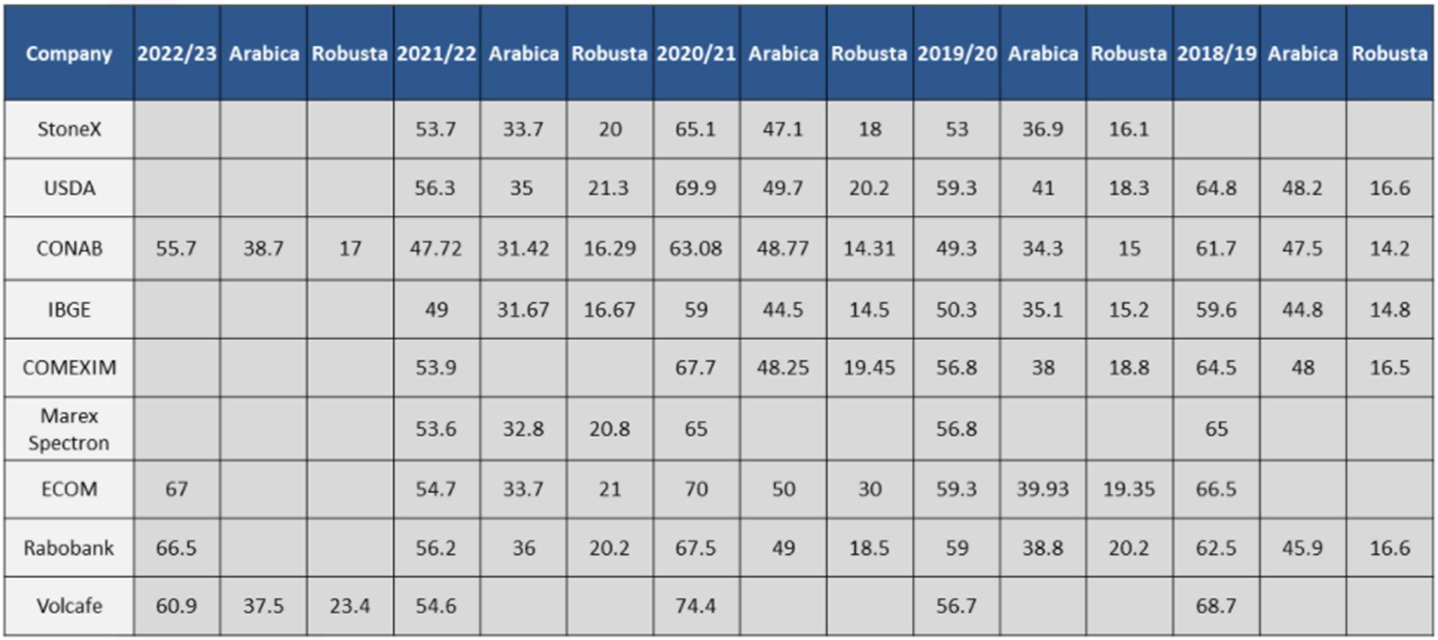
As presented in previous editions of this report, the market has been following the release of company estimates for Brazilian production in 2022/23. In January, new estimates were released for Brazilian production next season, which always showed a large difference.
On the higher side of estimates, we can highlight the prospect of 67 million bags by ECOM and 66.5 million bags estimated by Rabobank. On the other hand, Volcafé estimated the Brazilian production in 2022/23 at 60.9 million bags, 37.5 million bags of Arabica coffee and 23.4 million bags of Robusta coffee. Still, in the lower range of estimates, Conab estimated Brazilian production at 55.7 million bags, of which 38.7 million were Arabica and 17 million Robusta.
BRAZILIAN COFFEE PRODUCTION ESTIMATES
Considering the highest and lowest estimates, we have a range of 11.3 million bags, which indicates great uncertainty and should contribute to a more volatile market. Although some estimates point to production above 65 million bags, the market sentiment is that production in 2022/23 has really been impacted and that the volume will fall short of its potential. StoneX is conducting its studies on Brazilian production and will release its estimates in the first half of February.
Weather data indicates that La Niña will remain in place until the end of the summer in the southern hemisphere, which tends to be a bullish factor since the event has caused significant rainfall in Colombia and affected the country's production. FNC data shows that Colombia produced 12.6 million bags in 2021, a reduction of 9.28% compared to 2020; this is the lowest production since 2014. In addition, there are already reports that excessive rainfall could impact the secondary crop, Mitaca (April-June), which would potentially produce over 6 million bags.
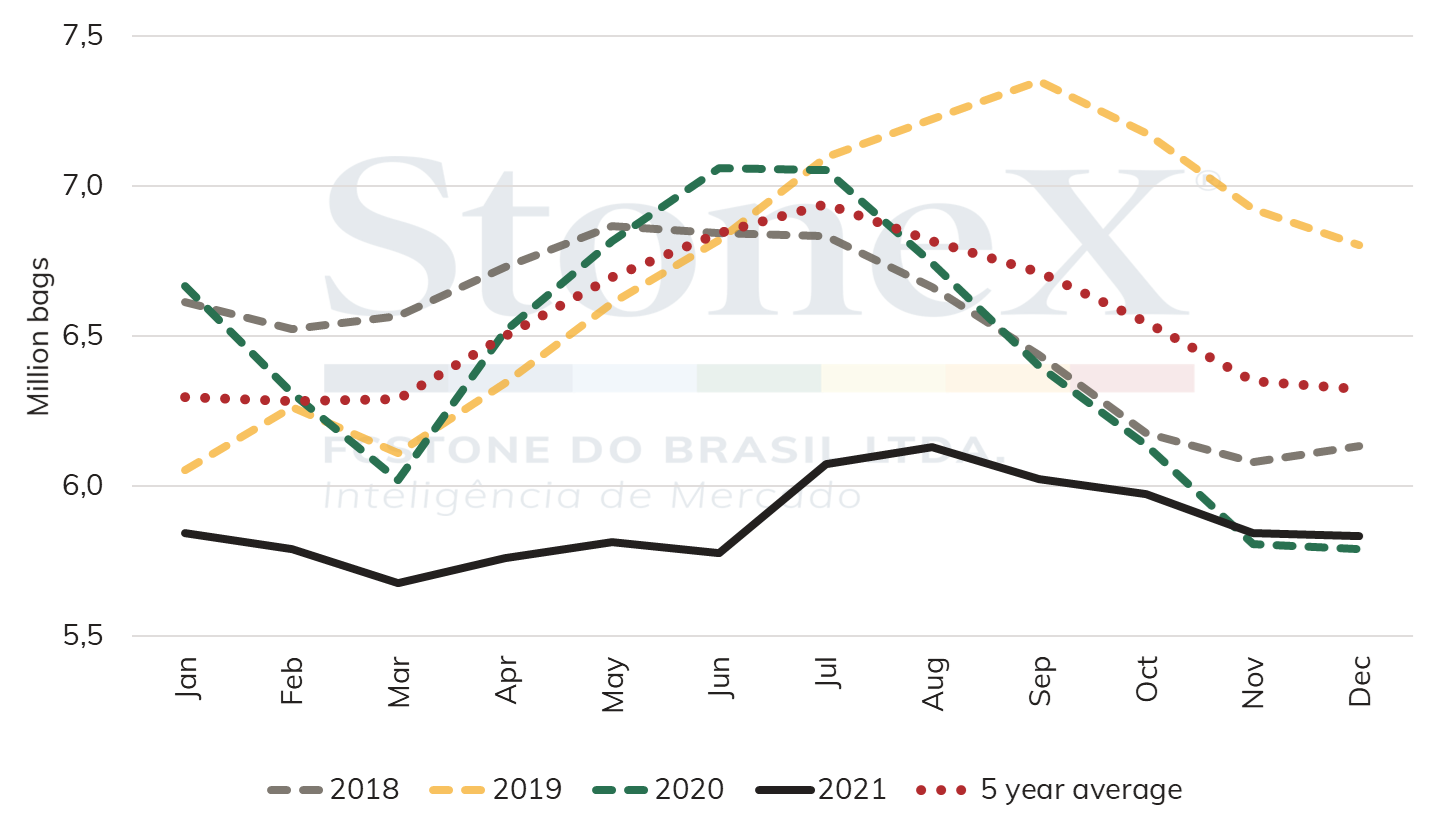
Last Thursday (15), the Green Coffee Association (GCA) released data on coffee stocks at US ports for December. According to the association, December stocks were seen at 5,833,692 bags, showing a drop of 10,029 bags (0.17%) compared to the previous month and 144,609 bags (2.4%) compared to December 2020. It is worth noting that stocks at US ports are below the 6 million bag level and well below the average stocks for December the last five years, which was over 6.2 million bags. Furthermore, December stocks have grown by an average of 39,000 bags over the last five years.
stocks at us ports – GCA (million bags)
Source: GCA. Design: StoneX.
The impact of logistics on Brazilian exports remains a positive fundamental for the market.
Despite the slight decrease in prices in recent weeks, the logistical difficulties that continue to hinder the flow of coffee deliveries from major global producers, particularly Brazil, continue to be an important basis for sustaining prices in the current price range.
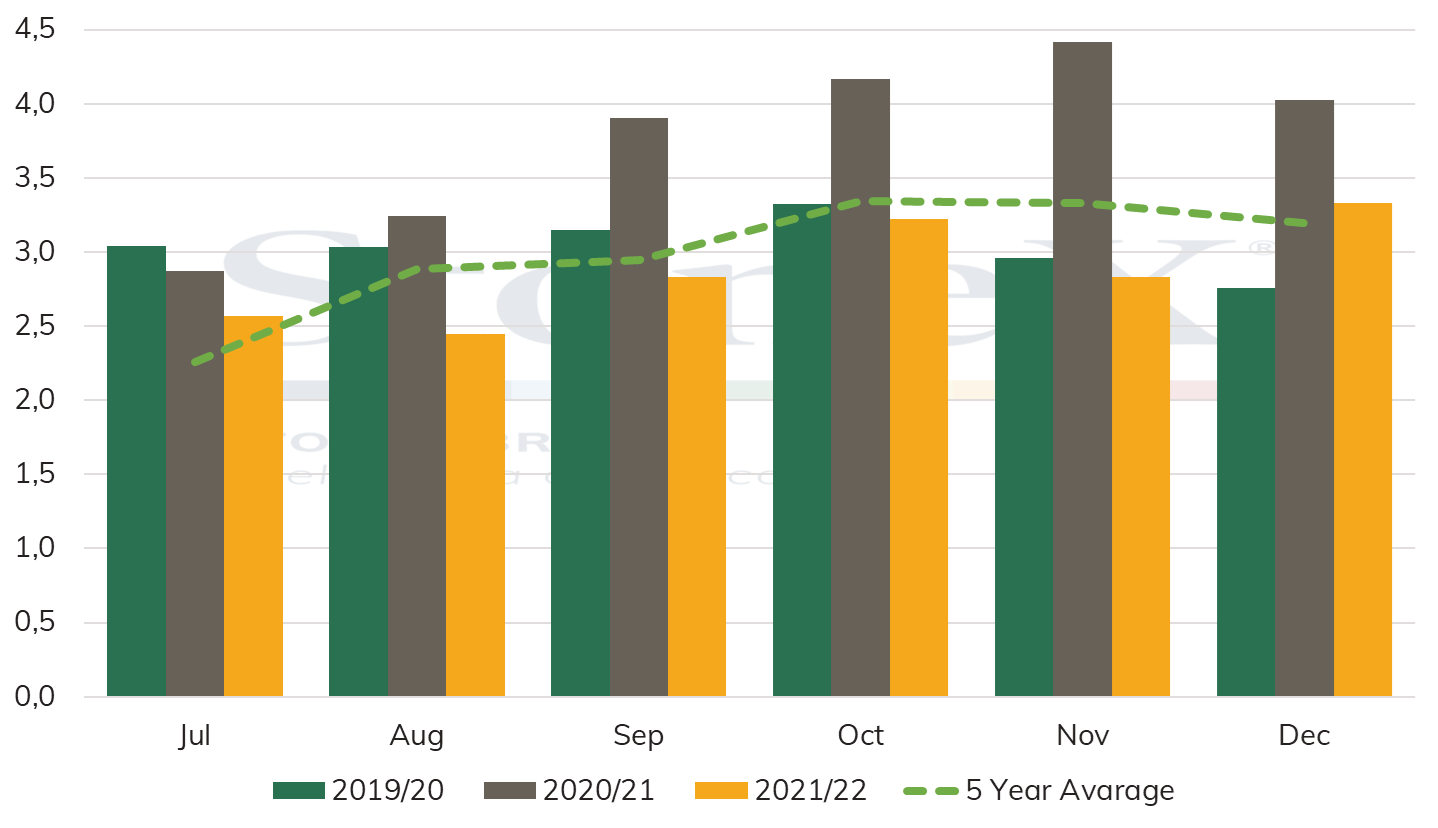
In 2021, Brazil exported 40.4 million bags of coffee, according to the last report released by Cecafé, a drop of 9.7% compared to the volume registered in 2020, with an increase, however, of 10.3% in foreign exchange revenues due to the advance of prices and devaluation of the Brazilian currency. According to Cecafé, around 3 million bags were not exported due to the logistic crisis. Last December, the green coffee exports totaled 3.329 million bags, a drop of 17.3% compared to the same month in 2020. Of this volume, 3.198 million bags were of Arabica coffee, a 12.2% decrease, and 131 thousand bags of Robusta coffee, a 66% decrease compared to December 2020.
BRAZILIAN COFFEE EXPORTS IN THE FIRST HALF OF THE CROP YEAR
Source: Cecafé. Design: StoneX.
Considering the first six months of the Brazilian crop year 2021/22, Brazilian green coffee exports totaled 17.2 million bags, a 23.8% decrease compared to the previous year, when 22.6 million bags were shipped, and a 5.7% decrease compared to the last off-year, when 18.2 million bags were shipped. Compared to the last off-year, 2019/20, exports have only been higher in December, when they were 20.8% higher and lower for the first five months of the season. Thus, it is important to monitor whether the improved performance of shipments will also continue in January. Any increased pressure on coffee prices should probably be due to the reestablishment of better functioning global logistics dynamics and, above all, Brazilian coffee shipments.
Dollar drops for the third week in a row
The US labor market and Brazil Copom should be the week's highlights
Despite the strong appreciation of the American currency in the international market, the real/dollar pair registered its third consecutive drop in the Brazilian currency market, retreating 1.2% to close the week at BRL 5.392. Abroad, the Federal Reserve's Federal Open Market Committee (FOMC) signaling that it may raise the basic interest rate in its next meeting and the geopolitical tensions on the border between Russia and Ukraine boosted the dollar against a basket of advanced currencies, with the dollar index advancing 1.7% in the week to close quoted at 97.3 points, its highest level since July 2020. In the opposite direction, part of the BRL appreciation in recent weeks has been attributed mainly to the entry of foreign investors into the São Paulo Stock Exchange (B3). They have considered the prices of certain assets "cheap" for investment. According to the latest data released by the B3, up to January 26, there was an inflow of BRL 24.8 billion in the month, 71% higher than the inflow observed in December (BRL 14.5 billion) and 6% higher than in January 2021.