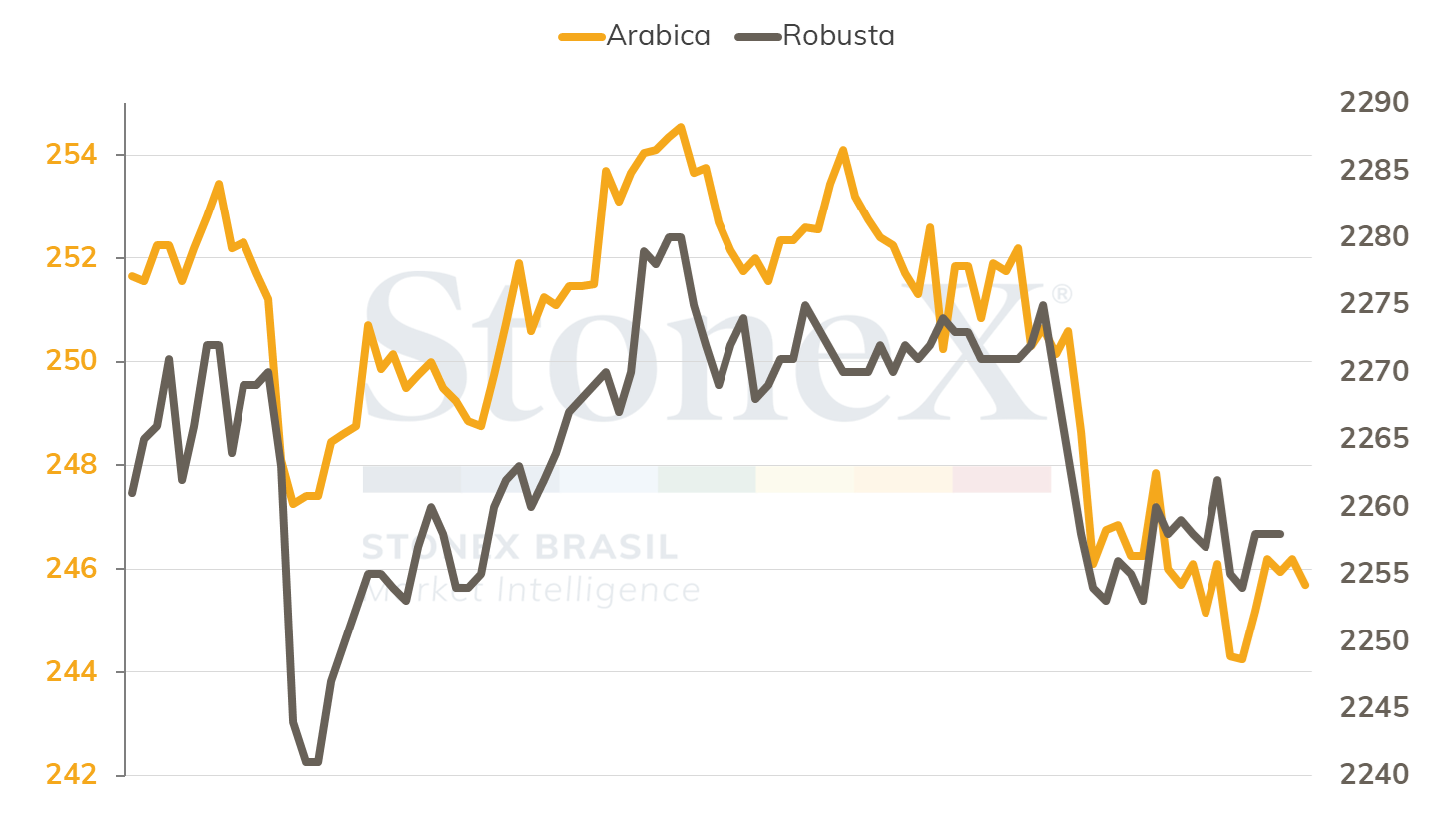
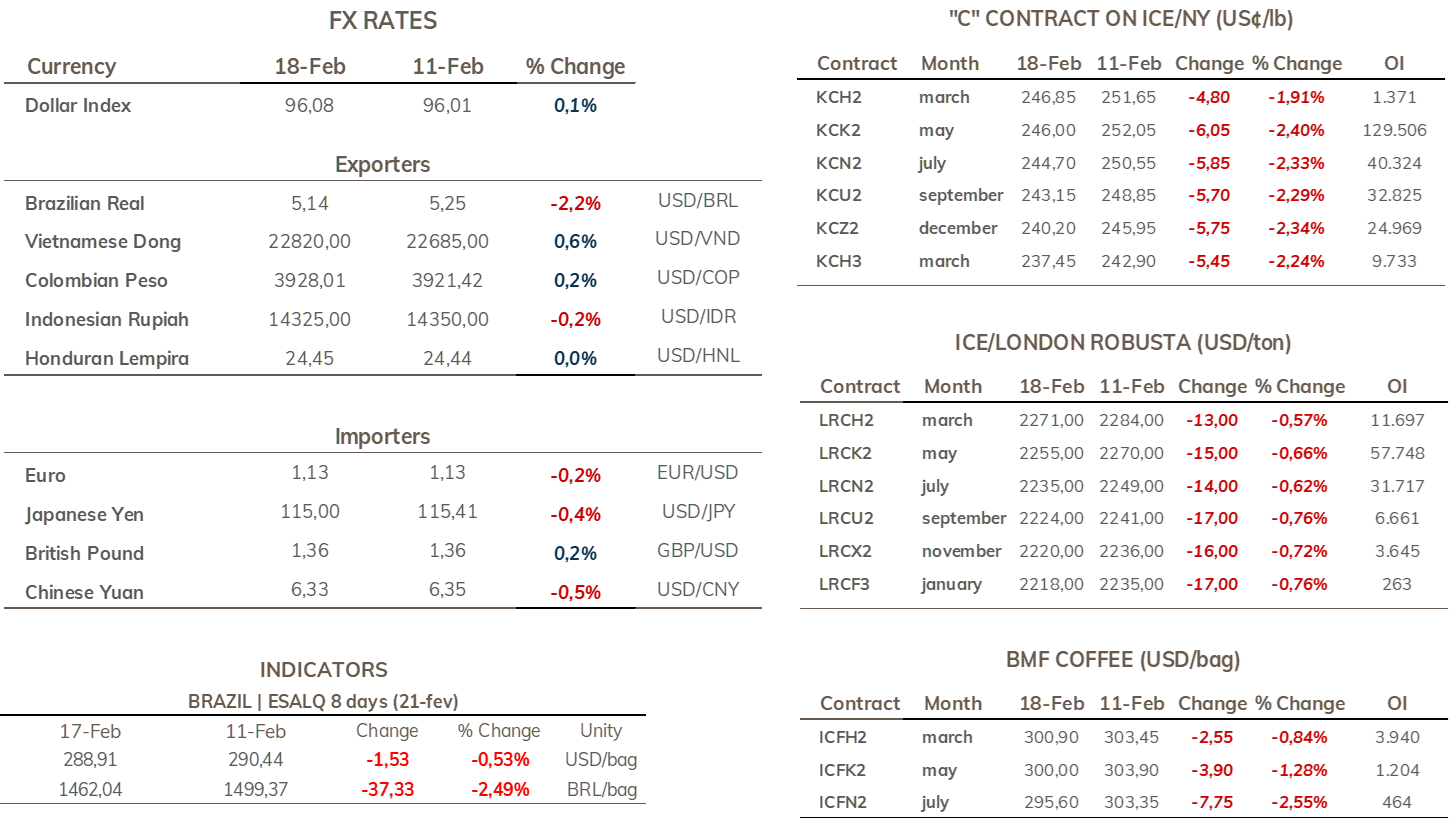
In previous weeks, in addition to the positive scenario for the coffee market, part of the gains reflected the approach of the first notice day for the March contract, which was on February 17. Thus, an important volume of contract rollovers and purchases by commercial players was observed.
However, with the passage of that date, there was a reduction in commercial activities, which can be seen in the reduction in the volume traded.
In addition, the escalation in tensions between Russia and Ukraine caused operators to remain retracted at the end of the week. As a result, agents have been cautious regarding the tensions and avoided riskier assets, such as commodities. This factor should continue to affect markets this week, as will be discussed in more detail in the macro session.
Furthermore, the sharp reduction in certified stocks was a key factor in the appreciation of coffee futures contracts. However, there was an increase of over 100,000 bags pending classification in certified stocks during the week, which drew the agents' attention. Some traders believe this is a reclassification of coffees removed from certified stocks a few months ago.
On the fundamentals side, the market continues with a positive sentiment amid the problems faced by the Brazilian production and the expectation of a more balanced balance in 2022/23, after a year with a negative balance in 2021/22. After conducting a study in Brazil’s producing regions, StoneX released its estimates for the 2022/23 crop. Brazilian production is estimated at 58.9 million bags, with 38.3 million bags of Arabica coffee and 20.6 million of Robusta coffee. This estimate consolidates the market's expectation of a strong reduction in the Brazilian production potential for 2022/23. If Brazil had not faced climate problems in 2020 and 2021, the country's production could reach volumes close to 70 million bags.
Regarding the weather, the Australian agency BOM pointed out that La Niña is still active but should weaken in the coming months. As a result, the El Niño region in the Pacific Ocean should move to a neutral condition in the autumn in the Southern Hemisphere. The permanence of La Niña has mainly affected Colombian production due to the excess rainfall that the country has received in recent months.
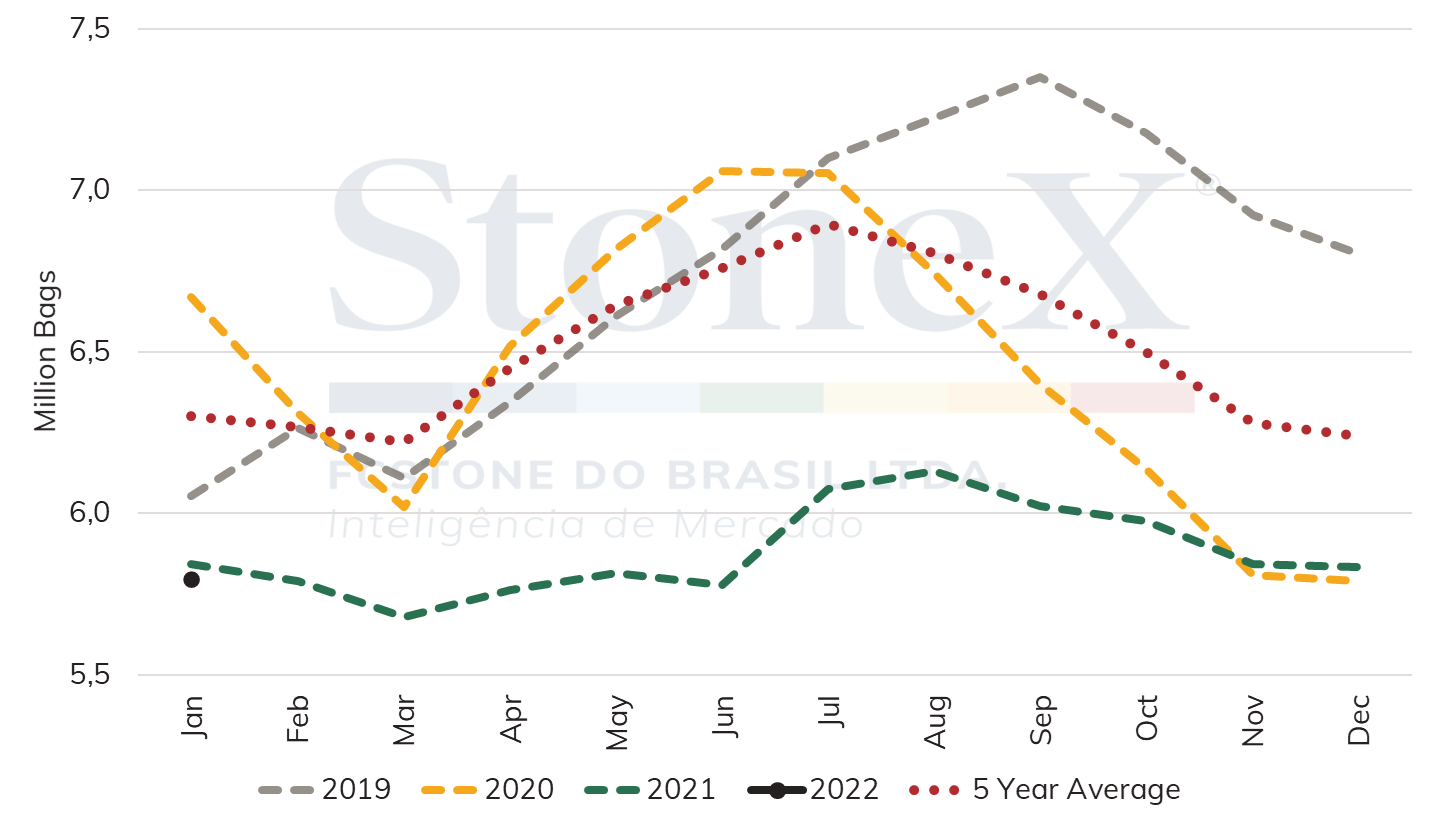
During the week, the Green Coffee Association also released data on coffee stocks at US ports, indicating that the stocks totaled 5,795,841 bags in January, representing a drop of 37,851 bags, or 0.6% compared to the previous month. In addition, the volume is 47,330 bags, or 0.2% lower than in January 2021. In the last five years, stocks have averaged 6,195,380 bags and showed an average decrease of 66,000 bags from December to January. Despite the less intense decline, stocks are expected to increase over the next few months, a seasonal trend, as can be seen in the seasonality graph of GCA stocks.
Coffee stocks at US ports - GCA (million bags)
Source: GCA. Design: StoneX.
Funds extend long positions in New York; the number of open interest falls amid trading activity
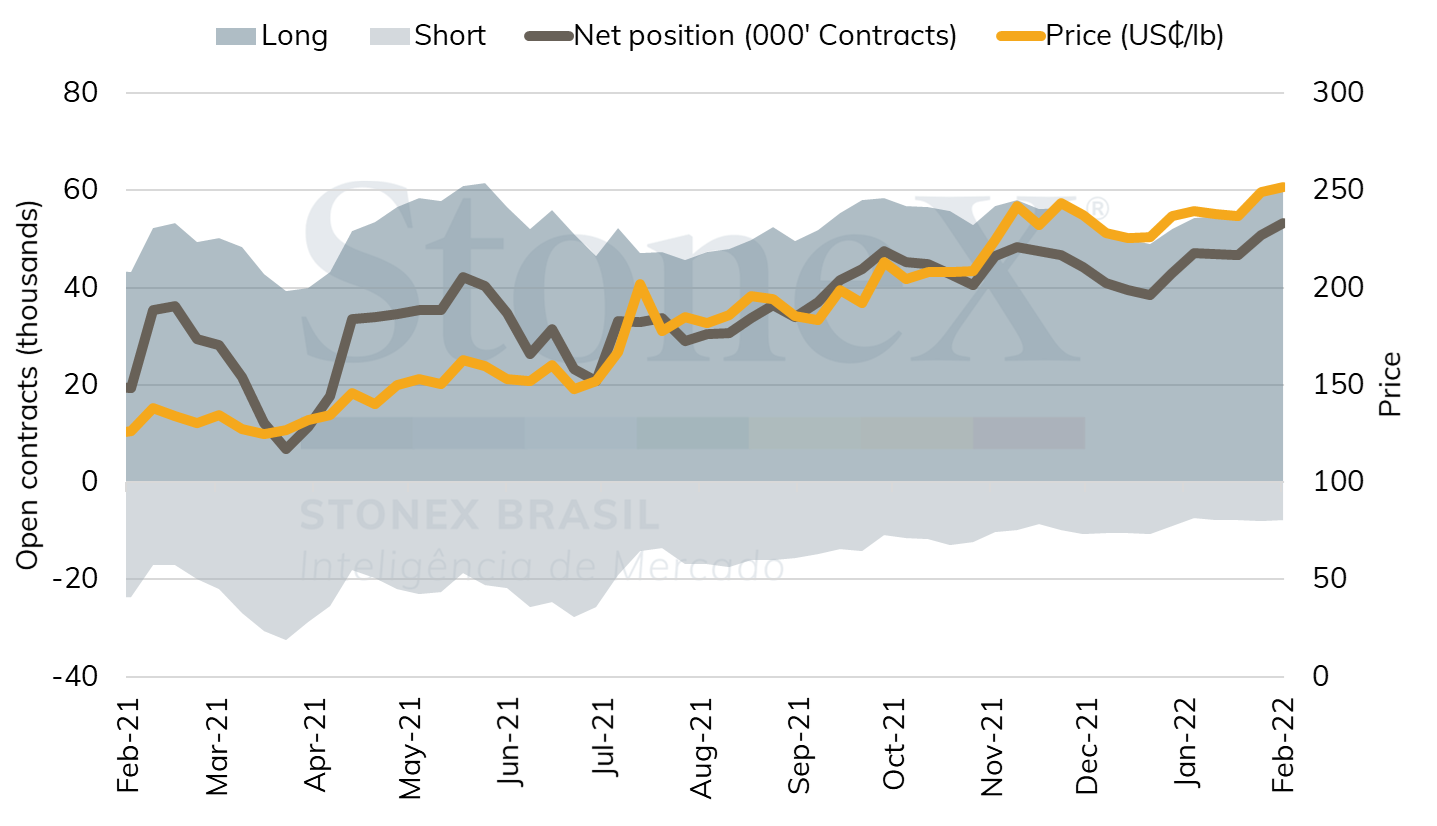
The movement of speculative funds continues to reflect the moment of bullish fundamentals. According to the latest CFTC report released last Friday (February 18), speculative funds increased their long positions in coffee futures and options in New York by 2,232 between February 8 and 15, from 58,881 to 61,113, while they reduced their short positions by only 129 contracts, from 7,963 to 7,834. As a result, funds' net position went from 50,918 to 53,279, the highest net long since November 2016.
Spec funds position in New York coffee futures and options
Source: CFTC. Design: StoneX.
It is important to note that there was a strong reduction in the number of open interest, of almost 50 thousand contracts, going from 347,387 to 297,599 contracts. The strong decline mainly reflected the settlement and repurchase of contracts by commercial agents. The last report shows that commercial agents reduced their long positions by 17,053 to 82,921 contracts on 02/15. In addition, commercial agents decreased their short positions by 14,935 contracts to 186,310 short.