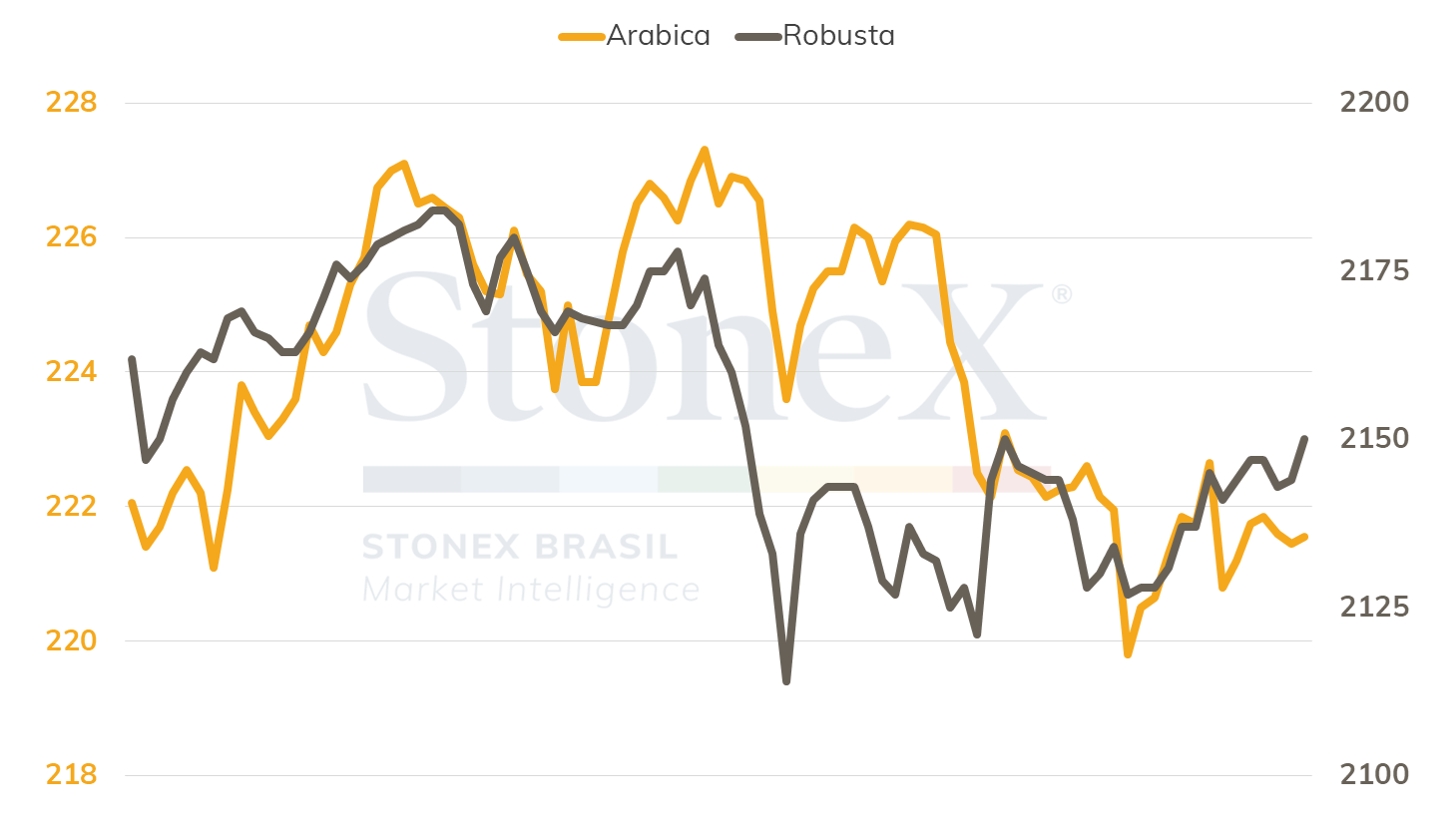
With no major news in terms of fundamentals, the week was relatively quiet for movements on the New York and London exchanges. The coffee market remains under pressure due to the impacts and uncertainties linked to the armed conflict between Russia and Ukraine, as we have already discussed in previous issues of this report. The possible drop in global consumption, mainly driven by the countries involved, should continue as the main concern of the coffee market while the confrontation persists.
In the next two weeks, attention should turn to the export data, especially in Brazil, which may indicate the first impacts of the war on coffee exports. Russia is the sixth-largest destination of Brazilian coffee exports and accounted for 233,600 bags in January and February 2022, an increase of 14.4% compared to 2021, according to the latest Cecafé report. The expectation is that March export data will already show the impacts of the war on Brazilian exports to the country.
As mentioned in previous issues, despite this still uncertain scenario, other bullish factors are still present in the current context, with lower production in Brazil, the prospect of a tighter S&D balance sheet, excess rainfall in Colombia and the possibility of a La Niña scenario continuing in the coming months.
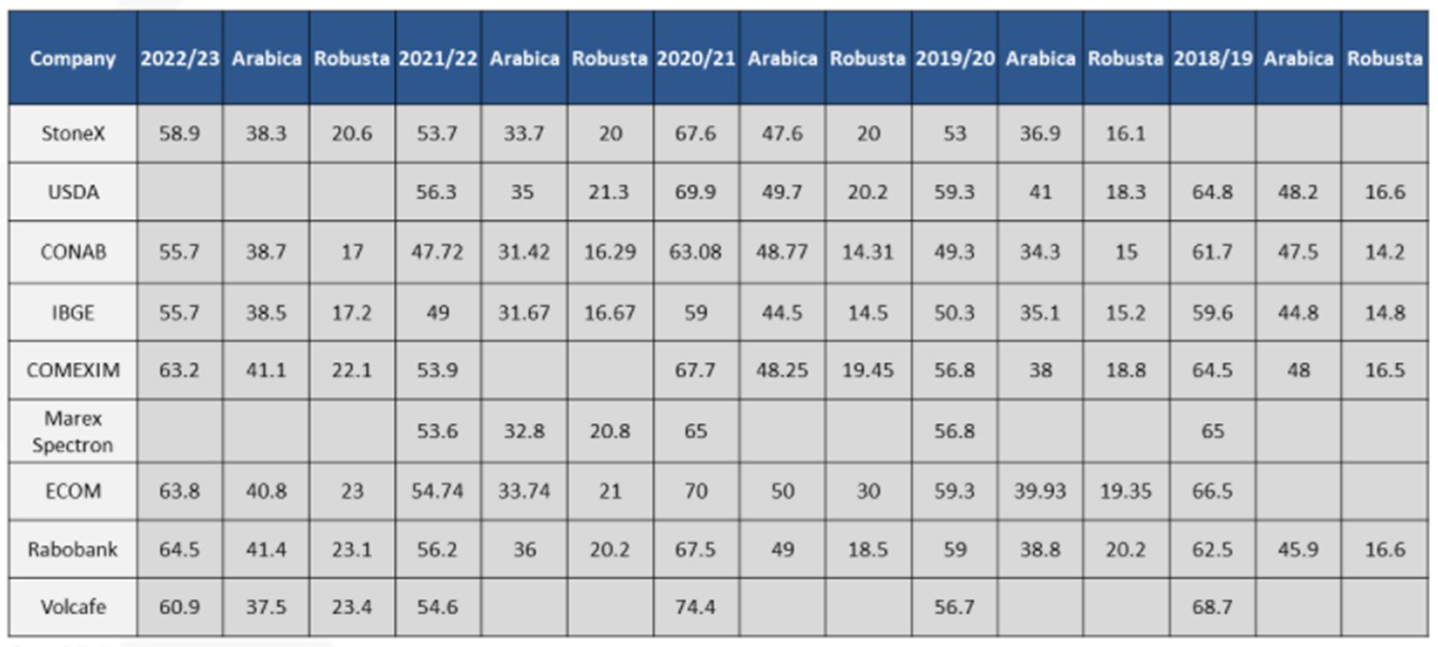
Regarding estimates for Brazilian production, Dutch bank Rabobank recently updated its estimates for Brazilian coffee production in 2022/23. In its latest publication, the bank reduced its estimates for Brazilian production to 64.5 million bags, a 3% decrease from the previous estimate of 66.5 million bags - in the last update, Arabica production was estimated at 41.4 million bags and Robusta at 23.1 million bags.
This is the third update for the bank's estimates, which had estimated production at 63.5 million bags in early November last year, then, in the same month, changed the estimate to 66.5 million bags. Despite the decrease, this is the highest estimate available on the market, with the lowest estimate belonging to Conab at 55.7 million bags. Therefore, the difference between the highest and lowest estimate is still 8.8 million bags, bringing uncertainties and greater volatility. StoneX estimates the Brazilian production at 58.9 million bags, 38.3 million bags of Arabica and 20.6 million bags of Robusta coffee.
Brazilian coffee production Estimates (million bags)
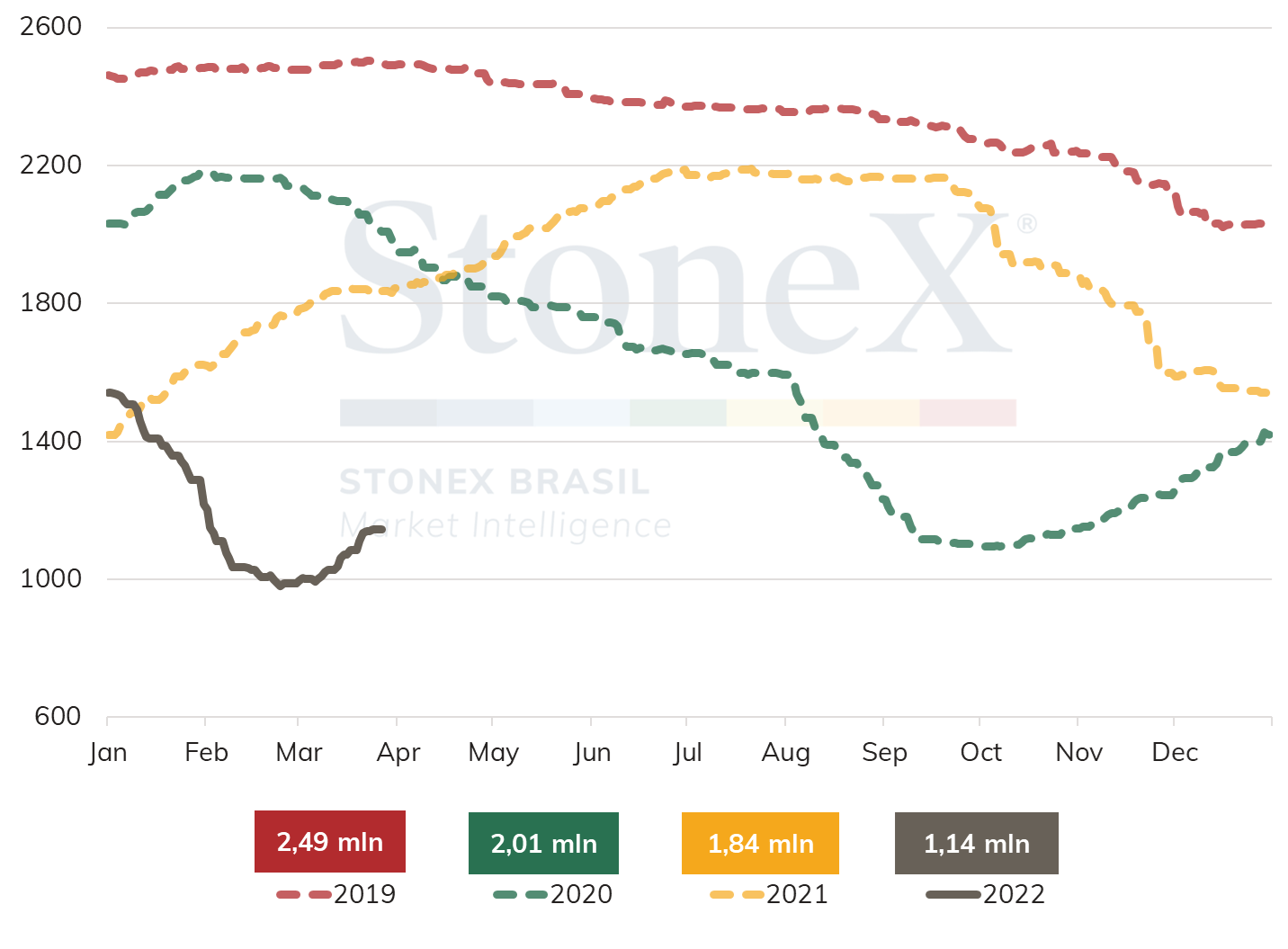
Over recent weeks, the advance in certified stocks has been an additional factor contributing to pressure on coffee prices in futures markets. From the middle of last year until February, certified stocks of Arabica coffee have fallen sharply, from around 2.2 million bags to less than 1 million bags in February. However, in recent weeks certified stocks have reversed their trend and are increasing - since the beginning of March, stocks have advanced by over 146,000 bags (14.7%).
Arabica certified stocks (thousand bags)
Source: ICE. Design: StoneX.
The big issue with this scenario is that the market conditions are not yet favorable for coffee certification by producing countries due to unattractive differentials, high freight costs, and the low availability of coffees with the quality standard required by the exchange in the case of Brazil. Therefore, the big question is where this certified coffee is coming from. Many analysts and traders believe that the coffees that were recently certified are the same coffees removed from the certified stocks a few months ago, thus characterizing a recertification process. If this is the scenario, this process is likely to lose steam since, as mentioned, the other variables are unfavorable to encouraging the certification process of new coffees by the countries of origin.
As it was presented, the coffee market will be watching Cecafé's releases for Brazilian exports in the coming weeks. For this week, export data from Vietnam will be released, which should be out in the next few days, and production and export data from Colombia, which should indicate the extent of the impacts of excess rainfall caused by La Niña. Furthermore, coffee prices should react to macroeconomic movements and the USDBRL and news regarding the war situation in Ukraine. Moreover, the agents will keep an eye on weather issues and update the probabilities of maintenance or not of La Niña in the coming months. On Tuesday (29), the Australian agency BOM will update its projections for the weather phenomenon, with the American agency NOAA scheduled to update its estimates on April 14.
USDBRL continues its downward trend and supports coffee prices
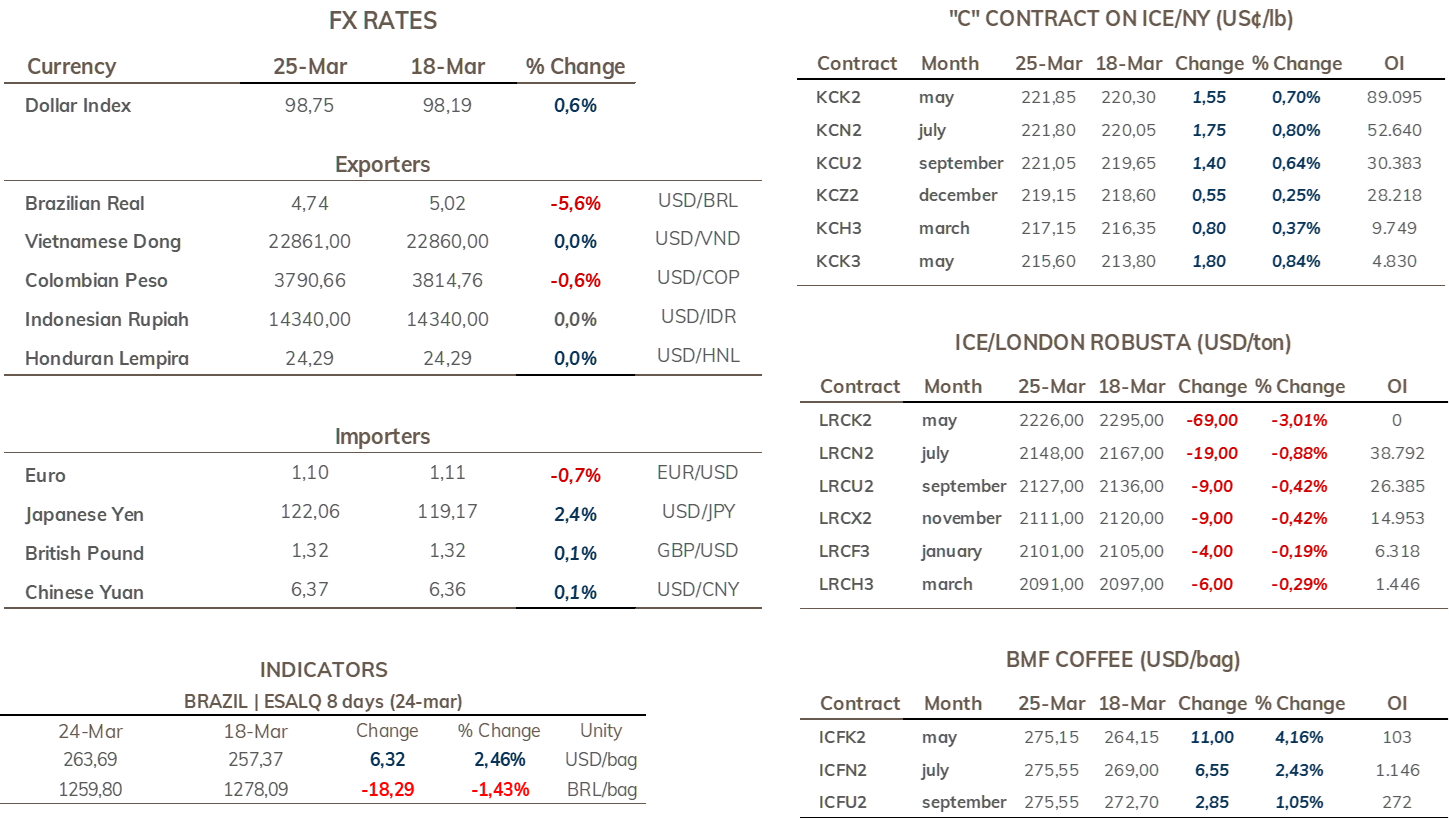
The USD's sharp drop in the Brazilian exchange market contributed as an important factor to supporting coffee prices, mainly in New York, during the last week. The American currency fell for the fourth consecutive week, with the real/dollar pair registering a weekly variation of -5.4%, ending last Friday (25) at BRL 4.747. In the year, the currency has already accumulated a 14.8% drop against the BRL. On the other hand, the dollar index advanced 0.6% to end quoted at 98.8 points, reflecting the apprehension of agents with the effects of the war between Russia and Ukraine on global economies and the search for assets considered safe havens, which, in turn, tends to keep speculators away from betting on new highs for coffee.