

Daily Coffee Report 8/6/26
Daily coffee report

StoneX Coffee Team
- Coffee
Quarterly Commodities Outlook is available for free now. Download your report →
By: StoneX Intelligence Brazil, StoneX Intelligence Brazil


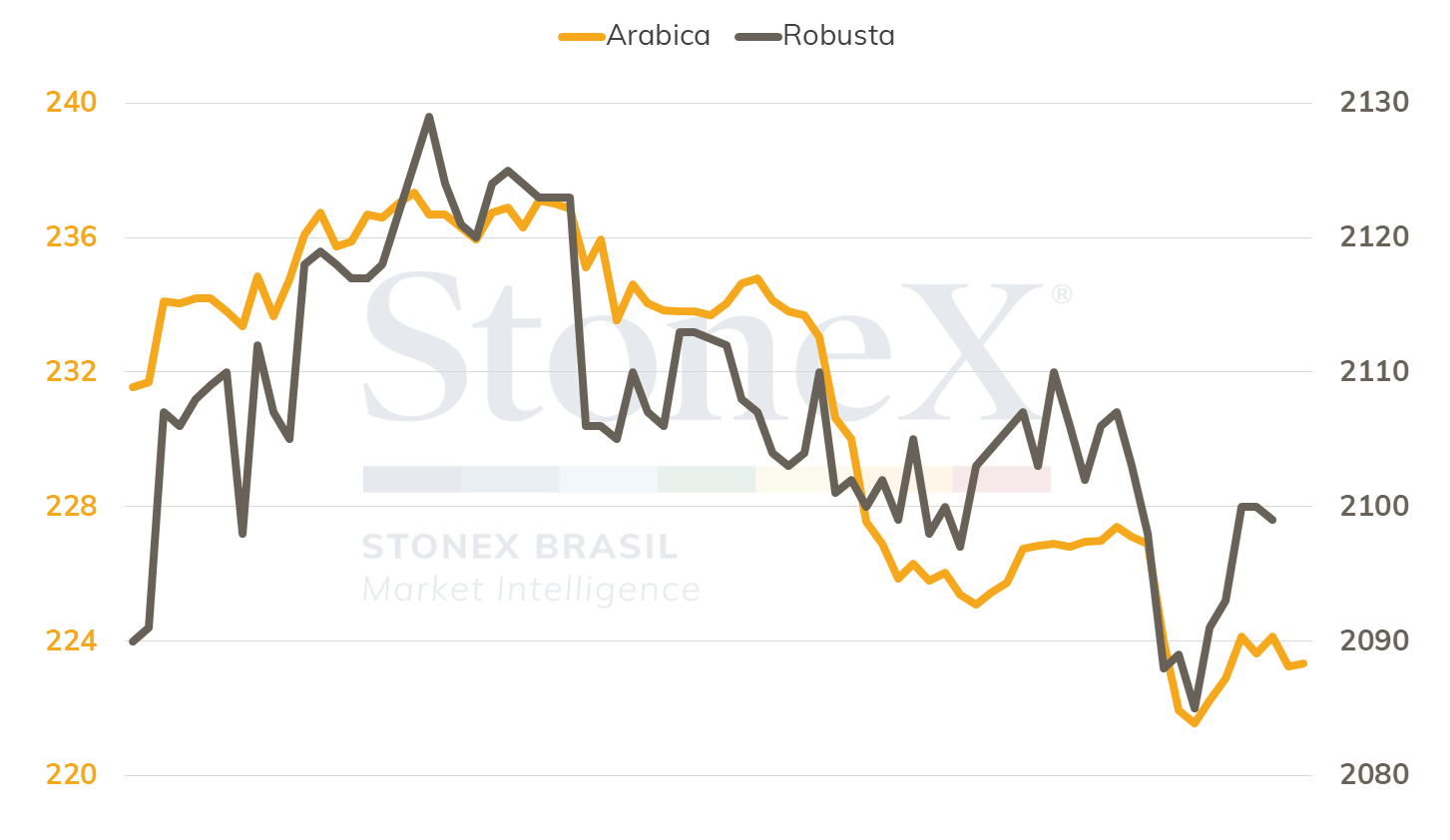
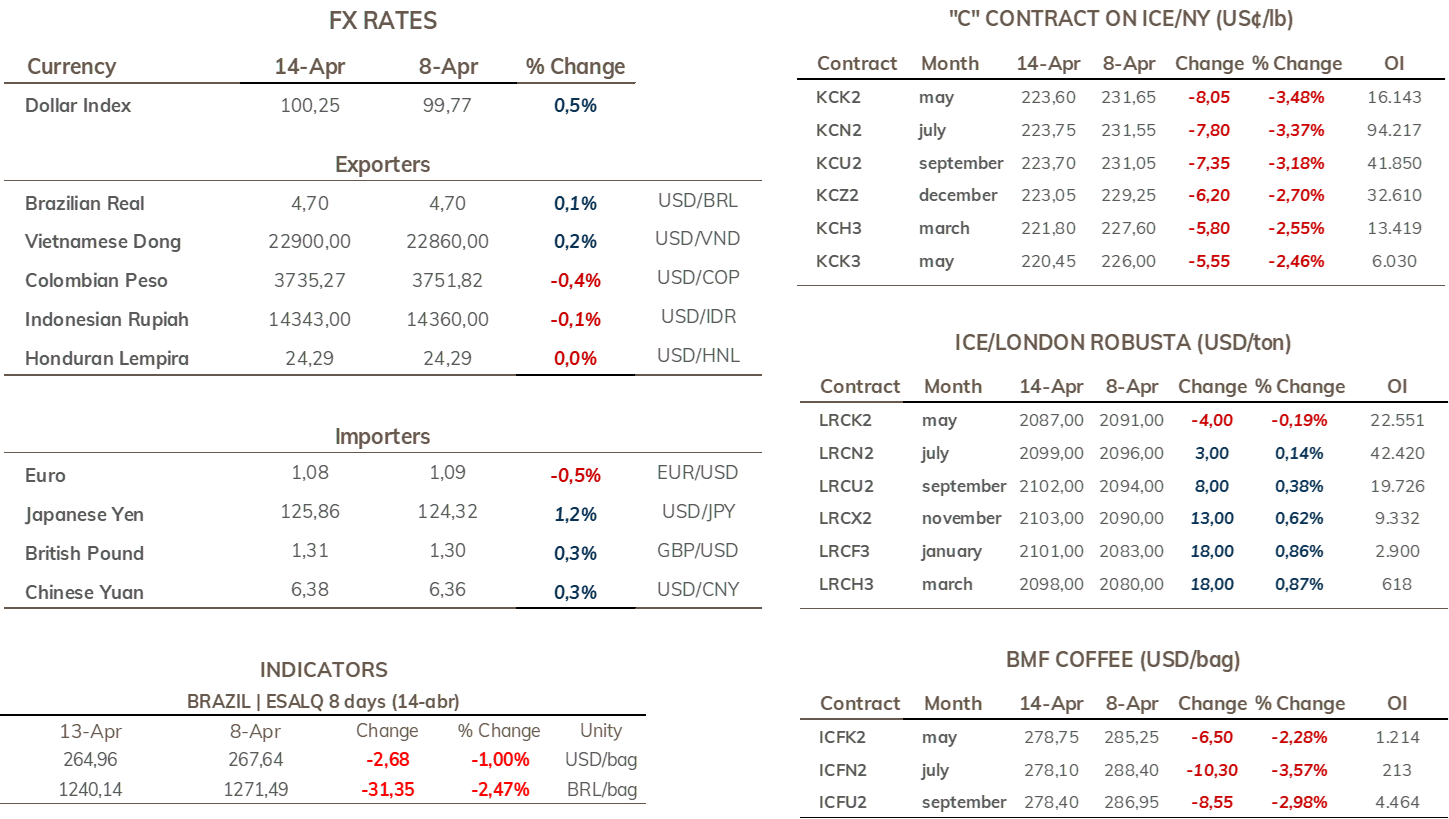
• Arabica prices dropped by 780 points (3.4%) in NY, closing the week quoted at US₵ 223.75/lb.
• Cepea’s Arabica indicator dropped by 2.5%, closing at BRL 1,240.14/bag.
• Robusta prices increased by USD 3 (0.14%) in London to USD 2099/t.
• Cepea’s Robusta indicator increased by 0.6% and ended the week quoted at BRL 822.53/bag.
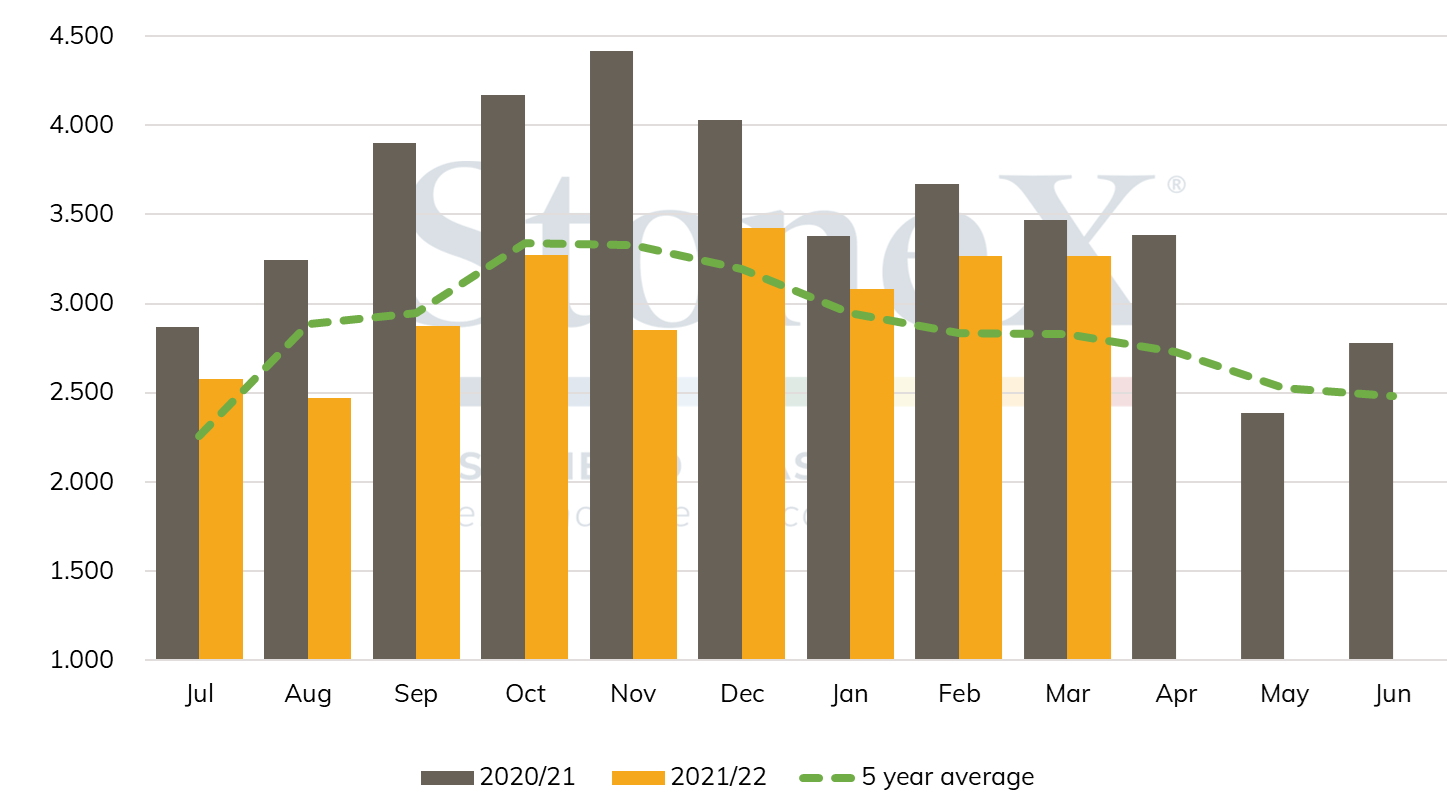
• Cecafé: Brazil exported 3.27 million bags in March, a decrease of 6% ▲
• Cecafé's data indicated a less intense retreat than Secex's ▼
• Brazilian Robusta exports dropped by 65% in March ▲
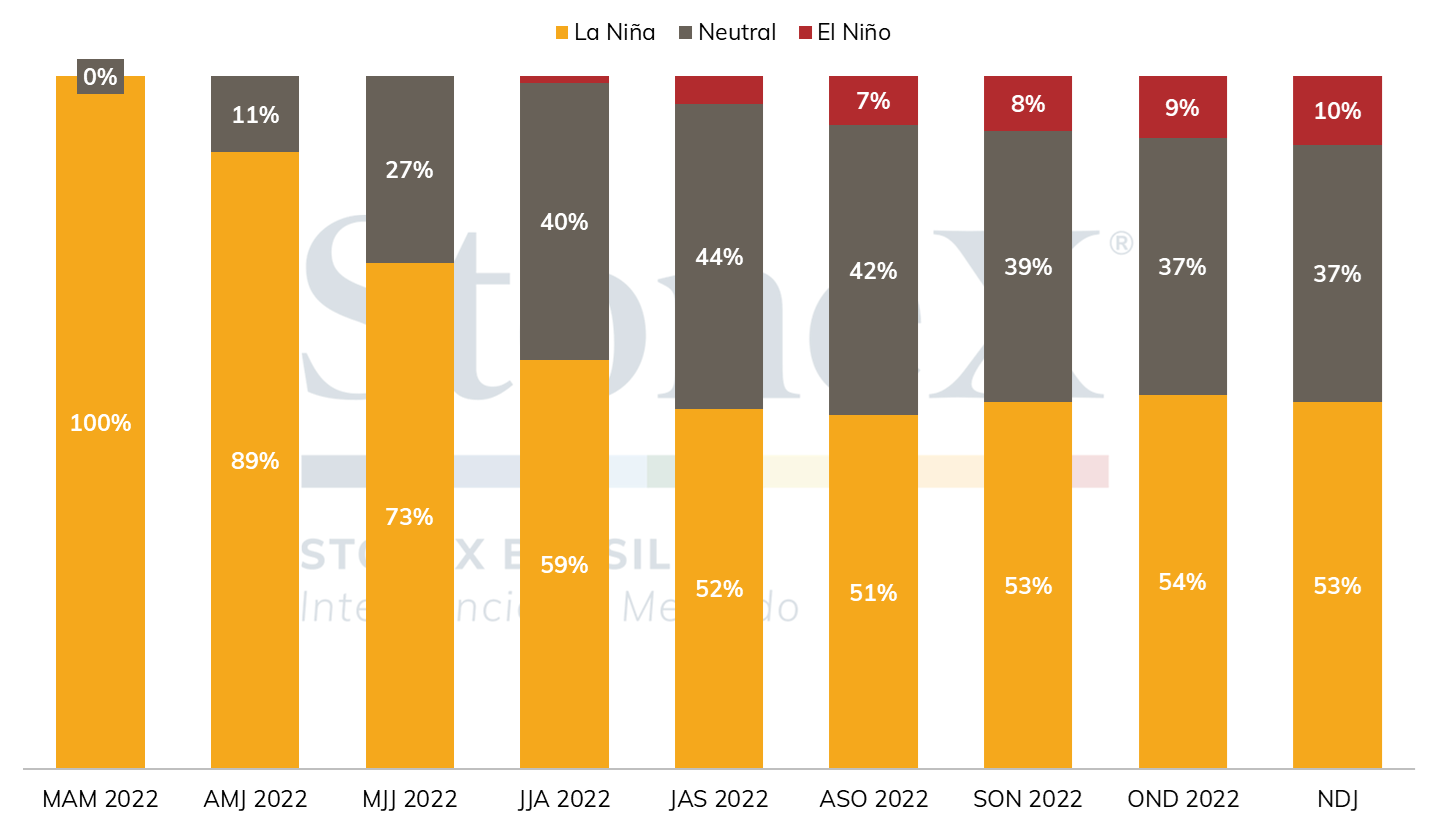
• NOAA updates La Niña's probabilities up▲
• CFTC: funds increased, but commercial agents reduced positions ▼
• Tensions between Russia and Ukraine create uncertainties▼
• Dollar records a slight retreat in the week, despite the global risk aversion scenario ▲
• Tighter monetary policy in the United States raises demand for the dollar abroad ▼
• Prolonged inflation and war are warning factors for consumption
▼ Bearish Factors ▲ Bullish Factors
Macroeconomic factors, which have been prevalent in recent weeks, continue to pressure coffee prices in New York. With the still tense situation between Russia and Ukraine, uncertainties and risk-averse sentiment have acted in a bearish manner for coffee. As a result, the dollar index rose by 0.5% for the week. In addition, Brent oil prices, which have been heavily affected due to Russia's importance as a supplier, advanced 8.7%.
Furthermore, the export data released by Cecafé somewhat cooled the concerns regarding Arabica coffee exports, as will be discussed below. Thus, Arabica’s most active contract (July/22) ended Thursday (14) quoted at US₵ 223.75 /lb, a retreat of 780 points (3.4%) compared to the previous Friday (08). In Brazil, following the New York trend, Arabica’s Cepea indicator ended the week lower, showing a decrease of BRL 31.35 (2.5%), quoted at BRL 1,240.14/bag.
For the Robusta market, prices remained practically unchanged. Robusta's most active contract (July/22) advanced only USD 3 (0.14%) to end the week quoted at USD 2,099. In Brazil, supported by demand in the domestic market, Robusta’s Cepea indicator showed an advance of 0.6% and ended Thursday (14) quoted at BRL 822.53/bag.
At the beginning of the month, the data released by the Secretariat of Foreign Trade (Secex) showed a decrease of 16% in coffee exports between March 2021 and March 2022. However, Cecafé's data, released on Monday (11), pointed to a decrease of only 6%. It is important to highlight that there is no great difference in the numbers presented for March this year, as much for Secex as Cecafé. However, the biggest impact of this disparity in the variations is in the difference in the export data for March 2021, with Secex pointing to 4.02 million while Cecafé indicated that 3.47 million were exported.
Cecafé's data showed that 3.27 million bags were exported in March, a decrease of 5.8% compared to the same month in 2021. Arabica exports totaled 3.14 million bags, representing a 0.7% increase. On the other hand, exports of Robusta coffee decreased by 64.6% to 123,400 bags.
As already presented in other editions of this report, the drop in Robusta coffee exports reflects the current differential condition, which does not favor exports of this type. The differential between the Brazilian domestic market and the London market has exceeded USD 800/ton in recent weeks. Therefore, it is much more viable to commercialize Robusta coffee in the domestic market than export it. The increase in Robusta prices reflects the strong increase in Arabica prices, which forced the Brazilian industry to increase the use of Robusta in the blend, thus increasing the demand for Robusta.
Last Thursday (14), the US National Oceanic and Atmospheric Administration (NOAA) updated its ENSO probability forecast, indicating greater chances that the La Niña phenomenon should remain longer than previously projected. The probabilities that La Niña will remain in the next few mobile quarters were significantly elevated, revised for the April-June quarter from 64% to 89%, for the May-July quarter from 46% to 73%, and remaining with chances above 50% until the end of the year, while the previous update pointed to higher probabilities of neutrality already starting in the May-June quarter. The data also indicate higher chances that the temperature variation should remain similar to recent months, between -0.5 °C and -1.0 °C, with intensity classified as weak.
This update indicates that, in the short term, Colombian production, which has already been showing falling production figures in recent months due to the torrential rains in producing areas, tends to continue to suffer some damage due to the weather. In the medium to long term, the fear about the possible effects of La Niña on Brazil in the second half of the year returns, which could bring delays and reduction in rainfall in this period for the third year in a row.
Currently, Brazil is heading towards a dry season between May and October, where precipitation volumes tend to be lower. In the coffee-producing regions of Minas Gerais, the rainfall in March, the last month with more significant rainfall volumes, was significantly below average. According to StoneX's precipitation forecast model, these regions should receive significantly lower volumes, which should also cause the rainfall in April to be below the average of recent years. In this scenario, a delay or reduction in rainfall in the second half of the year could affect 2023/24, bringing a bullish trend to the market.
The CFTC's Commitment of Traders report revealed last week that spec funds increased their net long positions in coffee futures and options between April 5 and 12 on the New York exchange. According to the report, specs increased their long positions by 6,023 while reducing their short positions by 199 contracts, advancing their net long balance by 6,222 to 29,617 contracts. In the same period, prices increased by 230 points, going from US₵ 231.25/lb to US₵ 233.55/lb.
On the other hand, there was a strong decrease in commercial agents' positions, both for long and short. The report pointed out that the commercial agents reduced their net long positions by 10,500 contracts and their net short positions by 3,959 contracts, presenting an advance of 6,541 contracts in the net short balance to 74,627. With this reduction in the positions, there was a decrease of 23,771 in the number of open contracts.
Last week, the USDBRL closed with a slight drop of 0.3% in the Brazilian exchange market, quoted at BRL 4.697. The expectation of a continued rise in the basic interest rate (Selic) after releasing a higher than expected IPCA in the previous week maintained the country's attractiveness for foreign exchange inflows, despite the rise in risk aversion in most global markets. Abroad, the release of data indicating still accelerated inflation in the United States and the less rigid posture of central banks in other countries significantly increased the demand for the American currency since investors expect the Fed to lead the process of monetary tightening in the world, increasing the attractiveness of investments in dollar-denominated securities. In this context, the dollar index, with a weekly gain of 0.5%, closed at 100.3, renewing its two-year highs.
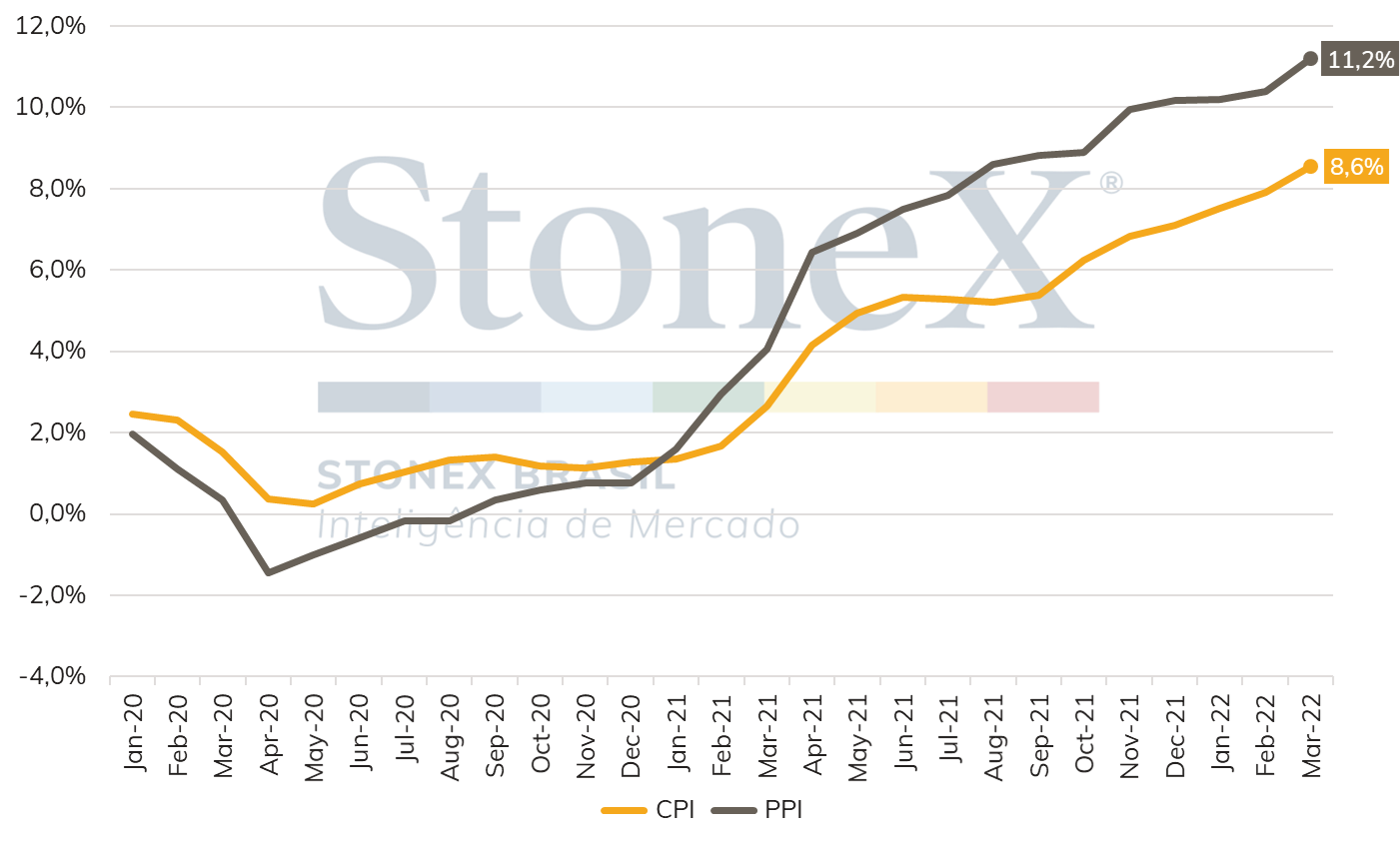
The release of increases in the Consumer Price Index (CPI) and the Producer Price Index (PPI) in the United States were the data most reflected in the foreign exchange market in recent sessions. The Bureau of Labor Statistics (BLS) revealed that the CPI grew 1.2% in March, slightly above analysts' projections (1.1%) and raising the 12-month accumulated from 7.9% in the previous month to 8.5%, the highest level since 1981. The PPI, an indicator that usually anticipates consumer price hikes in the following months, registered an acceleration of 1.4%, above expectations of 1.1%. The accumulated value in 12 months rose from 10.0% in February to 11.2%, the highest value in the historical series, which began in 2010.
The prospect that monetary tightening in the United States to control inflation will occur significantly faster than in other advanced economies, which have also been facing problems to control price increases, has increased the attractiveness of the American currency. The decision by the European Central Bank (ECB) to keep its monetary policy unchanged in the eurozone, that is, not to raise interest rates in the economic bloc, despite the difficulties in controlling a CPI that is at its highest in the region since the start of its historical series in 1997 contributed to this perception. For the time being, the ECB has opted only to reduce its monthly asset purchase program. According to the institution's president Christine Lagarde, the ECB will keep a "close watch" on inflation and that options remain "open."
On the other hand, the indications given by the minutes of the last meeting of the Federal Reserve's Federal Open Market Committee (FOMC) and the statements of its members show that the Fed should follow a cycle of subsequent hikes in the US basic interest rate over the coming months. Accordingly, the widening of the differential between the basic interest rates of the United States and other advanced economies has influenced a greater flow of foreign currency in the direction of the American economy.
The strong inflation registered in recent months and the signs that the war between Russia and Ukraine has reduced its chances of coming to an end, which should maintain the acceleration of prices and reduce the growth perspective of the economies most affected by the conflict, still generates concerns about a drop in consumption of certain products. Among them, doubts persist in the market about a possible reduction in the demand for coffee. In its main consuming countries, coffee consumption has a strong cultural bias. Because of this, its consumption has a low price elasticity, and income elasticity, i.e., impacts on prices and income, tend not to affect its consumption strongly.
However, the advance in prices significantly above the average of other products, and a general decrease in the purchasing power of global consumers, still generate risks in demand for the commodity. This factor should be monitored, especially among coffee-consuming countries in Europe, and may provide downward pressure on prices.
In Brazil, coffee consumption also needs to continue to be monitored. Last week, the Brazilian Coffee Industry Association (ABIC) announced that the consumption in the country between November 2020 and October 2021 registered an increase of 1.7%, totaling 21.54 million bags. On the other hand, the significant price increase of more than 100% in the Brazilian physical market should affect the passing on of industry costs to supermarkets. The March IPCA showed that prices reached a significant increase of 64.66% in the last 12 months for the final Brazilian consumer. If the increase continues fast, the country's growth in consumption may also be affected.
The StoneX Group Inc. group of companies provides financial services worldwide through its subsidiaries, including physical commodities, securities, exchange-traded and over-the-counter derivatives, risk management, global payments and foreign exchange products in accordance with applicable law in the jurisdictions where services are provided. References to over-the-counter (“OTC”) products or swaps are made on behalf of StoneX Markets LLC (“SXM”), a member of the National Futures Association (“NFA”) and provisionally registered with the U.S. Commodity Futures Trading Commission (“CFTC”) as a swap dealer. SXM’s products are designed only for individuals or firms who qualify under CFTC rules as an ‘Eligible Contract Participant’ (“ECP”) and who have been accepted as customers of SXM. StoneX Financial Inc. (“SFI”) is a member of FINRA/NFA/SIPC and registered with the MSRB. SFI is registered with the U.S. Securities and Exchange Commission (“SEC”) as a Broker-Dealer and with the CFTC as a Futures Commission Merchant and Commodity Trading Adviser. References to securities trading are made on behalf of the BD Division of SFI and are intended only for an audience of institutional clients as defined by FINRA Rule 4512(c). References to exchange-traded futures and options are made on behalf of the FCM Division of SFI . StoneX is a trading name of StoneX Financial Ltd (“SFL”). SFL is registered in England and Wales, Company No. 5616586. SFL is authorized and regulated by the Financial Conduct Authority [FRN 446717] to provide to professional and eligible customers including: arrangement, execution and, where required, clearing derivative transactions in exchange traded futures and options. SFL is also authorised to engage in the arrangement and execution of transactions in certain OTC products, certain securities trading, precious metals trading and payment services to eligible customers. SFL is authorised & regulated by the Financial Conduct Authority under the Payment Services Regulations 2017 for the provision of payment services. SFL is a category 1 ring-dealing member of the London Metal Exchange. In addition SFL also engages in other physically delivered commodities business and other general business activities which are unregulated and not required to be authorised by the Financial Conduct Authority. StoneX Group Inc. acts as agent for SFL in New York with respect to its payments services business. StoneX APAC Pte. Ltd. acts as agent for SFL in Singapore with respect to its payments services business. ‘StoneX’ is the trade name used by StoneX Group Inc. and all its associated entities and subsidiaries.
Trading swaps and over-the-counter derivatives, exchange-traded derivatives and options and securities involves substantial risk and is not suitable for all investors. Past performance of any futures or option is not indicative of future success. Indicators are not a trading system and are not published as a specific trade recommendation. The information herein is not a recommendation to trade nor investment research or an offer to buy or sell any derivative or security. It does not take into account your particular investment objectives, financial situation or needs and does not create a binding obligation on any of the StoneX group of companies to enter into any transaction with you. You are advised to perform an independent investigation of any transaction to determine whether any transaction is suitable for you. No part of this material may be copied, photocopied or duplicated in any form by any means or redistributed without the prior written consent of StoneX Group Inc.
© 2026 StoneX Group Inc. All Rights Reserved.
Our subscribers have access to comprehensive market analysis from StoneX spanning commodities, equities, currencies and more.
Daily coffee report

August 6 – This morning’s stronger-than-expected U.S. labor data offered markets some relief, reinforcing confidence in the economy while giving the Fed greater flexibility to raise rates should inflationary pressures reaccelerate in next week’s July data. Stock futures are pointing to a mixed open to start the day, with the tech-heavy Nasdaq showing the most weakness. The VIX has fallen notably from yesterday’s spike above 18.4 as it starts the day hovering just below the 16-mark. The dollar is quietly higher as it trades just above 99.8, holding in the tight range seen thus far this week as traders continue to digest data to shape expectations for the Fed’s next move, which we’ll dive into in more depth below. Long-term treasury yields have relaxed slightly from their recent spike, with 30-year yields starting the day trading just above 5.19%, while 10-year yields trade above 4.64%, and 2-year yields sit below 4.22%. Crude oil is modestly higher to start the session after sharp declines earlier in the week, with nearby WTI up 1.8% to trade at $76.40 and nearby Brent up 2.4% to trade at $81.40. Meanwhile, the ags are quietly mixed to start the day.

Daily coffee report
Our market expertise, advanced platforms, global reach, culture of full transparency and commitment to our clients’ success all set us apart in the financial marketplace.
Reach
With access to 40+ derivatives exchanges, 180+ foreign exchange markets, nearly every global securities marketplace and numerous bi-lateral liquidity venues, StoneX’s digital network and deep relationships can take clients anywhere they want to go.
Transparency
As a publicly traded company meeting the highest standards of regulatory compliance in the markets we serve; our financials and record of accomplishment are matters of public record. StoneX’s commitment to “doing the right thing over the easy thing” sets us apart in the industry and helps us build respect, client trust and new partnerships.
Expertise
From our proprietary Market Intelligence platform, to “boots on the ground” expertise from award-winning traders and professionals, we connect our clients directly to actionable insights they can use to make more informed decisions and achieve their goals in the global markets.