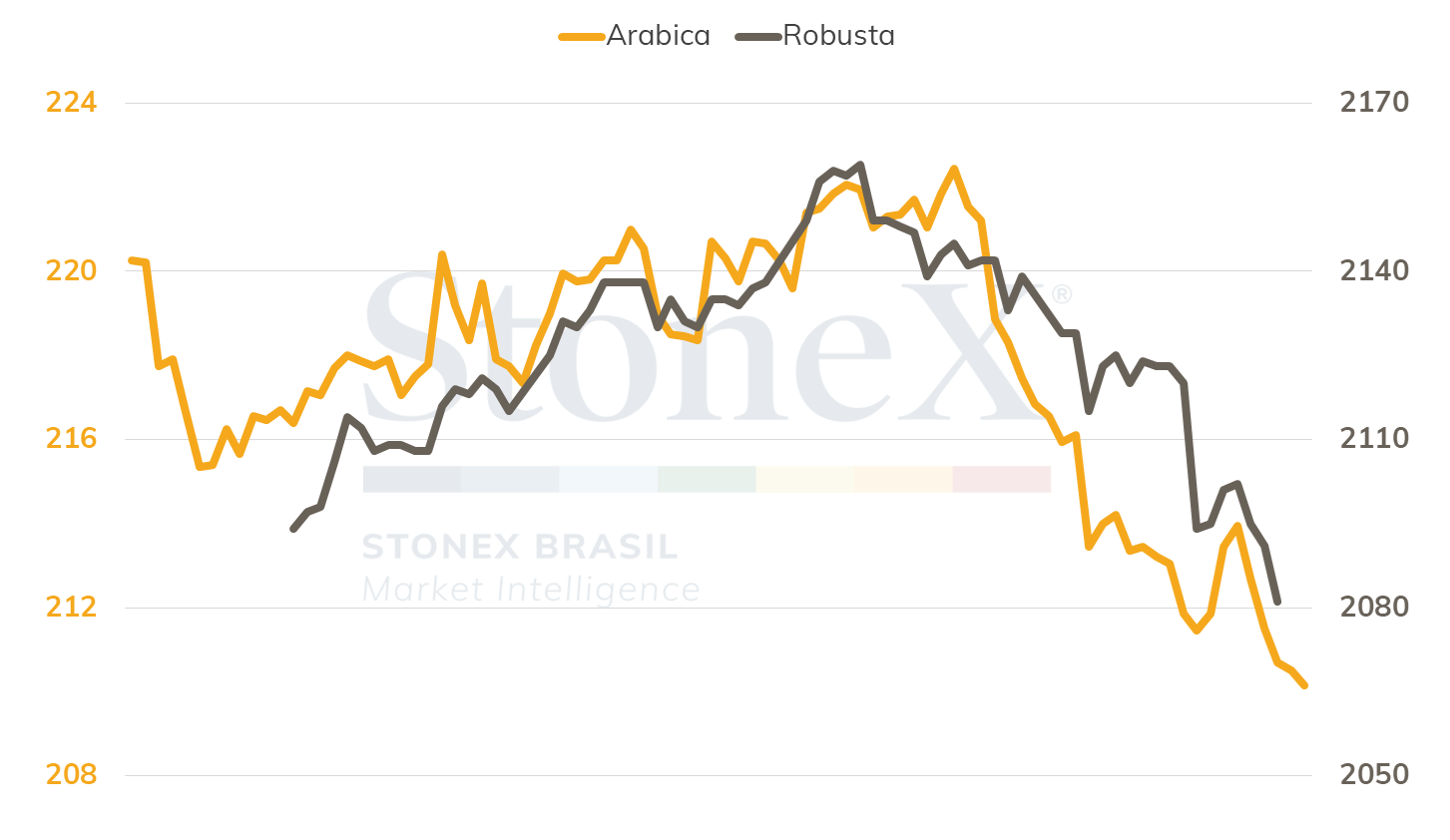
Despite the doubts that still permeate the next Brazilian crop, Colombia's production has been showing significant losses while suffering from excessive rainfall. Data from the Colombian Coffee Growers Federation (FNC) indicated that the country's production in April totaled 750,000 bags, 7% less than the same month last year. Colombian production continues to be impacted by excessive rainfall in the country, a reflection of the impact of La Niña on the weather. As a result, the accumulated production for the first four months of the year totals 3.460 million bags, 14.5% below the same period in 2021, when the country produced 4.048 million bags.
The Robusta coffee market keeps a close eye on coffee exports from Vietnam, which have reached higher volumes this year. As presented in more detail in the outlook report, the differentials for Robusta coffee in Brazil are high, while the differentials in Vietnam continue to weaken, indicating the country's increased competitiveness. Thus, Brazilian export volumes have fallen while Vietnamese shipments have advanced.
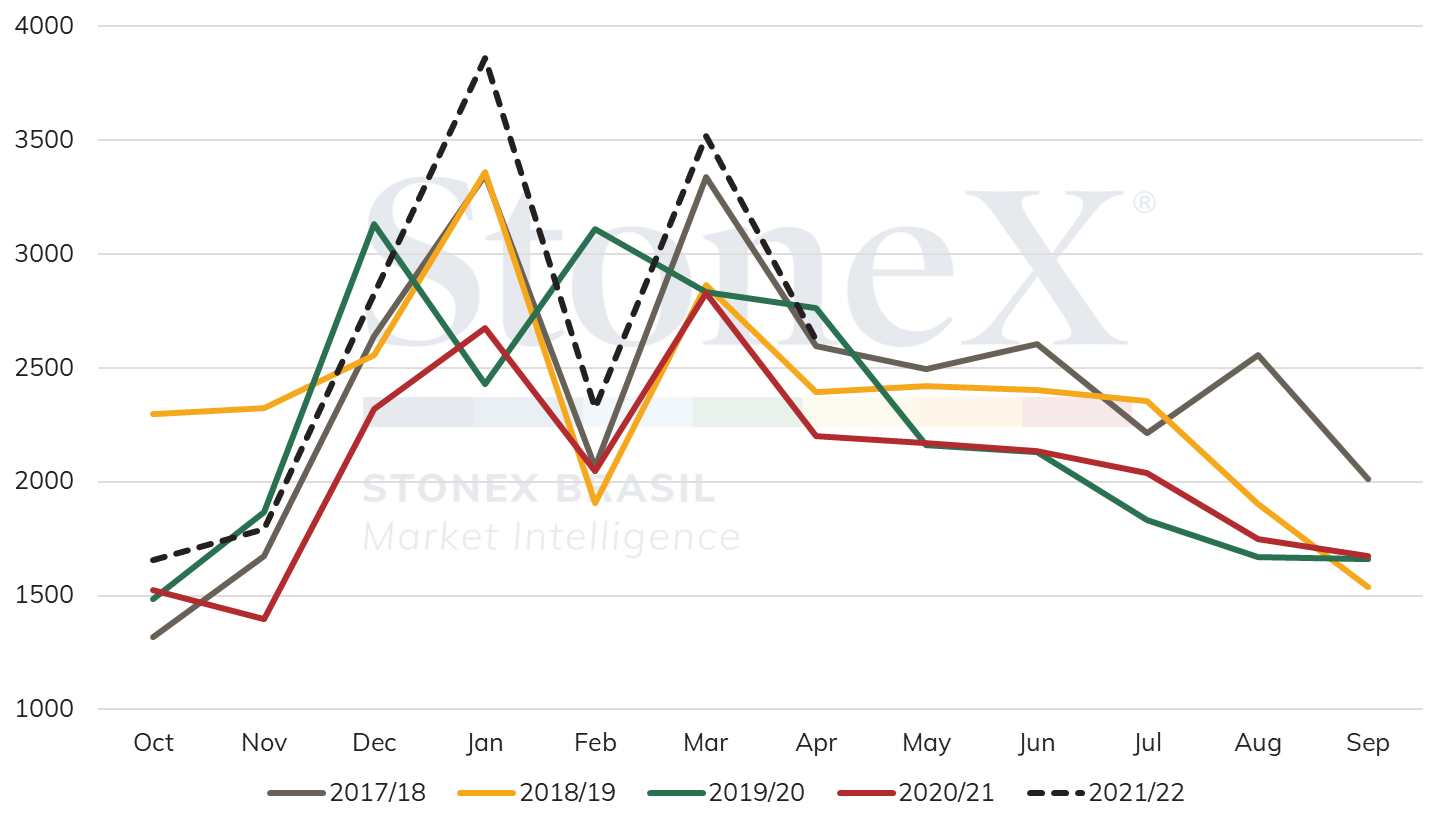
Seasonality of Vietnamese coffee exports (million bags)
Source: Vietnam Customs. Design: StoneX.
Data released by the Vietnamese Customs indicated that Vietnam exported 2.6 million bags in April, 19.2% higher than in April 2021 but 24% lower than the volume exported in March, indicating a slowdown in exports from Vietnam. As we can see in the seasonality of the exports chart, there is a tendency to reduce exports due to the country's inter-crop period. The Vietnam harvest starts in mid-November and continues until January.
As for demand, Starbucks' financial data pointed to strong consumption, but the new cases in China are worrying. With the end of the pandemic in most countries, coffee consumption is recovering. Starbucks data shows that its sales advanced 7% in its fiscal second quarter, which ended April 3. The growth reflects the reopening of economies after the shock caused by the pandemic. However, a point of attention is the new cases of Covid-19 in China, leading the country to readopt restrictive measures to prevent the spread of the disease.
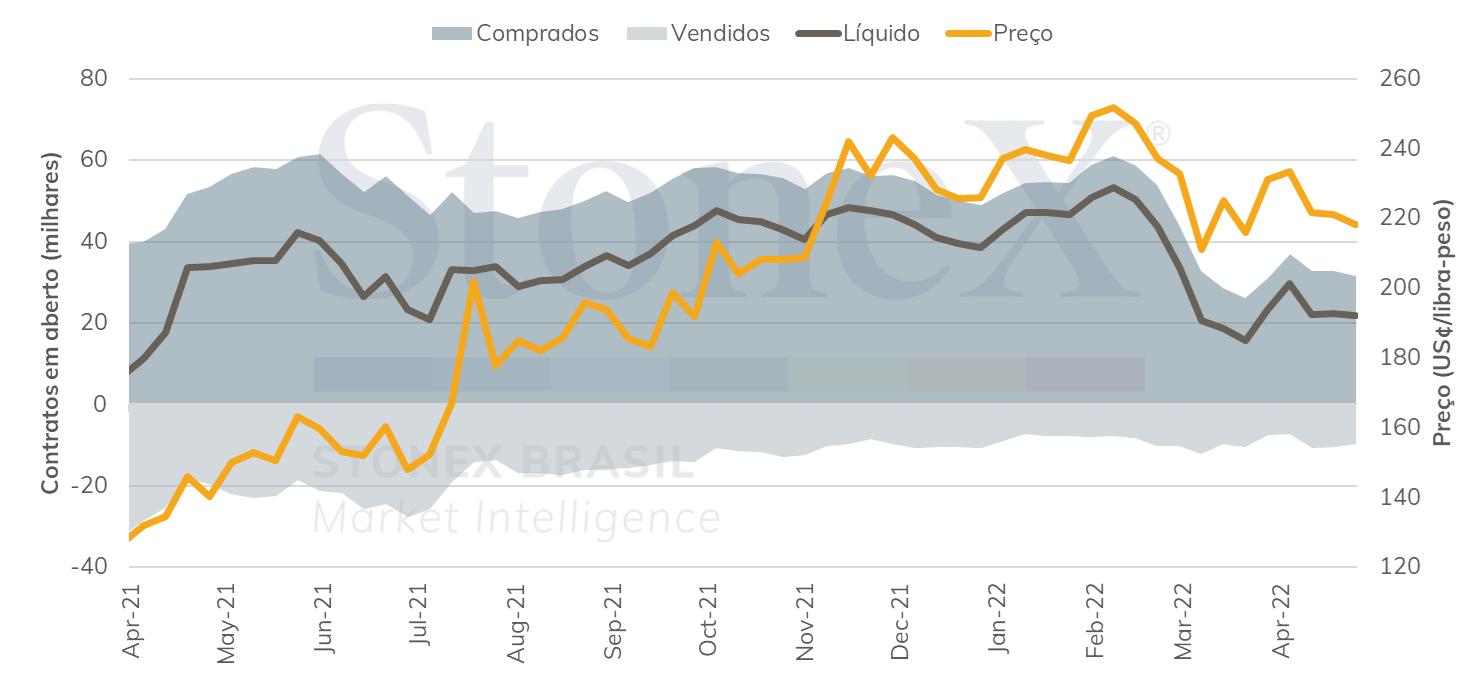
The latest Commitment of Traders report released by the CFTC showed a slight movement of spec funds in coffee futures and options on the New York exchange. According to the report data, speculators reduced their longs by 1,331 between April 26 and May 3, going for 31,510 contracts. In addition, the short positions also posted a drop, with a decrease of 749 contracts to 9,652 on the exchange. Thus, the spec's net balance slightly declined by 582, standing at 21,858 long positions.
Spec funds position in coffee futures and options vs. most active contract on ICE NY
Source: CFTC, Trader's Pro. Design: StoneX.
Through the chart above, it is possible to observe that since mid-December last year, after stock prices had absorbed most of the impacts of dry weather and frosts on the outlook for Brazilian production and the global S&D balance, prices and the funds' net positions began to relate more intensely, showing very similar movements over the weeks. This suggests that the most intense drops registered in the last few sessions, which extended to reach their lows since November on Monday and do not find a strong explanation on the fundamentals side, have a great influence from speculative funds' technical movements.
For this week, the attention of the agents is on the release of Brazil’s Cecafé export data. Cecafé's data, in addition to showing the pace of shipments and the possible impacts of the logistical problems in the country's exports, can also help to dimension the size of the impact of the war through the indicators of exports to Russia and Ukraine. Export data released by the Secretariat of Foreign Trade (Secex) indicate that Brazil exported 2.76 million bags in April, representing a 20% decline compared to April 2021. However, it is important to highlight that Secex and Cecafé's data usually diverge, which indicates that the numbers that Cecafé will release may present a different scenario.
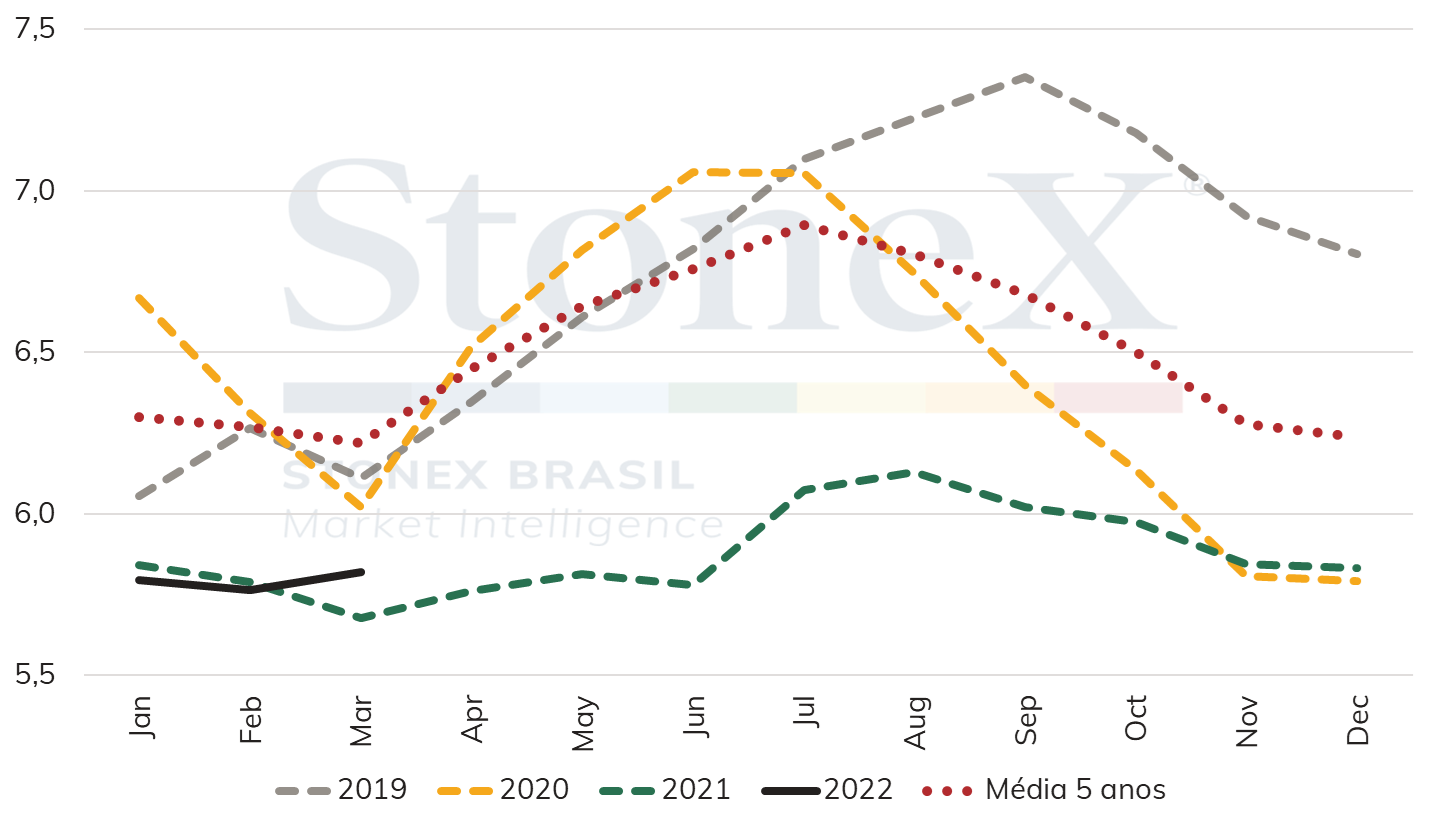
Next week the Green Coffee Association will release the report for coffee stocks at US ports. The last report showed an increase of almost 55,000 bags (0.95%) in March compared to the previous month. As can be seen in the seasonal graph of GCA stocks, there is a tendency for stocks to increase from March onwards. The seasonal pattern of GCA stocks reflects the higher import volumes of coffee from Central America, starting in March/April, and then the volumes coming from Colombia and Brazil in the second half of the year. Therefore, stock data may show substantial advances in April, which would act in a bearish manner for the coffee market.
Seasonality of coffee stocks at US ports - GCA (million bags)
Source: GCA. Design: StoneX.
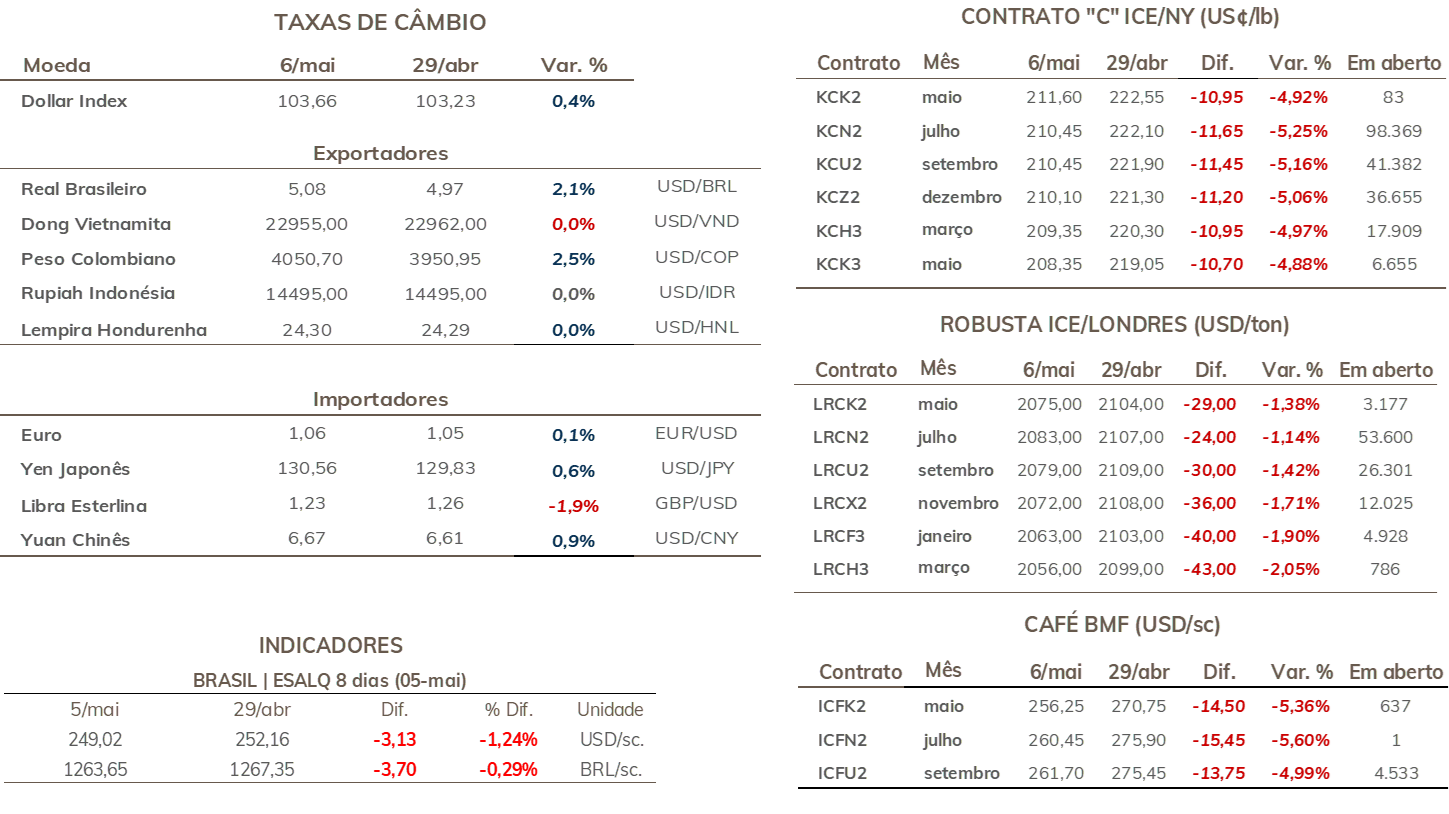
USDBRL closes the week above BRL 5.00 for the first time in 7 weeks
The USDBRL recovery continues to be a factor of pressure for coffee quotes on the stock exchange. The US currency recorded its third consecutive week of appreciation against the Brazilian real, with the exchange rate registering a weekly increase of 2.6% to end Friday (6), quoted at BRL 5.073.The dollar index, in turn, maintained its appreciation pace abroad for the fifth week in a row, advancing 0.7% to end the week quoted at 103.7 points, the highest level in 20 years.
Last week was a week of exacerbated volatility in the Brazilian foreign exchange market. The dollar posted a range of more than 10 cents in all sessions, indicating a moment of great uncertainty and instability in global markets.