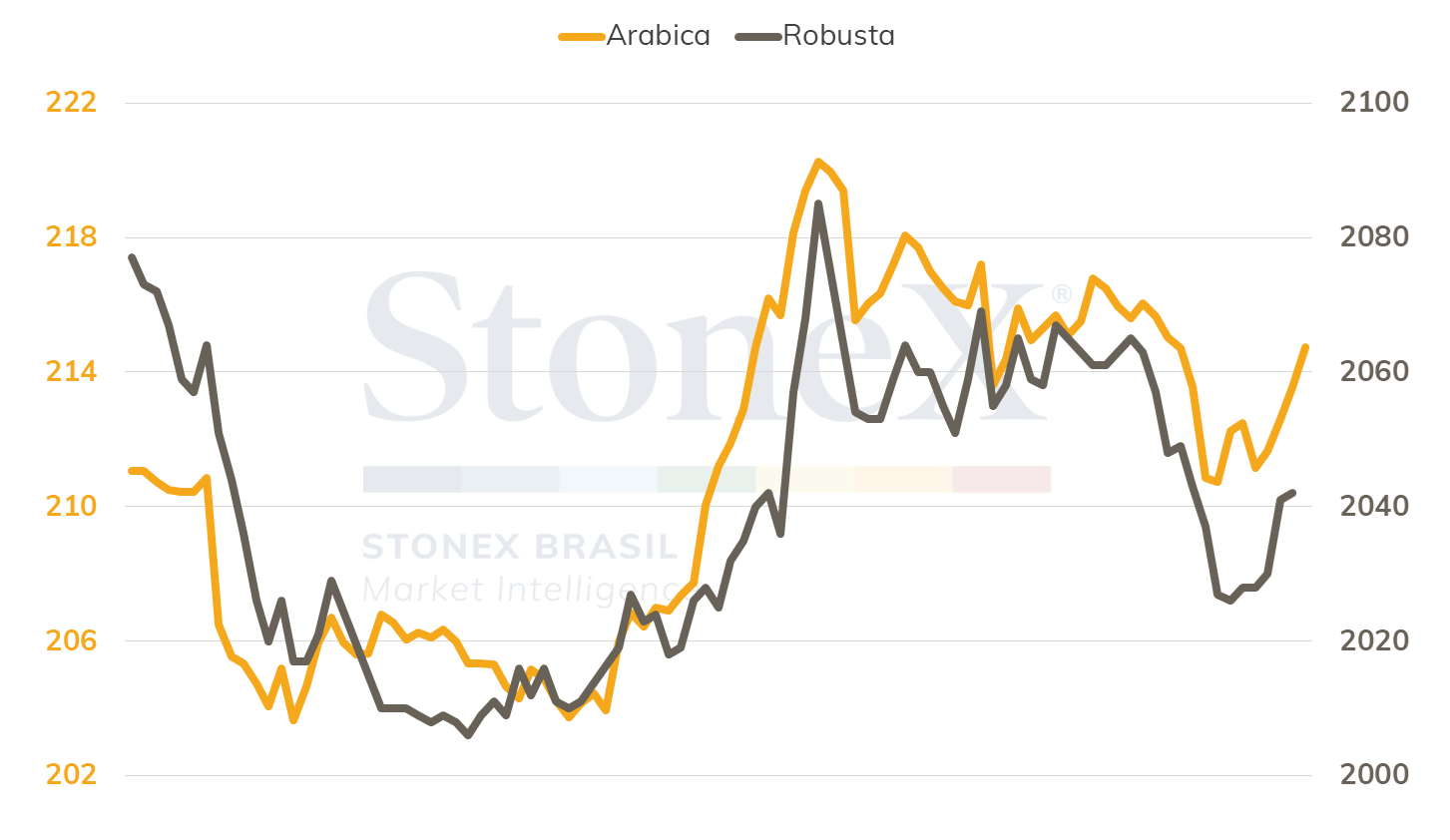
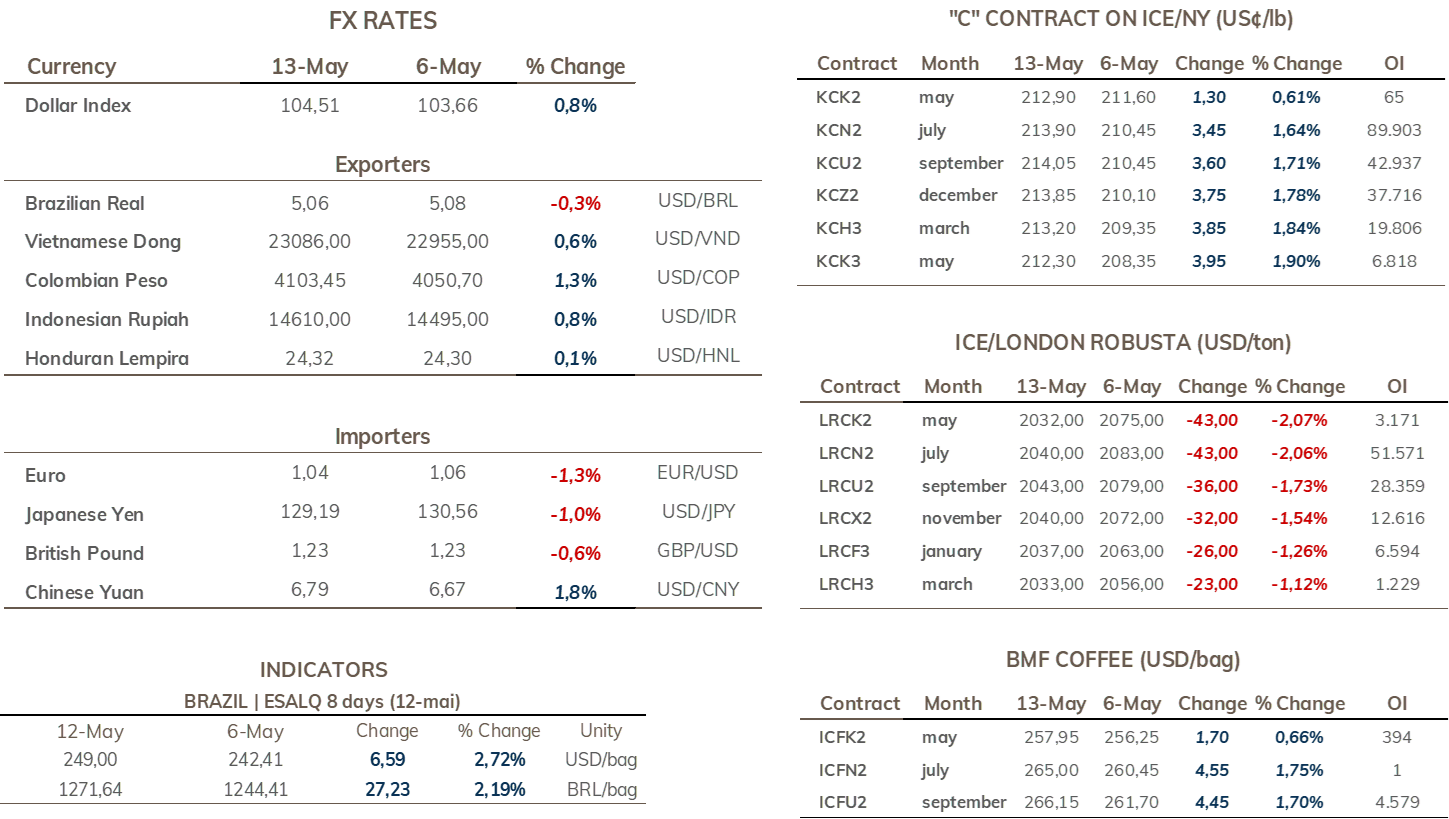
Arabica’s most active contract (July/22) ended Friday (13) at US₵ 213.90/lb, posting an increase of 345 points (1.6%) compared to the previous Friday (06). Following the same trend, the Cepea’s Arabica indicator ended the week high by 1.2%, quoted at BRL 1,259.80/bag.
For the Robusta market, despite the movements in New York, the prices reacted to forecasts of falling temperatures with an appreciation of USD 69/ton on Wednesday (11). Still, they ended the week lower, with Robusta's most active contract (July/22) falling USD 43 (2.0%) to end the week at USD 2,040. The Cepea's Robusta indicator closed 2.4% lower in Brazil, quoted at BRL 752.61/bag. As already mentioned in other editions of this report, the beginning of the Robusta harvest in Brazil increases its availability and puts pressure on prices.
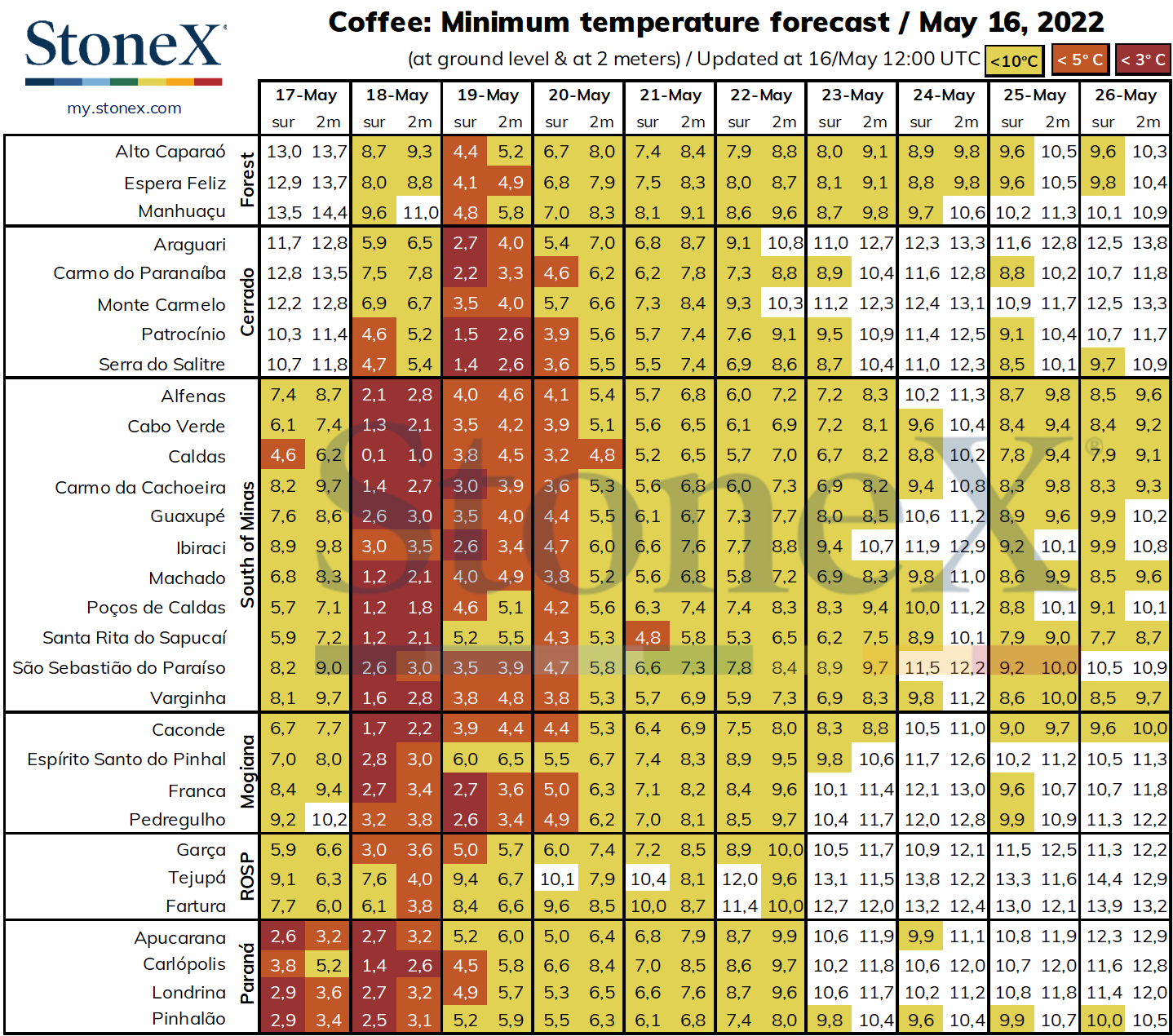
This week, the approach of the polar mass in Brazil will be in the spotlight. The latest update of the GFS model shows that the cold front will hit the coffee-producing regions on May 18, 19 and 20. According to the forecast, some municipalities in the South of Minas, Mogiana and Paraná should face temperatures below 3°C, while some municipalities in the South of Minas Gerais face temperatures around 1°C. Some meteorologists argue that there is a risk of frost, but it will not be widespread as observed in 2021.
Source: StoneX, with data provided by NCEP / GFS.
In any case, participants should closely monitor the advance of the cold front and its possible impacts on coffee crops. If the phenomenon does occur, the market trend tends to remain bullish, given that the occurrence could affect the development of crops and the 2023/24 crop. It is worth mentioning that it is still autumn, and the first polar mass is already approaching, which indicates the possibility of the approach of new cold waves, which should dictate the movements in the coming months.
Cecafé: Brazil sees sharp drop in coffee exports in April
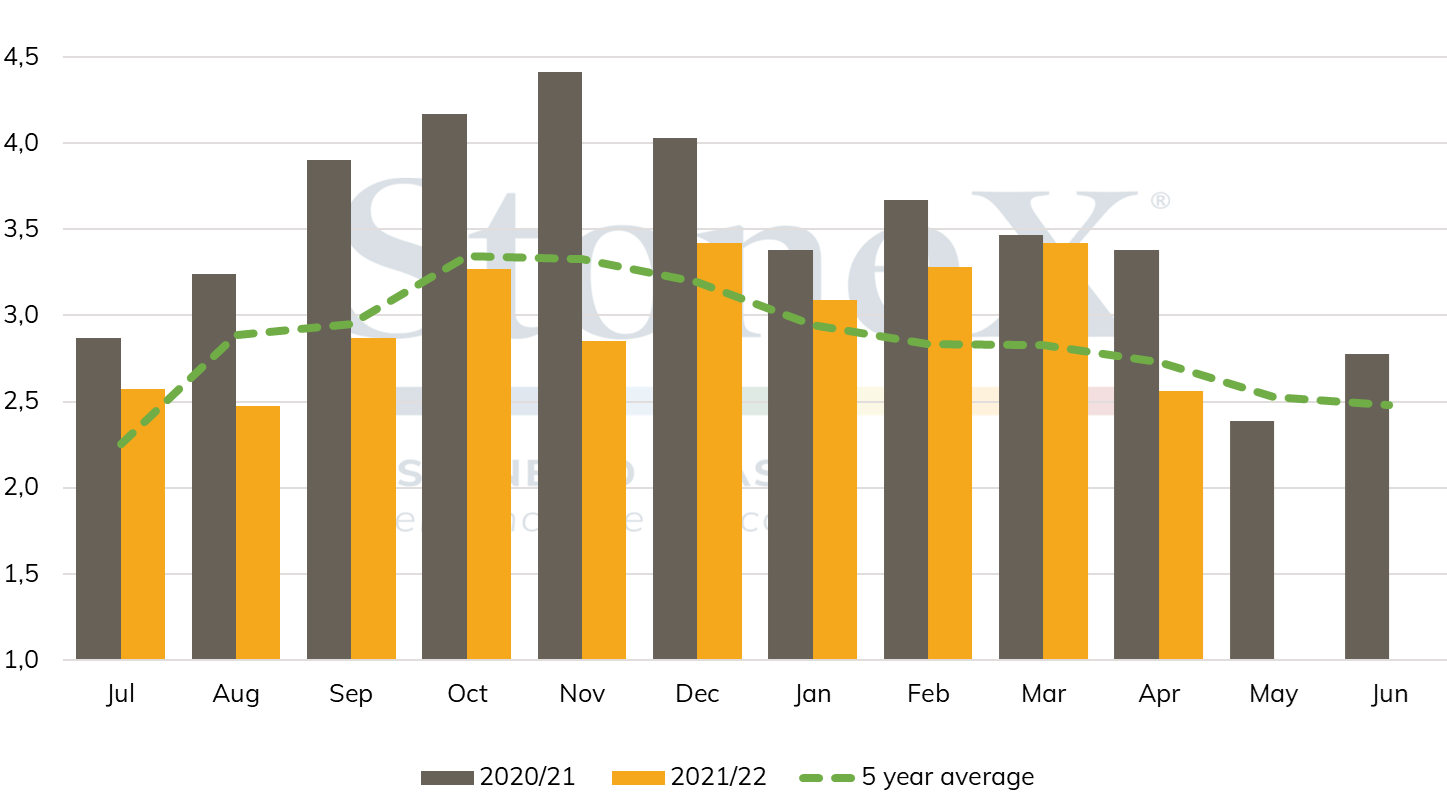
According to data released by Cecafé last week, Brazil exported 2.559 million bags of green coffee in April, a 24.3% drop compared to the previous year. Considering the total exported green coffee and industrialized coffee, the country exported 2.8 million bags, a decrease of 24.1% compared to the previous year. On the other hand, the foreign exchange revenue, reflecting the increase in prices, advanced 34.1% to USD 670.7 million.
In general, the lower volume results from lower production and the approaching end of the 2021/22 crop year. However, the drop in Robusta coffee exports was much sharper than the drop for Arabica. Cecafé's data show a drop of 20.4% in Arabica exports, to 2.4 million bags. Robusta exports fell by 60% to 134.5 thousand bags.
Brazilian green coffee exports (million bags)
Source: Cecafé. Design: StoneX.
As has already been mentioned in other editions of this report, the differentials of Robusta coffee prices, which are at high levels, discourage Robusta exports. The differentials reached USD 800/ton in mid-March. As anticipated, with the Robusta harvest progressing and its greater availability, the differentials have weakened in recent weeks, reaching USD 400/ton last week.
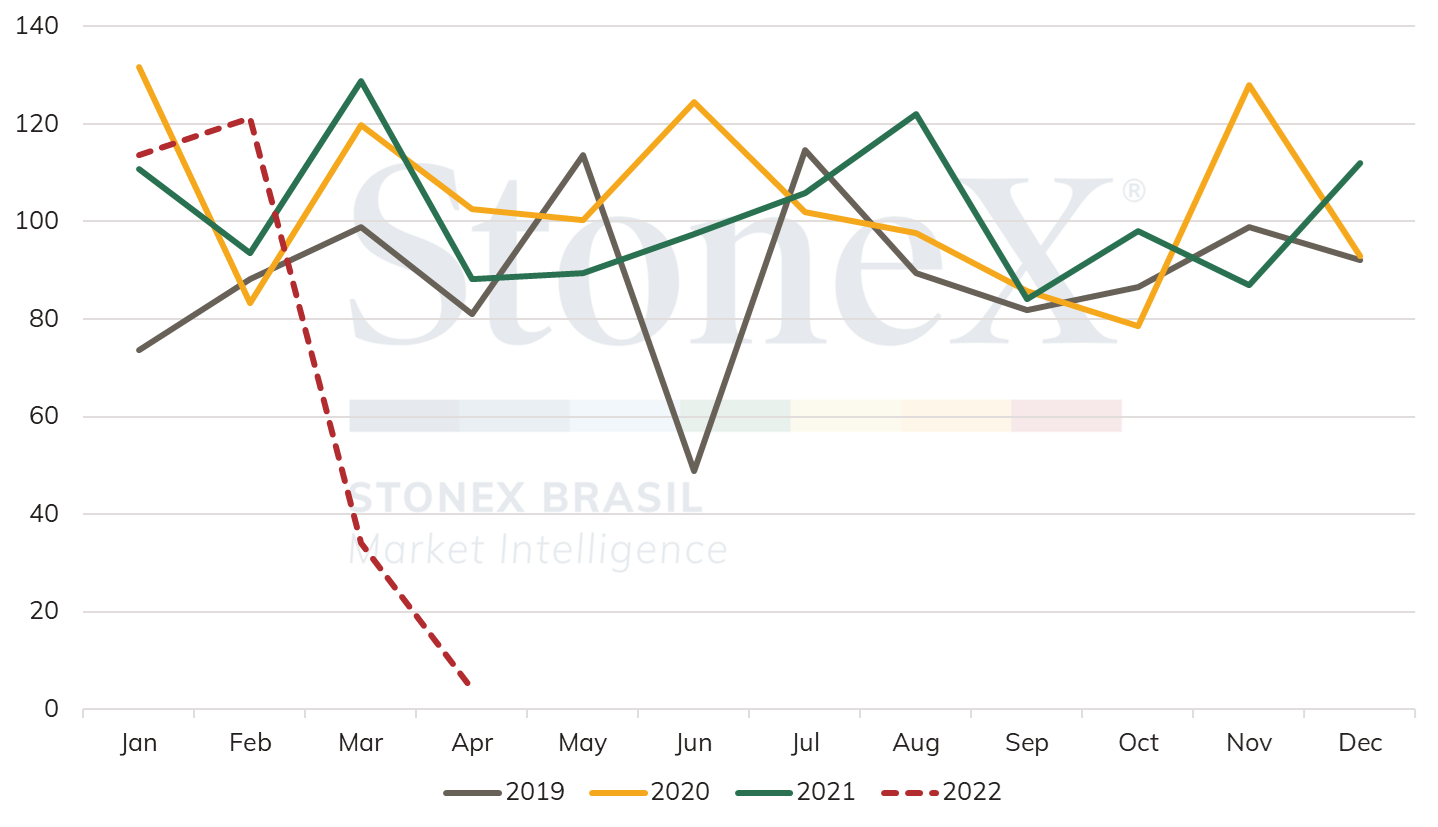
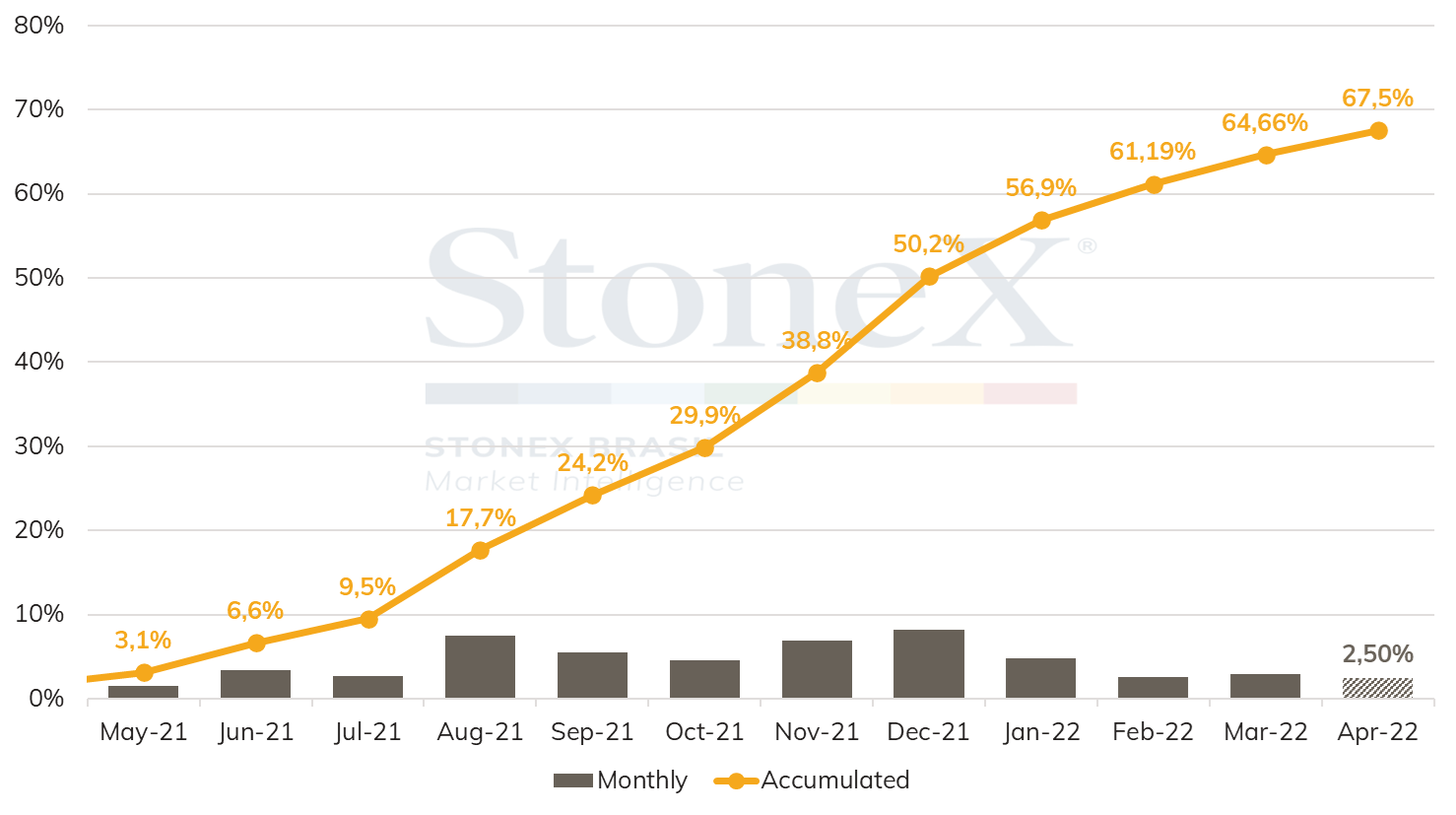
Another highlight was the sharp drop in exports to Russia in April, reinforcing the impacts of the war on Brazilian shipments. According to Cecafé's report, only 4,077 bags of coffee were sent to that country last month, a decrease of 95.4% from April last year and to the average of the last three years for the month, of about 90.6 thousand bags. The data also indicated that no soluble coffee bags were exported to the country, a category in which Moscow has the largest relative share of Brazilian shipments (9.4%) and is Brazil's second main trading partner with 378,000 bags imported in 2021, behind only the 704,000 imported by the United States. Last week, the Brazilian Soluble Coffee Industry Association (Abics) reported that Russia had stopped its soluble coffee purchases.
Brazilian coffee exports to Russia (thousand bags)
Source: Cecafé. Design: StoneX.
Suppose the war in Eastern Europe continues and coffee exports, in general, continue to be affected in similar proportions to April. In that case, the potential for a drop in total shipments from Brazil to Russia alone could reach more than 700,000 bags in the next seven months.
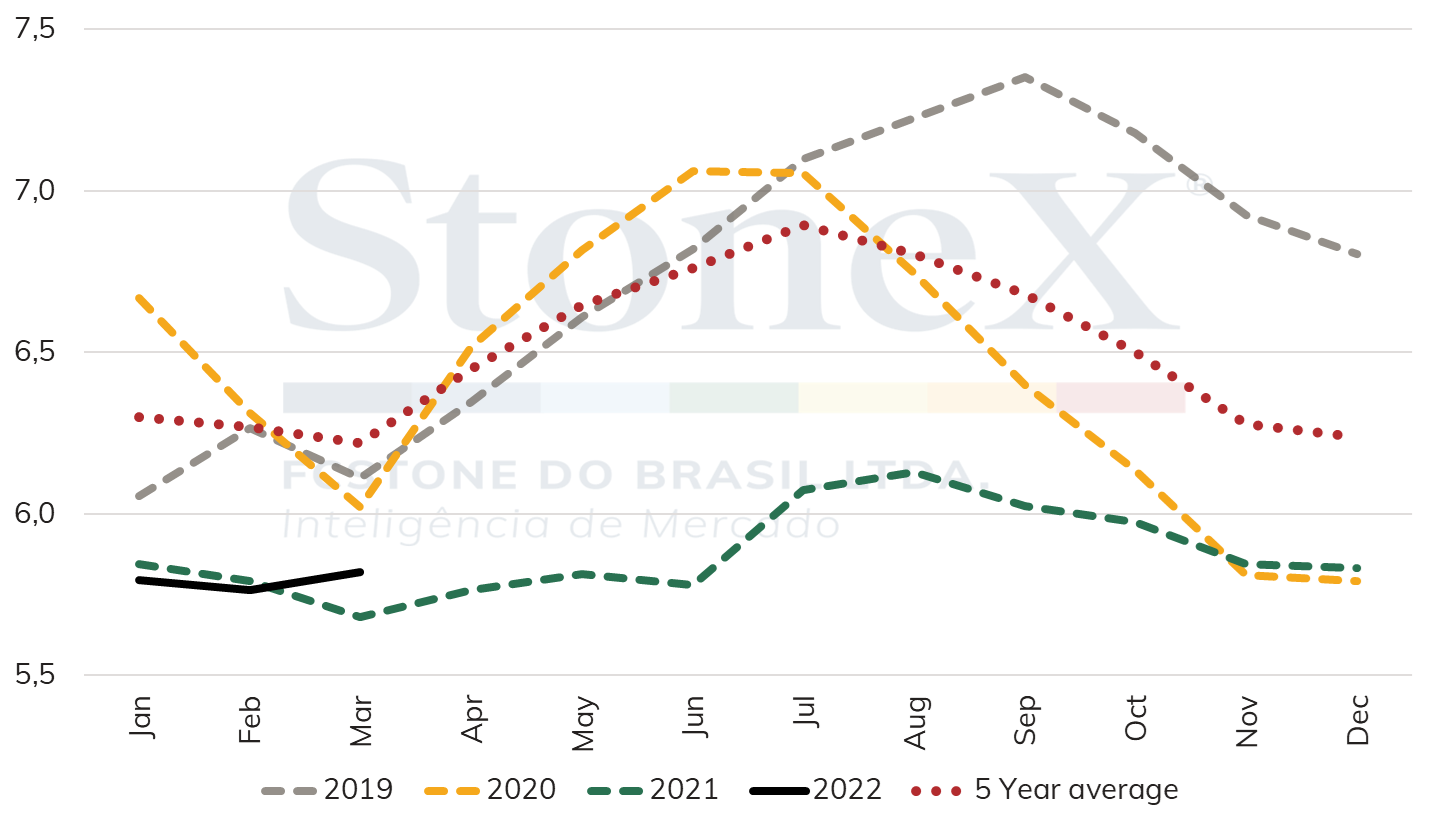
This Monday (16), the Green Coffee Association will release the report on coffee stocks at US ports for April. The last report showed an increase of almost 55,000 bags (0.95%) in March compared to the previous month. As can be seen in the seasonal graph of GCA stocks, there is a tendency for stocks to increase from March onwards. The seasonal pattern of GCA stocks reflects the higher import volumes of coffee from Central America, starting in March/April, and then the volumes coming from Colombia and Brazil in the second half of the year. Therefore, stock data may show substantial advances in April, which would act in a bearish manner for the coffee market.
Seasonality of coffee stocks at US ports - GCA (million bags)
Source: GCA. Design: StoneX.
USDBRL ends the week slightly lower
After appreciating for almost the entire week, the real/dollar pair retreated on Friday (13) to close with a weekly drop of 0.3%, quoted at BRL 5.058. Abroad, despite also retreating on Friday on a day of a slight reduction in global risk aversion, the dollar index showed a strong increase of 0.9% in the week, ending at 104.6 points, renewing its highest levels in nearly 20 years.
The appreciation of the American currency abroad has occurred due to the growing perception of a prolonged period of high inflation in global markets together with lower growth or, in certain economies, a possible retraction, which would characterize a situation of stagflation.