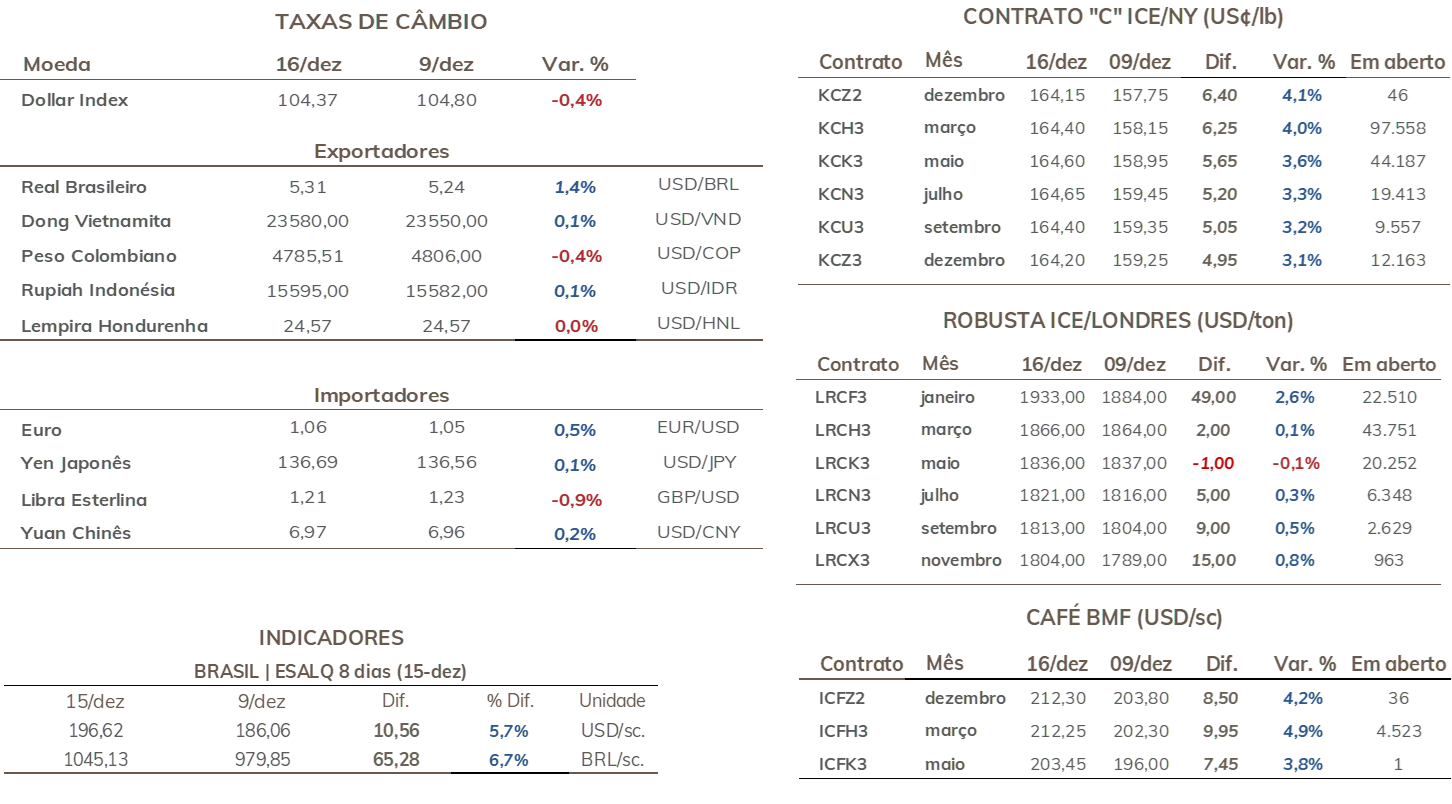
In Brazil, with few indicators to be released, the PEC continues this week as the main focus of investors. Before proceeding to vote on the Chamber proposal, deputies must wait for the definition of the judgment to suspend the so-called “secret budget” by the Superior Federal Court (STF), which should have its vote ended this Monday (19). The secret budget constitutes an important measure of parliamentary support in exchange for the release of public funds. The expiration of the deadline for approval of the PEC may lead the transition government to give in on some points regarding the proposal, such as reducing its value or its term, which, if it occurs, would tend to reduce the assessment of fiscal risks by investors and give some support to the Brazilian currency.
Abroad, the week was buoyed by the release of inflation indicators and interest rate decisions in the United States and Europe. The Federal Reserve confirmed what it had been signaling a few weeks ago and raised the US interest rate by 0,50 p.p. to the range between 4,25% and 4,50% per annum. Despite the reduction in the pace of adjustments, after four increases of 0,75 p.p., Fed members showed that despite signs of cooling inflation, it is necessary to continue raising the interest rate to achieve price stability.
In conjunction with the decisions, the Fed's revised quarterly projections for the US economy next year also raised concerns about a possible prolonged recession in 2023. The highlights are revisions to GDP growth from 1.2% to 0.5%, the unemployment rate from 4.4% to 4.6%, and consumer inflation from 2.8% to 3.1%. In addition, most members showed that they foresee the US basic interest rate between 5.00% and 5.25% at the end of 2023.
Following the Fed's lead, other major central banks in advanced economies, such as the Bank of England and the European Central Bank, also raised their key interest rates, reinforcing the effort to control an inflationary acceleration that has proven even more serious on the European continent.
The consumer price index (CPI) publication showed that inflation could continue to affect global demand even with reductions or slowdowns negatively. In the United States, the 12-month cumulative CPI fell from 7.7% in October to 7.1% in November, better than the market forecast of 7.3%. In Europe, the accumulated in 12 months showed a slight reduction from 10,6% to 10,1% in November. However, it frustrated analysts' expectations, who expected a reduction of 10,0%.
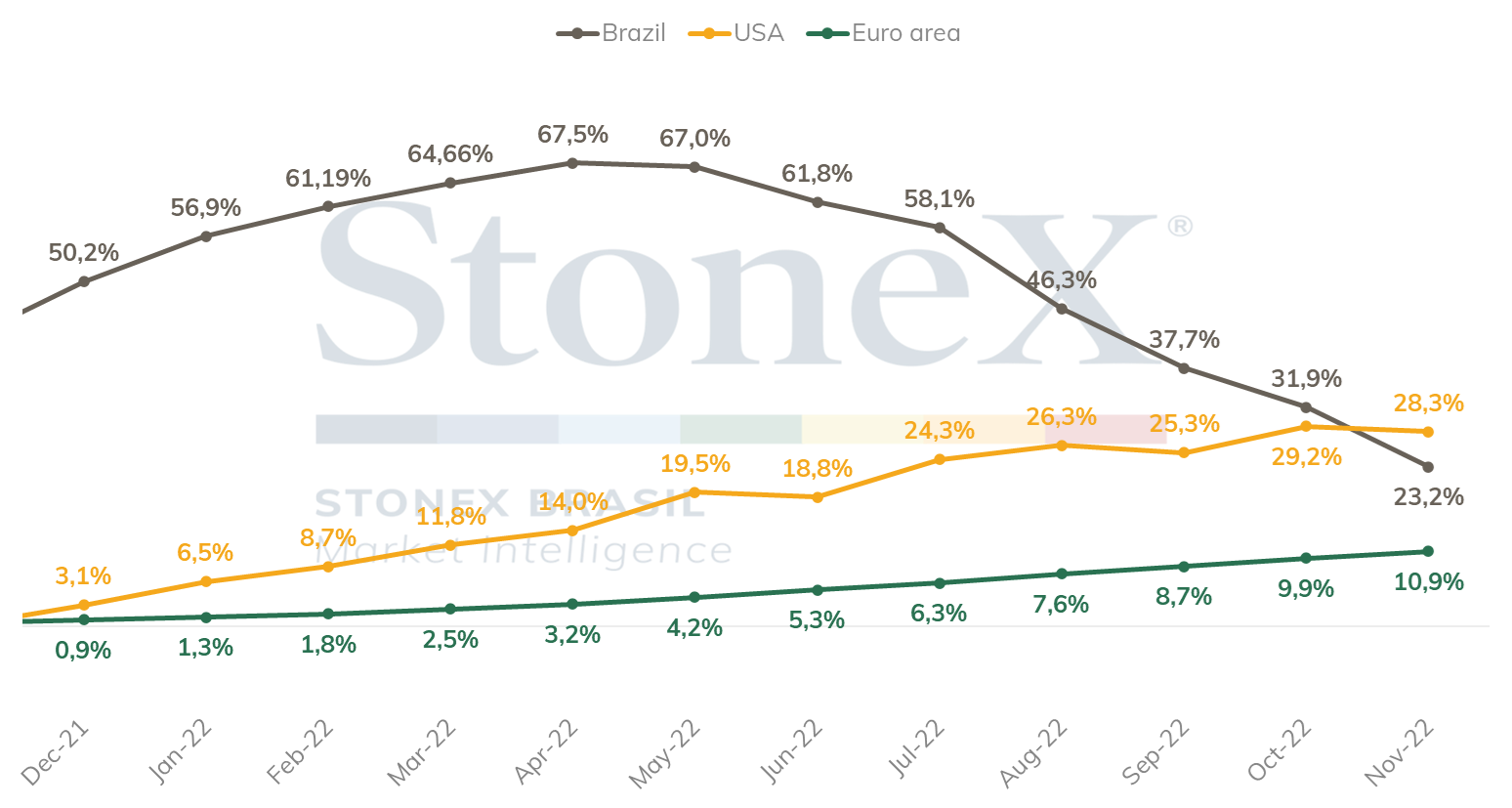
Coffee inflation to the consumer is still a source of concern regarding the consumption of the drink. The accumulated in 12 months in the United States remains at significantly high levels despite showing a slight reduction to 28,3%, in addition to not yet seeing a trend of sequences of reductions in the coming months as occurred in Brazil from May. The eurozone is also worried. The region accumulated follows in a sequence of advances, having reached double digits for the first time in November and its highest level since the beginning of the historical series for the European bloc.
12-month inflation of roasted and ground coffee to the consumer
Sources: BLS, Eurostat and IBGE. Design: StoneX.
On this week's economic calendar, the revision of the United States GDP for the 3rd quarter on Thursday (22) stands out, as well as indicators of consumer sentiment in the country. In addition, a gradual reduction in the pace of activity in global markets should also be noted as the Christmas and New Year holidays approach.
Source: ICE/NY; ICE/EU; B3; Commodity Network Trader’s Pro.