Quarterly Commodities Outlook is available for free now.  Download your report  →

StoneX logo

Coffee Weekly Report

By: StoneX Intelligence Brazil, StoneX Intelligence Brazil

Coffee futures hit a 3-month high last week
 
Fernando Maximiliano
 
Leonardo Rossetti
End of short-covering limited price increases. Trade remains attentive to estimates for Brazilian production and expectations for the 2023/24 S&D balance.
HIGHLIGHTS 

•    Arabica prices increased by 290 points (1.7%) in NY, closing at US₵ 172.80/lb.
•    Robusta coffee prices dropped by USD 22/t in London (1.1%) to USD 2031/t.
•    Cepea's Arabica indicator ended the week high by 1.7%, quoted at BRL 1,079.90/bag.
•    Cepea's Robusta indicator dropped by 0.7%, ending the week at BRL 682.77/bag.
•    Futures hit a 3-month high in New York.  
•    Less optimistic estimates boost coffee prices.  
•    As expectations for supply adjust, demand should regain importance in the medium term.
•    World exports dropped by 8.5% in December.
•    USDBRL advances amid tightening by world central banks.
•    Positive US jobs, services data add to US inflation fears
•    Copom maintains the interest rate at 13.75% in Brazil, showing a firm tone in its statement.  
•    Copom minutes, IPCA and data from Brazil's service and trade sectors are this week's highlights.

   Bearish factors        Bullish factors

Over the past week, Arabica and Robusta futures prices have reached a 3-month high, with the most active Arabica contract closing Tuesday's session at (31) U$₵ 181.75/lb, while the equivalent Robusta contract closed on at USD 2107/t. A strong short-covering by funds and speculative agents supported the bullish movement. The latest COT/CFTC report showed that, on 01/24, funds still had a net short position of more than 40 thousand contracts; the CFTC did not release the COT report last Friday (03) due, according to an official note, to a cyber incident.

With the end of the short-covering movement, coffee futures underwent a strong correction amid profit-taking by agents. In addition, the USDBRL strengthening, especially after the release of labor market data in the US, contributed to pressure on the commodity complex in general. The dollar index advanced after the report showed the creation of 517 new jobs, well above agents' expectation, which was around 180 thousand. The dollar's rise against the Brazilian currency on Friday also weighed on coffee quotes. 

Even with the losses at the end of the week, Arabica futures still ended the period with gains of 290 points (1.7%), closing Friday quoted at U$₵ 172.80/lb. On the other hand, the pullback of Robusta prices at the end of the week was able to drive its futures to a negative balance on the week, ending the period with losses of USD 22 (-1.07%), closing at USD 2031/t.
 

Weekly Intraday (most active contract) - Jan. 30 to Feb. 03

image 62818
Source: CommodityNetwork Traders ' Pro. Design: StoneX.

In Brazil, coffee prices in the domestic market followed the same moves seen in the international market, with Arabica prices ending the week on a high and Robusta prices posting declines. Cepea's Arabica indicator showed an increase of 1.7% in the week to BRL 1079.90/bag. Cepea's Robusta indicator ended the week with losses of 0,72%, closing at R$ 682,77/bag.

In the coming weeks, the coffee market is expected to react to the export data of the countries in January, to the GCA inventory data scheduled for Jan 15, and to the estimates for Brazilian production in 2023. In addition, the events in the macroeconomic field will also be on the agents' radar, especially the analyzes linked to the prospects for inflation and the growth of the world economy.

With progress in production data, prospects for coffee demand should take center stage
As mentioned in other editions of this report, the last week's advances happened after the release of the first reports with estimates for Brazilian production in 2023. Unfortunately, part of the estimates presented has pointed to production much lower than the agents' expectations, who believed in massive production in the next crop cycle. Although there are estimates higher than 75 million bags, the average of the estimates released so far points to production between 60 and 65 million bags. On Monday (13), StoneX will release the final report of the crop tour and its estimates for Brazilian production in 2023. 
With the increase in production data, another important aspect of the supply and demand balance begins to take greater prominence – demand. Due to the lack of transparency and uncertainty, estimating coffee demand becomes challenging. 
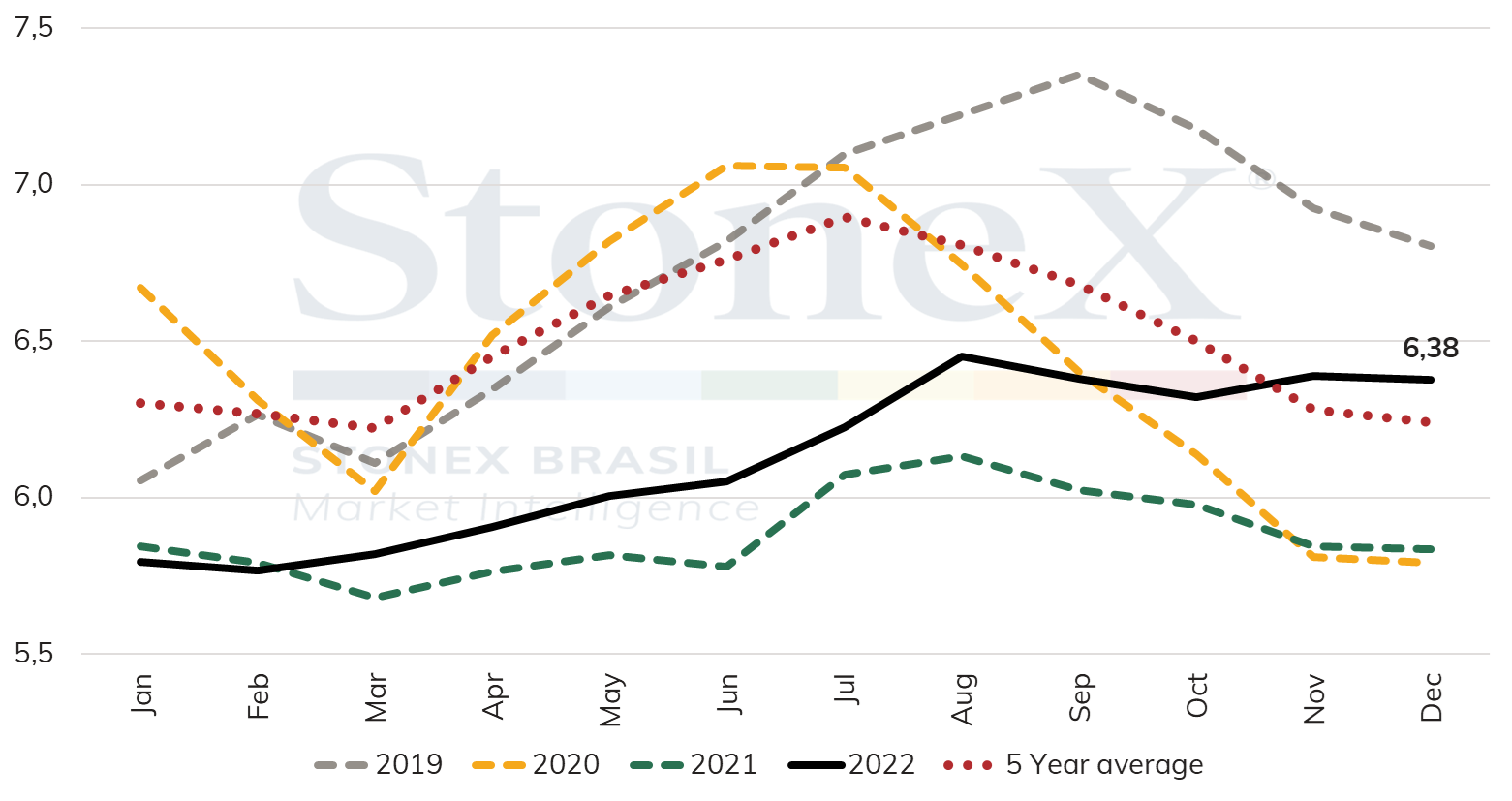
Data for the US, the largest global consumer of the beverage, show that inventories reported by GCA have advanced in recent months. Imports also advanced in 2022, compared to 2021, but are still below the level observed in 2019, the pre-pandemic period. For other countries, the lack of data, such as for stocks, becomes a barrier to accurately estimating consumption. From now on, several estimates and evidence should be closely monitored, such as countries' inflation and economic growth projections, the data on inventories, exports, imports, and the results of companies in the sector. 
 

Stocks at US ports - GCA (milhões de sacas)

image 62819
Source: GCA. Design: StoneX. 
World coffee exports dropped by 8.5% in December
The latest report by the International Coffee Organization (ICO) showed that global coffee exports totaled 10.88 million bags in December, a volume 8.5% lower than that observed in December 2021, when 11.89 million bags were exported. The accumulated exports of 2022 totaled 79.67 million bags of Arabica coffee, 1.1% lower than that observed in 2021, and 48.29 million bags of Robusta, almost unchanged compared to 2021. 
USDBRL INCREASES amid tightening by world central banks

Impacted by monetary policy decisions abroad and in Brazil, the USDBRL ended last week by 0.6% at BRL 5.146. The dollar index also posted an increase of 1.0% to end at 102.8 points, boosted in the last two sessions of the week after positive activity data for the US currency.

Abroad, the decisions of the Federal Reserve in the United States, the European Central Bank (ECB) and the Bank of England (BoE) came within expectations of continued monetary tightening, but to a lesser extent. In the US, the Fed raised the rate to the range between 4.50% and 4.75% per annum, an increase of 25 basis points, after increases of 75 basis points in November and 50 points in December. The lower increase confirms the market's view that the country is going through a process of inflationary slowdown, which has allowed the US central bank to be softer in its adjustment. However, Fed Chairman Jerome Powell warned that many components of the economy are yet to show an inflationary slowdown, particularly the services sector.

On Friday, the January Labor Situation Report showed 517 thousand jobs created, well above expectations of 185 thousand. The services PMI also brought a positive surprise, rising from 49.2 points in December to 55.2 points, significantly above the 50-point threshold that separates a contraction and expansion condition. If, on the one hand, the recovery of the economy decreases the fear of a recession, on the other, it shows that the heated demand increases the difficulties of the Monetary Authority in regaining stability. In practice, the results raise the perception that the Fed may have to seek more increases or keep the rate high for longer than previously anticipated, which attracts greater foreign exchange flow to the US currency and puts pressure on risky assets such as emerging currencies or commodities.

In Brazil, the Monetary Policy Committee (Copom) of the Central Bank (BC) maintained the basic interest rate (Selic) at 13.75%, presenting a firm tone, signaling the intention to postpone rate cuts to ensure the disinflationary process in the country and stating that it remains alert to the risks and uncertainties concerning the fiscal policy of the new government. This Tuesday, the minutes of last week's meeting should have new information regarding the debate among committee members to postpone the rate cuts. In addition to the minutes, this week's agenda highlights the National Broad Consumer Price Index (IPCA) for January, which IBGE will publish on Thursday (9). Furthermore, the Monthly Survey of Trade and the Monthly Survey of Services for December, which will be released on Thursday and Friday, respectively, will help in reading about the performance of the Brazilian economy at the end of 2022 and in forming expectations for the GDP result in the last quarter and the year.
 

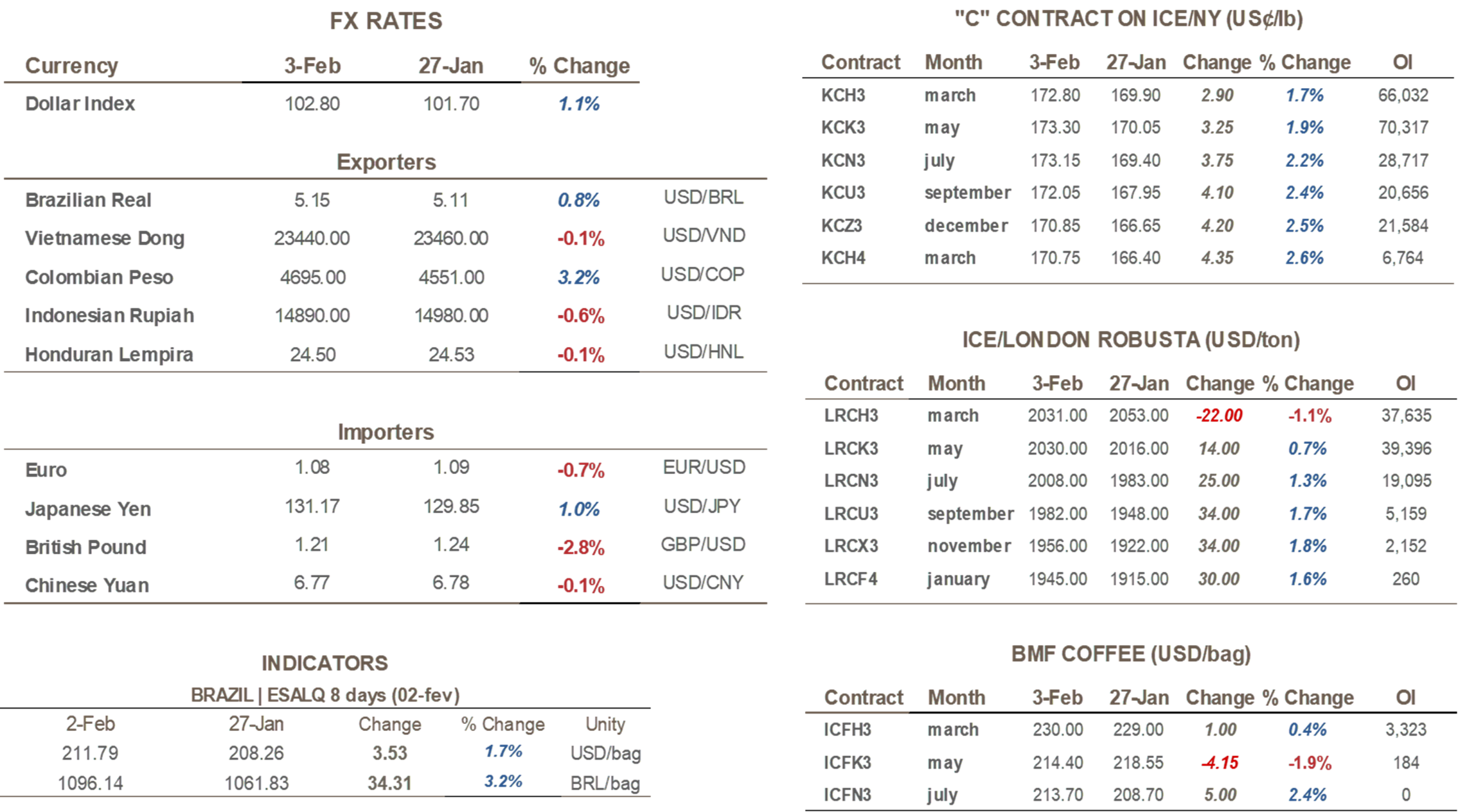
INDICATORS
image 62821
Fontes: ICE/NY; ICE/EU; B3; Commodity Network Trader’s Pro.

 

image 58497


  • Coffee

The StoneX Group Inc. group of companies provides financial services worldwide through its subsidiaries, including physical commodities, securities, exchange-traded and over-the-counter derivatives, risk management, global payments and foreign exchange products in accordance with applicable law in the jurisdictions where services are provided. References to over-the-counter (“OTC”) products or swaps are made on behalf of StoneX Markets LLC (“SXM”), a member of the National Futures Association (“NFA”) and provisionally registered with the U.S. Commodity Futures Trading Commission (“CFTC”) as a swap dealer. SXM’s products are designed only for individuals or firms who qualify under CFTC rules as an ‘Eligible Contract Participant’ (“ECP”) and who have been accepted as customers of SXM. StoneX Financial Inc. (“SFI”) is a member of FINRA/NFA/SIPC and registered with the MSRB. SFI is registered with the U.S. Securities and Exchange Commission (“SEC”) as a Broker-Dealer and with the CFTC as a Futures Commission Merchant and Commodity Trading Adviser. References to securities trading are made on behalf of the BD Division of SFI and are intended only for an audience of institutional clients as defined by FINRA Rule 4512(c). References to exchange-traded futures and options are made on behalf of the FCM Division of SFI . StoneX is a trading name of StoneX Financial Ltd (“SFL”). SFL is registered in England and Wales, Company No. 5616586. SFL is authorized and regulated by the Financial Conduct Authority [FRN 446717] to provide to professional and eligible customers including: arrangement, execution and, where required, clearing derivative transactions in exchange traded futures and options. SFL is also authorised to engage in the arrangement and execution of transactions in certain OTC products, certain securities trading, precious metals trading and payment services to eligible customers. SFL is authorised & regulated by the Financial Conduct Authority under the Payment Services Regulations 2017 for the provision of payment services. SFL is a category 1 ring-dealing member of the London Metal Exchange. In addition SFL also engages in other physically delivered commodities business and other general business activities which are unregulated and not required to be authorised by the Financial Conduct Authority. StoneX Group Inc. acts as agent for SFL in New York with respect to its payments services business. StoneX APAC Pte. Ltd. acts as agent for SFL in Singapore with respect to its payments services business. ‘StoneX’ is the trade name used by StoneX Group Inc. and all its associated entities and subsidiaries.
 
Trading swaps and over-the-counter derivatives, exchange-traded derivatives and options and securities involves substantial risk and is not suitable for all investors. Past performance of any futures or option is not indicative of future success. Indicators are not a trading system and are not published as a specific trade recommendation. The information herein is not a recommendation to trade nor investment research or an offer to buy or sell any derivative or security. It does not take into account your particular investment objectives, financial situation or needs and does not create a binding obligation on any of the StoneX group of companies to enter into any transaction with you. You are advised to perform an independent investigation of any transaction to determine whether any transaction is suitable for you. No part of this material may be copied, photocopied or duplicated in any form by any means or redistributed without the prior written consent of StoneX Group Inc.
 
© 2026 StoneX Group Inc. All Rights Reserved.

Satellite view of Earth at night showing illuminated cities across Asia and the Middle East

Discover more insights

Our subscribers have access to comprehensive market analysis from StoneX spanning commodities, equities, currencies and more.

StoneX: We open markets

Our market expertise, advanced platforms, global reach, culture of full transparency and commitment to our clients’ success all set us apart in the financial marketplace.

Reach

With access to 40+ derivatives exchanges, 180+ foreign exchange markets, nearly every global securities marketplace and numerous bi-lateral liquidity venues, StoneX’s digital network and deep relationships can take clients anywhere they want to go.

Transparency

As a publicly traded company meeting the highest standards of regulatory compliance in the markets we serve; our financials and record of accomplishment are matters of public record. StoneX’s commitment to “doing the right thing over the easy thing” sets us apart in the industry and helps us build respect, client trust and new partnerships.

Expertise

From our proprietary Market Intelligence platform, to “boots on the ground” expertise from award-winning traders and professionals, we connect our clients directly to actionable insights they can use to make more informed decisions and achieve their goals in the global markets.