
Daily Coffee Report 8/5/26
Daily coffee report
StoneX Coffee Team
- Coffee
Quarterly Commodities Outlook is available for free now. Download your report →
By: StoneX Intelligence Brazil, StoneX Intelligence Brazil


▼ Bearish drivers ▲ Bullish drivers
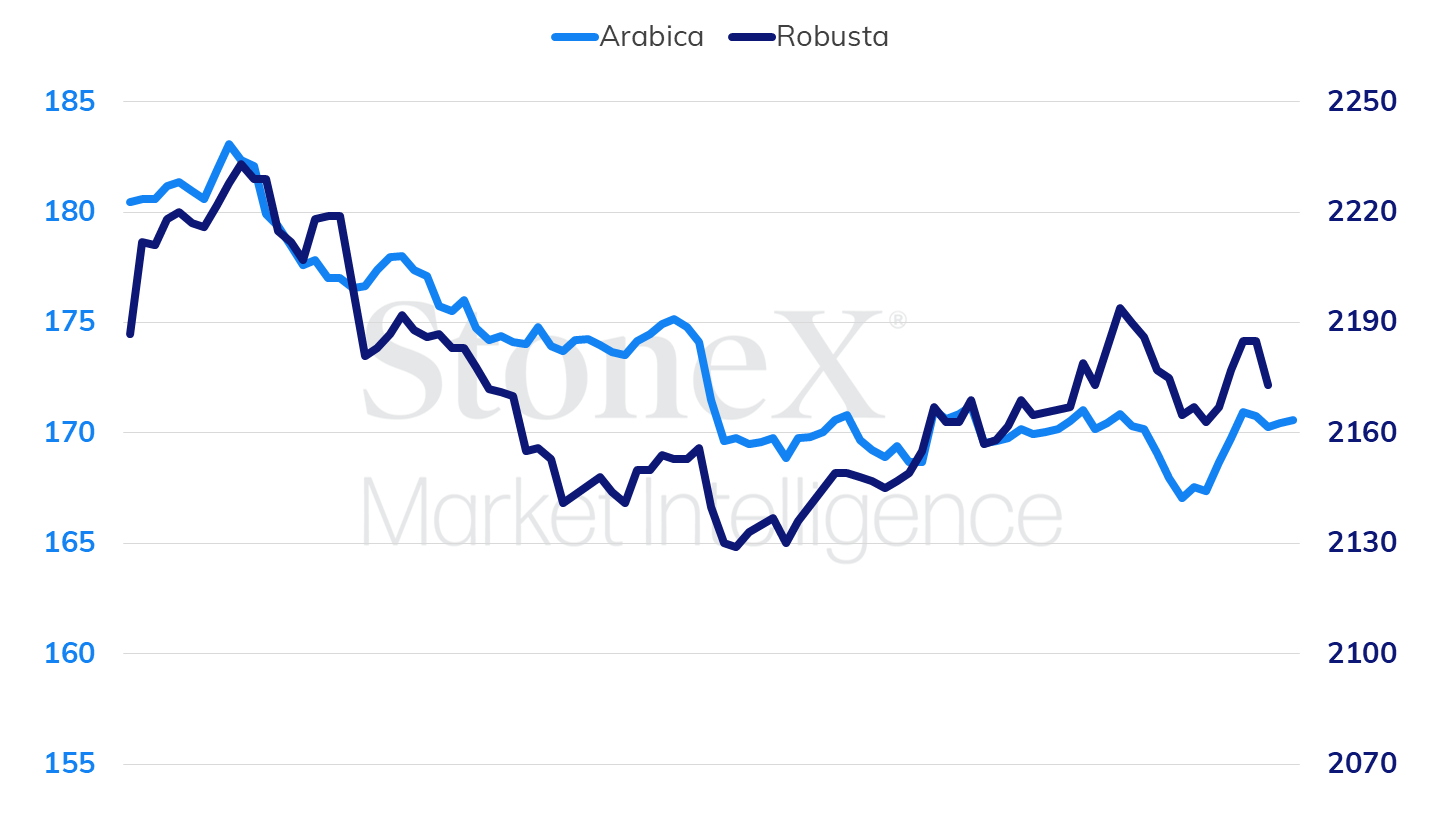
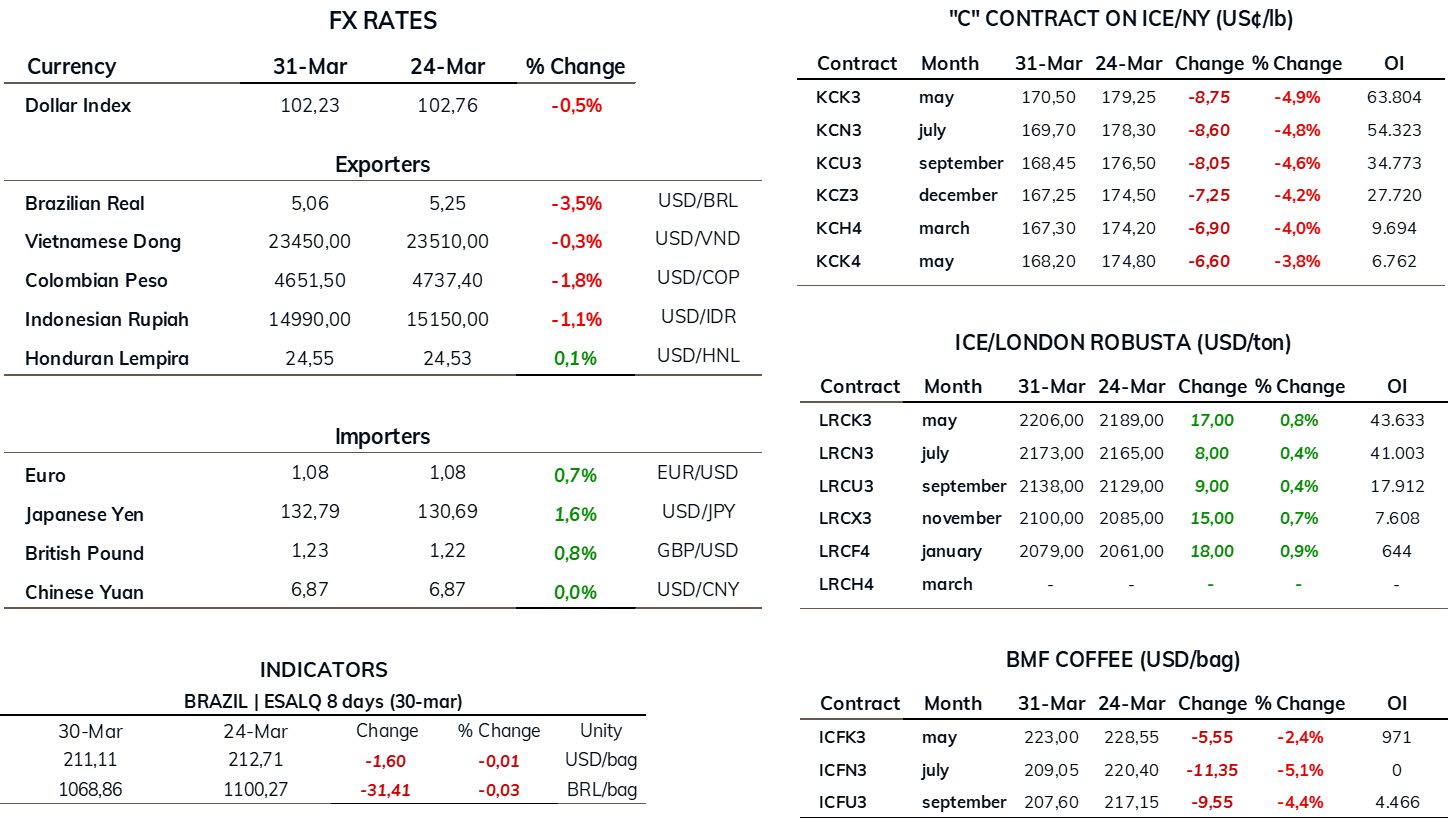
In the last week of March, arabica coffee futures prices closed Friday (31) with 875 points (4.9%) of losses, quoted at 170.50 c/lb, with the monthly variation showing an even more intense fall, with losses of 1580 points (8.5%) during the month of March. With no major changes in fundamentals, prices followed technical factors during the week. Part of the strong fall seen last week can be attributed to a strong liquidation movement from speculative agents.
In London, the most active contract ended with gains of USD 17/t (0.8%) in the week and gains of USD 66/t (3.1%) in the month, closing the last session of March quoted at USD 2206/t. Robusta coffee prices rose higher due to technical factors and agents' concern with the supply of the product.
While Vietnam, the world's largest producer of this variety, is at the beginning of the inter-crop period, Indonesia, the third largest producer of Robusta in the world, faced adverse weather conditions, which should impact the country's production. According to an article by Bloomberg after an interview with the Association of Exporters and Coffee Industry of Indonesia, production should total 9.6 million bags, representing a decrease of 20% compared to 2022, which is a result of excessive rainfall in the country.
Weekly Intraday (most active contract) | March 27 to 31
In the Brazilian domestic market, both varieties ended in decline, but arabica coffee had more pronounced losses. The Cepea indicator for arabica coffee ended last week quoted at BRL 1044.94/bag, representing a drop of 6.9% in the week and 10% in the month. On the other hand, Robusta coffee prices closed the last session of March with the Cepea indicator at BRL 638.64/bag, indicating losses of just 0.3% in the week, but a fall of 8% in the month.
Both Arabica and Robusta coffee markets were more influenced by movements in the type “C” contract in New York. Therefore, the decline in prices reflects the drop in prices in NY as well as the dollar decline in the period. The USDBRL pair ended quoted at USDBRL 5.06, reflecting a drop of 3.4% in the week and 3.3% in the monthly variation.
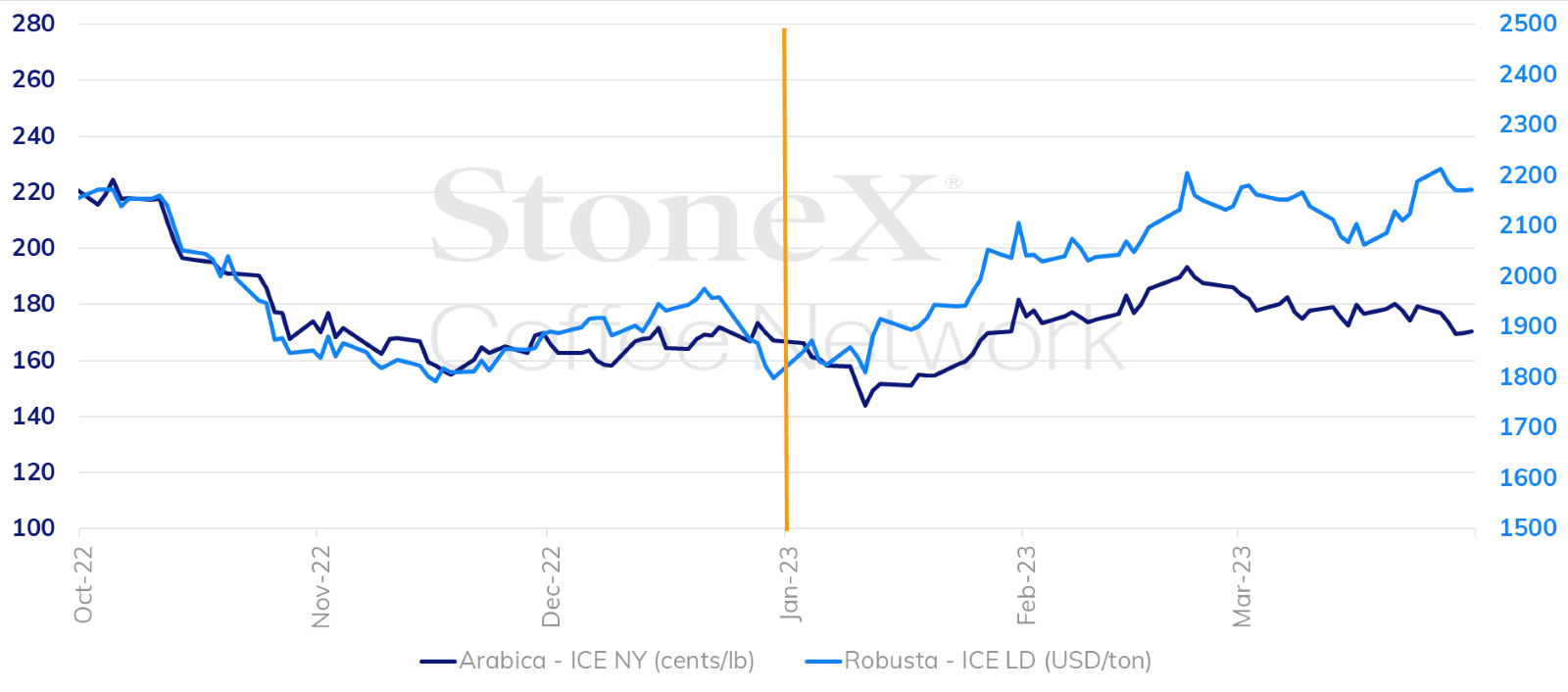
Since the last quarter of 2022, arabica coffee futures prices have been under pressure amid the prospects of a large crop in Brazil, following the return of rains to the country's coffee belt and concerns about demand due to the inflation scenario and doubts regarding the growth of the global economy. In the last quarter of 2022, arabica coffee futures prices accounted for losses of 24.5% while Robusta prices retreated 16.4%.
Marked by volatility, the first quarter of this year was positive for coffee futures prices, mainly robusta. Since the beginning of the year, arabica quotes rose by 15.6% to a maximum 193.35 c/lb on February 22, but the movement lost strength and prices retreated, consolidating an advance of only 1.9% at the end of the quarter. On the other hand, the future prices of robusta gained 23% to the quarter's highest value of USD 2214/t at the close of March 27, later retreating to USD 2173/t and consolidating an increase of 20.8% in the first quarter of the year.
Trend of arabica and robusta coffee futures prices
While coffee prices continued to be pressured amid optimism about the Brazilian crop in 2023, with projections by some agents reaching above 75 million bags, the release of several estimates, including StoneX, indicated that the crop would not be so large, which frustrated some of the agents and supported the price rises.
The average of available estimates for coffee production in 2023 is 63.5 million bags. After carrying out a study, StoneX estimated the Brazilian crop at 62.3 million bags, of which 40.7 million should be arabica coffee and 21.6 million robusta coffee. For robusta, prices rise in reaction to agents' concerns with supply, mainly due to the inter-crop period in Vietnam and the drop in production in Indonesia.
Range of estimates for coffee production in Brazil (million bags)
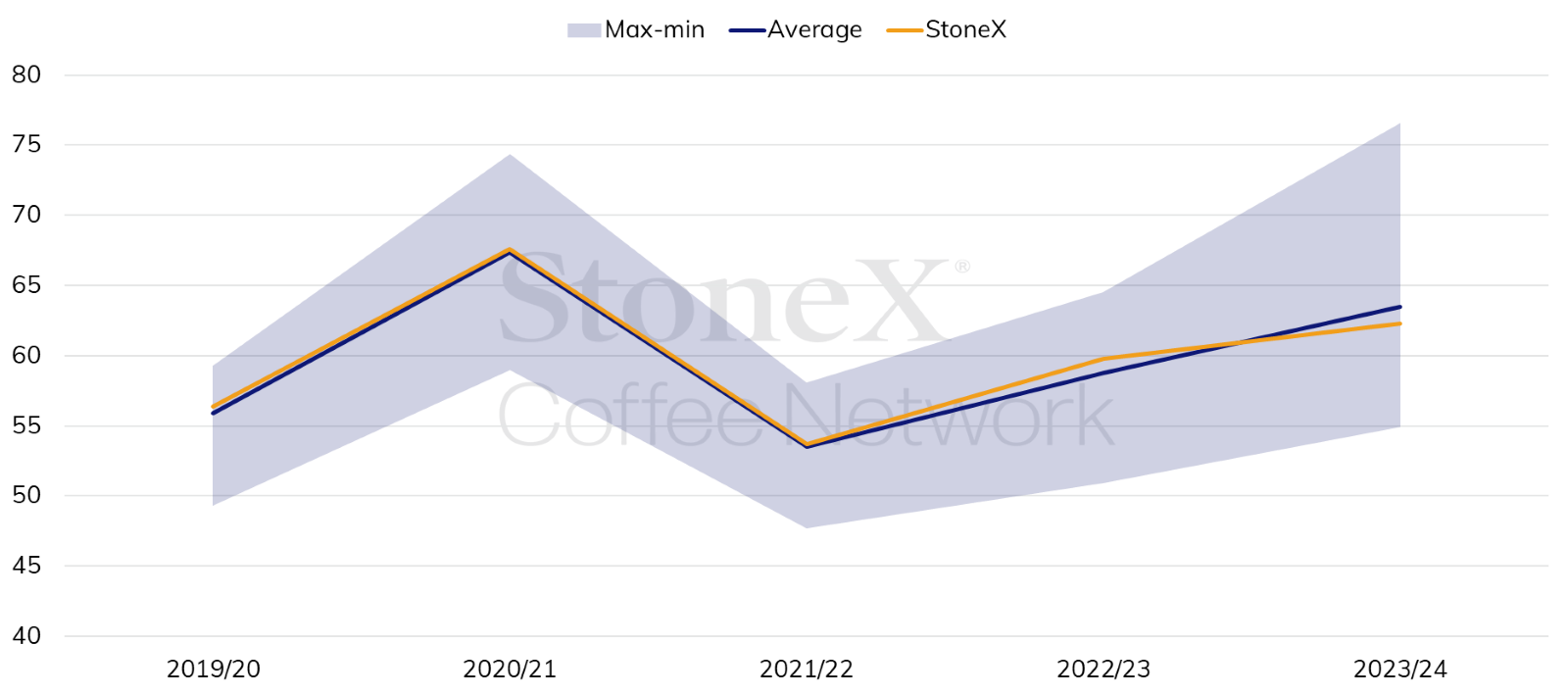
One factor that limited advances and pressured arabica prices at the end of the quarter was concerns about demand amid inflation. According to Brazil's Abic, there was a 35% inflation in roasted and ground coffee, resulting in a drop of more than 1% in consumption. While the pace of inflation lost strength in Brazil, the pace of inflation in the US and Europe is still worrying. For the next quarter, demand will continue to be a point of attention and the indicators of exports, imports and, mainly, stocks and inflation in consuming countries, should indicate their pace of consumption.
In addition, the period may suffer from volatility due to the start of the Brazilian winter, considering that, although there are still no signs, a polar mass with the potential to cause frost may support price increases and generate volatility, since they tend to retreat if the event does not happen. It is important to mention that, despite the uncertainties, coffee prices should be pressured as the new Brazilian crop is harvested and made available on the market.
Finally, much of the attention will turn to the USDA attaché reports, which will bring details on coffee production in the countries in 2023 and should be released in the second half of May, but without a defined date. On June 22, the USDA will release its final report with the perspectives for the global balance of supply and demand in 2023/24.
Last week saw continuous devaluations of the exchange rate in the Brazilian foreign exchange market, influenced by reduced fears about a financial crisis in the United States and Europe and the disclosure of a new fiscal framework proposed by the current government, which contributed to agents recovering the appetite for the Brazilian currency. In this scenario, the dollar closed with a change of 3.4% in the week and 3.0% in the month, closing last Friday (31) at BRL 5.07.
While concerns about a banking crisis are gradually being reduced, market participants should monitor the banks' quarterly earnings reports throughout April, in particular small US regional banks, in order to assess whether the nation's financial system remains sound.
In Brazil, the disclosure of a new framework for fiscal policy by the current government's economic team, which seeks to provide greater predictability for public accounts in the coming years, received a generally positive repercussion from investors, which also contributed positively to the Brazilian real's appreciation.
The first quarter of the year was very volatile for the Brazilian foreign exchange market, which ended the period with an appreciation of 1.0% compared to the end of 2022. The dollar in Brazil, which historically tends to have a negative correlation with coffee prices for the most part, has not shown such influence in this period. In the last 12 months, the correlation between the USDBRL pair and the 1st contract on the New York exchange was -40.4%, that is, dollar declines positively influenced the price of coffee, and vice versa, but in the last three months the correlation reached 5.0%.
Coffee quotes (KCc1) vs. USDBRL in Q1 2023
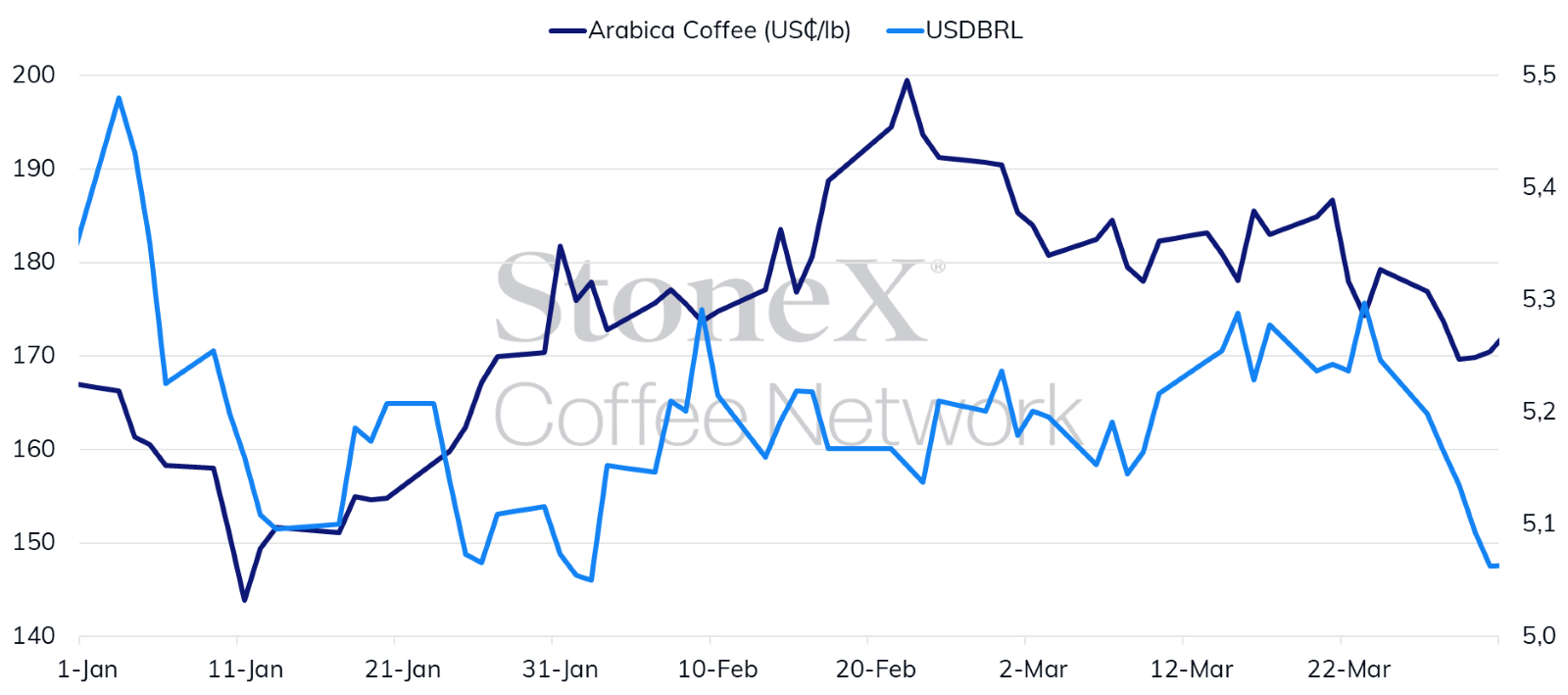
Despite a brief period of time, the performance shows how the exchange rate played a secondary role for coffee prices, especially in January and February, when they were significantly impacted by the realignment in general market sentiment, with some agents reducing their expectations of a possible record crop in Brazil.
Seasonally, in the inter-crop period, especially between April and June, when market fundamentals are more mutated, the negative correlation between dollar prices and coffee reaches its most accentuated period. Even though it is not a rule, this must be a fundamental moment to monitor the macroeconomic scenario. The aversion to the risk of a banking crisis, the expectations for global inflation and interest rates of the main central banks in the world and the development of the Brazilian fiscal framework proposal in the Chamber of Deputies and Senate, as well as its influence on the Central Bank's next decisions, will be the focus of coffee market participants, with possibilities of strong influence on the exchange rate, and, as a consequence, on coffee prices both in the physical market and on the exchange.

The StoneX Group Inc. group of companies provides financial services worldwide through its subsidiaries, including physical commodities, securities, exchange-traded and over-the-counter derivatives, risk management, global payments and foreign exchange products in accordance with applicable law in the jurisdictions where services are provided. References to over-the-counter (“OTC”) products or swaps are made on behalf of StoneX Markets LLC (“SXM”), a member of the National Futures Association (“NFA”) and provisionally registered with the U.S. Commodity Futures Trading Commission (“CFTC”) as a swap dealer. SXM’s products are designed only for individuals or firms who qualify under CFTC rules as an ‘Eligible Contract Participant’ (“ECP”) and who have been accepted as customers of SXM. StoneX Financial Inc. (“SFI”) is a member of FINRA/NFA/SIPC and registered with the MSRB. SFI is registered with the U.S. Securities and Exchange Commission (“SEC”) as a Broker-Dealer and with the CFTC as a Futures Commission Merchant and Commodity Trading Adviser. References to securities trading are made on behalf of the BD Division of SFI and are intended only for an audience of institutional clients as defined by FINRA Rule 4512(c). References to exchange-traded futures and options are made on behalf of the FCM Division of SFI . StoneX is a trading name of StoneX Financial Ltd (“SFL”). SFL is registered in England and Wales, Company No. 5616586. SFL is authorized and regulated by the Financial Conduct Authority [FRN 446717] to provide to professional and eligible customers including: arrangement, execution and, where required, clearing derivative transactions in exchange traded futures and options. SFL is also authorised to engage in the arrangement and execution of transactions in certain OTC products, certain securities trading, precious metals trading and payment services to eligible customers. SFL is authorised & regulated by the Financial Conduct Authority under the Payment Services Regulations 2017 for the provision of payment services. SFL is a category 1 ring-dealing member of the London Metal Exchange. In addition SFL also engages in other physically delivered commodities business and other general business activities which are unregulated and not required to be authorised by the Financial Conduct Authority. StoneX Group Inc. acts as agent for SFL in New York with respect to its payments services business. StoneX APAC Pte. Ltd. acts as agent for SFL in Singapore with respect to its payments services business. ‘StoneX’ is the trade name used by StoneX Group Inc. and all its associated entities and subsidiaries.
Trading swaps and over-the-counter derivatives, exchange-traded derivatives and options and securities involves substantial risk and is not suitable for all investors. Past performance of any futures or option is not indicative of future success. Indicators are not a trading system and are not published as a specific trade recommendation. The information herein is not a recommendation to trade nor investment research or an offer to buy or sell any derivative or security. It does not take into account your particular investment objectives, financial situation or needs and does not create a binding obligation on any of the StoneX group of companies to enter into any transaction with you. You are advised to perform an independent investigation of any transaction to determine whether any transaction is suitable for you. No part of this material may be copied, photocopied or duplicated in any form by any means or redistributed without the prior written consent of StoneX Group Inc.
© 2026 StoneX Group Inc. All Rights Reserved.
Our subscribers have access to comprehensive market analysis from StoneX spanning commodities, equities, currencies and more.
Daily coffee report

August 5 – U.S. equities markets are on fire this week, with both the Dow Jones and S&P 500 setting new all-time highs yesterday with futures indicating further gains again today; the marketplace remains optimistic over a deal with Iran despite no evidence of such as of yet. Crude oil is working on a lower high and low today but remains slightly on the high side on the session, while the dollar is retreating back towards Monday’s nearly two-month low. The ten-year note is steady-to-lower this morning (though solidly lower so far this month) at 4.605%, while the VIX index continues to rebound into mid-week at almost a 17-point reading this morning.

Brazil could still deliver a record arabica crop, but the bigger question for growers is what the next season holds. Out of season flowering and the swing of El Niño have put the spotlight on the rains still to come.

Our market expertise, advanced platforms, global reach, culture of full transparency and commitment to our clients’ success all set us apart in the financial marketplace.
Reach
With access to 40+ derivatives exchanges, 180+ foreign exchange markets, nearly every global securities marketplace and numerous bi-lateral liquidity venues, StoneX’s digital network and deep relationships can take clients anywhere they want to go.
Transparency
As a publicly traded company meeting the highest standards of regulatory compliance in the markets we serve; our financials and record of accomplishment are matters of public record. StoneX’s commitment to “doing the right thing over the easy thing” sets us apart in the industry and helps us build respect, client trust and new partnerships.
Expertise
From our proprietary Market Intelligence platform, to “boots on the ground” expertise from award-winning traders and professionals, we connect our clients directly to actionable insights they can use to make more informed decisions and achieve their goals in the global markets.