Access: El Niño and its possible impacts on world coffee production
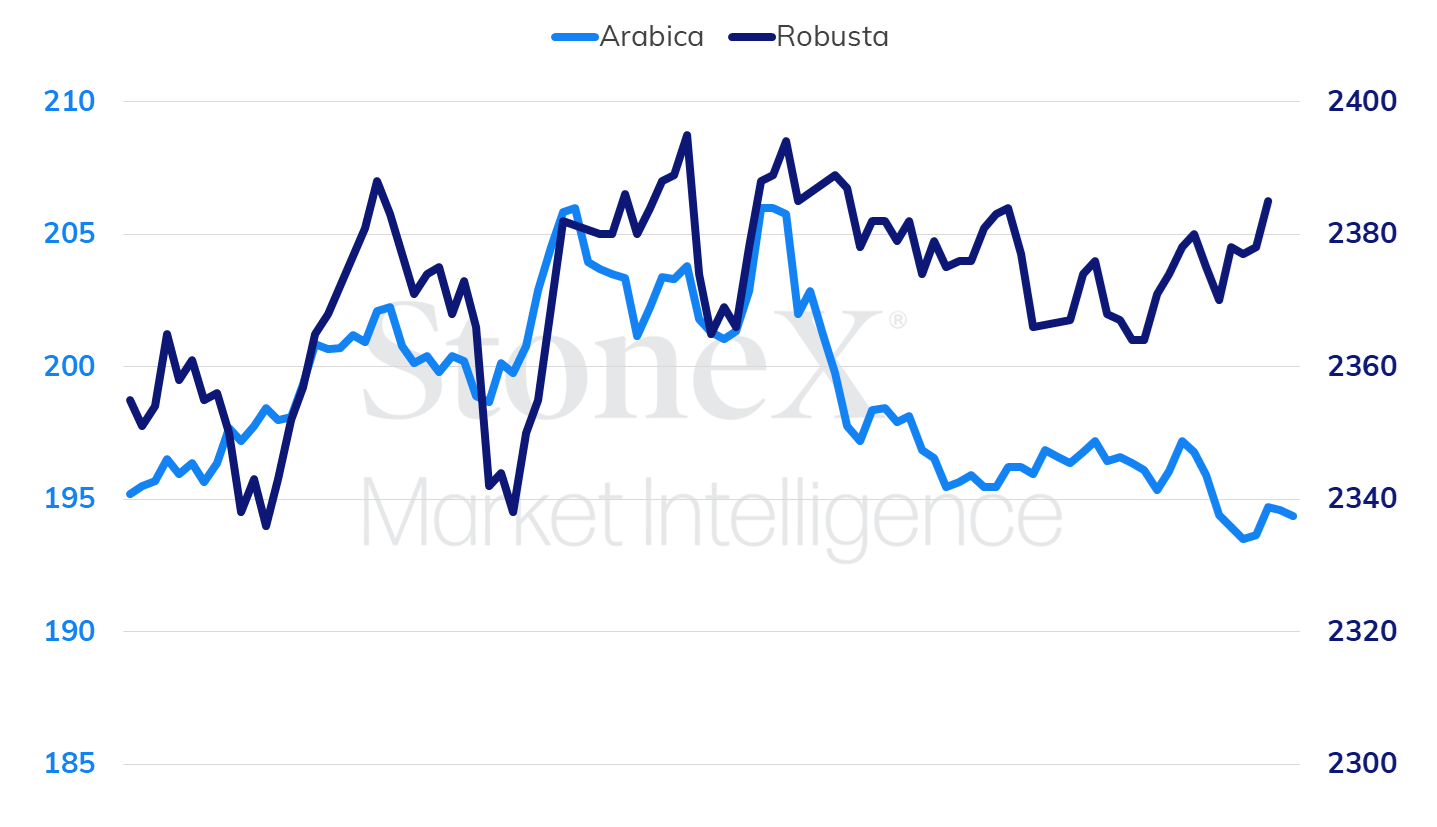
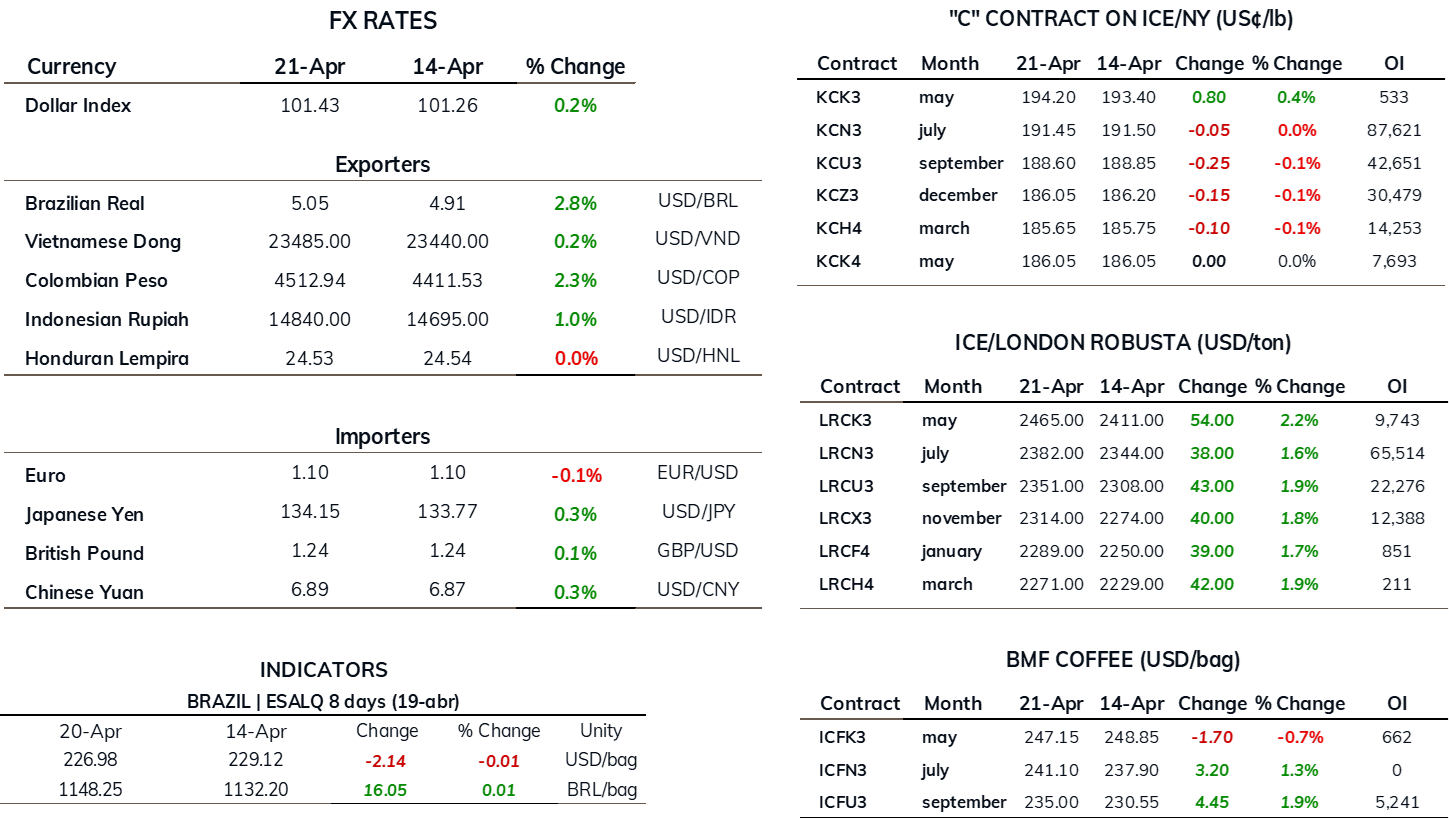
Arabica futures started the week extending the increase in prices seen in recent weeks, with the most active contract (July) advancing 1,155 points (6.0%) in the first two sessions of the week. However, the movement lost momentum, and quotes retreated for the rest of the week, with the referred contract closing Friday's session (21) steady at US₵ 191.45/lb. In London, the upward movement extended for almost the entire week, supporting an increase of USD 38 (1.6%), closing Friday's session at USD 2,382/t.
In the Brazilian domestic market, coffee prices ended Thursday (20) with mixed results – the Brazilian market was closed on Friday (21) due to the Tiradentes Day holiday. The Cepea indicator for Arabica ended the week at BRL 1,111.77/ bag, posting a drop of 1.2% compared to the previous week. For Robusta coffee, the indicated showed an increase of only 0.1%, closing quoted at BRL 665.23/bag.
Weekly Intraday (most active contract) - April 17 to 20
Source: CommodityNetwork Traders' Pro. Design: StoneX.
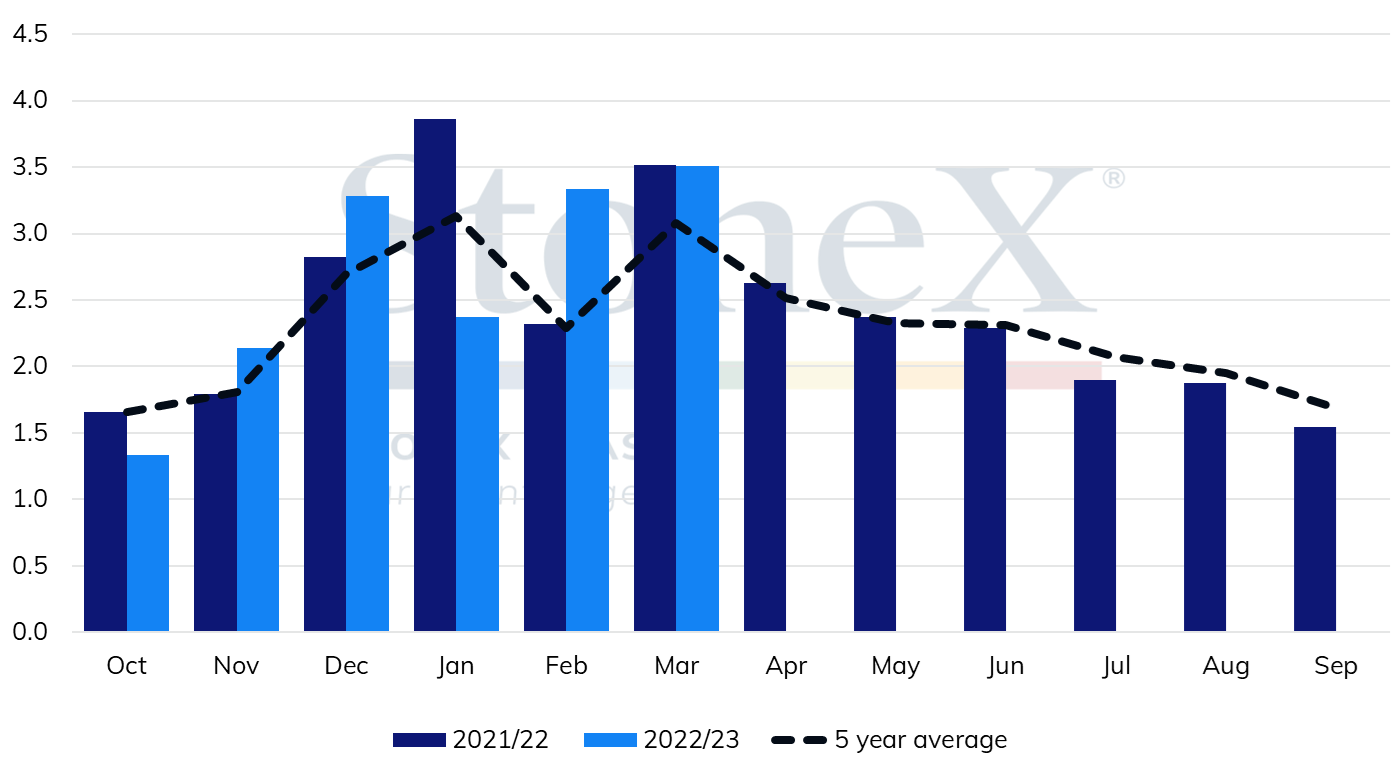
The bullish movement observed in recent weeks has strong relationships with macroeconomic and currency factors, with no news on the fundamentals side. Initially, the OPEC+ announcement on the cut in oil production and the release of a higher-than-expected Chinese Q1 GDP supported a rise in energy commodity prices, which contributed to the advance in commodity prices in general. For Robusta specifically, the prospect of lower production in Indonesia and the inter-crop period in Vietnam has been supporting prices. Due to seasonality, Vietnamese coffee exports are expected to decrease in the coming months.
Seasonality of coffee exports in Vietnam (million bags)
Source: Vietnam Customs. Design: StoneX.
Then, the release of lower-than-expected figures on the US economy and other factors, such as the IPCA in Brazil, contributed to the fall of the dollar in producer countries, such as Brazil and Colombia, supporting coffee prices. However, there was a correction process last week, with the dollar index ending the period with an increase of 0.2%, the USDBRL +2.8% and the USDCOP +2.3%, contributing to the correction in Arabica prices.
In addition, in this macroeconomic context, there was a greater appetite by investors for risky assets such as commodities, including coffee. The latest CFTC report showed that the funds went from a net short position of 342 contracts on 04/04 to 10,907 contracts long on 04/11 and 20,262 contracts long on 04/18.