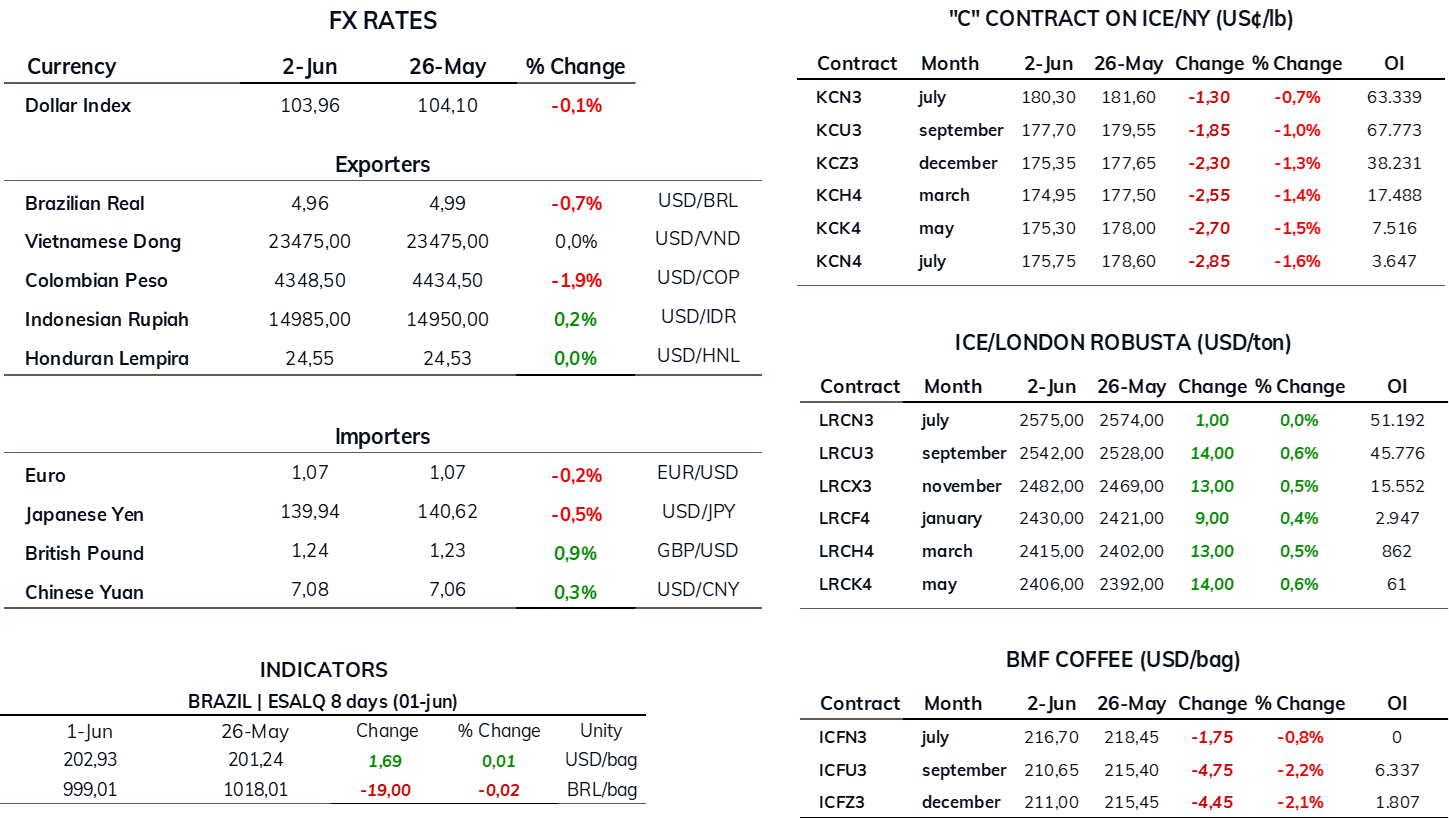
• Arabica futures fell 130 points (0.7%) to US¢ 180.30/lb.
• Robusta advanced USD 14/ton (0.6%) to USD 2542/t.
• Cepea indicator for Arabica ended the week 2.4% lower to BRL 993.37/bag.
• Cepea indicator for Robusta advances 2.1%, ending Friday's session at BRL 711.10/bag
• Macroeconomic scenario has had important weight on commodity prices in recent weeks.
• Approval of the US debt ceiling suspension in Congress reduces fears of a historic default.
• Dollar depreciation and higher global risk appetite favor coffee recoveries in the second half of the week.
• Market awaits the release of the latest USDA's Attachés reports, including on Brazil.
• Without the GCA stocks data, export data in Brazil and import data in the US become more important.
• Cecafé will release the report on Brazilian exports in May on June 13.
• USDA will release the result of imports in the US in April on 06/07.
• Funds' net long position reach more than 43.8 thousand contracts in London.
• Certified Arabica stocks have fallen by nearly 25,000 bags in the past week.
• Brazilian FOB price differentials dropped in May.
• Brazilian winter still supports prices.
Last week, coffee futures prices ended the period with mixed results in New York and London. The coffee market remains sideways pending the release of the remaining reports of the USDA Attachés and the final report with the supply and demand balance, with a release date scheduled for June 22.
In New York, Arabica coffee futures prices ended the week losing 130 points (0.7%), closing Friday's session at US₵ 180.30/lb. While the liquidation of agents put pressure on prices in some sessions of the week, the dollar depreciation contributed to supporting prices – as discussed below, it mainly reflected the US debt deal and economic data from Brazil.
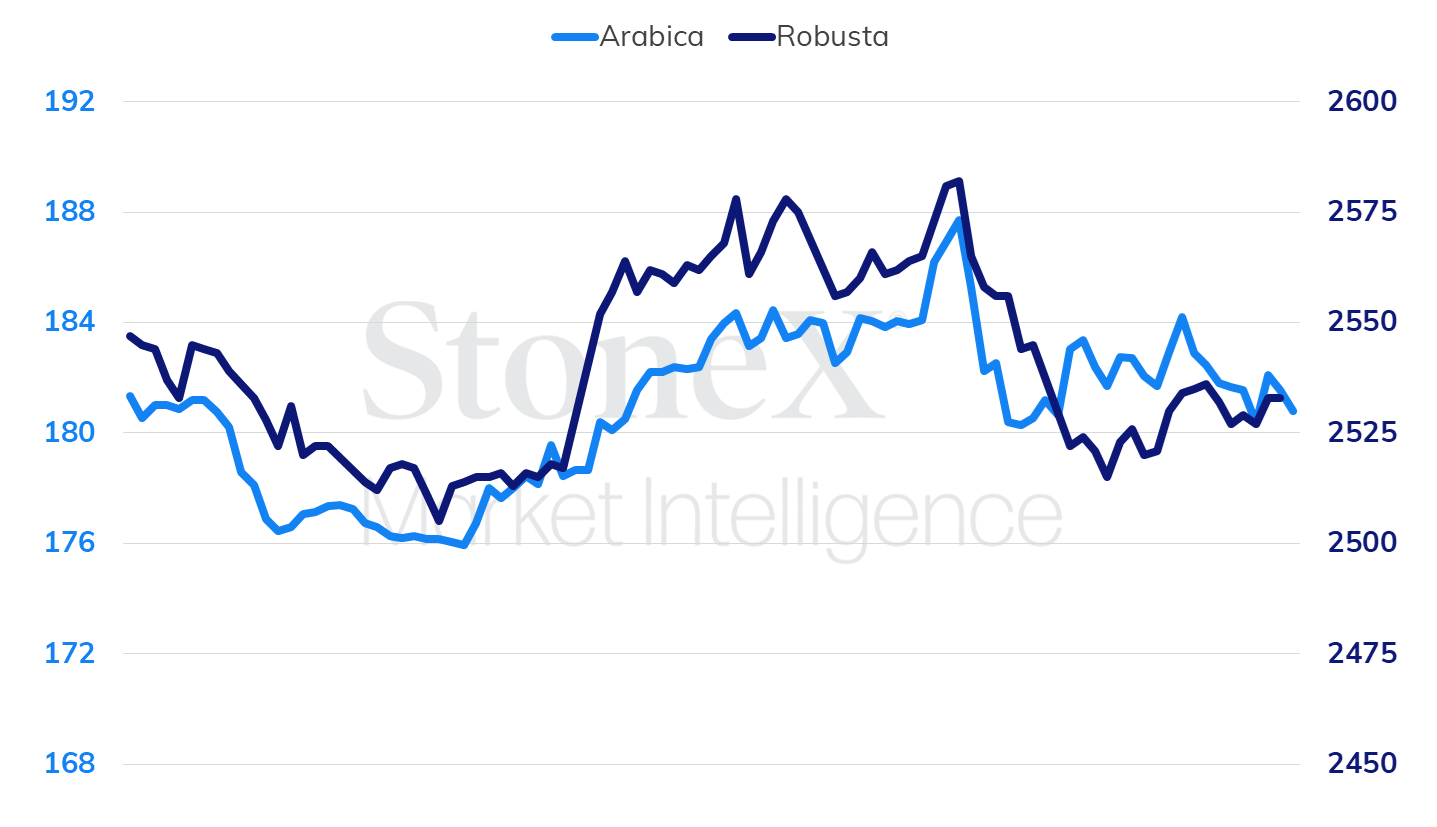
In London, on the other hand, Robusta prices ended the week unchanged for the July contract but with gains of USD 14/t (0.6%), closing the week quoted at USD 2542/t. The Robusta market continues to be supported amid lower availability in Vietnam and a sharp drop in Robusta production in Indonesia. As has been reported in other editions of this report, the USDA, through its attaches, has adjusted the carryout in Vietnam in 2022/23 from 3.5 million bags to 1.8 million and pointed to a drop of more than 18% in production in Indonesia in 2023/24.
Following the movements abroad, coffee prices in the Brazilian domestic market also ended the week with different results. Arabica coffee ended the week lower, with the Cepea indicator for the type closing the period at BRL 993.37/bag (-2.4%). The Cepea indicator for Robusta, in turn, indicated an increase of 2.1% to BRL 711.10/bag.
After a hard-pressed start to the week, coffee and most commodity prices found relief from worries about the US debt situation, with the risk that the US government would not be able to afford its debts dwindling over days as the proposal to suspend the country's debt ceiling advanced through Congress. After approval in the House of Representatives, on Wednesday (31), and in the Senate, on Thursday (1) of the bill that seeks to suspend the US debt ceiling until January 1, 2025, global markets regained a greater appetite for risks, which favored progress in coffee prices at the end of the week.
At the end of the week, the Bureau of Labor Statistics (BLS) release of US labor market data for May also stood out. According to the report, the balance between admissions and layoffs in the country last month was 339 thousand, surpassing the creation of new jobs in the previous month, which was adjusted up from 253 thousand to 294 thousand and significantly higher than analysts' projections of 180 thousand. This is also the best performance of the labor market in the country since January when 504 thousand new jobs were created.
The result suggests that the US economy continues to heat up significantly and that, despite being a positive indicator for demand, it warns that inflation in the country may continue to be a concern. Accordingly, the bets on a new increase of 0.25 p.p. in the country's basic interest rate in the decision on June 14 may rise in the coming days. In general, higher expectations for a new increase in the US basic rate would tend to act bullish for the US currency and bearish for risk assets, such as stocks, currencies of emerging countries and commodities.
Although the USDA has already released reports on several countries, it has yet to release the report on Ecuador, Malaysia, China, Honduras and Brazil. About Brazil, the big bet is that the agency should aim for a recovery in production in 2023/24. In addition, participants will try to anticipate the outlook for the global supply and demand (S&D) balance in 2023/24, which will be released in the final report on June 22, whose bet is on an S&D balance with a significant surplus.
One of the major sources of uncertainty is the outlook for world coffee consumption amid the inflationary process observed in countries. The US stocks data released by GCA was a good indicator of this condition in the US, the world's largest coffee consumer. However, as reported in the last issue, there will no longer be the disclosure of inventory data, which increases uncertainty and has contributed to greater price volatility. Given the absence of GCA data, Brazil's export figures, released by Cecafé, and import data, reported by the USDA, become even more important.
Monthly exports of green coffee by Brazil (million bags)
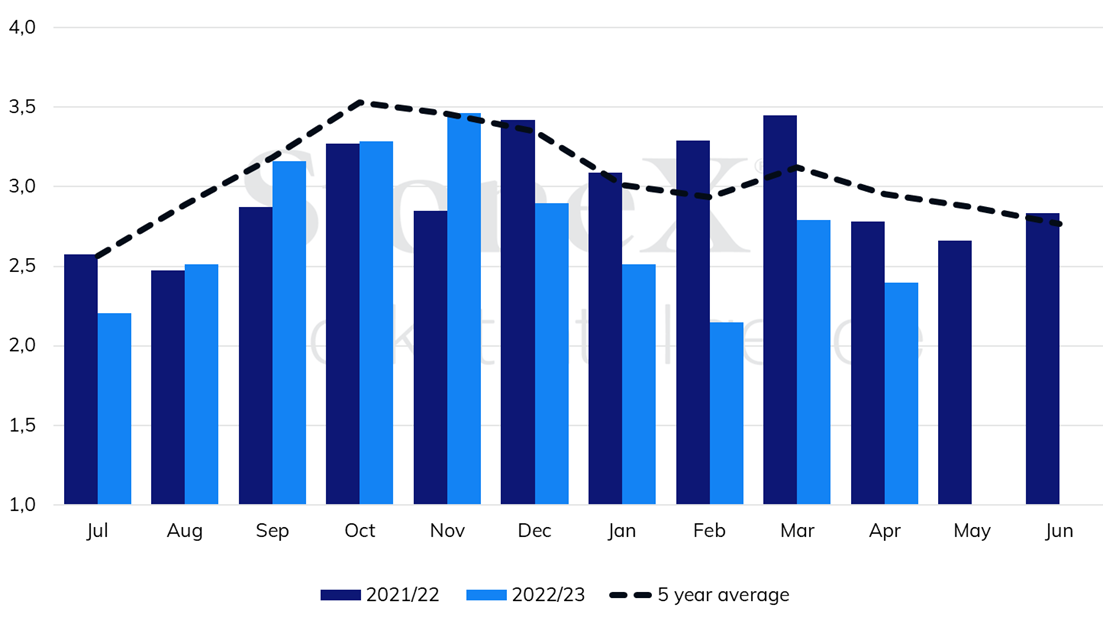
Participants are waiting for May coffee data about exports, which Cecafé should release on June 13. Since the beginning of the year, export volumes have shown a strong annual decline, with a drop of 32% in January, 19% in March and 14% in April. The prospect is of recovery of exports in the second half of the year, as commented by the president of Cecafé, Marcio Ferreira, during the Coffee Dinner 2023 event, which took place on May 25 and 26.
In the US, coffee imports also fell in the annual comparison, with the volume observed with a drop of 14.5% in January, 3.2% in February and 8.6% in March – import data for April will be released on 06/07.
Despite the prospects for coffee supply and demand acting negatively for quotes, such as higher production in Brazil and the harvest progress, and the prospect of potentially weakened demand, some factors have acted positively for prices, supporting them at current levels. Among these factors, we can highlight the appetite of speculative agents amid the global macroeconomic scenario, certified Arabica stocks, concerns about the supply of Robusta and the Brazilian winter.
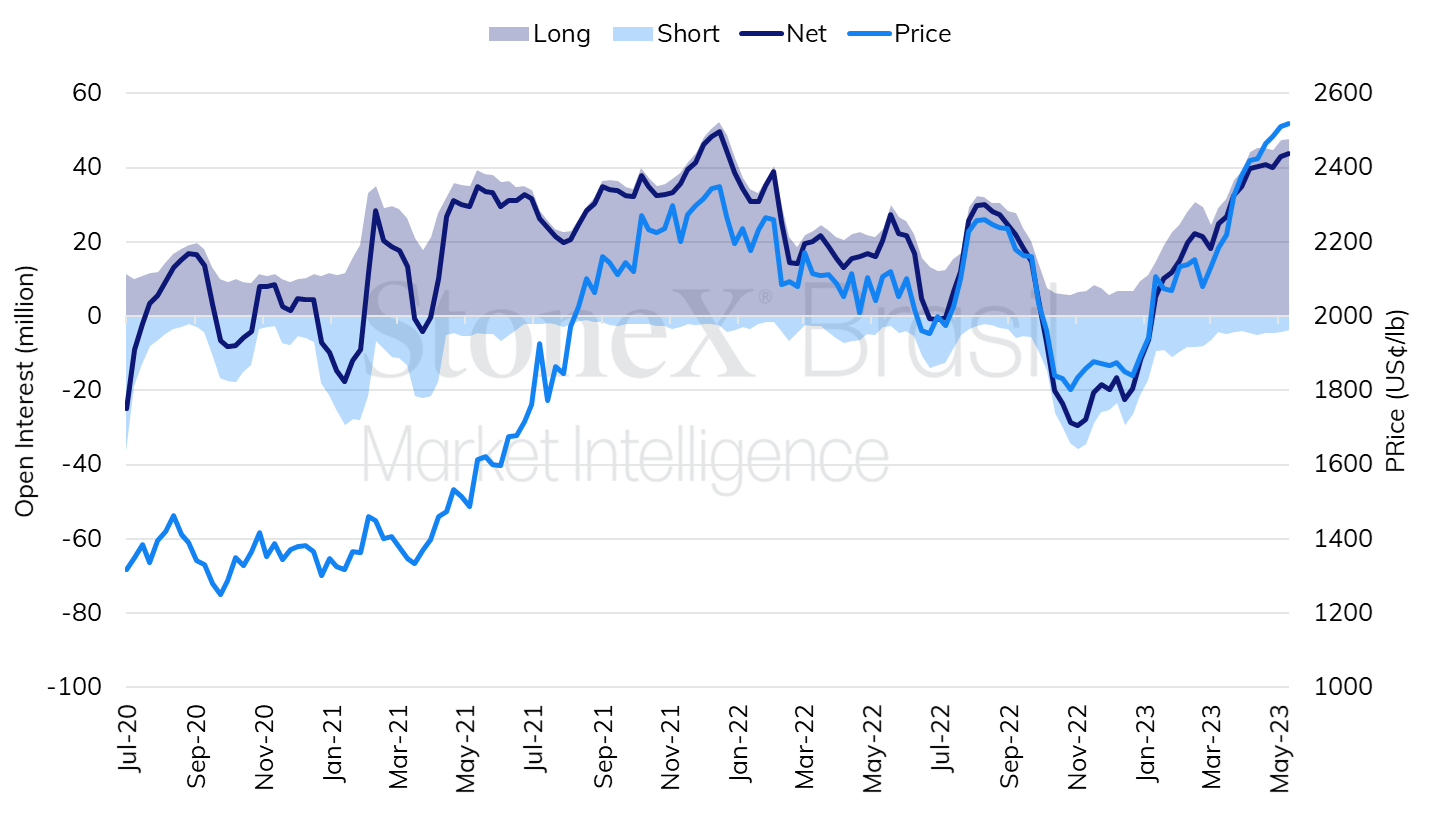
Looking at the funds in the COT report, although they showed a decline of 6.9 thousand contracts in the net long balance in the Arabica market in the last week of May, agents still maintain a net long position of almost 8 thousand contracts. On the other hand, the Robusta market had shown a condition of greater appetite, with speculators advancing almost 850 contracts between May 23 and 30 in the London futures and options report, totaling a net long position of more than 43.8 thousand contracts, the highest volume since January 2022, when the market advanced in reaction to the lower supply caused by the drought and frost of 2021 in Brazil. If, on the one hand, the high volume of contracts bought by the funds justifies the price level for Robusta, the prospect of possible liquidation opens space for a price correction.
Fund position on Robusta coffee futures and options in London
Another factor that has supported prices is the low level of certified Arabica stocks. In the last week, stocks dropped by almost 25 thousand, totaling 573,5 thousand bags on Friday (02). As presented in other editions of this report, the drop in certified stocks is related to the strengthened differentials at the origins, discouraging the certification of new coffees.
In 2020, reflecting the record production of that year, Coffee differentials in Brazil were weakened, which caused Brazil to certify new coffees in the warehouses of the New York exchange, becoming, at that time, the main source of stocks.
This year, despite the expected production is lower than in 2020, there is a possibility that price differentials will be pressed and reach parity for certification on the exchange. According to StoneX's survey, at the end of April, the FOB price differential for semi-washed coffee 2/3 fine cup 14/16 was level, that is, zero, but the differential for the same coffee standard fell to -6 cents/lb at the end of May. According to calculations carried out by StoneX, the parity for certification on the exchange would be around -14 to -15 cents/lb.
Despite the absence of frost risks, the Brazilian winter still supports the prices. This is attributed to the lingering memory of the phenomenon that occurred in 2021.